Flange manufacturer: How ISO 9001:2015 audits differ from ASME B16.5 compliance checks
Author
Date Published
Reading Time
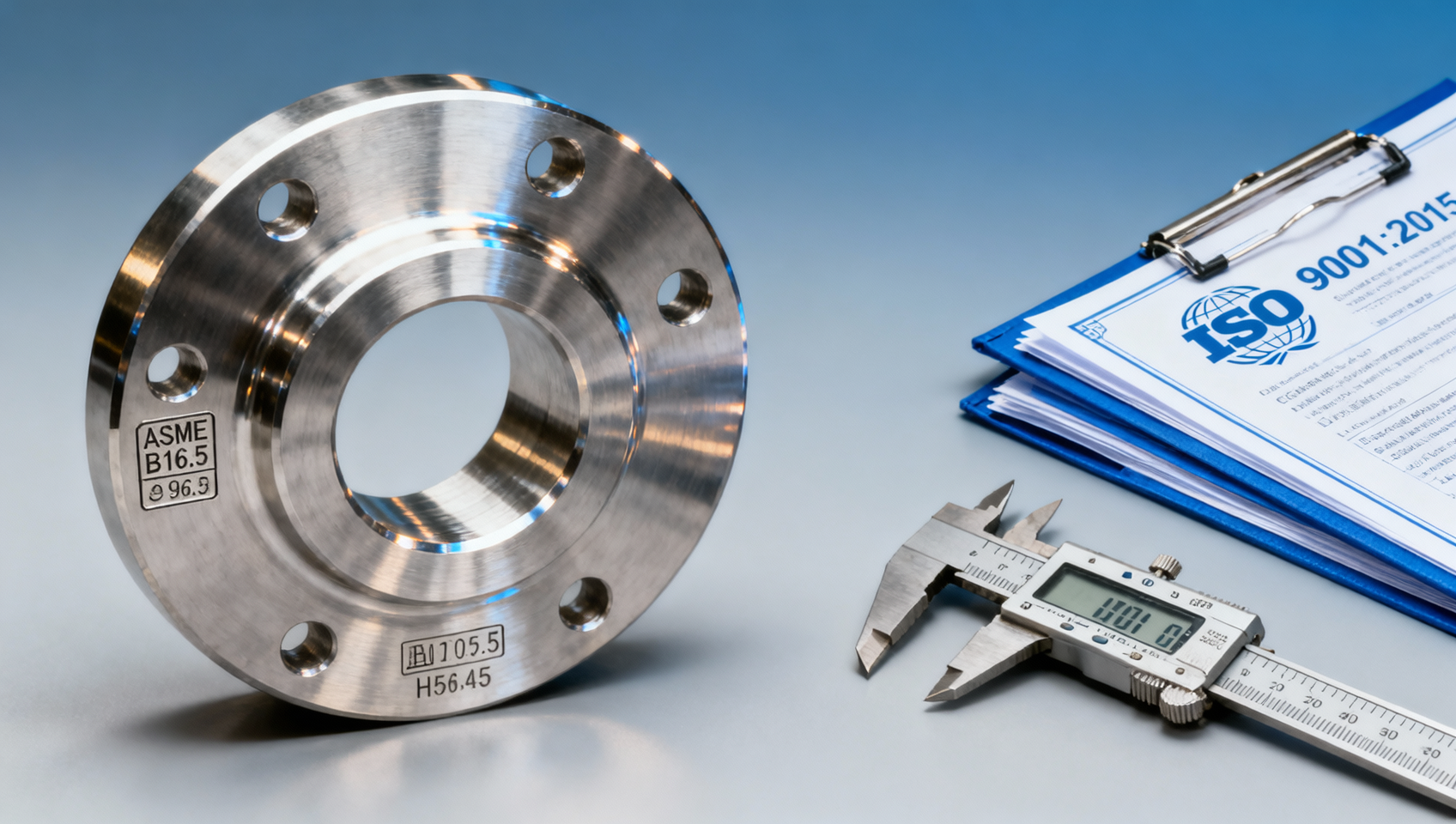
Flange Manufacturer: How ISO 9001:2015 Audits Differ from ASME B16.5 Compliance Checks
For procurement professionals, EPC contractors, and plant engineers sourcing critical components like weld neck flanges, blind flanges wholesale, or forged steel fittings, understanding the distinction between ISO 9001:2015 audits and ASME B16.5 compliance checks is non-negotiable. While ISO 9001:2015 validates a flange manufacturer’s quality management system, ASME B16.5 governs dimensional accuracy, material traceability, and pressure-temperature ratings—directly impacting safety relief valves, stainless steel pipe fittings, and seamless stainless steel tubes in high-stakes industrial environments. Global Industrial Core delivers authoritative, E-E-A-T-aligned insights to ensure your sourcing decisions meet both systemic rigor and application-critical conformity.
Short Answer: One Validates *How* They Make Flanges — The Other Validates *What* They Deliver
If you’re evaluating a flange supplier for a refinery revamp, offshore platform tie-in, or pharmaceutical clean utility loop, here’s what matters most: ISO 9001:2015 tells you whether the manufacturer has a robust, auditable process for consistency and continual improvement. ASME B16.5 tells you whether the specific flange in your hand meets the exact geometry, metallurgical, and performance requirements for your piping class, design temperature, and service fluid.
Confusing the two—or assuming one replaces the other—is how costly field rework, hydrotest failures, or unplanned shutdowns begin. A supplier may hold ISO 9001:2015 certification but ship flanges with out-of-tolerance hub thickness or incorrect ASTM A182 F22 heat treatment. Conversely, a shop may produce fully B16.5-compliant flanges batch-by-batch via manual inspection—but lack documented procedures, root-cause analysis, or calibration traceability required for long-term reliability across projects.
Why This Distinction Is Mission-Critical for Your Next Procurement Cycle
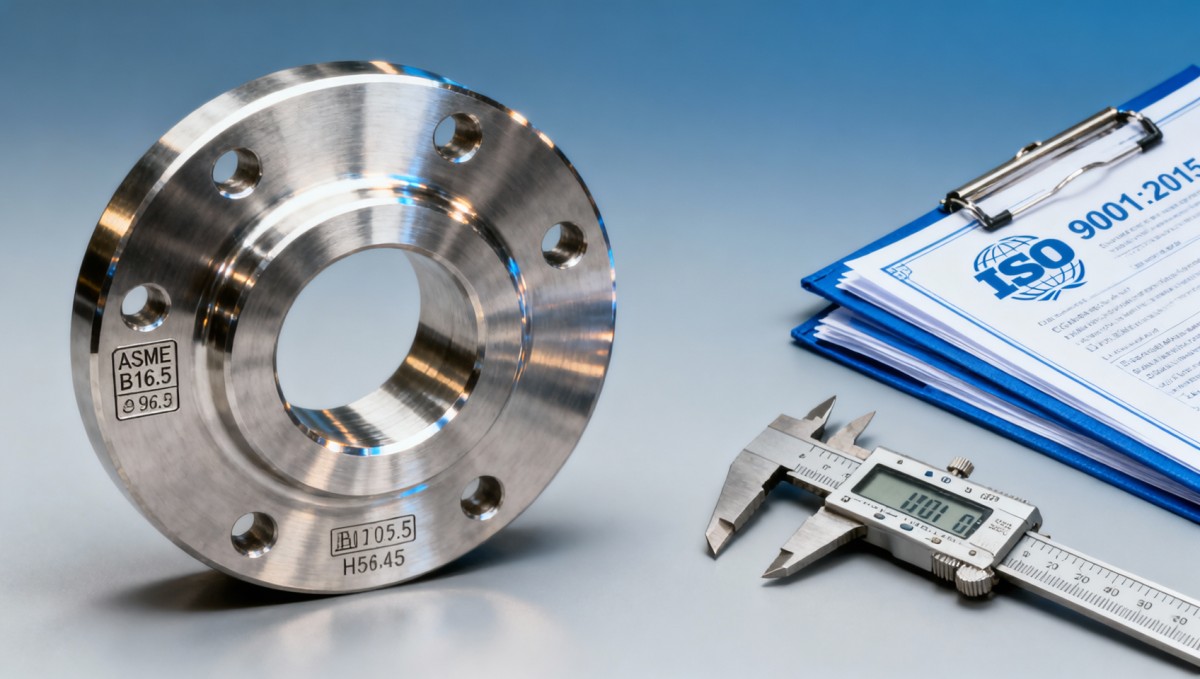
EPC contractors and facility managers don’t just buy flanges—they procure assurance. That assurance operates on two non-overlapping layers:
- Systemic Assurance (ISO 9001:2015): Confidence that the manufacturer will consistently deliver conforming products—not just today, but across 50 batches, three shifts, and two raw material lots. It covers internal audit frequency, corrective action effectiveness, document control, and management review rigor. For multi-year infrastructure programs, this is your hedge against process drift.
- Product Assurance (ASME B16.5): Proof that this specific flange satisfies mandatory dimensional tolerances (e.g., ±1.6 mm on outside diameter for Class 300 NPS 12), material chemistry (e.g., max 0.030% sulfur in ASTM A105), and pressure–temperature rating alignment. This is what your third-party inspector verifies during pre-shipment hold points—and what your P&ID stress analysis assumes.
Procurement teams who skip cross-checking both layers risk misalignment at the interface where paperwork meets physics: e.g., accepting a “certified” ISO 9001:2015 mill test report without verifying its linkage to the actual heat number stamped on the flange face, or approving a vendor based solely on B16.5 dimensional reports while overlooking gaps in their nonconformance tracking system.
What You Actually Need to Verify — Not Just What’s on the Certificate
Don’t rely on certificate scans alone. Here’s what experienced procurement directors and plant engineers request—and why:
- For ISO 9001:2015: Ask for the latest scope statement (not just the logo), evidence of internal audit closure records for the last 12 months, and how they control subcontracted heat treatment or NDT. A valid certificate covering “forged flanges” doesn’t automatically extend to machining or coating processes.
- For ASME B16.5: Demand batch-level documentation, not generic specs: certified mill test reports (MTRs) with full heat chemistry, dimensional inspection reports signed by a Level II NDT technician, and a pressure–temperature rating chart explicitly referencing the flange’s material grade, size, and class. Bonus: Request a photo of the actual flange face showing the ASME B16.5 stamp, heat number, and material grade—cross-referenced against the MTR.
Real-world red flag: A supplier provides an ISO 9001:2015 certificate issued by a non-accredited body (e.g., not UKAS, ANAB, or DAkkS recognized), or offers “B16.5 compliance” without specifying whether it’s verified per Section 7 (dimensional), Section 8 (material), or Annex D (pressure–temperature ratings). Both signal shallow due diligence.
When to Prioritize One Over the Other — And When You Must Have Both
Your decision hinges on risk exposure—not checklist convenience:
- Prioritize ISO 9001:2015 rigor when procuring for multi-year EPC contracts, OEM equipment packages, or safety-critical systems (e.g., nuclear island auxiliary piping). Systemic failure here compounds over time and geography.
- Prioritize ASME B16.5 verification for spot buys, emergency replacements, or applications with narrow tolerance windows (e.g., cryogenic LNG transfer lines where thermal contraction amplifies dimensional errors). Product failure here is immediate and visible.
- Non-negotiable dual validation applies to all flanges used in API RP 14C-specified offshore safety systems, ASME B31.4/B31.8 pipeline interconnects, or FDA-regulated biopharma utilities. GIC’s compliance leads confirm: Regulatory auditors now routinely request side-by-side evidence of both certifications during facility qualification reviews.
Bottom Line: Certificates Are Inputs — Your Judgment Is the Control Valve
ISO 9001:2015 and ASME B16.5 serve fundamentally different purposes—one certifies the factory’s discipline, the other certifies the flange’s fitness. Neither guarantees the other. As an EPC contractor managing $200M+ infrastructure delivery, or a procurement director accountable for uptime in a continuous-process chemical plant, your leverage lies not in collecting certificates, but in interrogating them: Who issued them? What’s in scope? How recent is the evidence? Does the data chain—from heat number to inspection signature to final stamp—hold up under scrutiny?
Global Industrial Core’s technical sourcing framework embeds this interrogation logic into every vendor evaluation matrix we publish. Because in heavy industry, the difference between specification compliance and operational safety isn’t theoretical—it’s measured in microns, megapascals, and minutes of unplanned downtime.
Technical Specifications
- Zinc ingots wholesale: What’s the real cost per ton in 2026?Author :Heavy Industry Strategist
- Aluminum ingots bulk vs. cast bars: Which delivers better yield for extrusion?Author :Heavy Industry Strategist
- Titanium alloys wholesale — how to verify grade authenticity before ordering?Author :Heavy Industry Strategist
Expert Insights

Chief Security Architect
Dr. Thorne specializes in the intersection of structural engineering and digital resilience. He has advised three G7 governments on industrial infrastructure security.
Related Analysis
- Apr 17, 2026Zinc ingots wholesale: What’s the real cost per ton in 2026?Author :Heavy Industry Strategist
- Apr 17, 2026Aluminum ingots bulk vs. cast bars: Which delivers better yield for extrusion?Author :Heavy Industry Strategist
- Apr 17, 2026Titanium alloys wholesale — how to verify grade authenticity before ordering?Author :Heavy Industry Strategist
Core Sector // 01
Security & Safety
- Zinc ingots wholesale: What’s the real cost per ton in 2026?Author :Heavy Industry Strategist

- Aluminum ingots bulk vs. cast bars: Which delivers better yield for extrusion?Author :Heavy Industry Strategist

- Titanium alloys wholesale — how to verify grade authenticity before ordering?Author :Heavy Industry Strategist

- Titanium Grade 2 sheet: Is mill test report enough for aerospace use?Author :Heavy Industry Strategist

- Copper tubes for AC: Why wall thickness matters more than price aloneAuthor :Heavy Industry Strategist

- Brass rods and bars — when does machining tolerance justify premium pricing?Author :Heavy Industry Strategist

- Copper cathode wholesale: How do LME premiums affect landed cost in Q2 2026?Author :Heavy Industry Strategist

- Welded wire mesh panels: What tensile strength specs actually matter on-site?Author :Heavy Industry Strategist