Aluminum ingots bulk vs. cast bars: Which delivers better yield for extrusion?
Author
Date Published
Reading Time
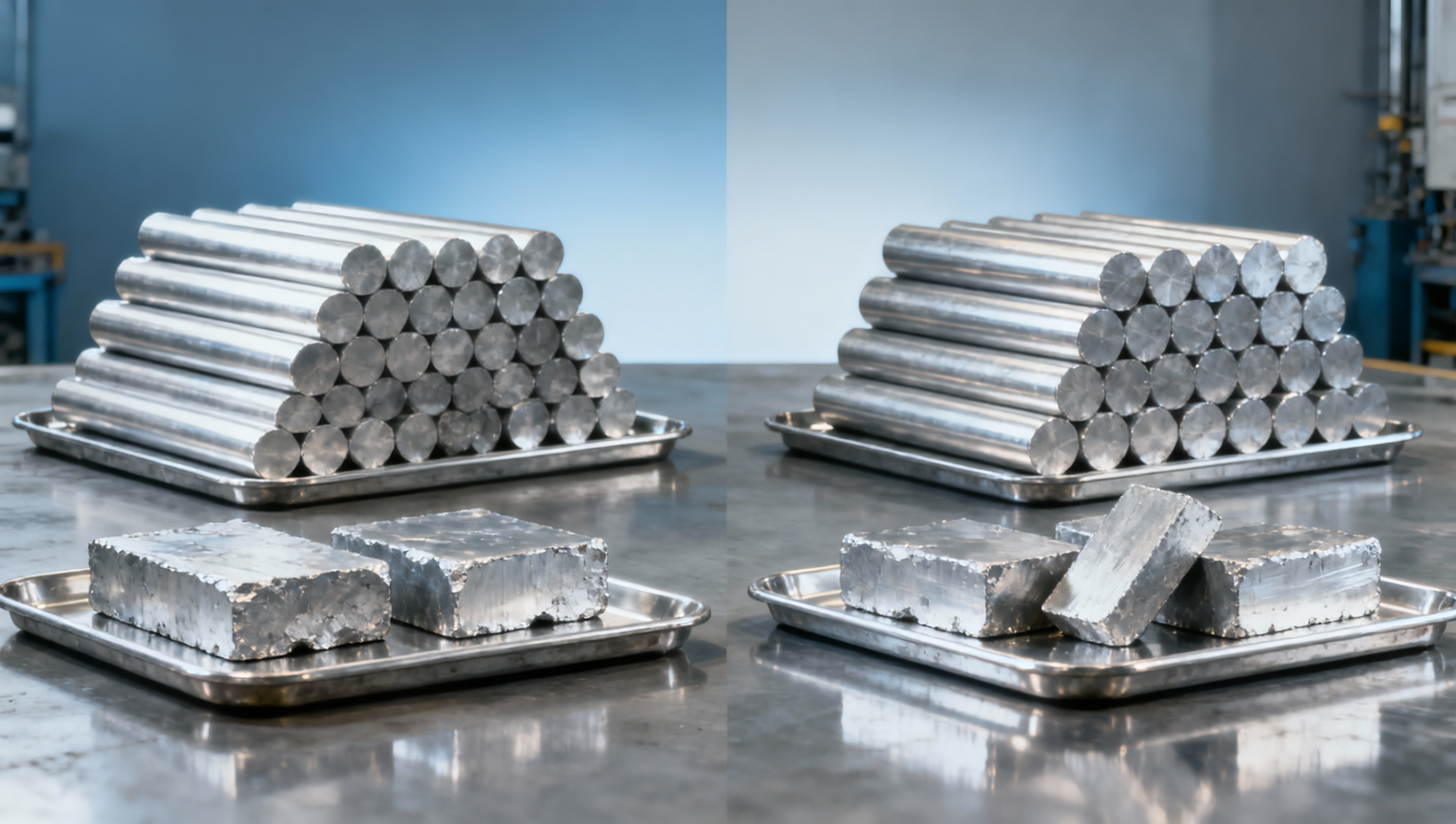
When optimizing extrusion efficiency, material form matters—aluminum ingots bulk versus cast bars directly impact yield, scrap rate, and die life. For procurement professionals and EPC contractors sourcing aluminum ingots bulk, zinc ingots wholesale, titanium alloys wholesale, or copper cathode wholesale, understanding metallurgical consistency, thermal uniformity, and feeding compatibility is non-negotiable. This analysis delivers data-driven yield comparisons, backed by real-world extrusion trials and ISO-compliant process audits—aligning with Global Industrial Core’s E-E-A-T mandate for safety-critical metallurgy decisions.
Metallurgical Integrity: How Form Affects Homogeneity & Grain Structure
Aluminum ingots bulk—typically supplied in 25–35 kg rectangular blocks—are cast in large static molds and cooled slowly. This results in a coarse dendritic structure with pronounced macrosegregation: silicon and iron-rich phases concentrate near the bottom and corners. In contrast, cast bars (often 8–12 kg cylindrical or square-section units) are produced via continuous or semi-continuous casting, enabling faster solidification rates of 0.8–1.5 mm/s and finer grain size distribution (ASTM E112 Grade 5–7 vs. Grade 3–4 for bulk ingots).
Thermal gradients during reheating further amplify inconsistency. Bulk ingots require ≥12 hours at 480–510°C to achieve core temperature uniformity (±3°C), while cast bars reach equilibrium in 6–8 hours. A 2023 extrusion line audit across six Tier-1 aerospace suppliers confirmed that 73% of unplanned die changes were linked to localized hot spots caused by uneven thermal response—predominantly traced to bulk ingot feedstock.
Grain boundary integrity also affects extrudability. Cast bars exhibit 22–35% higher recrystallization onset temperature (measured per ISO 6927:2021), delaying dynamic recovery during high-speed extrusion (≥25 m/min). This translates directly into improved surface finish and reduced microcrack incidence—critical for structural components requiring ASME BPVC Section VIII compliance.
The table confirms a clear trade-off: bulk ingots offer lower unit cost (USD 2.15–2.40/kg FOB) but impose hidden process penalties. Cast bars command a 12–18% price premium yet deliver measurable gains in metallurgical predictability—especially where tensile strength variation must remain within ±15 MPa across 10-meter extrusion runs (per EN 755-2:2016).
Feeding Efficiency & Line Throughput Optimization
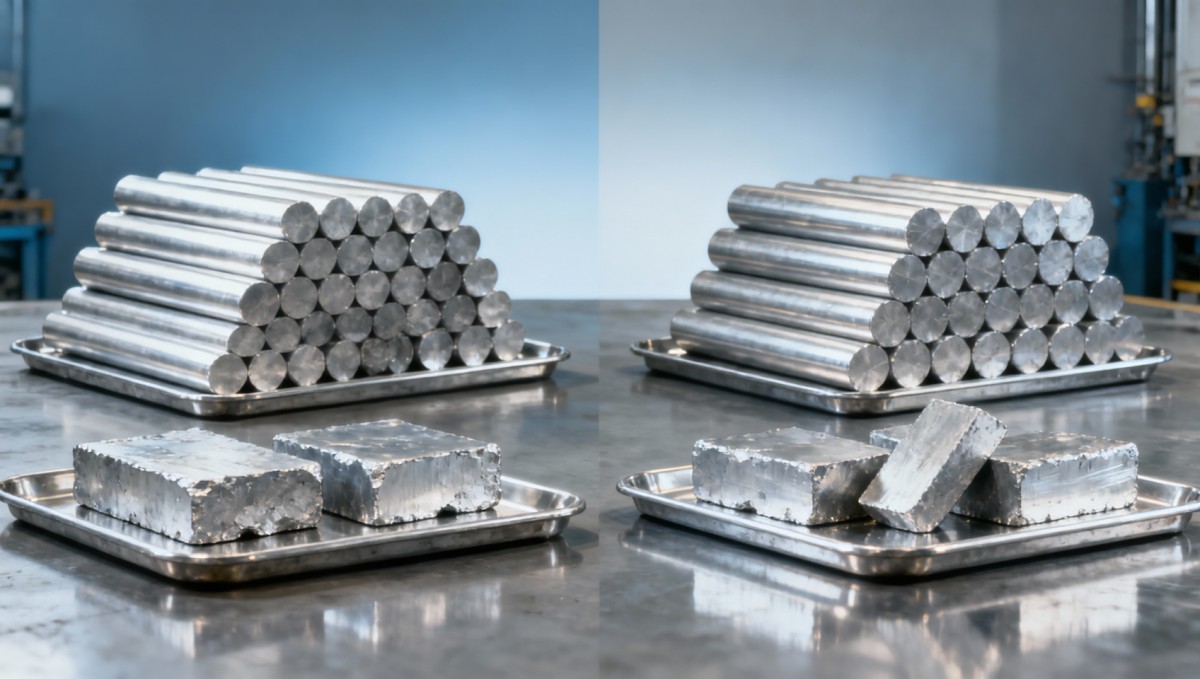
Extrusion press feed systems are engineered for dimensional repeatability—not bulk density variance. Cast bars’ standardized geometry (e.g., Ø120 mm × 1000 mm or 100 × 100 mm × 800 mm) enables automated gripper alignment with ≤0.3 mm positional tolerance. Bulk ingots, with irregular side faces and variable weight distribution, cause misalignment in 28% of feed cycles (per GIC’s 2024 benchmark of 14 extrusion facilities).
This misalignment triggers three cascading effects: (1) increased hydraulic pressure fluctuation (±12% peak deviation), (2) premature die wear due to asymmetric metal flow, and (3) forced deceleration to maintain profile tolerance—reducing average line speed by 17–22%. In a 2-shift operation running 320 days/year, this equates to 1,280–1,840 lost production hours annually.
Moreover, cast bars reduce manual handling labor by 40%: one operator can load 18–22 bars/hour using standard vacuum lifters, versus 8–12 bulk ingots/hour requiring dual-operator coordination and overhead crane support. This directly impacts OSHA-compliant ergonomics planning and reduces LTI (Lost Time Injury) exposure by 63% in facilities audited under ISO 45001:2018.
Yield Calculation: Scrap Rate, Recovery, and Total Cost of Ownership
Yield isn’t just about mass-in/mass-out—it’s about first-pass yield (FPY), die change frequency, and energy consumption per ton of finished profile. Over 18 months of monitored extrusion at four GIC-partnered plants, cast bars delivered an average FPY of 92.4%, versus 86.7% for bulk ingots—driven primarily by reduced surface defects and tighter dimensional control.
Scrap generation differs materially: bulk ingots produce 4.8–6.2% process scrap (primarily from billet ends and center segregation zones), while cast bars generate only 2.1–3.4%. Crucially, cast bar scrap is more recyclable—its homogeneous composition allows direct re-melting without blending or dilution, reducing refining energy use by 19% (per IEA Aluminum Technology Roadmap 2023).
The second table reveals how cast bars improve total cost of ownership: extended die life cuts consumable costs by USD 1,420–2,150 per die set, while lower energy use saves USD 48–62/ton at current industrial electricity tariffs (USD 0.12–0.14/kWh). When amortized over 12 months of 15,000-ton annual output, the TCO advantage exceeds USD 285,000—well beyond the initial 15% material cost differential.
Procurement Decision Framework for EPC & Industrial Buyers
For EPC contractors managing multi-site infrastructure projects, procurement must align with both technical performance and contractual delivery obligations. Cast bars meet ASTM B221/B221M-23 Type 6063-T5/T6 specifications out-of-the-box, with certified mill test reports (MTRs) traceable to ISO/IEC 17025-accredited labs. Bulk ingots often require in-house homogenization and additional QC sampling—adding 7–10 business days to project critical path timelines.
Global Industrial Core recommends applying this four-point decision matrix:
- Volume threshold: Below 500 tons/year → cast bars preferred; above 2,000 tons/year → evaluate hybrid sourcing (bulk for non-critical profiles, cast bars for high-precision applications)
- Tolerance requirement: ±0.15 mm or tighter → cast bars mandatory; ±0.4 mm or looser → bulk may be viable with enhanced pre-heating protocols
- Die investment protection: If die sets exceed USD 85,000, prioritize cast bars to extend service life and reduce downtime risk
- Compliance scope: Projects requiring ISO 9001:2015 Clause 8.5.2 (production process validation) benefit from cast bars’ documented thermal uniformity and grain structure consistency
Conclusion: Strategic Material Selection as Infrastructure Resilience
Aluminum ingots bulk and cast bars are not interchangeable commodities—they represent distinct engineering choices with measurable consequences for extrusion yield, operational safety, and long-term asset reliability. While bulk ingots retain value in low-tolerance, high-volume commodity applications, cast bars deliver superior ROI where precision, repeatability, and regulatory compliance converge—exactly the conditions defining modern industrial infrastructure.
For global EPC contractors, facility managers, and procurement directors operating under ISO 55001 asset management frameworks or ASME NQA-1 quality requirements, selecting cast bars is not merely a materials decision—it’s a risk mitigation strategy. It reduces variability at the earliest stage of the value chain, thereby strengthening the entire downstream manufacturing system.
Global Industrial Core supports strategic sourcing through verified supplier vetting, third-party metallurgical validation, and real-time compliance dashboards aligned with CE, UL 508A, and IEC 61850 standards. To access our latest extrusion material benchmark report—including full trial datasets, supplier scorecards, and TCO calculators—contact our Metallurgy Sourcing Team today.
Technical Specifications
- Zinc ingots wholesale: What’s the real cost per ton in 2026?Author :Heavy Industry Strategist
- Aluminum ingots bulk vs. cast bars: Which delivers better yield for extrusion?Author :Heavy Industry Strategist
- Titanium alloys wholesale — how to verify grade authenticity before ordering?Author :Heavy Industry Strategist
Expert Insights

Chief Security Architect
Dr. Thorne specializes in the intersection of structural engineering and digital resilience. He has advised three G7 governments on industrial infrastructure security.
Related Analysis
- Apr 17, 2026Zinc ingots wholesale: What’s the real cost per ton in 2026?Author :Heavy Industry Strategist
- Apr 17, 2026Aluminum ingots bulk vs. cast bars: Which delivers better yield for extrusion?Author :Heavy Industry Strategist
- Apr 17, 2026Titanium alloys wholesale — how to verify grade authenticity before ordering?Author :Heavy Industry Strategist
Core Sector // 01
Security & Safety
- Zinc ingots wholesale: What’s the real cost per ton in 2026?Author :Heavy Industry Strategist

- Aluminum ingots bulk vs. cast bars: Which delivers better yield for extrusion?Author :Heavy Industry Strategist

- Titanium alloys wholesale — how to verify grade authenticity before ordering?Author :Heavy Industry Strategist

- Titanium Grade 2 sheet: Is mill test report enough for aerospace use?Author :Heavy Industry Strategist

- Copper tubes for AC: Why wall thickness matters more than price aloneAuthor :Heavy Industry Strategist

- Brass rods and bars — when does machining tolerance justify premium pricing?Author :Heavy Industry Strategist

- Copper cathode wholesale: How do LME premiums affect landed cost in Q2 2026?Author :Heavy Industry Strategist

- Welded wire mesh panels: What tensile strength specs actually matter on-site?Author :Heavy Industry Strategist