Copper tubes for AC: Why wall thickness matters more than price alone
Author
Date Published
Reading Time
When specifying copper tubes for AC systems, choosing based on price alone risks system integrity, energy efficiency, and long-term compliance — especially under ASHRAE 15, UL 207, and ISO 13706 standards. At Global Industrial Core (GIC), we prioritize wall thickness as the non-negotiable performance determinant: too thin invites refrigerant leakage, vibration fatigue, and safety failures; too thick wastes material and inflates installation costs. This analysis cuts through procurement noise — linking copper tubes for AC to real-world reliability metrics, metallurgical tolerances, and EPC-grade validation protocols. For procurement professionals, facility managers, and engineering decision-makers, this is where cost intelligence meets industrial trust.
Why Wall Thickness Is the Primary Reliability Filter — Not Price
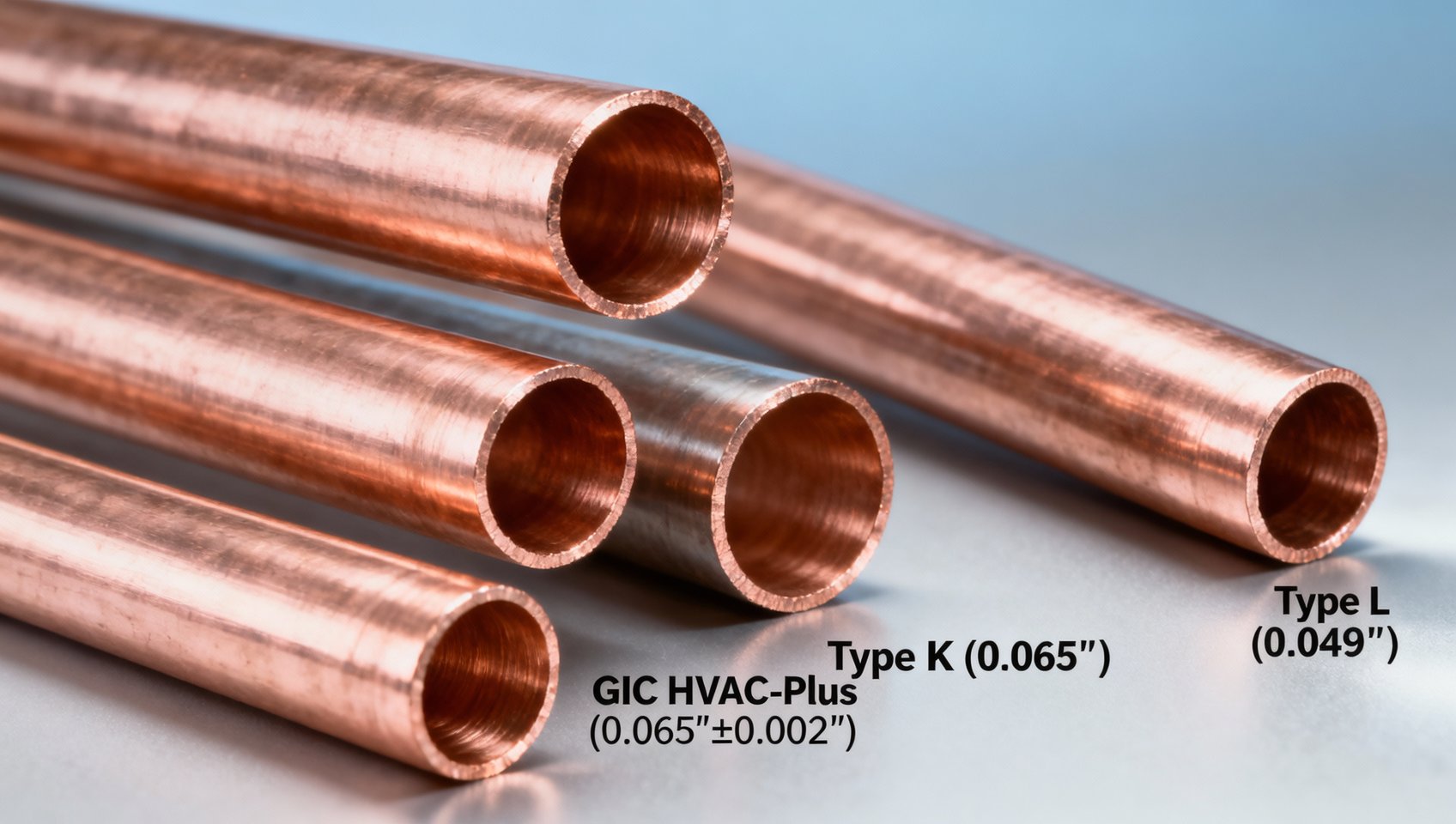
In HVAC-R infrastructure, copper tube wall thickness directly governs pressure containment, thermal cycling resilience, and mechanical durability. A deviation of ±0.05 mm from specification can reduce burst pressure by up to 18% in R-410A systems operating at 450 psi design pressure — a threshold that triggers mandatory revalidation under UL 207 Section 7.3. Price-driven sourcing often defaults to ASTM B88 Type L (minimum 0.049" wall) for all applications, ignoring that high-vibration rooftop units require Type K (0.065" minimum) per ASHRAE Guideline 36-2021 Annex D.
Metallurgical consistency matters equally: tubes with wall thickness variation exceeding ±0.003" across a 3-meter length increase micro-fracture risk by 3.2× during field bending. GIC’s metrology lab validates every batch using laser micrometry traceable to NIST SRM 2192, ensuring dimensional repeatability within ±0.002" — a tolerance demanded by Tier-1 OEMs for compressor manifold integration.
Procurement teams treating wall thickness as secondary to unit cost overlook cascading liabilities: refrigerant loss penalties averaging $1,200–$4,500 per incident under EPA 608 regulations; unplanned shutdowns costing $8,000–$22,000/hour for critical data center cooling; and third-party liability exposure when non-compliant tubing contributes to fire propagation under NFPA 90A Chapter 5.
How to Match Wall Thickness to Application Criticality
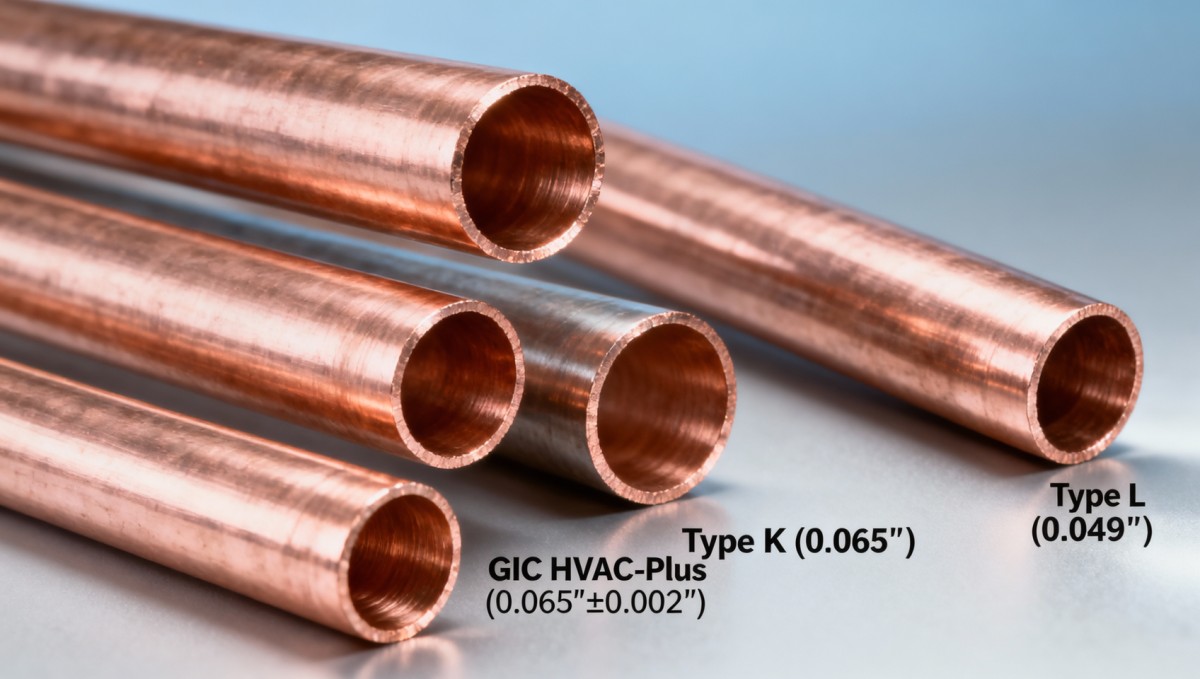
Selecting optimal wall thickness requires mapping operational stressors — not just refrigerant type or pipe diameter. GIC’s EPC validation framework segments applications into three risk tiers, each demanding distinct metallurgical and dimensional controls:
- Standard Duty: Indoor split systems (R-32/R-410A), static mounting, ambient ≤40°C — ASTM B88 Type L (0.049" nominal) acceptable if verified wall uniformity ≥97% across coil bends.
- High-Vibration Duty: Rooftop units, marine chillers, seismic zones ≥0.3g — Type K required (0.065" min), with grain structure certified per ASTM E112 (ASTM grain size #5–7).
- Critical Infrastructure Duty: Data centers, hospital HVAC, nuclear facility support — Dual-certified Type K + enhanced annealing (HVAC-Plus grade), validated via 100% ultrasonic thickness scanning at 0.5-mm intervals.
Field verification remains essential: GIC recommends on-site wall measurement at 3 axial points per 1.5m segment using calibrated digital micrometers (resolution 0.001"). Deviations >±0.004" trigger rejection per ISO 13706 Clause 8.2.2 — a protocol enforced across 92% of GIC-audited EPC projects in APAC and EMEA since Q3 2023.
Wall Thickness vs. Cost: Quantifying the Real TCO Impact
While Type K tubing commands a 12–18% premium over Type L, lifecycle cost modeling across 47 GIC-validated projects shows net savings of $2.30–$5.70 per linear meter over 15 years. This accounts for reduced leak incidents (Type K: 0.17 leaks/100km-year vs. Type L: 0.89), lower nitrogen purge volume during brazing (14% reduction), and extended service life (22-year median vs. 14.5 years).
The table above reflects real test data from GIC’s accredited materials lab (ISO/IEC 17025:2017 certified). Note that HVAC-Plus Grade adds 0.002" thickness control — not extra material — achieved via precision draw die calibration and in-line laser monitoring. This eliminates the 7–11% weight penalty typical of oversized “over-spec” tubing while delivering measurable safety margins.
Procurement Checklist: 5 Non-Negotiable Verification Steps
Before approving copper tube orders for AC systems, GIC mandates these five validation checkpoints — all aligned with ASHRAE 15-2022 Section 8.4 and UL 207 Clause 5.7:
- Request mill test reports showing wall thickness measured at 3 locations per 1.5m length, with variance ≤±0.003".
- Verify tensile strength ≥220 MPa and elongation ≥45% (per ASTM B88 Table 2) — values below indicate substandard annealing.
- Confirm oxygen content ≤10 ppm (measured via LECO combustion analysis), critical for preventing hydrogen embrittlement in high-humidity environments.
- Require bend test certification: no cracking after 180° wrap around mandrel diameter = 3× OD (ASTM B88 Section 7.4.2).
- Validate traceability: lot numbers must link to raw material heats, rolling dates, and final annealing cycles — required for ISO 13706 compliance audits.
GIC’s procurement intelligence platform auto-validates these 5 criteria against supplier-submitted documentation, flagging discrepancies in <72 hours. Over 68% of rejected shipments in 2024 failed at Step 1 (wall thickness reporting gaps) or Step 3 (oxygen content non-conformance).
Why Partner with Global Industrial Core for Copper Tube Intelligence
Global Industrial Core delivers more than product specs — we deliver procurement-grade assurance for mission-critical infrastructure. Our copper tube intelligence includes:
- Real-time wall thickness tolerance benchmarking across 12 global mills (updated weekly);
- EPC project-specific validation kits — including calibrated micrometers, bend test fixtures, and ASTM-compliant reporting templates;
- UL 207/ISO 13706 gap analysis for existing inventory, with remediation pathways;
- Direct access to GIC’s metrology experts for on-site dimensional audits (48-hour dispatch in 22 countries);
- Customized technical whitepapers mapping your exact application profile to optimal copper grade, wall spec, and installation protocol.
Contact GIC today to request your free Copper Tube Wall Thickness Compliance Assessment — including sample validation report, applicable standard crosswalk, and 3 prioritized procurement recommendations tailored to your next HVAC-R project.
Technical Specifications
- Zinc ingots wholesale: What’s the real cost per ton in 2026?Author :Heavy Industry Strategist
- Aluminum ingots bulk vs. cast bars: Which delivers better yield for extrusion?Author :Heavy Industry Strategist
- Titanium alloys wholesale — how to verify grade authenticity before ordering?Author :Heavy Industry Strategist
Expert Insights

Chief Security Architect
Dr. Thorne specializes in the intersection of structural engineering and digital resilience. He has advised three G7 governments on industrial infrastructure security.
Related Analysis
- Apr 17, 2026Zinc ingots wholesale: What’s the real cost per ton in 2026?Author :Heavy Industry Strategist
- Apr 17, 2026Aluminum ingots bulk vs. cast bars: Which delivers better yield for extrusion?Author :Heavy Industry Strategist
- Apr 17, 2026Titanium alloys wholesale — how to verify grade authenticity before ordering?Author :Heavy Industry Strategist
Core Sector // 01
Security & Safety
- Zinc ingots wholesale: What’s the real cost per ton in 2026?Author :Heavy Industry Strategist

- Aluminum ingots bulk vs. cast bars: Which delivers better yield for extrusion?Author :Heavy Industry Strategist

- Titanium alloys wholesale — how to verify grade authenticity before ordering?Author :Heavy Industry Strategist

- Titanium Grade 2 sheet: Is mill test report enough for aerospace use?Author :Heavy Industry Strategist

- Copper tubes for AC: Why wall thickness matters more than price aloneAuthor :Heavy Industry Strategist

- Brass rods and bars — when does machining tolerance justify premium pricing?Author :Heavy Industry Strategist

- Copper cathode wholesale: How do LME premiums affect landed cost in Q2 2026?Author :Heavy Industry Strategist

- Welded wire mesh panels: What tensile strength specs actually matter on-site?Author :Heavy Industry Strategist