New SASO IEC 62368-1:2026 Impacts China's Surveillance Exports
Author
Date Published
Reading Time
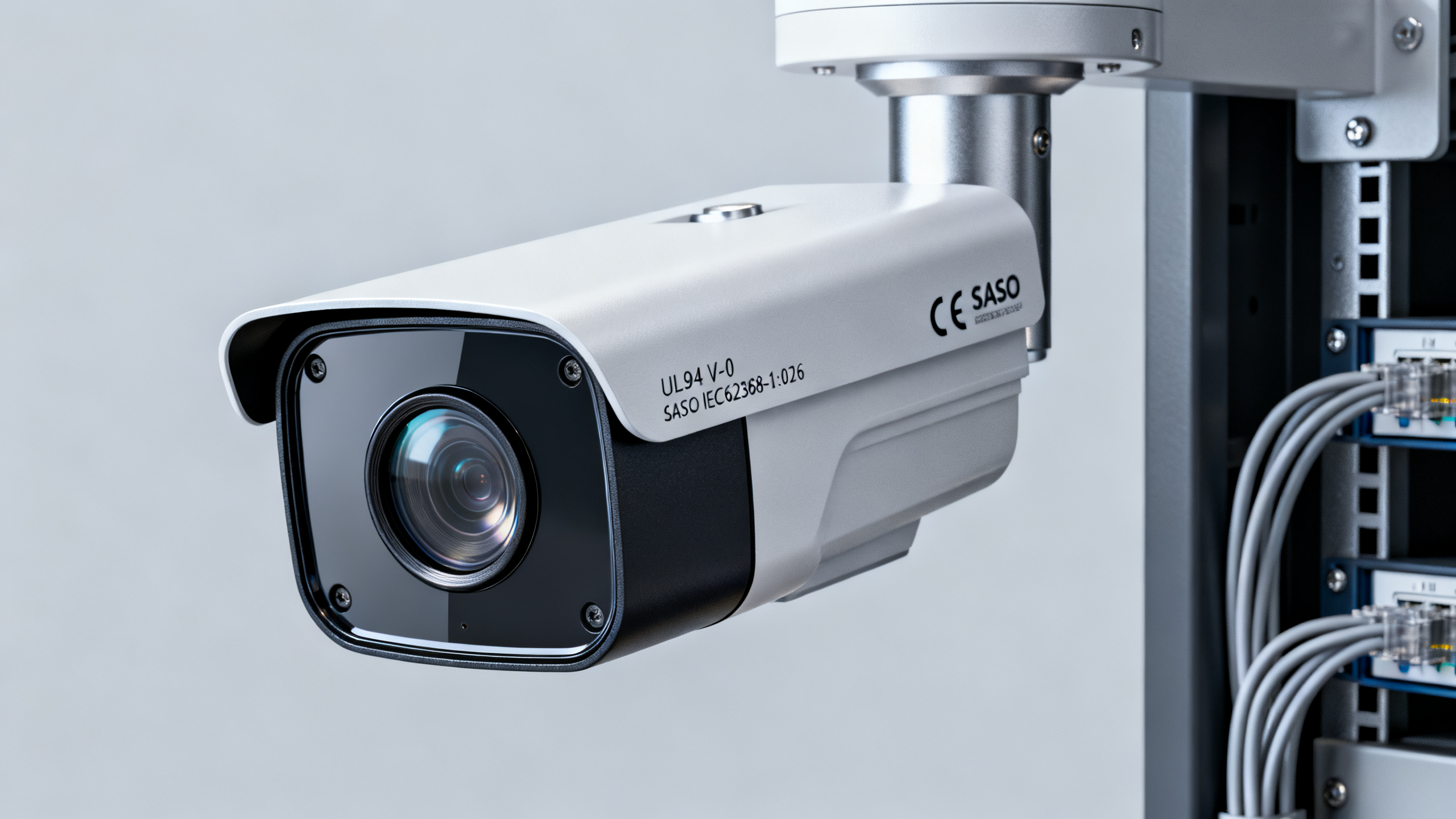
On May 11, 2026, Saudi Arabia’s Standards, Metrology and Quality Organization (SASO) and the UAE’s Emirates Authority for Standardization and Metrology (ESMA) jointly announced the mandatory enforcement of SASO IEC 62368-1:2026 for audio/video and IT equipment — effective September 1, 2026. This update introduces three new technical requirements specifically targeting PoE-powered CCTV cameras and access control devices, significantly affecting Chinese exporters of security monitoring equipment.
Event Overview
SASO and ESMA issued a joint notice on May 11, 2026, mandating compliance with SASO IEC 62368-1:2026 starting September 1, 2026. The revised standard adds three compulsory technical provisions for PoE-supplied CCTV and access control equipment: (1) power supply efficiency ≥ Level VI per DOE/IEC 62301; (2) battery thermal runaway protection mechanisms verified under accelerated stress testing; and (3) enclosure material flame resistance rated UL 94 V-0. Chinese IPC and NVR manufacturers have initiated batch certification submissions; several models were returned for redesign due to insufficient thermal management performance.
Industries Affected
Direct Exporters: Chinese OEMs and ODMs exporting surveillance hardware to GCC markets must now secure updated SASO CoC (Certificate of Conformity) under the 2026 version. Non-compliant units risk customs rejection after September 1, 2026 — impacting shipment timelines, inventory turnover, and contract fulfillment. Re-testing costs and potential design rework further compress margins.
Raw Material Suppliers: Component vendors supplying PoE injectors, lithium-based backup batteries, and flame-retardant polymer casings face increased specification scrutiny. Demand is shifting toward UL 94 V-0-certified polycarbonate blends and thermally stable LiFePO₄ cells — requiring traceable material certifications and third-party test reports aligned with SASO’s new annexes.
Contract Manufacturers: EMS and JDM facilities handling final assembly and firmware integration must verify thermal simulation outputs (e.g., CFD-based hotspot mapping) and validate PoE power stage efficiency across full-load operating conditions. Process documentation now requires inclusion of thermal aging logs and battery safety validation records — extending QA cycle time by 2–3 weeks per model family.
Supply Chain Service Providers: Certification consultants, test labs (e.g., SGS, TÜV Rheinland GCC-accredited sites), and logistics firms offering pre-clearance support report surging demand for integrated SASO+ESMA dual-market test packages. Lead times for thermal runaway verification alone have extended to 22–28 working days, creating bottlenecks in time-sensitive product launches.
Key Focus Areas & Recommended Actions
Verify PoE Power Stage Efficiency Early
Manufacturers should conduct preliminary DOE Level VI efficiency testing on PoE PSE/PD circuits before formal submission — especially for 802.3bt Type 4 (90W) modules common in AI-enabled IPCs. Inefficiencies often stem from MOSFET conduction losses and transformer core saturation at high ambient temperatures.
Implement Battery Thermal Runaway Mitigation Protocols
For devices with embedded rechargeable batteries, integrate multi-layer safeguards: cell-level voltage/temperature cutoffs, PCB-mounted thermal fuses, and vented housing design validated per UN 38.3 T.4 thermal propagation tests. Avoid reliance solely on BMS software limits — SASO now requires physical fail-safe redundancy.
Confirm Enclosure Material Compliance Beyond Datasheets
UL 94 V-0 rating must be verified on *as-molded parts*, not just raw resin. Flame testing applies to finished housings including screw bosses, lens gaskets, and cable entry ports. Suppliers must provide test reports from SASO-recognized labs (e.g., Intertek Riyadh or DEKRA Abu Dhabi) — generic UL certificates are insufficient.
Editorial Perspective / Industry Observation
Analysis shows this regulatory shift reflects a broader regional pivot: Gulf authorities are no longer treating surveillance gear as generic IT equipment but as critical infrastructure components requiring resilience against fire, overheating, and energy waste. Observably, SASO’s alignment with IEC 62368-1:2026 — rather than adopting a bespoke national standard — signals intent to harmonize with global safety frameworks while enforcing stricter local implementation thresholds. From an industry perspective, this marks the first time thermal safety has been codified as a mandatory conformity pillar for low-voltage security hardware in the Middle East. Current more pressing concern is not technical feasibility — most Tier-1 suppliers can meet these requirements — but the compressed timeline and fragmented lab capacity across GCC-accredited facilities.
Conclusion
This regulatory update underscores a structural evolution in market access: compliance is transitioning from documentation-driven to physics-driven verification. For Chinese exporters, success hinges less on paperwork agility and more on embedded thermal and electrical design rigor — a shift that favors vertically integrated players with in-house reliability labs over pure-volume OEMs. A rational interpretation is that the 2026 SASO revision serves as both a technical gatekeeper and a long-term catalyst for quality upgrading across the regional supply chain.
Source Attribution
Official notice published by SASO and ESMA on May 11, 2026 (Ref: SASO/ESMA/JNT/NOT/2026/017). Full text available via SASO e-Services Portal (https://eservices.saso.gov.sa) and ESMA Regulatory Updates Hub (https://www.esma.gov.ae/en/regulatory-updates). Note: Implementation timeline, scope exclusions for legacy stock, and transitional arrangements remain subject to official clarification — ongoing monitoring advised.
Technical Specifications
- How to Select Electronic Hotel Key Card Locks for Guest Rooms and Staff AreasAuthor :Safety Compliance Lead
- How to Select Lab Instruments for Reliable Chemical Analysis WorkflowsAuthor :Precision Metrology Expert
- How to Size a UPS for Server Rooms: Load, Runtime, and Redundancy FactorsAuthor :Grid Infrastructure Analyst
Expert Insights

Chief Security Architect
Dr. Thorne specializes in the intersection of structural engineering and digital resilience. He has advised three G7 governments on industrial infrastructure security.
Related Analysis
- Sep 17, 2026How to Select Electronic Hotel Key Card Locks for Guest Rooms and Staff AreasAuthor :Safety Compliance Lead
- Sep 16, 2026How to Select Lab Instruments for Reliable Chemical Analysis WorkflowsAuthor :Precision Metrology Expert
- Sep 15, 2026How to Size a UPS for Server Rooms: Load, Runtime, and Redundancy FactorsAuthor :Grid Infrastructure Analyst
Core Sector // 01
Security & Safety
- How to Select Electronic Hotel Key Card Locks for Guest Rooms and Staff AreasAuthor :Safety Compliance Lead

- How to Evaluate a Hotel Key Card Lock Supplier for Multi-Property RolloutsAuthor :Safety Compliance Lead

- Pre-Contract Audit Checklist for Verified Production Safety and Environmental ComplianceAuthor :Safety Compliance Lead

- How Can Distributors Build Procurement-Oriented Industrial Content That Drives RFQs?Author :Safety Compliance Lead

- EU Mandates EN 50131-1:2026 for Security SystemsAuthor :Safety Compliance Lead

- EU EN 50131-1:2026 Takes Effect on CCTV ComplianceAuthor :Safety Compliance Lead

- IEC Issues CCTV Interoperability Test StandardAuthor :Safety Compliance Lead

- EN 50131-4:2026 Raises EU Security Compliance BarAuthor :Safety Compliance Lead