How to Evaluate a Hotel Key Card Lock Supplier for Multi-Property Rollouts
Author
Date Published
Reading Time
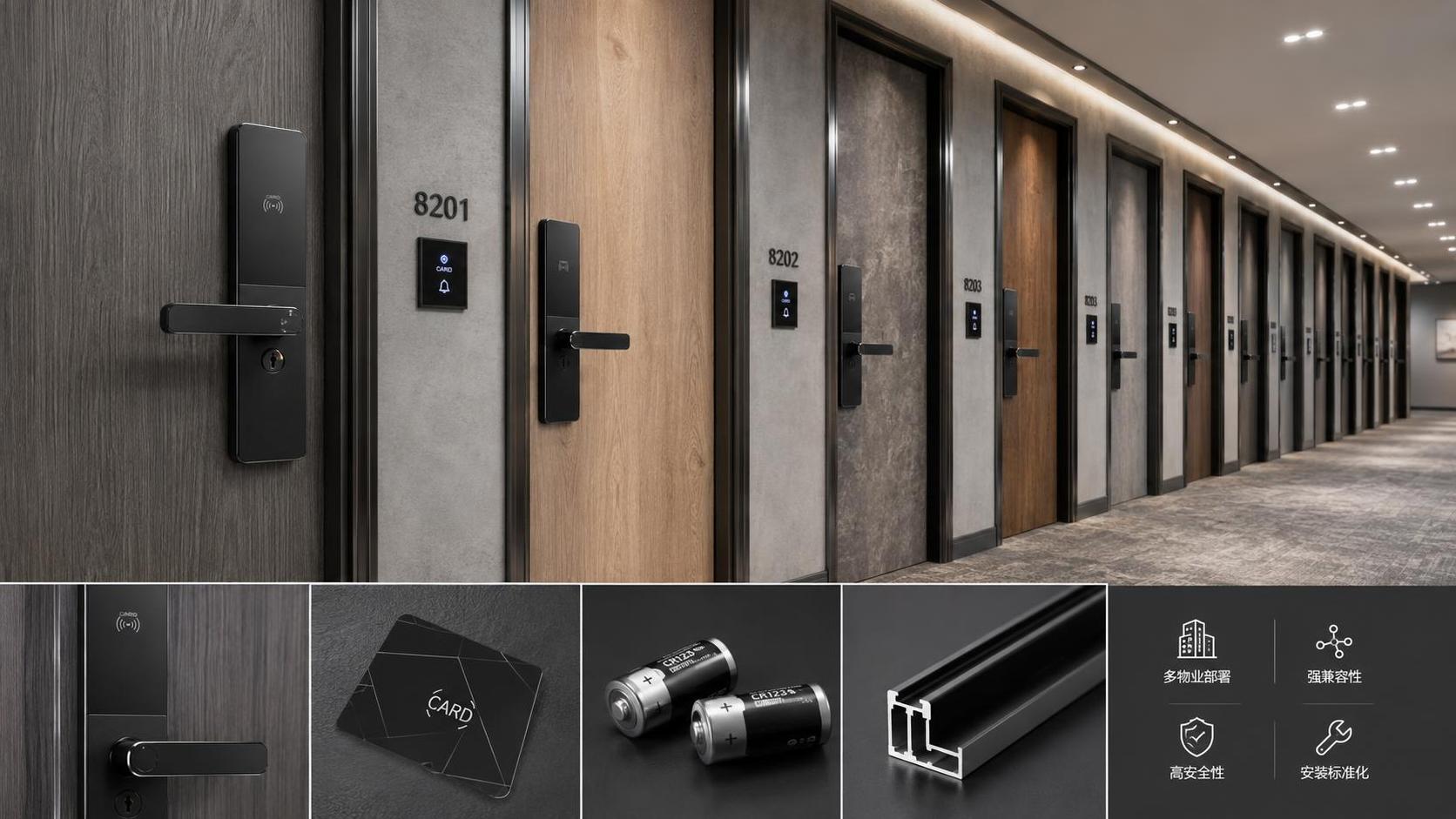
For a multi-property rollout, choosing a hotel key card lock supplier is less about selecting a door-hardware vendor than selecting a long-term operating platform. A low unit price can be quickly outweighed by incompatible credentials, inconsistent installation quality, delayed replacement parts, weak property-level support, or a system that cannot accommodate later renovations. Procurement teams should therefore compare suppliers against the portfolio’s operating model before comparing quotations.
The most suitable supplier is usually the one that can deliver a consistent access-control standard across different hotel formats while allowing controlled local variation. A limited-service property, an upscale urban hotel, and a resort may not need identical locksets, but they should not require separate credential systems, unrelated software environments, or entirely different maintenance practices.
Start with the portfolio, not the lock specification
A single-property purchase can be driven largely by door count, finish, credential type, and installation schedule. A multi-property program introduces different questions: Which properties are new builds? Which are renovations? Are there mixed door types, fire-rated assemblies, exterior guestroom entries, staff-only areas, or connecting-room requirements? Will all sites be managed centrally, or will each hotel operate its own access-control workflow?
These answers determine whether a supplier’s offer is genuinely scalable. Buyers should ask for a property segmentation exercise before committing to a common platform. The supplier should be able to map its product range to distinct operating conditions without forcing every site into an over-specified or under-specified lock.
- Guestroom doors may require a standard electronic mortise or cylindrical configuration, depending on the existing door preparation and local building practice.
- Exterior-facing rooms, villas, pool-access rooms, and remote buildings may require stronger weather resistance and more reliable power-management arrangements.
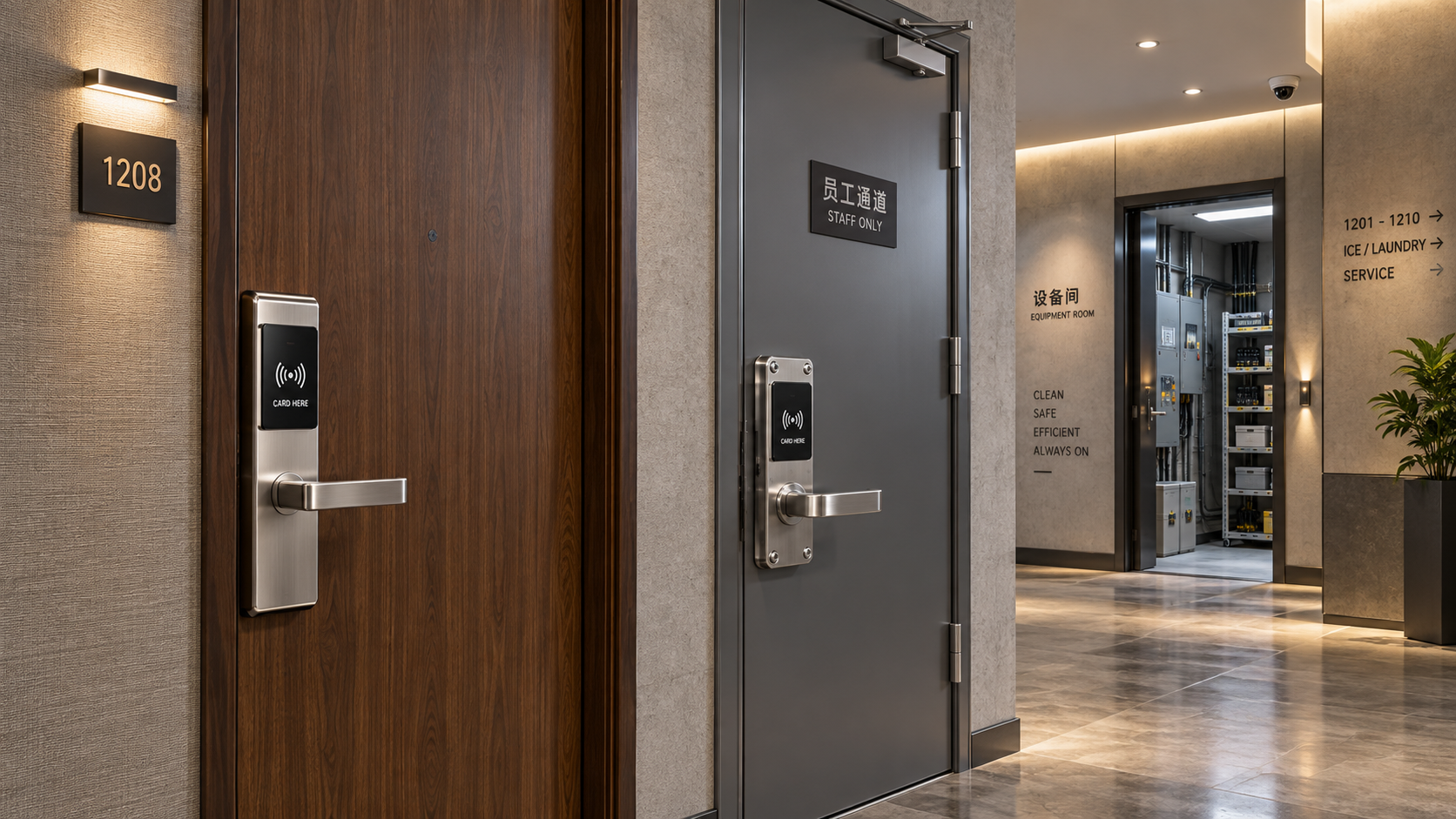
- Back-of-house doors often need different permissions, audit requirements, and opening schedules than guestroom doors.
- Fire-rated doors, emergency exits, and accessibility-related openings must be assessed as complete door assemblies rather than treated as ordinary lock replacements.
- Renovation properties may have legacy door cutouts or hardware dimensions that materially affect installation cost and guestroom downtime.
A supplier that only responds with a catalogue and a room-count quotation has not yet addressed the rollout risk. The better response is a documented configuration proposal showing which lock family, credential technology, accessories, and installation method apply to each property type.
Assess interoperability before committing to credential technology
Key cards remain straightforward for guests, but the procurement decision should account for the credential ecosystem around them. Hotels increasingly operate a mixture of physical cards, staff credentials, mobile keys, elevator access, parking barriers, amenity areas, and meeting spaces. A lock system may function well at the guestroom door while creating operational friction elsewhere if its credential architecture is isolated.
Ask the hotel key card lock supplier to explain, in practical terms, how credentials are issued, cancelled, reissued, audited, and transferred between systems. The discussion should cover front-desk workflows, offline and online locks, staff access, lost-card handling, emergency access procedures, and any integration required with the property-management system.
Compatibility claims deserve particular scrutiny. “Compatible with mobile access” can mean anything from a demonstrated production integration to a future option requiring different hardware, middleware, licensing, or a replacement reader. Likewise, a supplier may support third-party integrations only through a narrow list of approved partners. Procurement should request the exact interfaces, required components, ownership of integration work, and support responsibilities in writing.
For a phased rollout, future-readiness is often more important than immediate feature availability. A lock installed today should not prevent a property from adding mobile credentials later, but buyers should verify whether the upgrade is software-based, reader-based, or requires replacement of the full lock assembly. That distinction affects both capital planning and room-out-of-service scheduling.
Evaluate the door opening as a system
Electronic locks are frequently evaluated as stand-alone devices. That approach can obscure the biggest installation and reliability issues. The lock, door material, frame condition, strike, hinges, closer, latch engagement, fire rating, door preparation, and power source all influence performance.
During a multi-property rollout, small variations in doors can become expensive. A supplier may quote a lock that fits a standard preparation, while individual hotels have different backsets, stile widths, door thicknesses, panic hardware, metal reinforcements, or prior cutouts. The resulting field modification can slow installation, damage finished doors, compromise certifications, or create inconsistent appearance across the estate.
Require a survey methodology, not merely a site visit. The supplier or its authorized installation partner should document representative openings, identify exceptions, classify remediation work, and establish who approves deviations. The procurement team should be able to distinguish the base lock price from the costs associated with door repair, machining, replacement hardware, electrical work, and post-installation adjustment.
This is also where compliance documentation matters. Requirements differ by jurisdiction and project type, but buyers should establish which certifications, test reports, declarations, and door-assembly approvals are relevant to the properties involved. A CE marking, UL-related documentation, or an ISO-certified quality system may be relevant evidence in some procurements, yet none of those labels alone proves that a specific lock is suitable for every fire-rated, accessible, or emergency egress application. The approved configuration must match the actual opening.
Compare lifecycle cost in operational terms
Unit pricing is visible in the tender. The larger costs often emerge later through batteries, cards, replacement parts, technician travel, software subscriptions, lock failures, room moves, and staff time. Two suppliers can offer similar hardware prices while imposing very different support and maintenance burdens over the service life of the installation.
A useful comparison separates the commercial proposal into five cost categories:
Battery performance should be discussed as an operating model rather than a headline figure. Expected battery life depends on door traffic, temperature, credential reader behavior, lock configuration, and maintenance discipline. Buyers need to know how low-battery alerts are generated, whether staff can identify affected locks before failure, and whether the property can replace batteries without disrupting guests or losing configuration.
Spare-parts policy can be equally decisive. A lock supplier with strong manufacturing credentials may still be a poor fit if it cannot support an installed base through renovations and ownership changes. Ask about component availability, product change notification, replacement compatibility, warranty exclusions, and the process for handling obsolete models. A portfolio rollout often extends over several years; buying one model at the start does not guarantee that the same product will remain available at the end.
Test supplier capacity through rollout governance
Manufacturing capacity should be assessed, but it is not simply a question of monthly output. The supplier must coordinate forecasting, regional logistics, installation resources, configuration records, property acceptance, defect resolution, and change control across multiple sites. A vendor capable of shipping hardware in volume may still struggle with staggered handovers or local technical support.
Procurement should request a rollout governance model that identifies accountable contacts for commercial matters, technical design, logistics, installer management, training, and escalation. It should also define how serial numbers, lock firmware versions, door configurations, master-access permissions, and site acceptance records are controlled. These records become important when a property later needs to replace a lock, investigate an access event, or expand into another building.
It is prudent to validate the model through a pilot that reflects the hard parts of the estate, not only the easiest property. The pilot should include representative door types, normal front-desk issuance, staff access, maintenance procedures, and an exception such as a lost credential, battery alert, lock replacement, or system outage. The purpose is to examine operational fit and supplier response, not merely confirm that a card opens a door.
Use the contract to protect consistency
Multi-property procurement benefits from a framework agreement with controlled property-level orders. The framework can standardize approved hardware families, finishes, credential formats, software versions, installation standards, documentation, warranties, and pricing logic, while allowing each hotel to order the configuration it actually needs.
Commercial terms should also address substitutions. Suppliers sometimes need to change components because of supply availability or product revisions. A substitution process should require equivalent or approved performance, advance notice, compatibility confirmation, and clear responsibility for any resulting rework. Without this discipline, identical specifications can gradually become different systems across the portfolio.
The supplier selection decision becomes clearer when the evaluation team treats the lock as part of hotel operations rather than a line item in a hardware schedule. The preferred partner is the one that can document fit across the door estate, support the chosen credential roadmap, expose lifecycle costs, and govern delivery consistently from the first property to the last.
Technical Specifications
- Air Handling Unit Supplier Checklist: Performance Data, Lead Times, and SupportAuthor :Environmental Engineering Director
- Buying Fiberglass Water Tanks Wholesale: Compare Quotes and Delivery CostsAuthor :Environmental Engineering Director
- Choosing an XLPE Power Cable Supplier: Test Reports, Traceability, and Lead TimesAuthor :Grid Infrastructure Analyst
Expert Insights

Chief Security Architect
Dr. Thorne specializes in the intersection of structural engineering and digital resilience. He has advised three G7 governments on industrial infrastructure security.
Related Analysis
- Oct 19, 2026Air Handling Unit Supplier Checklist: Performance Data, Lead Times, and SupportAuthor :Environmental Engineering Director
- Oct 18, 2026Buying Fiberglass Water Tanks Wholesale: Compare Quotes and Delivery CostsAuthor :Environmental Engineering Director
- Oct 17, 2026Choosing an XLPE Power Cable Supplier: Test Reports, Traceability, and Lead TimesAuthor :Grid Infrastructure Analyst
Core Sector // 01
Security & Safety
- How to Build an Equipment Budget for EPC Projects Without Underestimating Lifecycle CostsAuthor :Safety Compliance Lead

- Selecting EPC Procurement Support Tools to Reduce Vendor and Delivery DelaysAuthor :Safety Compliance Lead

- How to Select an Access Control Management System for Multi-Site FacilitiesAuthor :Safety Compliance Lead

- How to Select Electronic Hotel Key Card Locks for Guest Rooms and Staff AreasAuthor :Safety Compliance Lead

- How to Evaluate a Hotel Key Card Lock Supplier for Multi-Property RolloutsAuthor :Safety Compliance Lead

- Pre-Contract Audit Checklist for Verified Production Safety and Environmental ComplianceAuthor :Safety Compliance Lead

- How Can Distributors Build Procurement-Oriented Industrial Content That Drives RFQs?Author :Safety Compliance Lead

- EU Mandates EN 50131-1:2026 for Security SystemsAuthor :Safety Compliance Lead