Industrial Level Sensors: Which Type Works Best for Corrosive or Dusty Environments?
Author
Date Published
Reading Time
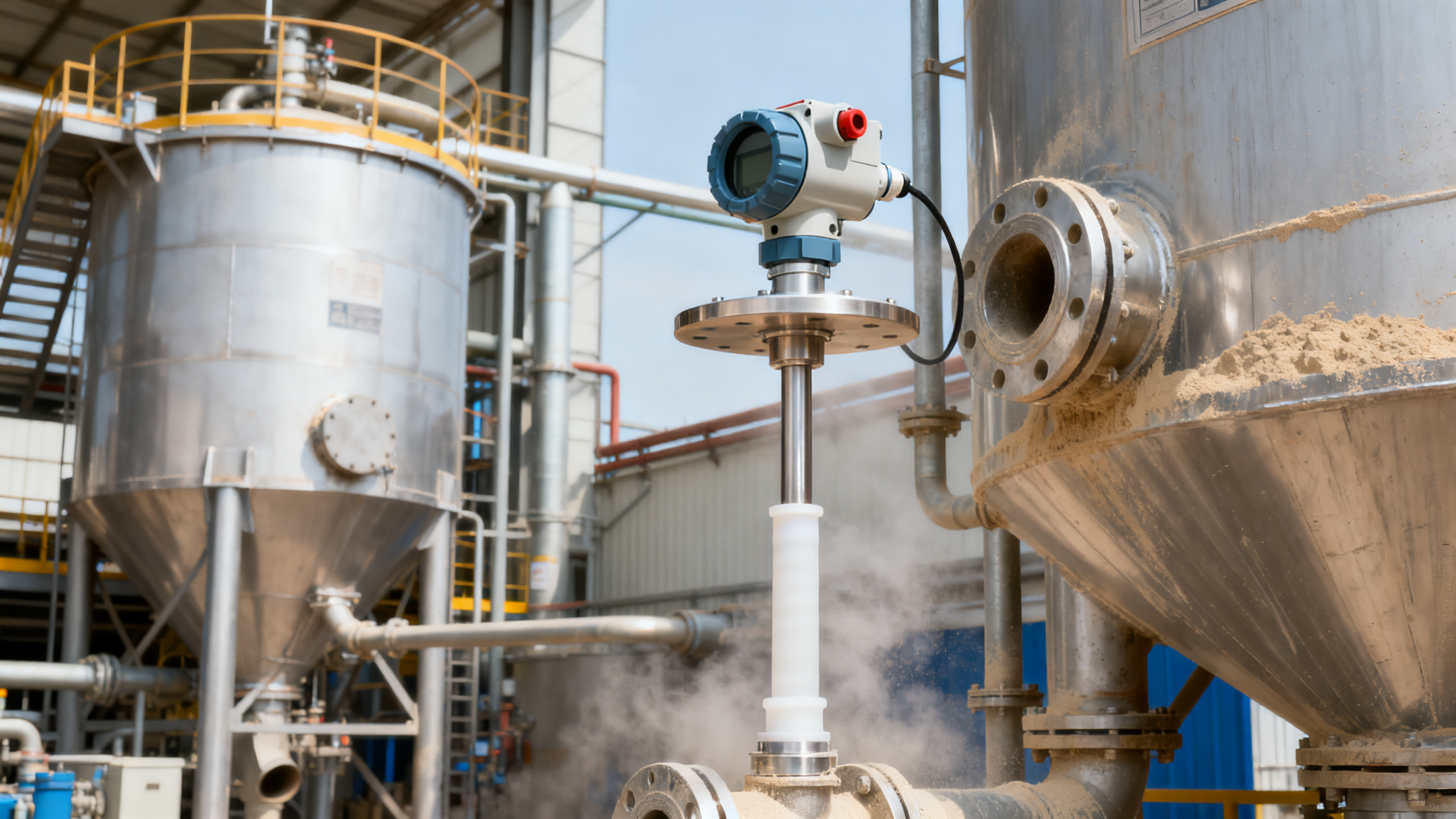
Industrial Level Sensors for Corrosive or Dusty Environments: What Really Works
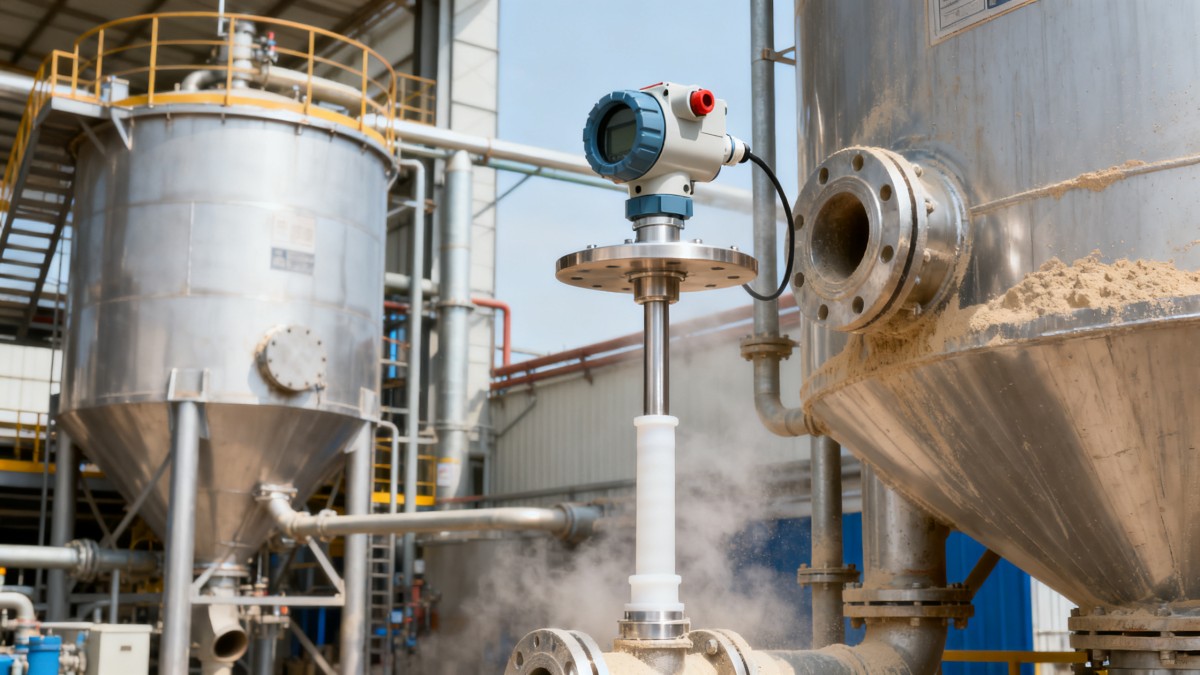
Choosing the right industrial level sensors for corrosive or dusty environments is not just a specification exercise. It affects safety, uptime, compliance, and maintenance cost.
In harsh plants, the wrong sensor fails early. It may drift, foul, corrode, or trigger false alarms during normal operation.
That is why technical evaluations should start with process conditions, not with price or a familiar product line.
Some industrial level sensors perform well in acids, solvents, slurries, and bulk powders. Others struggle when dust clouds, foam, buildup, or vapor enter the picture.
The best choice depends on four things. These are material compatibility, sensing principle, installation geometry, and maintenance tolerance.
This guide breaks down which industrial level sensors work best in corrosive or dusty settings, where they fit, and what to watch before purchase.
Why Harsh Environments Change Sensor Selection
Standard tank conditions are rarely the real problem. Harsh environments add failure modes that are easy to underestimate during specification review.
Corrosive media can attack housings, wetted parts, seals, and cable jackets. Dust can coat sensing surfaces, block signal paths, and increase false switching.
In actual operations, temperature cycling also matters. It changes dielectric properties, creates condensation, and accelerates material stress.
This also means a sensor that looks accurate in a catalog may become unreliable in a silo, scrubber, acid tank, or cement hopper.
- Corrosive liquids demand strong wetted materials such as PTFE, PVDF, Hastelloy, or high-grade stainless steel.
- Dusty solids require non-contact measurement when buildup is frequent or vessel access is limited.
- High humidity or vapor needs stable signal processing and good ingress protection.
- Compliance may require ATEX, IECEx, CE, UL, or plant-specific safety approval.
Which Industrial Level Sensors Perform Best
No single technology dominates every harsh application. The better approach is to match failure risk with sensing behavior.
Radar Level Sensors
Radar is often the strongest all-around choice for difficult service. It works well in dusty bins, corrosive tanks, and high-temperature processes.
Because radar is non-contact in many designs, it reduces fouling risk. It also avoids direct exposure to aggressive chemicals.
Modern FMCW and high-frequency radar units handle uneven surfaces, changing bulk density, and long measuring distances better than older designs.
- Best for acids, solvents, powders, grains, fly ash, cement, and enclosed storage vessels.
- Main strengths include non-contact operation, long range, and low maintenance.
- Main watchpoints include internal obstructions, heavy condensation, and nozzle design.
Guided Wave Radar
Guided wave radar is useful when vapors, foam, or narrow vessels confuse free-space radar. Its signal follows a probe, improving stability.
It is common in chemical tanks and interface measurement. However, probe coating can become a maintenance issue in sticky products.
Ultrasonic Sensors
Ultrasonic industrial level sensors can work in corrosive service if non-contact measurement is needed and vapor is limited.
They are generally less ideal in heavy dust, steam, turbulence, or strong temperature gradients. Sound-based measurement is sensitive to changing air conditions.
Capacitive Sensors
Capacitive industrial level sensors are attractive for point level detection. They are compact, cost-effective, and widely used.
Still, they can struggle with buildup, changing dielectric constants, and conductive coating. In dusty applications, this becomes a real limitation.
Hydrostatic and Pressure-Based Sensors
Hydrostatic sensors are common for liquid level measurement in open tanks, pits, and wastewater systems. They offer simple continuous measurement.
For corrosive media, diaphragm material and seal design are critical. For dusty solids, this technology is usually not the right fit.
Vibrating Fork and Rotary Paddle Sensors
These industrial level sensors are popular for point level alarms in powders and granules. They are practical, proven, and easy to integrate.
They are less suitable for aggressive liquid corrosion unless material selection is excellent. Mechanical wear also matters in abrasive solids.
Best Sensor Choice by Application
A more useful question is not which technology is best overall. It is which one performs best in a specific operating envelope.
From a recent market shift, radar-based industrial level sensors are gaining preference because they reduce intervention in hard-to-access assets.
What to Check Before Final Selection
Even strong sensor technologies fail when selection details are rushed. A disciplined review usually prevents expensive surprises later.
- Verify chemical compatibility for every wetted part, not just the probe or diaphragm.
- Check dust load, particle size, angle of repose, and expected buildup behavior.
- Review pressure, temperature, foam, agitation, and condensation patterns.
- Confirm vessel geometry, nozzle length, internal ladders, mixers, and fill streams.
- Assess output needs such as 4-20 mA, HART, Modbus, relay alarms, or digital integration.
- Validate hazardous area certifications and site compliance requirements early.
In practice, lifecycle cost often matters more than purchase cost. A cheaper sensor with frequent cleaning is rarely the cheaper decision.
Common Mistakes in Harsh-Service Projects
Several selection errors appear again and again across industrial upgrades and new EPC packages.
- Choosing industrial level sensors only by measuring range, while ignoring coating, vapor, or corrosion.
- Using contact sensors in sticky media where non-contact designs would reduce service interruptions.
- Overlooking cable, gasket, and enclosure resistance in chemical washdown areas.
- Ignoring calibration access and mounting orientation during mechanical design.
- Assuming dusty solids behave like clean liquids during commissioning.
The clearer signal is this: performance depends on application fit, not on a generic ranking of technologies.
A Practical Recommendation
For many corrosive liquid tanks, non-contact radar is the safest starting point. It combines strong reliability with lower exposure to aggressive media.
For dusty silos and powder vessels, radar also leads in most cases. If only point detection is needed, vibrating fork devices remain a practical option.
Guided wave radar fits more specialized conditions, especially where vapor, foam, or narrow geometry make free-space measurement harder.
The best industrial level sensors are the ones that stay accurate with minimal intervention, while meeting safety, material, and integration requirements.
Before release, compare at least three options against process media, maintenance access, certification, and total operating cost. That approach usually leads to better long-term results.
When harsh conditions define the process, careful sensor matching is not a minor detail. It is part of the reliability strategy from day one.
Expert Insights

Chief Security Architect
Dr. Thorne specializes in the intersection of structural engineering and digital resilience. He has advised three G7 governments on industrial infrastructure security.
Related Analysis
- Jun 18, 2026EN 61000-6-4:2026 Takes Effect for EMC CertificationAuthor :Grid Infrastructure Analyst
- Jun 18, 2026Brazil ANATEL Rule 712 Adds LoRaWAN 1.0.4 for Test InstrumentsAuthor :Precision Metrology Expert
- Jun 18, 2026CPSC Recall Signals Stricter UL 867 ComplianceAuthor :Environmental Engineering Director
Core Sector // 01
Security & Safety
- Brazil ANATEL Rule 712 Adds LoRaWAN 1.0.4 for Test InstrumentsAuthor :Precision Metrology Expert

- Wholesale Moisture Meters: Pin vs Pinless, and How to Choose for Wood or ConcreteAuthor :Precision Metrology Expert

- Anemometers Wholesale Buying Guide: Which Types Fit HVAC, Labs, and Field Inspections?Author :Precision Metrology Expert

- Brazil ANATEL Revises Resolution 712 for LoRaWAN 1.0.4Author :Precision Metrology Expert

- 700+ Overseas Buyers Target M&E and New Energy at Langfang 2026Author :Precision Metrology Expert

- Digital Sound Level Meter Accuracy: Key Specs, Calibration, and Compliance BasicsAuthor :Precision Metrology Expert

- How to Choose OBD2 Code Readers for DIY Diagnostics and Professional RepairAuthor :Precision Metrology Expert

- Industrial Measurement Techniques for Safety Compliance: Which Methods Fit Your Process?Author :Precision Metrology Expert