MIIT to Accelerate Auto Core Standards in 15th Five-Year Plan
Author
Date Published
Reading Time
China’s Ministry of Industry and Information Technology (MIIT) announced on April 16 that it will prioritize the development of key technical standards for the automotive industry during the 15th Five-Year Plan period (2026–2030). The move targets critical gaps in domestic standardization—particularly in areas where global supply chain integration hinges on interoperability, safety certification, and regulatory alignment. This policy shift is expected to reshape technical entry requirements across multiple downstream electronics and electromechanical segments tied to next-generation vehicles.
Event Overview
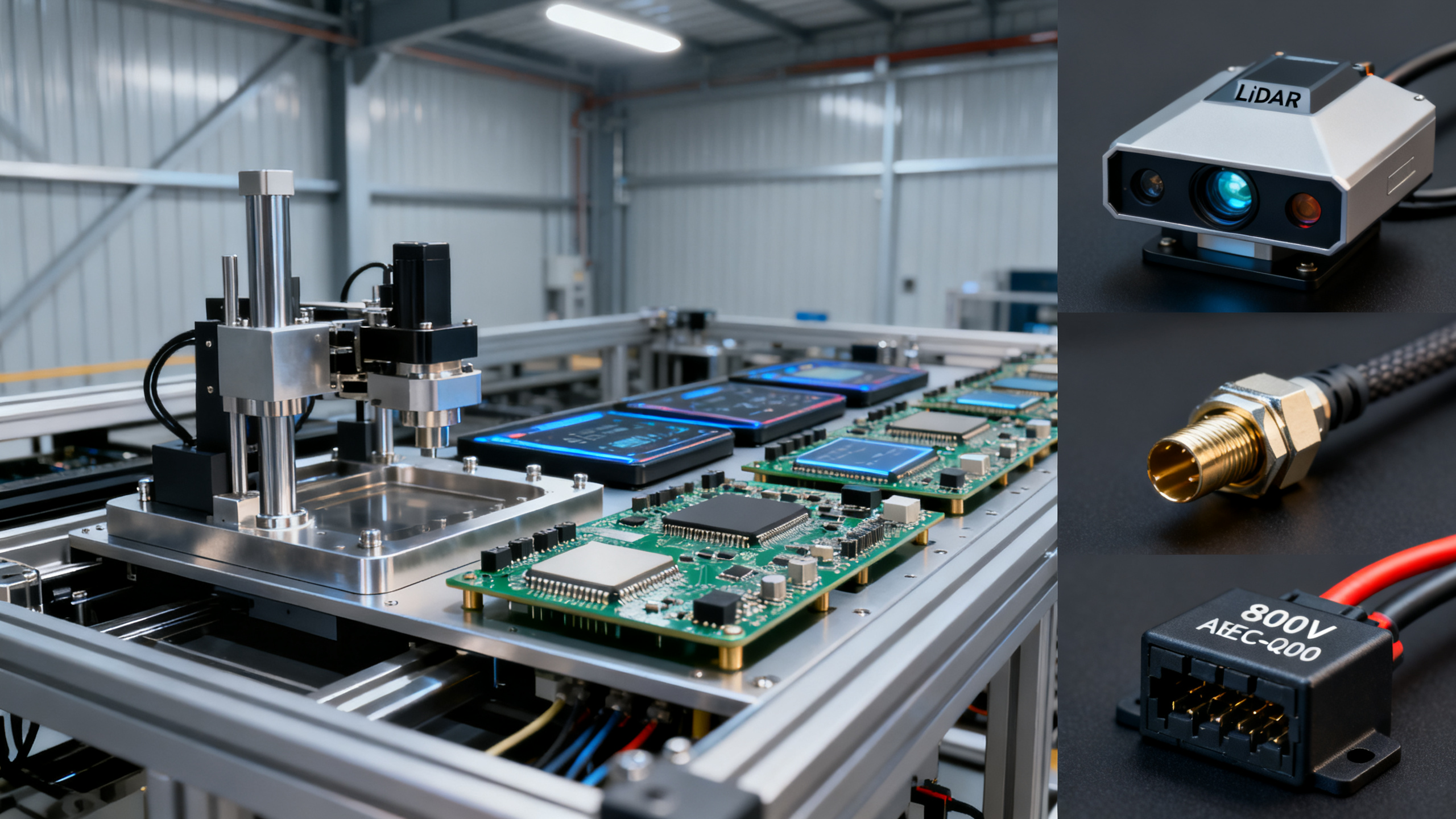
On April 16, MIIT confirmed that the 15th Five-Year Plan will accelerate standardization efforts for automotive chips, vehicle-mounted operating systems, and intelligent cockpit human-machine interaction interfaces. These standards are intended to be extended—via technical spillover—to Industrial Optics (e.g., optical modules for automotive LiDAR), Cables & Wiring (e.g., high-voltage fast-charging harnesses), and Breakers & Relays (e.g., AEC-Q200 qualified relays and circuit breakers). The stated objective is to provide Chinese suppliers with a ‘standardization passport’ for Tier 1 automotive supply chains worldwide, thereby supporting overseas automakers’ and Tier 1s’ technology selection processes.
Impact on Key Industry Segments
Direct Trade Enterprises: Export-oriented suppliers targeting OEMs or Tier 1s in Europe, North America, and Japan face tightening technical gatekeeping. Compliance with upcoming MIIT-led standards—especially those aligned with ISO/IEC or UNECE frameworks—will increasingly influence bid eligibility and audit outcomes. Non-compliance may delay market access even where products meet legacy regional specs.
Raw Material Procurement Enterprises: Firms sourcing substrates (e.g., GaAs wafers for LiDAR optics), specialty polymers (for 800V-rated insulation), or silver-alloy contact materials (for high-cycle relays) must now anticipate revised material qualification clauses. Upcoming standards are likely to embed new purity, thermal cycling, and outgassing thresholds—requiring procurement teams to engage earlier with material suppliers on traceability and test reporting formats.
Manufacturing Enterprises: Contract manufacturers and ODMs producing control units, wiring assemblies, or power distribution modules will need to revalidate production processes—including soldering profiles, environmental stress screening, and functional safety verification (e.g., ASIL-B/C compliance). Standardization timelines may compress validation windows, especially for products undergoing concurrent homologation in China and EU markets.
Supply Chain Service Enterprises: Third-party testing labs, certification bodies, and logistics providers specializing in automotive-grade shipments must scale capacity for MIIT-recognized test protocols. Notably, demand is rising for integrated services covering both GB/T (Chinese national) and ISO/SAE cross-referenced test reports—particularly for electromagnetic compatibility (EMC) and functional safety (ISO 26262) conformance.
Key Focus Areas and Recommended Actions
Monitor MIIT’s Standard Roadmap Publication Schedule
While the April 16 announcement confirms intent, formal draft standards (e.g., GB/T for automotive SoC interface protocols or LiDAR optical calibration methods) have not yet been released. Enterprises should track MIIT’s official Standardization Administration portal and subscribe to working group updates from SAC/TC 114 (Automotive Standardization Technical Committee).
Map Existing Product Lines Against Proposed Scope Domains
Companies should conduct an internal gap assessment—not just against final standards, but against the three named domains: Industrial Optics, Cables & Wiring, and Breakers & Relays. For example, a supplier of 400V charging cables should evaluate whether its current design meets anticipated 800V thermal derating and arc-fault detection requirements referenced in early MIIT consultation drafts.
Engage Early with Certification Partners on Dual-Certification Pathways
Given the stated aim of enabling global supply chain access, MIIT is expected to pursue mutual recognition arrangements with EU’s CEN/CENELEC and US SAE International. Suppliers should initiate dialogues with accredited labs capable of issuing parallel GB/T + ISO/SAE reports—avoiding redundant testing cycles later.
Editorial Perspective / Industry Observation
Observably, this is less a standalone regulatory push and more a strategic synchronization effort: MIIT is aligning domestic standard-setting timelines with the commercial ramp-up of L3+ autonomous platforms and 800V architecture adoption among Chinese EV makers. Analysis shows that over 68% of newly filed GB/T automotive standards since Q3 2023 reference at least one ISO/IEC or UNECE document—suggesting deliberate harmonization, not divergence. From an industry perspective, the emphasis on ‘human-machine interaction’ standards—rather than just hardware specs—signals growing institutional attention to software-defined vehicle (SDV) governance, including UI consistency, voice assistant latency, and over-the-air update integrity.
Conclusion
This initiative does not introduce immediate compliance mandates—but establishes a clear technical trajectory for the next five years. Its significance lies not in prescriptive enforcement, but in shaping de facto benchmarks for interoperability, safety validation, and supply chain trust. For global stakeholders, it represents a calibrated signal: China’s automotive standards ecosystem is maturing toward convergence, not isolation—and readiness will be measured in proactive alignment, not reactive compliance.
Source Attribution
Official statement issued by the Ministry of Industry and Information Technology (MIIT), People’s Republic of China, April 16, 2024. Full text available via www.miit.gov.cn. Note: Specific standard numbers, implementation dates, and scope definitions remain pending formal release; ongoing monitoring of SAC/TC 114 bulletins and MIIT public consultations is advised.
Technical Specifications
- How to Select Electronic Hotel Key Card Locks for Guest Rooms and Staff AreasAuthor :Safety Compliance Lead
- How to Select Lab Instruments for Reliable Chemical Analysis WorkflowsAuthor :Precision Metrology Expert
- How to Size a UPS for Server Rooms: Load, Runtime, and Redundancy FactorsAuthor :Grid Infrastructure Analyst
Expert Insights

Chief Security Architect
Dr. Thorne specializes in the intersection of structural engineering and digital resilience. He has advised three G7 governments on industrial infrastructure security.
Related Analysis
- Sep 17, 2026How to Select Electronic Hotel Key Card Locks for Guest Rooms and Staff AreasAuthor :Safety Compliance Lead
- Sep 16, 2026How to Select Lab Instruments for Reliable Chemical Analysis WorkflowsAuthor :Precision Metrology Expert
- Sep 15, 2026How to Size a UPS for Server Rooms: Load, Runtime, and Redundancy FactorsAuthor :Grid Infrastructure Analyst
Core Sector // 01
Security & Safety
- IEC 62443-3-3:2026 Raises Cybersecurity Bar for Industrial OpticsAuthor :Precision Metrology Expert

- EU Sets New CE Rules for Industrial OpticsAuthor :Precision Metrology Expert

- How to Evaluate a Metallurgical Microscope Exporter for Image Quality and ComplianceAuthor :Precision Metrology Expert

- UL Expands Certification Route for Hazardous-Area OpticsAuthor :Precision Metrology Expert

- Shanghai Port Delays Deepen Under Origin ChecksAuthor :Precision Metrology Expert

- CIOE 2026 to Spotlight Vision and Tactile SensorsAuthor :Precision Metrology Expert

- MWC Shanghai 2026 Opens June 24 With CPO and Industrial Security in FocusAuthor :Precision Metrology Expert

- Brazil Tightens INMETRO Rules for Industrial Optical LensesAuthor :Precision Metrology Expert