China's First 10MeV Ultra-Compact Medical Cyclotron Developed
Author
Date Published
Reading Time
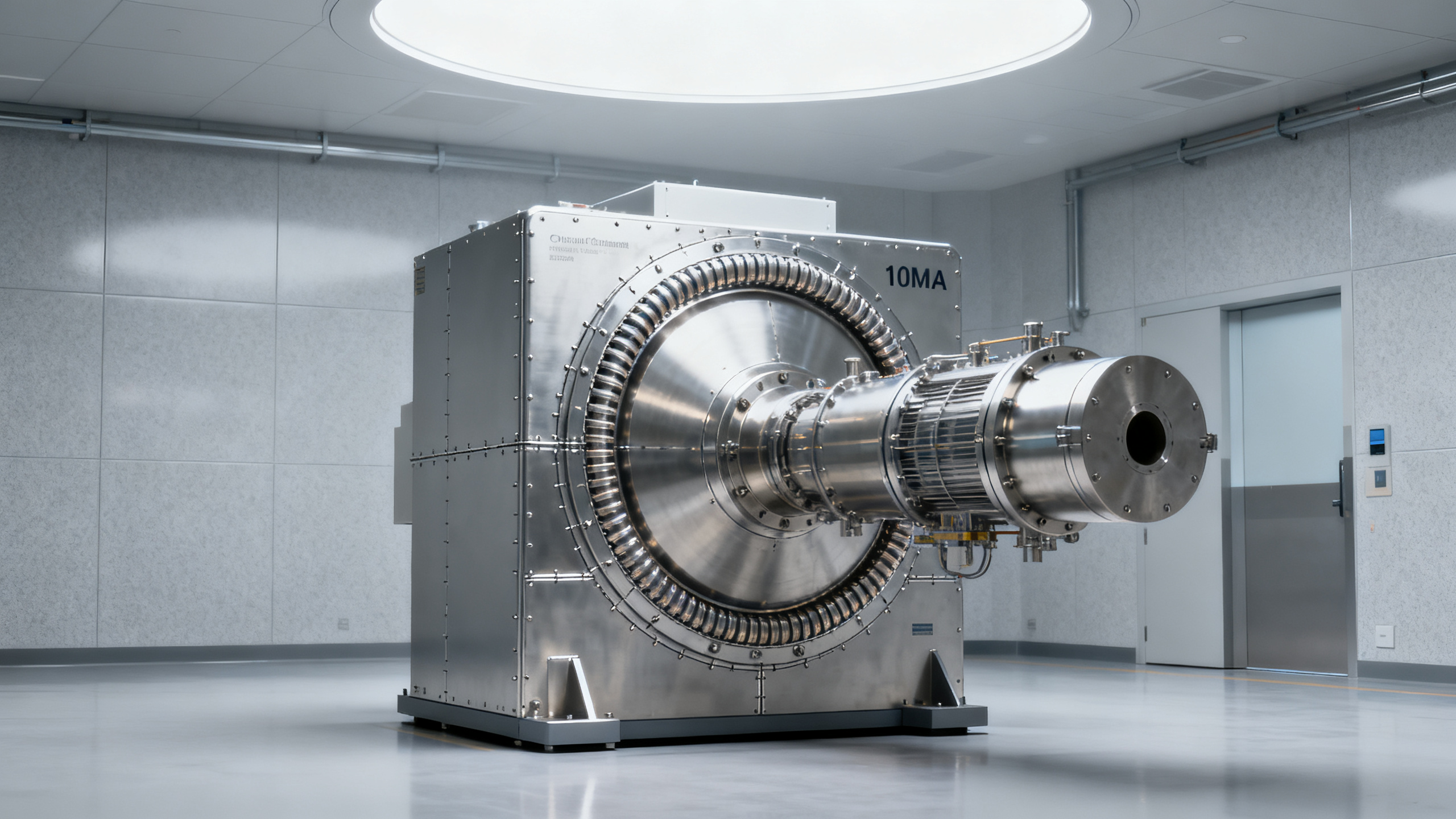
On April 20, China successfully developed its first 10MeV ultra-compact medical cyclotron — a milestone with cross-sectoral implications for medical equipment manufacturing, industrial metrology, and analytical instrumentation. The breakthrough stems not from incremental improvement but from integrated innovation in RF systems, magnet architecture, and ultra-high-vacuum cavity design — technologies now demonstrably transferable to precision optical platforms, high-resolution particle detectors, and isotope analyzers. This signals a structural shift in domestic capability: from component-level sourcing to full-system co-design and validation.
Event Overview
On April 20, the domestic development of the first 10MeV ultra-compact medical cyclotron was announced. Its RF system, magnet structure, and vacuum cavity technologies are confirmed transferable to Industrial Optics precision optical platforms, Testing & Measurement high-precision particle detectors, and Lab & Analytics isotope analyzers. No further technical specifications, certification status, or commercial deployment timeline were disclosed.
Industries Affected
Direct Trade Enterprises
Export-oriented medical device distributors and OEM integrators face recalibration of competitive positioning. As this cyclotron enables more compact, lower-power, and potentially lower-cost alternatives to imported mid-energy cyclotrons (e.g., from IBA or Sumitomo), trade enterprises targeting emerging markets — especially in Southeast Asia, Latin America, and Africa — may see improved price-performance leverage. However, export compliance pathways (e.g., FDA 510(k), CE IVDR) remain unconfirmed; market access timing is therefore uncertain.
Raw Material Procurement Enterprises
Suppliers of high-purity copper alloys, NbTi superconducting wire, and ultra-high-vacuum-compatible ceramics may experience increased inquiry volume — but not yet orders. The cyclotron’s compactness implies tighter material tolerances and higher batch consistency requirements. Procurement firms must assess whether current supplier certifications (e.g., ASTM B187 for oxygen-free copper) align with nuclear-grade QA protocols. No procurement contracts or material specs have been published.
Manufacturing Enterprises
Contract manufacturers specializing in vacuum-integrated electromechanical assemblies — particularly those already certified to ISO 13485 or ASME BPVC Section VIII — are best positioned to absorb technology spin-offs. The validated integration of RF cavities within constrained magnetic yokes suggests demand growth for precision CNC-machined RF components and active cooling manifolds. Yet, no licensing agreements or joint development announcements involving Tier-1 manufacturers have been released.
Supply Chain Service Providers
Logistics providers offering cleanroom-compliant transport, customs brokers with radiation equipment classification expertise, and calibration labs accredited to ISO/IEC 17025 for ion-beam measurement face early-stage opportunity. The cyclotron’s compact footprint lowers installation barriers, potentially increasing demand for turnkey site commissioning support — but only after regulatory clearance and pilot deployment are achieved.
Key Considerations and Recommended Actions
Verify Technology Transfer Pathways
Enterprises should map which subsystems (e.g., RF power amplifiers, shimming coil windings) are explicitly cited as transferable — and confirm whether associated IP is licensable, open, or restricted. Public documentation does not specify ownership or commercialization rights.
Assess Regulatory Readiness Gaps
While technical feasibility is demonstrated, no evidence confirms conformity with IEC 62304 (medical device software), IEC 61000-6-4 (EMC), or national radiation safety standards (e.g., CNMC regulations). Firms planning integration should initiate pre-submission consultations with NMPA and provincial radiation safety authorities.
Monitor Pilot Deployment Signals
Commercial viability hinges on clinical or industrial validation. Stakeholders should track announcements of first installations — particularly at Class III hospitals or national metrology institutes — as leading indicators of scalability and reliability.
Editorial Perspective / Industry Observation
Observably, this achievement reflects progress in systems engineering maturity rather than isolated component advancement. Analysis shows that the ability to co-optimize RF, magnetic, and vacuum domains under tight spatial constraints points to strengthened cross-disciplinary R&D coordination — likely enabled by national key R&D programs. However, it is more accurate to interpret this as an enabler than a disruptor: near-term impact will be strongest in cost-sensitive replacement markets and non-therapy applications (e.g., radioisotope production for PET tracers or materials analysis), not in displacing established proton therapy platforms. Current more relevant benchmark is not global leadership, but reduced dependency on single-source imports for mid-range accelerator infrastructure.
Conclusion
This development marks a tangible step toward sovereign capability in accelerator-based instrumentation — one that expands options without yet reshaping global supply hierarchies. Its longer-term significance lies less in immediate substitution and more in validating a domestic design-to-integration pipeline capable of iterative refinement across adjacent high-precision sectors.
Source Attribution
Official announcement issued by the China Academy of Engineering Physics (CAEP), April 20, 2024. Technical details sourced from CAEP’s press briefing transcript and accompanying white paper (‘Ultra-Compact Cyclotron System Integration Framework’, Version 1.0). Certification status, commercial partners, and export licensing terms remain unconfirmed and are subject to ongoing monitoring.
Technical Specifications
- How to Select Electronic Hotel Key Card Locks for Guest Rooms and Staff AreasAuthor :Safety Compliance Lead
- How to Select Lab Instruments for Reliable Chemical Analysis WorkflowsAuthor :Precision Metrology Expert
- How to Size a UPS for Server Rooms: Load, Runtime, and Redundancy FactorsAuthor :Grid Infrastructure Analyst
Expert Insights

Chief Security Architect
Dr. Thorne specializes in the intersection of structural engineering and digital resilience. He has advised three G7 governments on industrial infrastructure security.
Related Analysis
- Sep 17, 2026How to Select Electronic Hotel Key Card Locks for Guest Rooms and Staff AreasAuthor :Safety Compliance Lead
- Sep 16, 2026How to Select Lab Instruments for Reliable Chemical Analysis WorkflowsAuthor :Precision Metrology Expert
- Sep 15, 2026How to Size a UPS for Server Rooms: Load, Runtime, and Redundancy FactorsAuthor :Grid Infrastructure Analyst
Core Sector // 01
Security & Safety
- IEC 62443-3-3:2026 Raises Cybersecurity Bar for Industrial OpticsAuthor :Precision Metrology Expert

- EU Sets New CE Rules for Industrial OpticsAuthor :Precision Metrology Expert

- How to Evaluate a Metallurgical Microscope Exporter for Image Quality and ComplianceAuthor :Precision Metrology Expert

- UL Expands Certification Route for Hazardous-Area OpticsAuthor :Precision Metrology Expert

- Shanghai Port Delays Deepen Under Origin ChecksAuthor :Precision Metrology Expert

- CIOE 2026 to Spotlight Vision and Tactile SensorsAuthor :Precision Metrology Expert

- MWC Shanghai 2026 Opens June 24 With CPO and Industrial Security in FocusAuthor :Precision Metrology Expert

- Brazil Tightens INMETRO Rules for Industrial Optical LensesAuthor :Precision Metrology Expert