Wholesale Cleanroom Garments: What Buyers Should Check Before Placing Bulk Orders
Author
Date Published
Reading Time
Buying wholesale cleanroom garments is rarely a simple price exercise. In controlled production spaces, a weak fabric, missing certificate, or unstable supplier can quickly turn a low quote into a costly disruption.
That is why bulk purchasing decisions should connect cost, compliance, wear life, and replenishment planning. A solid order protects product quality, operator safety, audit readiness, and long-term supply continuity.
For industrial buyers working across electronics, pharma support areas, precision assembly, and high-spec manufacturing, the best approach is practical: verify what affects performance on the floor, not just what looks good on a quotation sheet.
The points below focus on what should be checked before placing large-volume orders for wholesale cleanroom garments, especially when compliance, consistency, and repeat supply matter as much as unit cost.
Start with the specifications that affect real use
The first review should stay close to the actual cleanroom environment. Garments that seem equivalent on paper often behave very differently after repeated wear, washing, and movement.
A supplier may offer competitive wholesale cleanroom garments, but if particle control, seam durability, or sizing stability are inconsistent, the savings disappear fast.
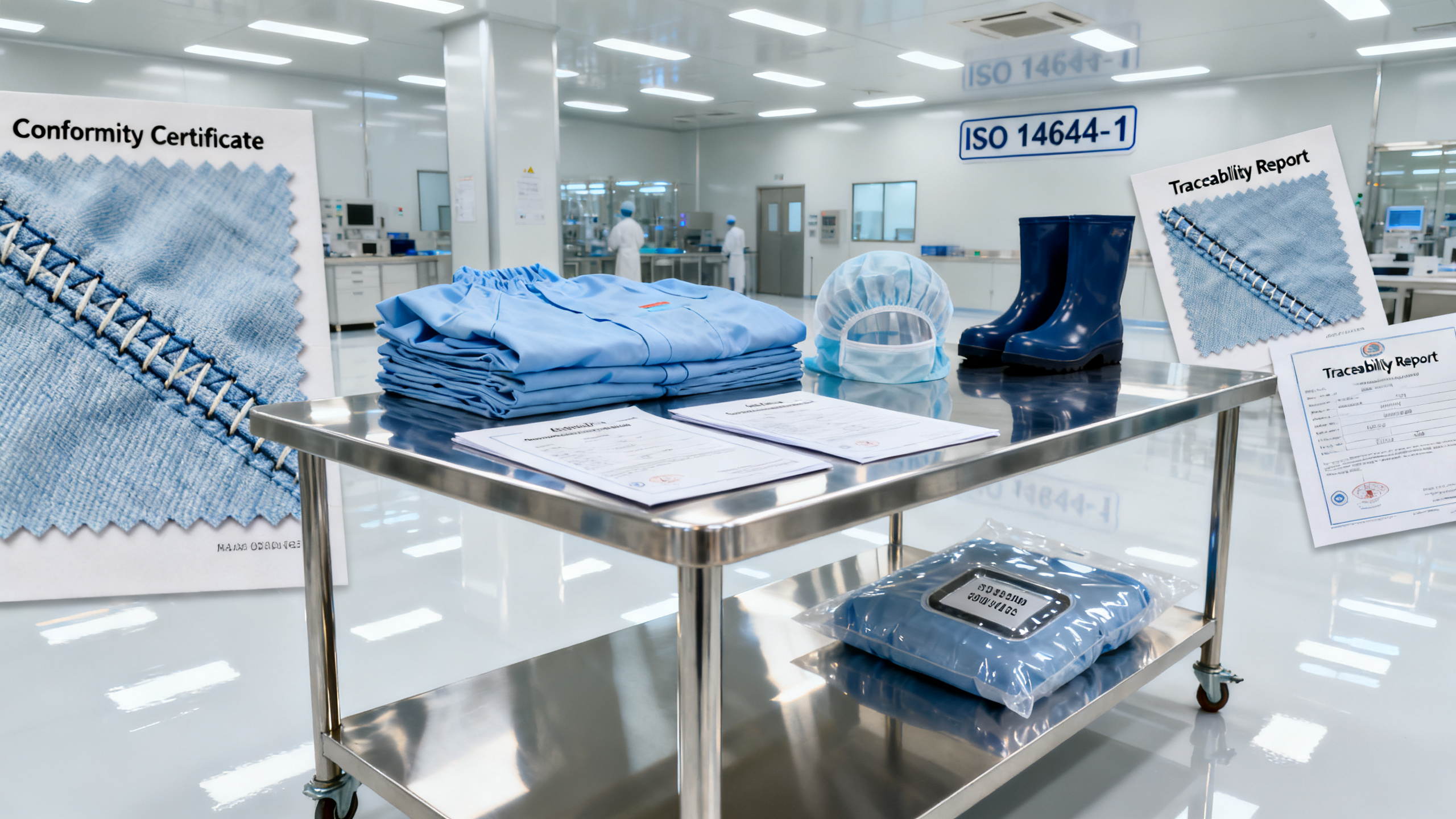
[Image 01: Bulk cleanroom garments inspection with fabric, seams, labels, and certification documents]
This is also where Global Industrial Core’s sourcing perspective matters. In high-reliability industrial procurement, performance claims should always be supported by traceable data, recognized standards, and repeatable manufacturing controls.
- Check fabric composition, weight, and antistatic performance. Good wholesale cleanroom garments should match the room classification, process sensitivity, and expected laundering cycle.
- Review seam construction and closure design carefully. Bound seams, secure zippers, and tight cuff interfaces help reduce particle shedding during repetitive movement and long shifts.
- Confirm that sizing stays consistent across production lots. Bulk orders fail in practice when fit varies enough to affect comfort, compliance, or contamination control.
- Verify whether hoods, coveralls, boots, and sleeve interfaces work together. A garment system performs better when all contact points are designed as one controlled solution.
- Ask for wash-cycle durability data, not just new-product samples. Many wholesale cleanroom garments pass visual inspection once, then degrade after repeated cleaning and sterilization.
Why sample approval should go beyond appearance
A neat-looking sample is not enough. The real question is whether the same fabric, stitching, and trim quality can be maintained across every carton in a bulk shipment.
It helps to request pre-production samples, size-set samples, and if possible, post-laundering samples. That gives a better view of how wholesale cleanroom garments will perform after normal use.
Certifications and traceability should be checked early
Compliance checks should happen before price negotiation gets too far. If the documentation is weak, every later discussion becomes slower, riskier, and harder to validate internally.
For industrial procurement, Global Industrial Core consistently emphasizes one principle: source decisions are stronger when backed by verifiable standards, test reports, and supplier accountability.
- Request current ISO-related documentation, ESD test records, and any applicable CE or product safety files. Certificates should match the exact garment model being quoted.
- Check lot traceability from raw fabric to finished packing. Reliable wholesale cleanroom garments suppliers can identify production date, sewing batch, and inspection history quickly.
- Validate third-party test reports instead of relying on generic declarations. Particle retention, surface resistivity, and cleanliness data should be recent and product-specific.
- Review labeling and carton identification rules before ordering. Clear internal codes reduce receiving mistakes, stock confusion, and mix-ups between cleanroom grades or garment sizes.
Look closely at supplier stability, not just the quote
A low price can look attractive in the first order and become a problem in the third. That usually happens when capacity, raw material sourcing, or quality discipline is weaker than the sales promise.
When comparing wholesale cleanroom garments, it helps to ask how the supplier handles demand spikes, fabric substitutions, and lead-time pressure. Those answers often reveal more than the price sheet.
- Ask about monthly capacity, backup materials, and reserved production slots. Supply continuity matters when cleanroom operations cannot stop for delayed replenishment.
- Review how nonconforming garments are handled. A serious supplier should document inspection criteria, rejection thresholds, corrective actions, and replacement turnaround.
- Check whether fabric sources are stable or frequently changed. In wholesale cleanroom garments, material substitution can quietly affect ESD control, comfort, and wear life.
- Confirm communication speed for technical questions and urgent updates. Slow answers during sampling usually become slower during shipment issues or repeat orders.
A practical scenario: electronics and precision assembly
In electronics environments, static control and particle control usually carry equal weight. A garment that feels comfortable but shows unstable surface resistivity can create hidden process risk.
In this case, wholesale cleanroom garments should be reviewed together with footwear, gloves, and laundering procedures. A single weak link can compromise the full control strategy.
Another scenario: pharma support and sterile-adjacent spaces
Here, garment cleanliness, packaging discipline, and documented handling become especially important. Even if the room is not the highest classification, documentation gaps can become audit headaches.
That is why many buyers compare wholesale cleanroom garments not only by cost per piece, but by usable life, replacement rate, and administrative burden during inspections.
Calculate total cost, not only purchase price
The cheapest order is often not the lowest-cost program. Cleanroom garments influence replacement frequency, operator acceptance, inventory levels, and even production downtime.
A better buying model compares landed cost, expected wash life, rejection rate, and reorder reliability. This is especially relevant when wholesale cleanroom garments support continuous industrial operations.
- Estimate cost per wear cycle, not only cost per unit. A slightly higher-priced garment may deliver better value if it lasts longer and maintains compliance.
- Include freight, import duties, and emergency reorder exposure. Low-cost wholesale cleanroom garments can become expensive when supply interruptions force urgent shipments.
- Track expected failure points such as zipper damage, seam opening, or cuff wear. These details affect replacement planning more than many quotations suggest.
- Consider worker acceptance and usability during long shifts. Poor comfort often leads to misuse, lower compliance, and faster garment turnover.
Common details that are easy to miss
Packaging format matters more than it seems. Inner-bag quality, size labels, barcode readability, and carton cleanliness all affect receiving speed and stock accuracy.
Color consistency can matter too, especially where garment coding supports area segregation. With wholesale cleanroom garments, visual control is often part of contamination control.
Use a simple approval process before signing the bulk order
A short approval workflow reduces surprises. It also helps align technical review, quality review, and commercial review before volume commitments are locked in.
This approach fits the broader sourcing discipline promoted by Global Industrial Core: critical industrial purchases perform better when technical evidence, compliance data, and commercial terms are checked together.
- Approve the exact specification sheet, including fabric, seam type, closures, sizes, and packaging. Avoid leaving any technical point open to interpretation.
- Lock in golden samples for future comparison. For repeat wholesale cleanroom garments orders, this makes incoming inspection faster and more objective.
- Set written acceptance criteria before production starts. Define tolerances for sizing, labeling, cleanliness, stitching, and documentation completeness.
- Agree on replenishment timing and buffer stock rules. Stable ordering plans reduce last-minute buying pressure and improve supplier performance.
In the end, buying wholesale cleanroom garments well comes down to discipline. Check the fabric, prove the compliance, test the consistency, and confirm the supplier can keep performing after the first shipment.
If the next order decision is approaching, start with a side-by-side review of samples, certificates, wash-life data, and replenishment terms. That one step usually makes the right supplier much easier to identify.
Technical Specifications
- How to Select Electronic Hotel Key Card Locks for Guest Rooms and Staff AreasAuthor :Safety Compliance Lead
- How to Select Lab Instruments for Reliable Chemical Analysis WorkflowsAuthor :Precision Metrology Expert
- How to Size a UPS for Server Rooms: Load, Runtime, and Redundancy FactorsAuthor :Grid Infrastructure Analyst
Expert Insights

Chief Security Architect
Dr. Thorne specializes in the intersection of structural engineering and digital resilience. He has advised three G7 governments on industrial infrastructure security.
Related Analysis
- Sep 17, 2026How to Select Electronic Hotel Key Card Locks for Guest Rooms and Staff AreasAuthor :Safety Compliance Lead
- Sep 16, 2026How to Select Lab Instruments for Reliable Chemical Analysis WorkflowsAuthor :Precision Metrology Expert
- Sep 15, 2026How to Size a UPS for Server Rooms: Load, Runtime, and Redundancy FactorsAuthor :Grid Infrastructure Analyst
Core Sector // 01
Security & Safety
- How to Select Lab Instruments for Reliable Chemical Analysis WorkflowsAuthor :Precision Metrology Expert

- Buying Lint-Free Wipes in Bulk: How to Match Material and Packaging to Cleanroom UseAuthor :Precision Metrology Expert

- How to Choose a Class II Biosafety Cabinet Supplier for Compliant Lab ProcurementAuthor :Precision Metrology Expert

- Wholesale Binocular Microscopes: Comparing Specifications, MOQs, and QC RiskAuthor :Precision Metrology Expert

- How to Evaluate a UV-Visible Spectrophotometer Manufacturer for Lab Accuracy?Author :Precision Metrology Expert

- China Temporarily Bans Helium ExportsAuthor :Precision Metrology Expert

- What to Check Before Buying a Digital Lab Incubator Wholesale OrderAuthor :Precision Metrology Expert

- Electric Muffle Furnace Wholesale: How to Evaluate Capacity, Temperature, and MOQAuthor :Precision Metrology Expert