Choosing a 5-Part Hematology Analyzer: Throughput, Sample Volume, and QC
Author
Date Published
Reading Time

Choosing a 5-Part Hematology Analyzer: Throughput, Sample Volume, and QC
Choosing a 5 part hematology analyzer requires more than comparing advertised tests per hour. The real challenge is matching sustained throughput, aspiration volume, and quality control requirements to the laboratory’s workload without compromising analytical reliability. A system that performs well under ideal conditions may create bottlenecks when reruns, flagged samples, maintenance, and QC procedures enter the workflow.
A defensible equipment specification therefore starts with how samples move through the laboratory—not with the largest number on a brochure. The useful comparison is between complete operating workflows: receiving a tube, producing a reliable result, resolving exceptions, and releasing the report.
Define the workload before comparing instruments
A five-part differential distinguishes neutrophils, lymphocytes, monocytes, eosinophils, and basophils. That classification alone does not establish equivalence between analyzers. Measurement technologies, reportable parameters, abnormal-cell flags, sample modes, and limitations differ. Additional capabilities, such as reticulocyte analysis or body-fluid testing, should be treated as separate requirements and verified for the proposed configuration.
Start with representative workload records. Daily totals matter, but arrival patterns often matter more. A laboratory receiving concentrated morning batches has a different capacity problem from one handling a steady stream of routine samples alongside urgent requests. Separate routine CBC with differential testing from optional tests, reruns, dilution procedures, and samples requiring microscopy.
Record the existing reasons for delayed results. If delays mainly arise from smear review or specimen transport, a faster analyzer may leave the actual bottleneck untouched. Conversely, an instrument with reliable urgent-sample access may improve service more than one offering higher nominal throughput but an inflexible queue.
This is where Global Industrial Core’s instruments-and-measurement sourcing perspective is relevant: translate operational needs into verifiable acceptance criteria. For clinical equipment, however, industrial certification language cannot substitute for applicable medical-device requirements or laboratory performance verification.
Measure throughput as usable capacity
Advertised throughput usually describes processing under specified conditions. Ask what those conditions are: operating mode, test profile, loading method, and whether startup, QC, cleaning, or repeat measurements are excluded. Two figures expressed as “samples per hour” may represent different workflows.
Keep three measures separate: analyzer cycles, completed patient samples, and reportable results. A rerun consumes instrument capacity without adding a new patient sample. A flagged result may be analytically available but not ready for release. Combining these measures can make an apparently successful demonstration conceal a growing review queue.
For capacity planning, estimate total analytical demand as initial patient runs plus expected repeats, additional measurement cycles, QC runs, and other relevant procedures. Compare that demand with the processing time genuinely available after planned downtime. This is a planning model, not a substitute for a timed workflow trial.
During a demonstration, use a representative workload and record:
- Time from loading to the first result and completion of the batch.
- Urgent-sample turnaround while routine testing remains in progress.
- Operator interventions for loading, reagent replacement, exceptions, and reruns.
- Time spent recovering from interruptions and restoring normal processing.
Autoloading deserves close inspection. Rack capacity is not the same as walkaway time. Verify tube compatibility, barcode handling, mixing, continuous loading, and what happens when one tube cannot be aspirated. An isolated specimen problem should not unexpectedly stop an entire unattended batch.
Do not plan routine operation at the demonstrated capacity limit. The necessary reserve depends on workload variability, service expectations, and backup arrangements. Where interruption would jeopardize service, redundancy may be more valuable than extra speed on a single instrument.
Low aspiration volume does not guarantee low-volume compatibility
Aspiration volume is the amount drawn by the analyzer for a measurement. Minimum sample volume is the amount required in a particular tube for dependable sampling. They are not interchangeable. Probe reach, tube geometry, residual volume, and operating mode can make the minimum tube requirement substantially different from the stated aspiration volume.
This distinction becomes critical when evaluating pediatric specimens, difficult collections, or samples shared across departments. A low aspiration figure is useful only if the actual collection device and workflow are supported. Open-tube, closed-tube, and predilution modes may have different requirements, limitations, and operator burdens.
Map the volume requirement from collection through initial testing and potential repeat analysis. Include the sample needed for any additional testing or smear preparation, rather than assuming the first aspiration is the entire requirement.
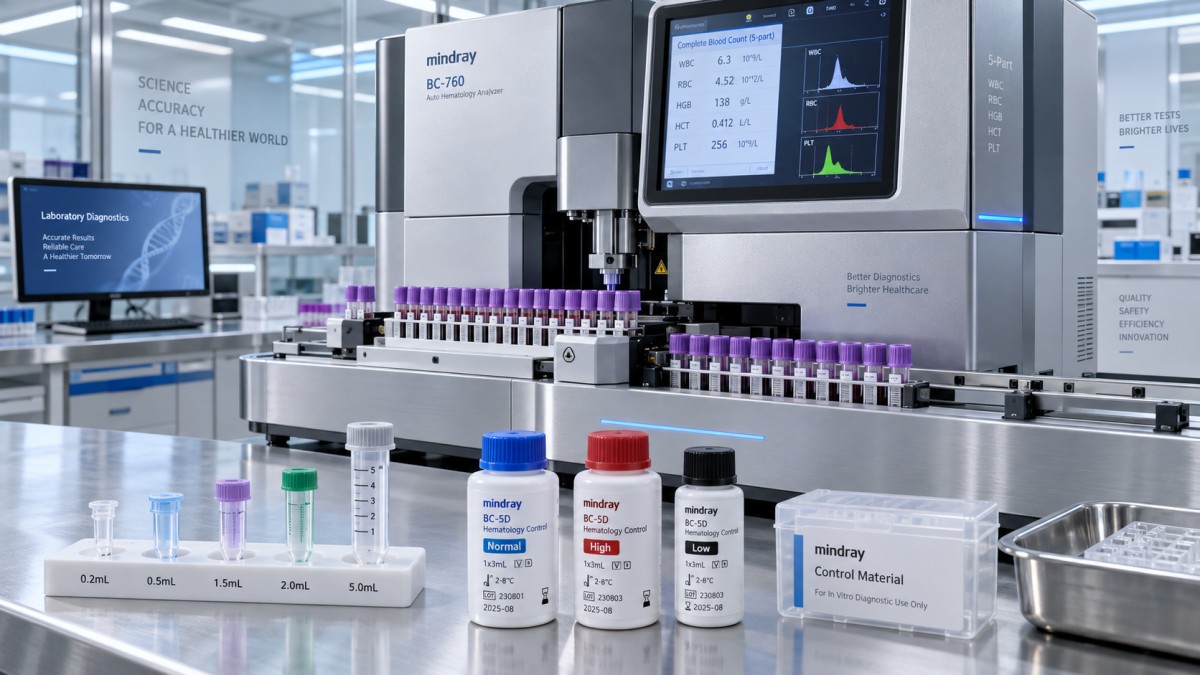
Request a tube-specific compatibility matrix covering dimensions, cap types, adapters, minimum volumes, and permitted modes. Confirm that the stated limits apply to the proposed hardware and software version. Demonstrations should include the collection tubes the laboratory actually uses, not only convenient supplier-selected tubes.
Preanalytical quality remains a separate constraint. Incorrect anticoagulant-to-blood ratio, inadequate mixing, clots, or unsuitable storage cannot be solved by a smaller aspiration volume. Predilution also introduces dilution and handling uncertainties; verify its performance and permitted reporting scope before treating it as a routine low-volume solution.
Evaluate QC as a working process, not a software feature
A QC menu and a Levey–Jennings chart are useful, but they do not establish an effective quality system. The practical questions are whether the laboratory can detect relevant errors, investigate them, control result release, and retain an auditable record of what happened.
Ask suppliers to demonstrate control-lot entry, target and limit management, trend review, rule configuration, and handling of failed controls. QC frequency, levels, and acceptance rules should follow applicable requirements, manufacturer instructions, and the laboratory’s risk-based procedures. A universal schedule copied from another site is not a defensible specification.
Software behavior matters when QC fails. Does the analyzer merely display a warning, prevent further analysis, or communicate a status that the laboratory information system can use to hold results? These are different controls. Verify the complete workflow, including authorized overrides and the records retained for them.
Control materials also create a supply dependency. Confirm storage conditions, shelf life, open-vial stability, lot availability, and delivery arrangements. Ask how lot transitions are supported and how instrument-specific assigned values are provided. Unreliable control supply can disrupt testing even when the analyzer itself is functioning correctly.
Calibration, internal QC, and external quality assessment serve different purposes. Calibration establishes or adjusts the measurement relationship; internal QC monitors ongoing performance; external assessment provides an independent comparison within the scheme’s limitations. One cannot simply replace the others.
Patient-based monitoring may provide additional information where suitable methods are available and validated. Its usefulness depends on the patient population, algorithm, and local implementation. It should not be presented as an automatic replacement for control materials.
Verify analytical performance where mistakes are costly
High throughput and convenient sampling are poor trade-offs if the analyzer performs inadequately in the laboratory’s critical measurement ranges. Review precision, method comparison, carryover, analytical measuring intervals, and relevant low-count performance. Acceptance criteria should be defined before testing, using the intended clinical application and applicable guidance.
Overall correlation is not enough. A comparison dominated by results within common ranges may conceal clinically relevant disagreement at low platelet counts or other decision points. Evaluate agreement and bias across relevant concentrations, rather than accepting a single correlation coefficient as proof of equivalence.
Abnormal-cell flagging requires its own assessment. Flags support review decisions; they do not independently establish a diagnosis. Compare analyzer flags with the laboratory’s established review process using appropriate specimens. Consider both missed review triggers and unnecessary reviews, because excessive false-positive flags can consume the capacity gained through faster analysis.
Ask for documented interference limitations and sample-handling instructions. Issues such as platelet clumping, red-cell agglutination, and hemoglobin interference may require specific investigative procedures. The relevant question is not whether exceptions disappear, but whether staff can recognize and resolve them consistently.
Turn the shortlist into an acceptance plan
A supplier comparison becomes more useful when each claim is paired with required evidence. Separate mandatory requirements from preferences before commercial negotiations.
Include connectivity in acceptance testing. Verify patient identifiers, units, flags, corrected results, and behavior during interface downtime. A functioning connection is not necessarily a validated result-transfer workflow.
Compare ownership cost using realistic workload assumptions. Include reagents consumed during startup and cleaning, QC materials, calibrators, repeat testing, maintenance, service, and expired inventory. A nominal cost per test may exclude these items and misrepresent low-volume operation.
Before selection, obtain the relevant regulatory documentation for the destination market and intended use, alongside installation requirements and a written verification plan. The preferred analyzer should demonstrate sufficient usable capacity, supported sample handling, and a workable QC process under local conditions. If those points remain unresolved, a lower purchase price does not resolve the technical risk.
Technical Specifications
- Air Handling Unit Supplier Checklist: Performance Data, Lead Times, and SupportAuthor :Environmental Engineering Director
- Buying Fiberglass Water Tanks Wholesale: Compare Quotes and Delivery CostsAuthor :Environmental Engineering Director
- Choosing an XLPE Power Cable Supplier: Test Reports, Traceability, and Lead TimesAuthor :Grid Infrastructure Analyst
Expert Insights

Chief Security Architect
Dr. Thorne specializes in the intersection of structural engineering and digital resilience. He has advised three G7 governments on industrial infrastructure security.
Related Analysis
- Oct 19, 2026Air Handling Unit Supplier Checklist: Performance Data, Lead Times, and SupportAuthor :Environmental Engineering Director
- Oct 18, 2026Buying Fiberglass Water Tanks Wholesale: Compare Quotes and Delivery CostsAuthor :Environmental Engineering Director
- Oct 17, 2026Choosing an XLPE Power Cable Supplier: Test Reports, Traceability, and Lead TimesAuthor :Grid Infrastructure Analyst
Core Sector // 01
Security & Safety
- Choosing a 5-Part Hematology Analyzer: Throughput, Sample Volume, and QCAuthor :Precision Metrology Expert

- Wholesale Borosilicate Lab Glassware: How Buyers Verify Quality, Specs, and Supply ReliabilityAuthor :Precision Metrology Expert

- How to Select Lab Instruments for Reliable Chemical Analysis WorkflowsAuthor :Precision Metrology Expert

- Buying Lint-Free Wipes in Bulk: How to Match Material and Packaging to Cleanroom UseAuthor :Precision Metrology Expert

- How to Choose a Class II Biosafety Cabinet Supplier for Compliant Lab ProcurementAuthor :Precision Metrology Expert

- Wholesale Binocular Microscopes: Comparing Specifications, MOQs, and QC RiskAuthor :Precision Metrology Expert

- How to Evaluate a UV-Visible Spectrophotometer Manufacturer for Lab Accuracy?Author :Precision Metrology Expert

- China Temporarily Bans Helium ExportsAuthor :Precision Metrology Expert