Choosing a Multimode Microplate Reader: Detection Modes and Assay Needs
Author
Date Published
Reading Time
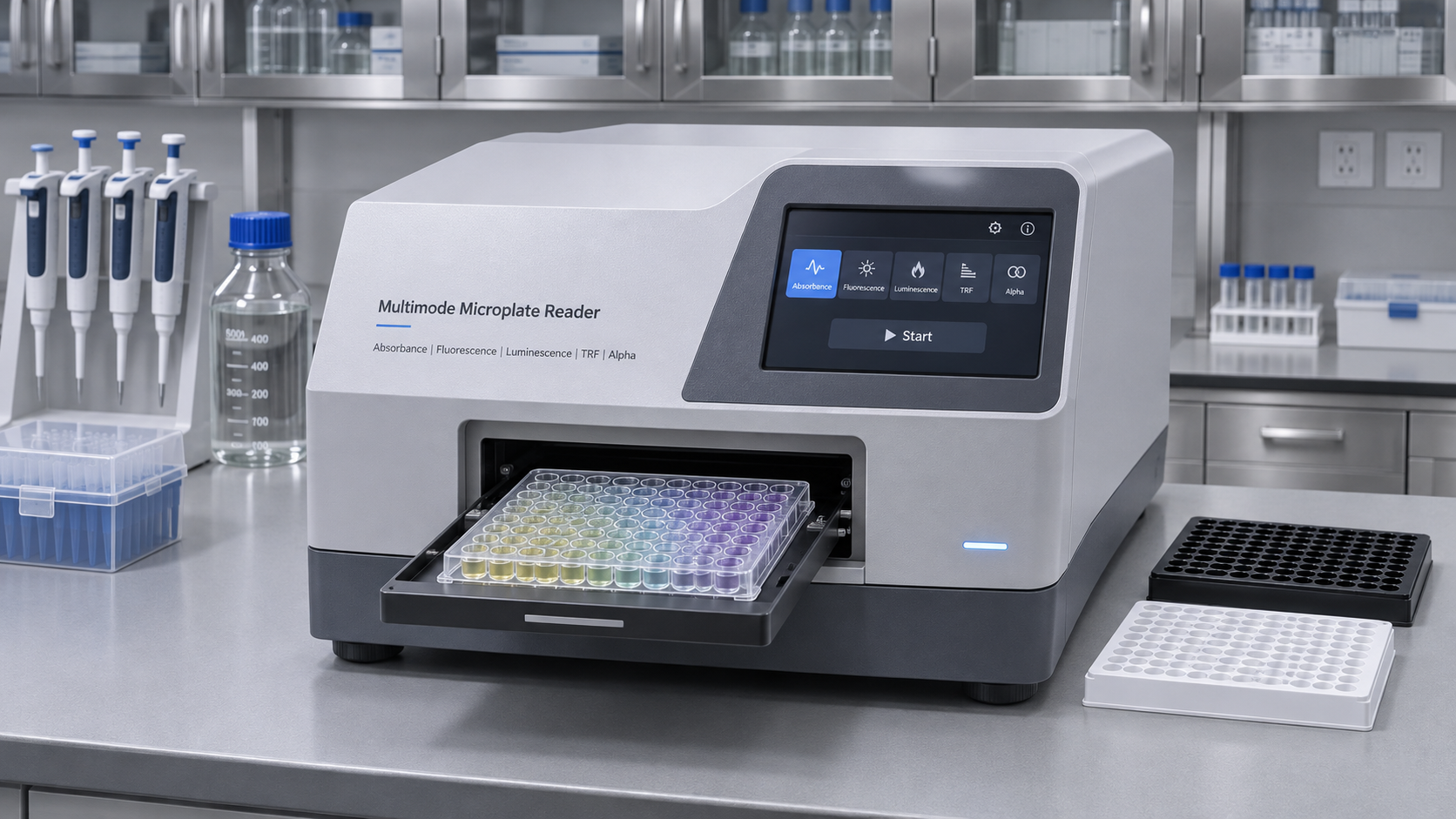
Choosing a multimode microplate reader requires more than comparing a list of instrument specifications. A reader may support absorbance, fluorescence, and luminescence, yet still be a poor fit for the plate formats, sample concentrations, or assay timing your laboratory relies on. The question is not simply which instrument has the most detection modes, but which can produce dependable results under your actual operating conditions.
For technical evaluators, the most useful starting point is an assay-by-assay assessment. Document what you measure today, where the workload is heading, and which performance limitations would make a result difficult to interpret. That groundwork turns a crowded specification sheet into a manageable procurement decision.
Start with the assay, not the instrument
Build a short inventory of representative assays before approaching suppliers. Include the detection chemistry, excitation and emission wavelengths where relevant, expected signal range, plate type, sample volume, and read time. Note whether each method is an endpoint measurement, a kinetic experiment, or a read requiring environmental control.
Then identify which requirements are essential and which are prospective. A laboratory running routine colorimetric assays may not need the same optics as a group measuring weak fluorescence in live cells. Conversely, a reader selected only for today’s highest-volume assay may become restrictive when a new method requires time-resolved detection or rapid reagent injection.
It is also worth distinguishing an assay’s published requirements from its behavior in your hands. Sample matrices, plate materials, reagent lots, and preparation steps can affect background and signal strength. A useful evaluation should account for these conditions rather than relying solely on an idealized demonstration.
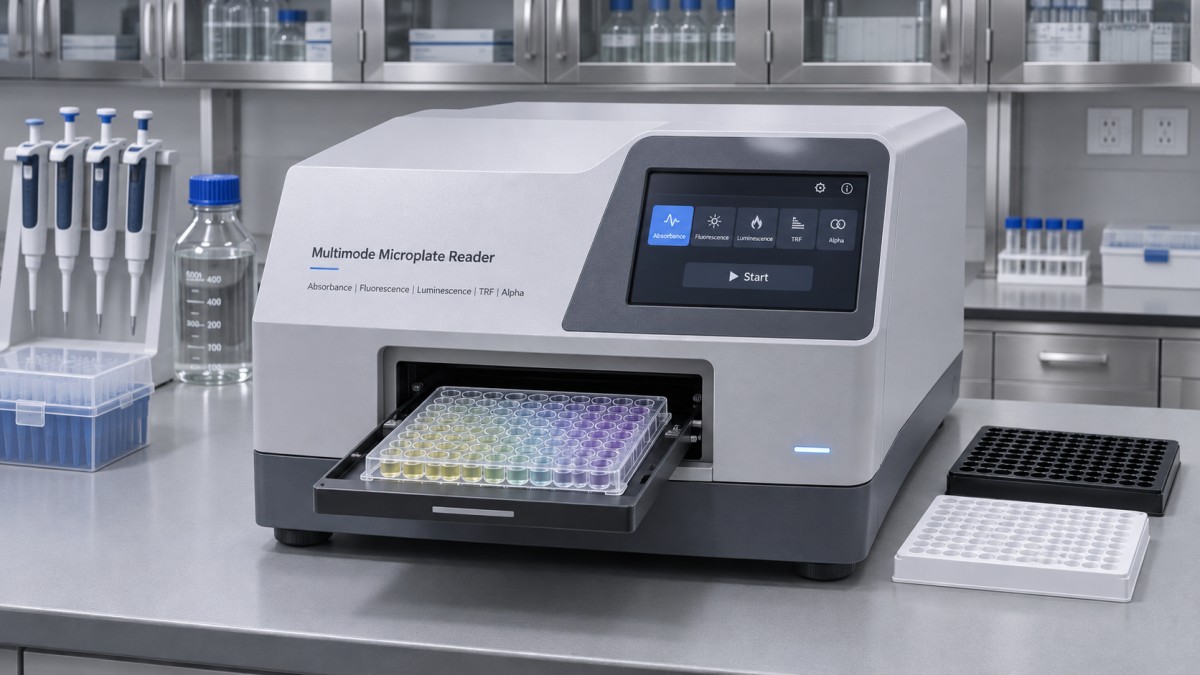
Match detection modes to the measurements you need
Multimode readers combine several optical methods in one platform, but mode availability does not guarantee equivalent performance across instruments. The optical configuration, accessories, and supported read geometry all matter.
Absorbance: check the usable range, not just the wavelength range
Absorbance measurements depend on the relationship between incident and transmitted light. For routine assays, check wavelength coverage and resolution, but also examine performance at the optical densities your samples will produce. High-absorbance samples can be affected by limited transmitted light and stray light; low signals can be vulnerable to background variation.
Microplate wells do not automatically provide the same optical pathlength as a standard cuvette. If concentration calculations depend on pathlength, determine whether the method requires correction and whether the instrument supports it for your plate and sample conditions. Bubbles, meniscus shape, and inconsistent fill volumes can also influence results.
Fluorescence: optical flexibility has trade-offs
Fluorescence detection requires appropriate excitation and emission wavelengths, as well as separation between them. Filter-based systems use selected optical filters; monochromator-based systems allow wavelength selection within their specified range. Some platforms combine approaches. Neither arrangement is universally preferable: flexibility, available bandwidths, signal performance, and the cost of additional optics all deserve consideration.
Read geometry is equally important. Bottom reading may be useful for adherent cells near the base of a well, while top reading is common for many solution-based assays. Confirm that the reader supports the needed geometry with the plates and accessories you intend to use. For multiplex assays, assess spectral overlap and background rather than assuming that the availability of several wavelengths eliminates interference.
Luminescence: timing can be as important as sensitivity
Luminescent assays generate light through a chemical or biological reaction and do not require an excitation source. Their signals may be weak, short-lived, or both. Ask how the instrument handles integration time, background, and cross-talk between adjacent wells, especially when strong and weak samples share a plate.
For rapidly changing signals, the interval between reagent addition and measurement can shape the result. An injector may be valuable, but its presence alone is not enough. Review dispensing precision, dead volume, priming and cleaning requirements, and the delay between injection and reading for your protocol.
Compare performance claims on equivalent terms
Published sensitivity figures are useful for narrowing a shortlist, but they are rarely a complete comparison. Manufacturers may use different dyes, concentrations, plates, volumes, integration times, and statistical definitions. A lower detection limit reported under one set of conditions does not automatically translate into better performance for your assay.
Request the test method behind important claims and compare it with your intended workflow. Pay particular attention to:
- Limit of detection and quantification: How are they calculated, and is performance acceptable in your sample matrix rather than only in buffer?
- Precision: What variation is observed within a plate, between plates, and across relevant operators or days?
- Dynamic range and linearity: Does the response remain useful across expected sample concentrations, including the low and high ends?
- Background and cross-talk: Can the system distinguish weak wells from blanks and nearby high-signal wells?
- Read conditions: Are integration time, flashes, bandwidth, gain, and plate type comparable to those planned for routine use?
Set acceptance criteria before testing. For example, define the lowest signal that must be distinguished from a blank and the precision your method can tolerate. The appropriate thresholds depend on the assay and its purpose; they should not be borrowed uncritically from a vendor’s brochure or a different laboratory’s protocol.
Plate compatibility and throughput: the workflow behind the number
A plate-format list is only the beginning. Confirm compatibility with the well counts, plate heights, skirt styles, and lid configurations used in your laboratory. Clear plates are common for absorbance, while black plates are often used to reduce fluorescence cross-talk and white plates to reflect luminescent signal. Plate selection still needs to be validated with the assay and read geometry.
For cell-based work, check whether bottom-read optics are compatible with the plate base and whether the instrument can maintain the temperature and, where needed, gas conditions required during measurement. Temperature uniformity, equilibration time, and the effect of opening or loading the reader may matter during longer kinetic experiments.
Throughput should be assessed as a complete process, not just a quoted plate-read time. Include plate loading, shaking, settling, incubation, multiple wavelengths, injector operations, data export, and any cleaning between runs. If automation is planned, verify the physical interface, plate transfer requirements, control options, and integration responsibilities with both the reader supplier and the automation provider.
Software and data integrity deserve an early review
A reader can meet optical requirements and still create friction if its software makes routine work slow or difficult to verify. Ask a prospective operator to build a representative protocol, run it, review flagged wells, and export both raw and processed results. Check whether calculations, plate maps, kinetic curves, and user-defined settings are clear enough for another team member to understand.
For regulated or controlled environments, determine which functions are available for user access, audit trails, electronic records, and data retention. Software features alone do not establish regulatory compliance; their suitability depends on configuration, validation, procedures, and the applicable requirements. Confirm instrument qualification support, backup and restoration processes, operating-system compatibility, and whether integration with a laboratory information management system requires additional software or development.
Run a practical comparison before committing
A meaningful demonstration should resemble the work the instrument will actually perform. Select one routine assay and, if possible, one demanding assay near a critical sensitivity, timing, or dynamic-range limit. Use representative plates, volumes, controls, and sample matrices. When comparing instruments, keep preparation and read conditions as consistent as the technologies allow, and document differences that cannot be eliminated.
Review the results alongside the experience of running the test. Did the reader meet predefined criteria? Were weak signals distinguishable from blanks? Did the protocol require manual adjustments that would be difficult to reproduce across operators? An instrument that produces an attractive demonstration result but relies on unusually long read times or fragile setup choices may not be the strongest routine solution.
Include the less visible procurement questions in the same assessment: preventive maintenance, calibration or verification options, consumables, software licenses, spare parts, service response, and training. Ask which detection modes and accessories are included in the quoted configuration and which would require later hardware changes. These details affect both ownership cost and the likelihood that a future assay can be added without disrupting the laboratory.
Choosing with room for the next assay
The best multimode microplate reader is the one that meets documented assay requirements with a workflow your team can sustain. Give essential measurements and demonstrated performance more weight than an extensive feature list. At the same time, investigate credible expansion paths for methods that are likely to arrive during the instrument’s service life.
With an assay inventory, comparable test conditions, and agreed acceptance criteria, the selection process becomes less about interpreting competing claims and more about identifying evidence. That gives technical reviewers and procurement teams a firmer basis for choosing a platform they can trust in day-to-day use.
Expert Insights

Chief Security Architect
Dr. Thorne specializes in the intersection of structural engineering and digital resilience. He has advised three G7 governments on industrial infrastructure security.
Related Analysis
- Nov 22, 2026McKinsey: India Needs Up to $400 Billion to Meet Steel Capacity Growth GoalAuthor :
- Nov 22, 2026Choosing Geotextile Fabric for Landfill Drainage and Liner ProtectionAuthor :Environmental Engineering Director
- Nov 21, 2026Japan's Steel Exports Could Fall to Lowest Level Since 1999 in 2026Author :
Core Sector // 01
Security & Safety
- Choosing a Multimode Microplate Reader: Detection Modes and Assay NeedsAuthor :Precision Metrology Expert

- Choosing a Lint-Free Wipes Factory: How to Evaluate Quality and CapacityAuthor :Precision Metrology Expert

- Buying Lab Incubators Wholesale: MOQs, Lead Times, and Warranty TermsAuthor :Precision Metrology Expert

- Choosing a 5-Part Hematology Analyzer: Throughput, Sample Volume, and QCAuthor :Precision Metrology Expert

- Wholesale Borosilicate Lab Glassware: How Buyers Verify Quality, Specs, and Supply ReliabilityAuthor :Precision Metrology Expert

- How to Select Lab Instruments for Reliable Chemical Analysis WorkflowsAuthor :Precision Metrology Expert

- Buying Lint-Free Wipes in Bulk: How to Match Material and Packaging to Cleanroom UseAuthor :Precision Metrology Expert

- How to Choose a Class II Biosafety Cabinet Supplier for Compliant Lab ProcurementAuthor :Precision Metrology Expert