Saudi Arabia Updates Washing Machine Energy & Water Efficiency Standards
Author
Date Published
Reading Time
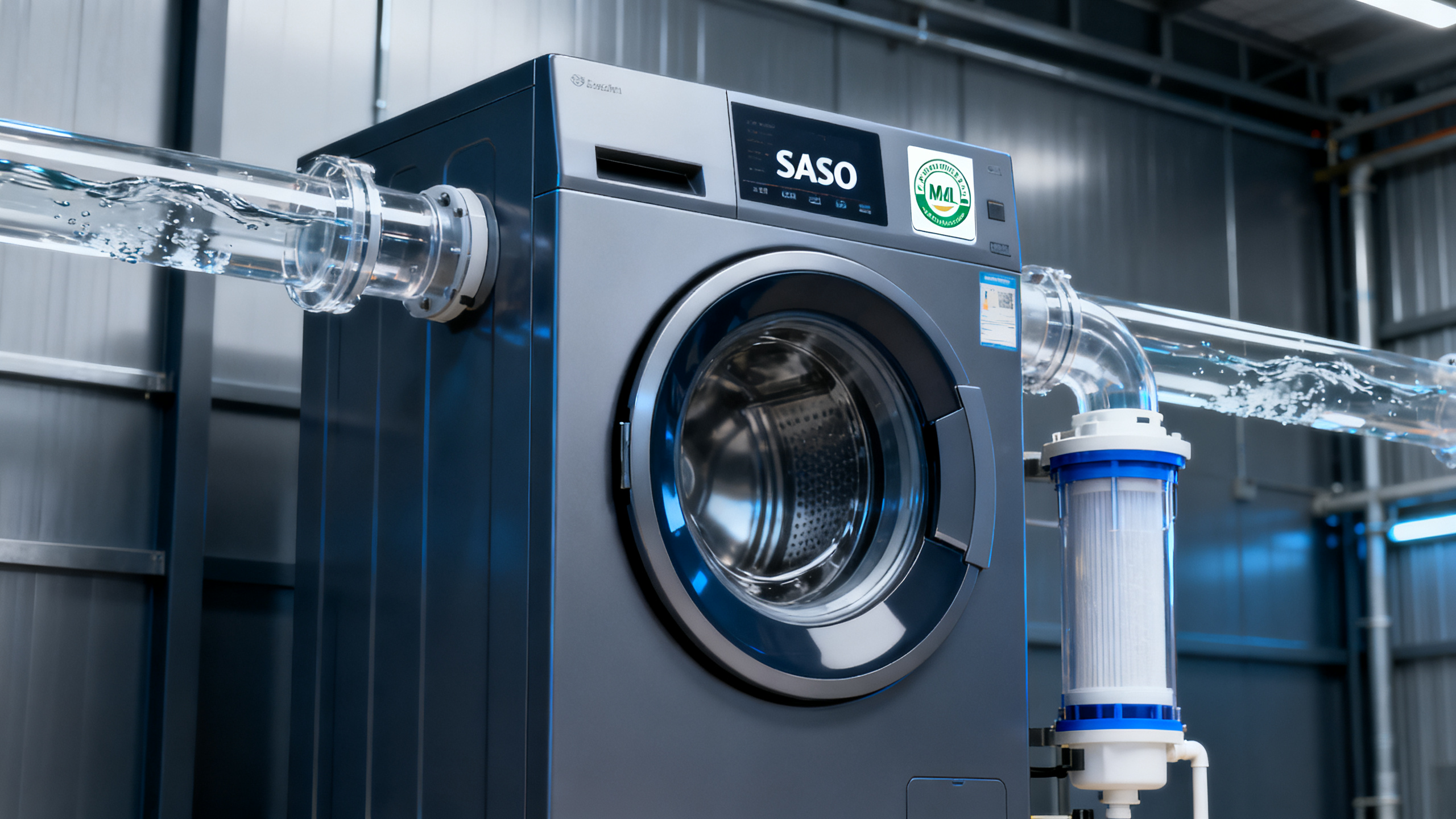
Saudi Arabia’s Standards, Metrology and Quality Organization (SASO) issued SASO 2663:2026 on May 15, 2026, mandating new water efficiency requirements for all imported washing machines—including commercial and industrial units—and introducing additional testing for integrated water treatment modules. Industrial water treatment system exporters, corrosion-resistant valve component manufacturers (e.g., bearings and seals), and related supply chain stakeholders must now assess revised certification pathways and compliance timelines.
Event Overview
On May 15, 2026, SASO published SASO 2663:2026. The standard requires all imported washing machines—regardless of application scope (residential, commercial, or industrial)—to achieve a minimum 5-star water efficiency rating as complete appliances. Additionally, any built-in water treatment module (e.g., water softeners, reverse osmosis membrane assemblies) must undergo separate evaluation for flow decay rate and salt rejection rate. No further implementation dates, transitional provisions, or test protocol details have been publicly released beyond the standard’s publication.
Industries Affected
Industrial Water Treatment Equipment Exporters
These exporters are directly affected because their modules—integrated into washing machines for scale prevention or feedwater conditioning—are now subject to standalone performance verification. Impact manifests in extended pre-market testing cycles, potential redesign of module housings or control logic to meet flow stability thresholds, and increased documentation burden for SASO conformity assessment.
Manufacturers of Corrosion-Resistant Valve Components (Bearings & Seals)
Suppliers of critical fluid-path components—including precision valve cores, dynamic seals, and bearing assemblies used in RO or softening modules—face downstream impact. Since flow decay rate testing reflects long-term hydraulic integrity under repeated cycling, component-level durability and material compatibility with Saudi water chemistry become de facto compliance factors—even if those components are not certified individually.
OEMs and System Integrators of Commercial/Industrial Washing Equipment
Companies assembling full washing systems for laundromats, hotels, or textile facilities must now validate both whole-unit water efficiency and subsystem-level water treatment performance. This introduces dual-layer certification complexity: one for appliance-level labeling (5-star), another for embedded module functionality—potentially requiring coordination across multiple third-party labs and technical files.
What Relevant Enterprises or Practitioners Should Focus On and How to Respond
Monitor official SASO communications for implementation timelines and test method references
SASO 2663:2026 has been published, but no enforcement date, grace period, or referenced test standards (e.g., ISO, IEC, or SASO-specific methods for flow decay or salt rejection) have been confirmed. Stakeholders should track SASO’s official portal and authorized conformity assessment bodies for updates before initiating lab work.
Prioritize validation of high-volume or high-risk module configurations
Exporters should identify which water treatment module types (e.g., compact RO cartridges vs. multi-stage softeners) are most commonly integrated into top-selling washing machine models destined for Saudi importers. Focused testing on these configurations helps allocate resources efficiently ahead of broader rollout.
Distinguish between regulatory signal and operational readiness
The issuance of SASO 2663:2026 signals tightening water resource governance—not yet an active barrier. Until SASO announces mandatory application dates or customs enforcement instructions, current shipments remain unaffected. However, procurement decisions made today (e.g., selecting seal materials or membrane suppliers) may constrain future compliance options.
Initiate cross-functional alignment between R&D, QA, and export compliance teams
Because water efficiency and module performance intersect mechanical design, material selection, and firmware-controlled rinse cycles, early internal alignment ensures test planning accounts for interdependencies—such as how pressure drop across a seal influences measured flow decay over 1,000-cycle endurance tests.
Editorial Perspective / Industry Observation
Observably, SASO 2663:2026 functions less as an immediate trade barrier and more as a forward-looking policy signal aligned with Saudi Vision 2030’s water conservation goals. Analysis shows that the inclusion of module-specific metrics—rather than relying solely on whole-appliance water consumption—reflects a shift toward regulating embedded technology performance within end-use appliances. From an industry perspective, this suggests growing regulatory attention on subsystem-level sustainability claims, especially where water or energy savings depend on auxiliary components rather than core motor or drum design alone. Current relevance lies not in immediate noncompliance risk, but in its indication of evolving expectations for system-level environmental accountability in regulated markets.
Conclusion: SASO 2663:2026 does not yet alter market access conditions, but it redefines the technical scope of compliance for washing machine exports to Saudi Arabia. It is better understood as a calibrated escalation in regulatory granularity—focusing on water treatment subsystems—rather than a broad-based efficiency mandate. Stakeholders are advised to treat it as a lead indicator for similar requirements in other Gulf Cooperation Council (GCC) markets, while prioritizing clarity on implementation timing before committing to new testing or design iterations.
Source: SASO (Saudi Standards, Metrology and Quality Organization), official publication of SASO 2663:2026 on May 15, 2026.
Note: Enforcement date, transitional arrangements, and referenced test methodologies remain unconfirmed and require ongoing monitoring.
Technical Specifications
- How to Select Electronic Hotel Key Card Locks for Guest Rooms and Staff AreasAuthor :Safety Compliance Lead
- How to Select Lab Instruments for Reliable Chemical Analysis WorkflowsAuthor :Precision Metrology Expert
- How to Size a UPS for Server Rooms: Load, Runtime, and Redundancy FactorsAuthor :Grid Infrastructure Analyst
Expert Insights

Chief Security Architect
Dr. Thorne specializes in the intersection of structural engineering and digital resilience. He has advised three G7 governments on industrial infrastructure security.
Related Analysis
- Sep 17, 2026How to Select Electronic Hotel Key Card Locks for Guest Rooms and Staff AreasAuthor :Safety Compliance Lead
- Sep 16, 2026How to Select Lab Instruments for Reliable Chemical Analysis WorkflowsAuthor :Precision Metrology Expert
- Sep 15, 2026How to Size a UPS for Server Rooms: Load, Runtime, and Redundancy FactorsAuthor :Grid Infrastructure Analyst
Core Sector // 01
Security & Safety
- How to Size a Wafer Butterfly Valve for HVAC Chilled-Water and Heating LoopsAuthor :Environmental Engineering Director

- How Pressure Class and Joint Design Affect Long-Term Performance of Ductile Iron Pipes in Drainage InfrastructureAuthor :Environmental Engineering Director

- How Ductile Iron Pipe Joints Affect Installation Reliability and Leak ControlAuthor :Environmental Engineering Director

- How to Size Effluent Treatment Equipment for Variable Industrial Wastewater LoadsAuthor :Environmental Engineering Director

- US Battery Push Raises New Entry Rules for SuppliersAuthor :Environmental Engineering Director

- EU EMC Rule Tightens for Water Treatment ExportsAuthor :Environmental Engineering Director

- EU REACH Restriction Targets PFAS Water Treatment ImportsAuthor :Environmental Engineering Director

- EU Mandates EN 14113:2026 for Water Treatment ExportsAuthor :Environmental Engineering Director