Industrial Water Softeners Explained: Types, Capacity Sizing, and Best Use Cases
Author
Date Published
Reading Time
Why do industrial water softeners matter so much in plant operations?
Industrial water softeners are not just water treatment add-ons. They protect critical assets that fail quietly, then expensively.
When hardness minerals stay in process water, scale forms inside boilers, heat exchangers, cooling loops, and wash systems.
That scale reduces heat transfer, increases energy use, restricts flow, and shortens equipment life.
In practical terms, a poorly matched softening system often leads to more cleaning cycles, more shutdowns, and less predictable output.
This is why industrial water softeners appear across broad sectors, from food processing and textiles to power support systems and commercial facilities.
At a foundational level, these systems remove calcium and magnesium ions, usually through ion exchange resin.
The result is softened water that behaves better inside pipes, valves, membranes, and heating surfaces.
For infrastructure-focused research, this matters because water quality connects directly with safety, reliability, and lifecycle cost.
That broader operational view aligns with how Global Industrial Core evaluates core systems: not by headline cost alone, but by resilience, compliance, and performance under real conditions.
What types of industrial water softeners are actually used?
The term sounds simple, but industrial water softeners come in several configurations, each suited to different duty cycles.
The most common design is the conventional sodium ion exchange softener. It is widely used because it is proven, scalable, and familiar to operators.
A single-tank unit works for intermittent demand. It softens water until the resin is exhausted, then pauses for regeneration.
That pause is acceptable in some washdown or batch operations, but risky in continuous systems.
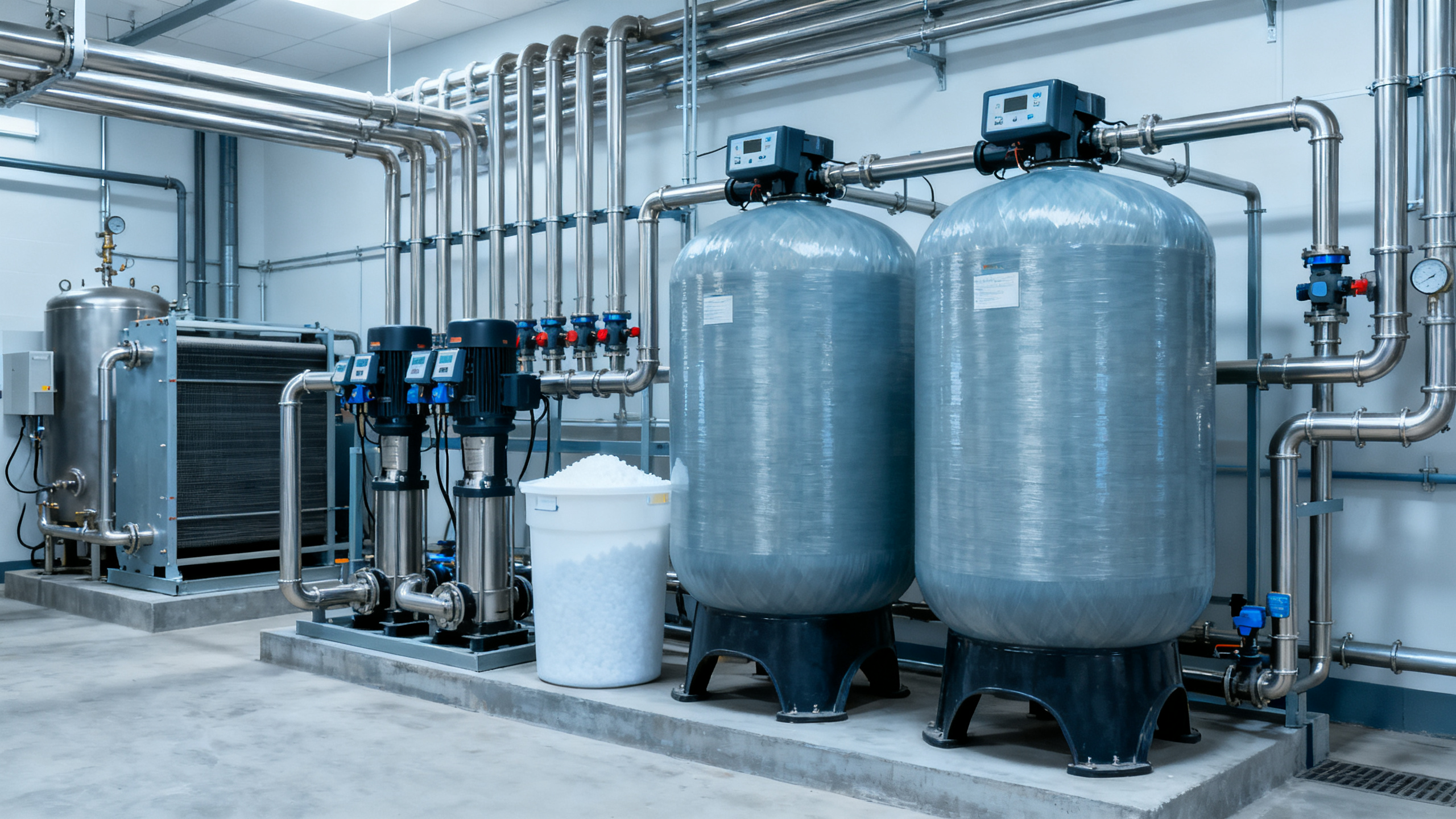
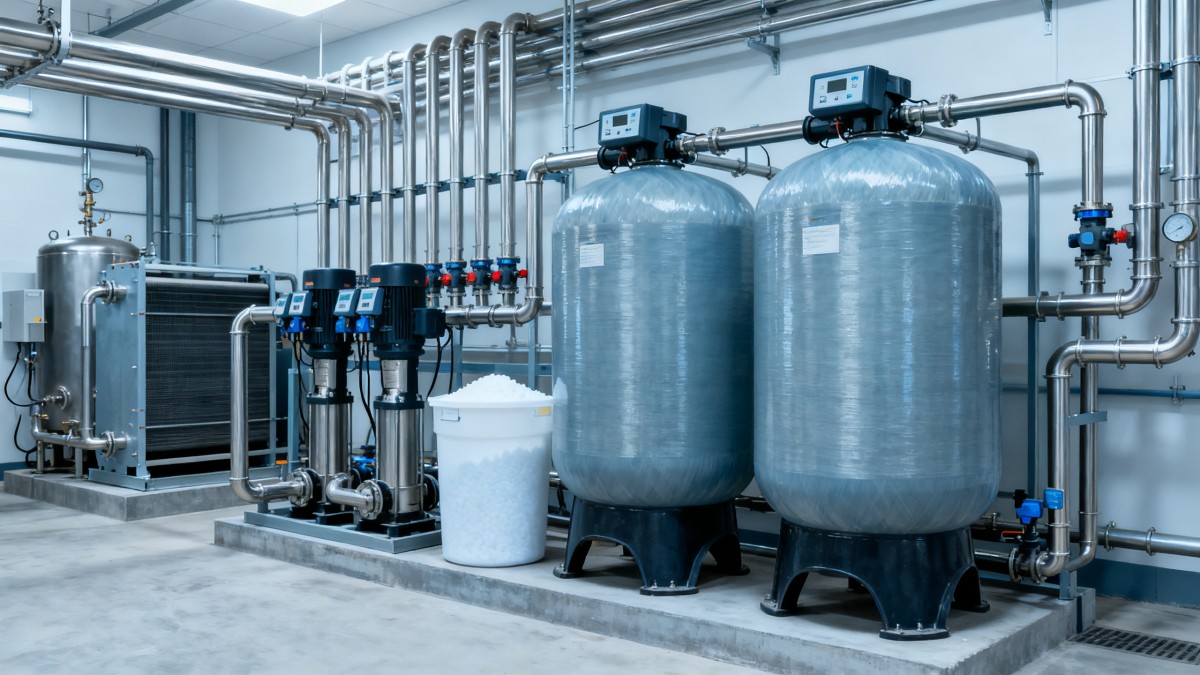
Twin alternating softeners solve that problem. One tank operates while the other regenerates or waits on standby.
That arrangement is often preferred for boiler feed, hospitals, district utilities, and process lines that cannot tolerate hard water breakthrough.
There are also multiplex systems with three or more vessels. These are common where flows swing sharply during the day.
They offer flexibility, staged capacity, and better redundancy during maintenance.
Salt-efficient and demand-initiated controls add another layer. They regenerate based on actual throughput or water quality, not just time.
That can reduce brine use and wastewater, especially where water costs or discharge rules are tight.
A quick comparison helps separate the choices.
In other words, the right choice depends less on labels and more on whether the process can tolerate interruption, hardness leakage, or maintenance windows.
How is softener capacity sized without guessing?
This is where many industrial water softeners are either overspecified or undersized.
Capacity sizing starts with three real numbers: flow rate, inlet hardness, and required service interval.
Flow rate tells you how much softened water the system must deliver. Hardness tells you how quickly resin capacity is consumed.
The service interval determines how often regeneration can reasonably occur without disrupting operations.
A simplified approach is to calculate daily hardness load, then match resin capacity to that demand with a safety margin.
But sizing only by daily average can mislead. Peak flow often matters more than average flow.
If the softener cannot handle peak service flow, pressure drop rises and hardness leakage becomes more likely.
In actual projects, these checks usually matter most:
- Peak and average flow in m³/h or gpm
- Raw water hardness and seasonal variation
- Required residual hardness target
- Available regeneration time
- Salt storage, drain, and wastewater limits
- Future expansion allowance
A common mistake is focusing only on resin volume. Vessel size, valve performance, brine system design, and control logic also affect usable capacity.
Another mistake is ignoring upstream conditions. Iron, manganese, suspended solids, or chlorine can damage resin or reduce efficiency.
So when people ask how to size industrial water softeners, the best answer is this: size for water chemistry and operational rhythm, not nameplate flow alone.
Where do different industrial water softeners perform best?
Not every application needs the same level of softening continuity, automation, or redundancy.
For low-pressure boilers, consistent hardness removal is usually non-negotiable. Scale formation quickly affects heat transfer and fuel use.
That is why twin alternating industrial water softeners are often preferred in boiler houses.
Cooling systems can be more nuanced. Some loops need softened make-up water, while others may use different treatment strategies based on cycles of concentration.
Laundry, hospitality, and institutional hot water systems also benefit because softer water improves detergent efficiency and reduces spotting.
In food and beverage plants, industrial water softeners are often used upstream of heaters, cleaning systems, and some process lines.
However, final water quality targets may still require RO, filtration, or disinfection after softening.
Textile finishing, metal treatment, and surface preparation also benefit when hardness interferes with chemical consistency or finish quality.
The better question is often not “Where can softeners be used?” but “Where does hardness create measurable loss?”
That framing keeps the evaluation tied to energy, maintenance, reject rate, and uptime.
What gets overlooked when comparing options?
Price is visible. Lifecycle fit is less visible, and that is where mistakes accumulate.
One overlooked issue is regeneration efficiency. Two systems with similar rated capacity may consume very different amounts of salt and rinse water.
Another is control reliability. Industrial water softeners often operate in environments with power variation, vibration, heat, or limited operator attention.
Valve quality, controller logic, and spare parts access matter more than brochure claims suggest.
Compliance and material suitability also deserve attention. Depending on the site, buyers may need CE, UL-related electrical conformity, food-contact compatibility, or documented pressure ratings.
This is especially relevant in infrastructure and heavy industry, where weak documentation can delay approval even if the equipment itself seems adequate.
The table below helps turn that comparison into a practical checklist.
This is where a technical review process adds value. Good selection is rarely about one specification sheet.
How should implementation, maintenance, and total cost be judged?
Industrial water softeners are often approved on capital budget, yet most real cost appears later.
Salt consumption, wastewater discharge, resin replacement, valve service, and unplanned bypass events all shape total cost of ownership.
Installation constraints also matter earlier than many expect. Floor space, drain capacity, brine storage, access for resin loading, and control integration should be checked before final selection.
In retrofit projects, pipe routing and downtime windows can influence the design as much as water chemistry does.
Maintenance planning should stay simple and visible. A good program usually includes hardness monitoring, regeneration verification, periodic valve inspection, and resin condition review.
If data logging is available, trend it. Small shifts in hardness leakage or regeneration frequency often reveal problems before the plant notices them elsewhere.
For organizations using GIC-style evaluation standards, the most useful next step is to build a short decision matrix.
- List actual peak flow and hardness data
- Define whether soft water must be continuous
- Check resin fouling risks in raw water
- Compare salt, water, and service needs
- Verify compliance documents and support availability
That approach keeps the choice grounded in operational evidence rather than assumptions.
In the end, industrial water softeners are most effective when they are sized around real load, matched to process continuity, and supported by realistic maintenance planning.
If the next review starts with those points, it becomes much easier to compare options, spot hidden risks, and choose a system that stays reliable over time.
Technical Specifications
- How to Select Electronic Hotel Key Card Locks for Guest Rooms and Staff AreasAuthor :Safety Compliance Lead
- How to Select Lab Instruments for Reliable Chemical Analysis WorkflowsAuthor :Precision Metrology Expert
- How to Size a UPS for Server Rooms: Load, Runtime, and Redundancy FactorsAuthor :Grid Infrastructure Analyst
Expert Insights

Chief Security Architect
Dr. Thorne specializes in the intersection of structural engineering and digital resilience. He has advised three G7 governments on industrial infrastructure security.
Related Analysis
- Sep 17, 2026How to Select Electronic Hotel Key Card Locks for Guest Rooms and Staff AreasAuthor :Safety Compliance Lead
- Sep 16, 2026How to Select Lab Instruments for Reliable Chemical Analysis WorkflowsAuthor :Precision Metrology Expert
- Sep 15, 2026How to Size a UPS for Server Rooms: Load, Runtime, and Redundancy FactorsAuthor :Grid Infrastructure Analyst
Core Sector // 01
Security & Safety
- How to Size a Wafer Butterfly Valve for HVAC Chilled-Water and Heating LoopsAuthor :Environmental Engineering Director

- How Pressure Class and Joint Design Affect Long-Term Performance of Ductile Iron Pipes in Drainage InfrastructureAuthor :Environmental Engineering Director

- How Ductile Iron Pipe Joints Affect Installation Reliability and Leak ControlAuthor :Environmental Engineering Director

- How to Size Effluent Treatment Equipment for Variable Industrial Wastewater LoadsAuthor :Environmental Engineering Director

- US Battery Push Raises New Entry Rules for SuppliersAuthor :Environmental Engineering Director

- EU EMC Rule Tightens for Water Treatment ExportsAuthor :Environmental Engineering Director

- EU REACH Restriction Targets PFAS Water Treatment ImportsAuthor :Environmental Engineering Director

- EU Mandates EN 14113:2026 for Water Treatment ExportsAuthor :Environmental Engineering Director