Can SPDs Handle Repeated Voltage Spikes in Tropical Grids?
Author
Date Published
Reading Time
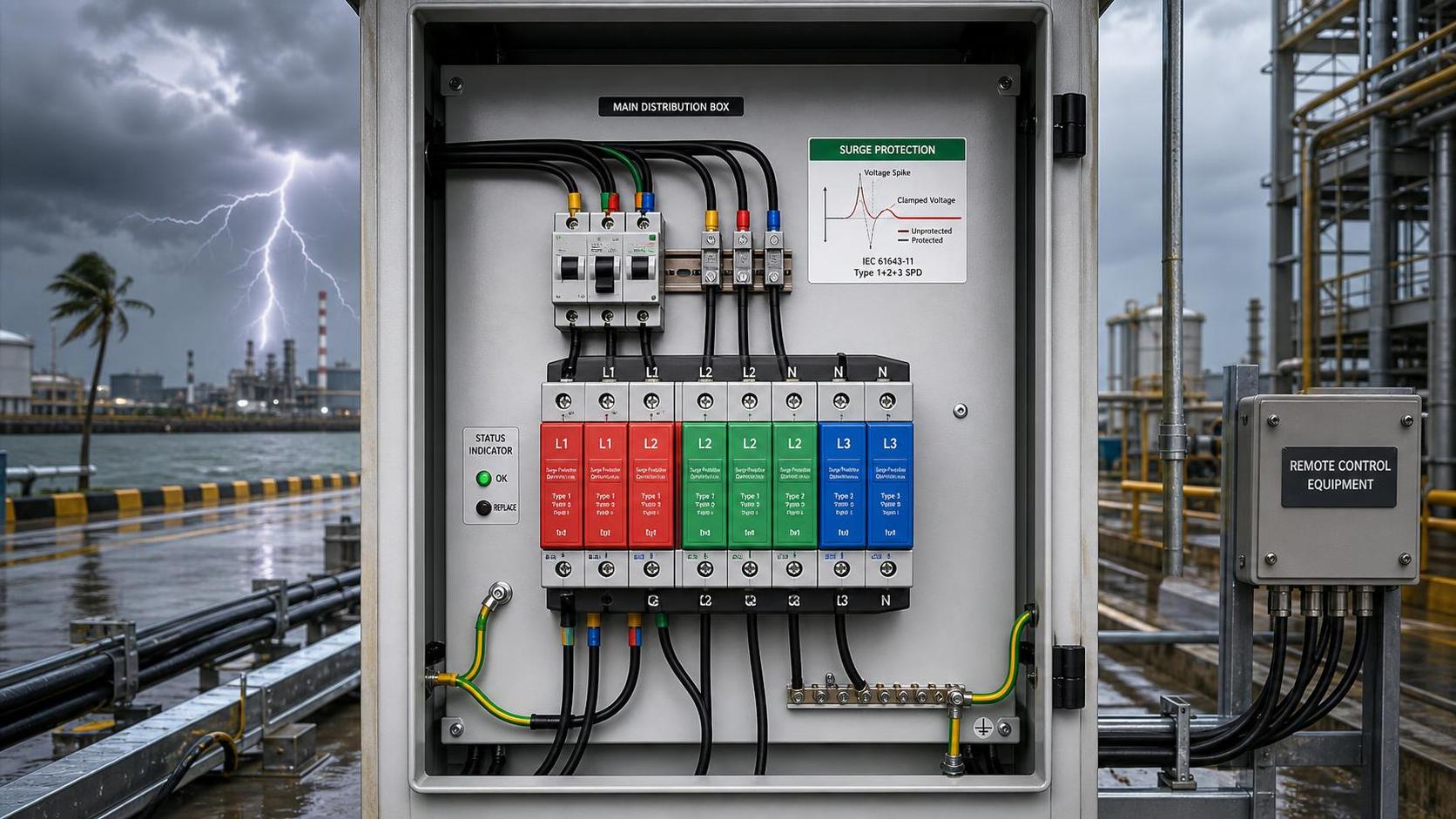
Can surge protection devices handle repeated voltage spikes in tropical power grids? Yes—but only when the SPD system is correctly specified, coordinated, installed, and maintained for the actual electrical environment. A device that performs well in a relatively stable inland network may age much faster at a coastal plant, a tropical data room, a water-treatment facility, or an industrial site supplied by long overhead feeders.
For EPC contractors, facility managers, and procurement teams, the important question is not simply whether an SPD has a high surge rating on its label. Tropical power systems often combine frequent lightning exposure, switching transients, high humidity, poor or variable grounding conditions, salt-laden air, and utility disturbances. Together, these factors can create repeated electrical stress that gradually consumes an SPD’s protective capacity—even when no single event appears catastrophic.
A resilient approach therefore treats surge protection as a managed system rather than a one-time component purchase.
Repeated spikes do not affect every SPD in the same way
Most surge protection devices are designed to divert transient overvoltage away from sensitive equipment. In common low-voltage installations, metal oxide varistors (MOVs) are widely used because they react quickly and can handle substantial surge current. Other technologies, including spark gaps, gas discharge elements, and hybrid arrangements, may be used depending on the location in the electrical distribution system and the required coordination.
The challenge is that surge protection is not endlessly renewable. Each surge event can place a small amount of cumulative stress on the protective element. A strong lightning-induced transient may cause obvious damage or activate an end-of-life indicator. More often, however, the device experiences hundreds or thousands of smaller events: capacitor-bank switching, motor starts and stops, generator transfer operations, utility recloser activity, nearby lightning, or disturbances entering through outdoor cable runs.
Over time, MOV-based SPDs can degrade. Their operating characteristics may shift, leakage current may increase, and thermal stress may build. A quality SPD should include thermal disconnection and visual or remote status indication so that a failed or exhausted protection module does not remain unnoticed in service. Yet those features do not eliminate the need for inspection; they make inspection meaningful.
In short, an SPD can handle repeated voltage spikes within its tested duty capability. It cannot be assumed to withstand unlimited exposure, especially where the electrical installation repeatedly presents severe surge energy.
Why tropical grids create a tougher operating profile
“Tropical” is not one electrical condition. A modern industrial park with underground utility supply and a well-engineered earth grid faces different risks from a remote processing plant supplied by overhead lines. Still, several conditions appear frequently enough to shape SPD selection.
- High lightning density: Convective storms can generate frequent nearby strikes. Even when lightning does not strike the building directly, electromagnetic coupling and induced voltages on incoming conductors can create damaging transients.
- Long outdoor feeders: Cables running between buildings, pumps, substations, gates, tanks, process skids, and communications cabinets act as pathways for surge energy.
- Unstable utility conditions: Rural or rapidly expanding distribution networks may experience switching events, voltage fluctuations, transformer disturbances, and restoration transients after outages.
- Humidity and condensation: Moisture can compromise enclosure integrity, terminal insulation, and panel conditions. It may also accelerate corrosion around grounding connections and terminals.
- Coastal corrosion: Salt mist and polluted air can degrade metallic connections, especially in outdoor enclosures or poorly sealed electrical rooms.
- Generator and renewable integration: Transfer switching, inverter operation, and distributed generation can introduce transient sources that are separate from lightning exposure.
This is why the keyword question—Can surge protection devices handle repeated voltage spikes in tropical power grids?—should be answered at installation level, not at catalog level. The grid, the earthing system, cable routing, load type, and maintenance practices all influence whether an SPD remains effective.
The first decision: classify the exposure, not just the voltage
Nominal system voltage is essential, but it is only the starting point. A 400/230 V facility, for example, may need very different protection arrangements depending on whether its main switchboard is fed by an exposed overhead service, a utility transformer located nearby, or a protected underground network.
For a site-level assessment, engineers commonly examine the incoming supply arrangement, lightning protection system, building dimensions, local lightning activity, connected external lines, sensitive electronic loads, and consequences of downtime. The assessment should also identify what must remain available during a disturbance: safety systems, PLCs, instrumentation, fire protection controls, telecom equipment, access systems, variable-speed drives, laboratory equipment, or process control networks.
Standards such as IEC 62305 for lightning protection and IEC 61643 series requirements for low-voltage SPDs provide an important technical framework. In North American-oriented specifications, relevant UL requirements and local electrical codes may also apply. Compliance markings matter, but they should not be treated as proof that every model is suitable for every site. The selected device must match the system earthing arrangement, voltage configuration, short-circuit environment, and intended location within the distribution architecture.
A coordinated SPD arrangement is usually more durable than one oversized device
One common procurement mistake is to seek a single, very high-capacity SPD and install it at the main panel, expecting it to protect every downstream asset. A strong service-entrance device is valuable, particularly where external lightning current may enter the building. But distance, conductor impedance, and fast transient rise times mean that protection at the main board alone may not keep voltage at a remote control panel or instrument within a safe level.
Industrial sites normally benefit from a coordinated approach:
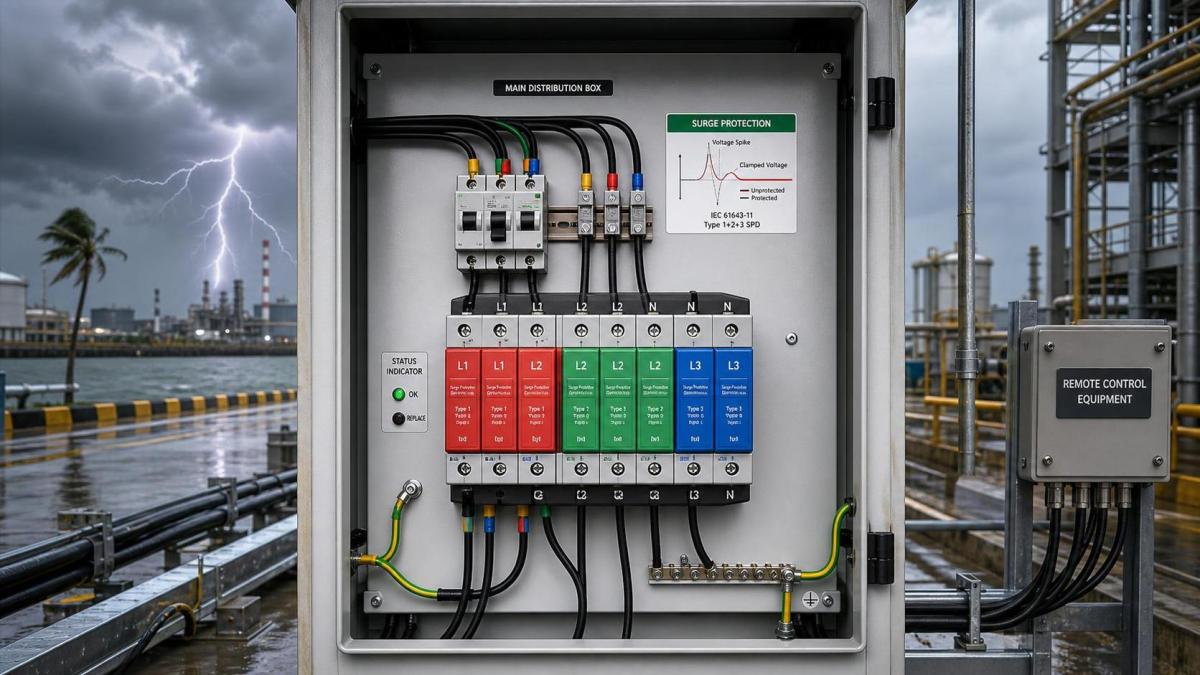
- Type 1 or lightning-current-capable protection at the service entrance where the installation requires it, particularly in buildings with an external lightning protection system or elevated direct-strike exposure.
- Type 2 protection at main and sub-distribution boards to manage switching and residual surges within the electrical system.
- Type 3 or point-of-use protection near sensitive equipment where necessary, such as control racks, servers, analyzers, communications equipment, and critical electronic loads.
- Protection for non-power lines including Ethernet, RS-485, telecom, coaxial, sensor, and control circuits that cross between buildings or connect to outdoor equipment.
The layers must be coordinated according to the manufacturer’s instructions and the electrical design. Improper coordination can cause one device to take excessive energy, shorten its life, or leave a downstream device ineffective. This is particularly relevant in tropical facilities with extensive outdoor process equipment, where signal cables may be as vulnerable as power conductors.
Key technical ratings that deserve a closer look
Procurement specifications often become overly focused on one number, such as maximum discharge current. That rating is relevant, but it does not tell the entire story. A practical review should include the following.
Nominal discharge current and impulse capability
These ratings indicate the test currents an SPD can withstand under defined waveforms. For higher-exposure locations, the selected duty rating should reflect a documented risk assessment rather than a lowest-cost tender comparison. Where direct or partial lightning-current exposure is plausible, an SPD tested for the relevant impulse-current duty is important.
Voltage protection level
A lower protection level can help reduce the residual voltage reaching connected equipment, but it must be evaluated with system voltage, installation conditions, and coordination requirements. The actual voltage at equipment terminals can be higher than the device’s published value if connection leads are long or poorly routed.
Maximum continuous operating voltage
The SPD must tolerate the normal voltage expected on the system, including reasonable operating variations. Selecting an operating voltage that is too close to nominal conditions can lead to premature stress, especially on networks with persistent overvoltage or unusual neutral conditions.
Short-circuit current rating and backup protection
An SPD is part of a power system that may deliver significant fault current. Its short-circuit rating, recommended fuse or breaker arrangement, and coordination with upstream protection must be checked. An incorrectly protected SPD can fail unsafely or create unnecessary outages.
Environmental enclosure and connection quality
For tropical applications, the enclosure rating is not a cosmetic detail. Panel-mounted devices require clean, dry internal conditions; externally mounted equipment may need an enclosure appropriate to rain, dust, UV exposure, corrosion, and condensation risk. Verify terminal materials, enclosure sealing, cable gland quality, and available operating-temperature range.
Installation errors can defeat an otherwise capable SPD
Surge currents are fast. The geometry of the installation matters. Long, looping conductors between the SPD and the busbar or earth terminal add inductive voltage during a transient. This can substantially raise the voltage that downstream equipment experiences.
Keep SPD connections as short, straight, and direct as practical. Avoid unnecessary loops, sharply separated line and earth paths, and improvised grounding extensions. The protective earth conductor must connect into an effective equipotential bonding system; an SPD cannot compensate for an earth network with loose joints, corroded electrodes, isolated metallic structures, or inconsistent bonding between buildings.
Grounding is often misunderstood as a simple resistance number. Low earth resistance is useful, but surge performance also depends on bonding continuity, conductor routing, parallel paths, and the ability to equalize potential across interconnected equipment. In a tropical plant, buried connections may corrode faster than expected. Periodic inspection of accessible earth bars, joints, test links, and outdoor terminations is therefore as important as commissioning measurements.
Maintenance is what makes repeated-spike protection credible
An SPD may look intact while its internal protective elements have aged. Facilities with frequent lightning or recurring utility events should include surge protection in their preventive maintenance program rather than waiting for equipment failure.
A practical routine may include checking visual status indicators, reviewing remote alarm contacts through the building management or SCADA system, inspecting for heat discoloration or moisture ingress, verifying panel cleanliness, and confirming that terminals remain correctly tightened according to approved maintenance procedures. After a known lightning incident, major switching event, generator fault, or utility restoration disturbance, targeted inspection is sensible even if no immediate equipment failure has been reported.
Remote monitoring becomes especially valuable at unmanned pumping stations, telecom shelters, solar sites, and distributed industrial assets. An alarm does not diagnose the entire electrical system, but it can prevent a degraded SPD from becoming an invisible single point of failure.
Frequently asked questions
How long will an SPD last in a tropical facility?
There is no dependable universal service life. It depends on surge frequency and energy, operating voltage, device technology, temperature, installation quality, and environmental conditions. A device in a sheltered, stable electrical room may remain serviceable for years, while one exposed to repeated severe transients may require replacement much sooner. Status indication and maintenance records are more useful than a calendar-only replacement rule.
Can an SPD protect against every lightning event?
No. SPDs reduce transient overvoltage by diverting surge energy and limiting residual voltage, but no component can guarantee protection against every extreme event or compensate for inadequate lightning protection, bonding, wiring practices, or equipment design. The goal is risk reduction through a coordinated protection system.
Do generator-backed sites still need surge protection?
Yes. Generators can reduce dependence on an unstable utility supply, but transfer switching, load changes, cable runs, and lightning exposure remain relevant. The generator, automatic transfer switch, main distribution board, and critical downstream panels should be assessed as part of one protection scheme.
Is protecting the power line enough for PLCs and field instruments?
Often not. A PLC cabinet may be protected on its AC supply yet still be exposed through Ethernet, serial communications, analog loops, or field cables extending outdoors. Power, data, and signal interfaces should be reviewed together.
What a defensible procurement specification should ask for
When selecting SPDs for a tropical grid environment, request more than a generic surge rating. The specification should identify the supply system and earthing arrangement, intended installation point, applicable standards, required SPD type, continuous operating voltage, discharge-current duties, voltage protection level, short-circuit rating, upstream protection requirements, status indication, remote signaling needs, enclosure conditions, and replacement-module strategy.
It should also require installation documentation: single-line diagrams, conductor routing guidance, coordination information, and maintenance instructions. For critical facilities, it is worth asking how the proposed arrangement protects external data and control circuits, not merely the incoming AC service.
The reliable answer to whether SPDs can withstand repeated tropical voltage spikes is conditional but encouraging: they can provide durable protection when their duty is matched to real exposure and when the rest of the installation supports them. Treat the SPD as one element in a wider resilience plan—alongside lightning protection, earthing and bonding, cable management, monitoring, and disciplined maintenance—and it becomes far more than a small device mounted inside a panel.
Technical Specifications
- How to Select Electronic Hotel Key Card Locks for Guest Rooms and Staff AreasAuthor :Safety Compliance Lead
- How to Select Lab Instruments for Reliable Chemical Analysis WorkflowsAuthor :Precision Metrology Expert
- How to Size a UPS for Server Rooms: Load, Runtime, and Redundancy FactorsAuthor :Grid Infrastructure Analyst
Expert Insights

Chief Security Architect
Dr. Thorne specializes in the intersection of structural engineering and digital resilience. He has advised three G7 governments on industrial infrastructure security.
Related Analysis
- Sep 17, 2026How to Select Electronic Hotel Key Card Locks for Guest Rooms and Staff AreasAuthor :Safety Compliance Lead
- Sep 16, 2026How to Select Lab Instruments for Reliable Chemical Analysis WorkflowsAuthor :Precision Metrology Expert
- Sep 15, 2026How to Size a UPS for Server Rooms: Load, Runtime, and Redundancy FactorsAuthor :Grid Infrastructure Analyst
Core Sector // 01
Security & Safety
- Can SPDs Handle Repeated Voltage Spikes in Tropical Grids?Author :Grid Infrastructure Analyst

- How to Evaluate IEC-Compliant Power Protection Devices for Industrial PanelsAuthor :Grid Infrastructure Analyst

- How to Choose Smart Industrial Control Equipment for Harsh Plant EnvironmentsAuthor :Grid Infrastructure Analyst

- EU EMC Update Triggers Re-Certification for BreakersAuthor :Grid Infrastructure Analyst

- How to Select the Right SPD for Solar Inverter Protection in PV Systems?Author :Grid Infrastructure Analyst

- Industrial Valve Systems Factory Checklist: What Buyers Should Verify Before OrderingAuthor :Grid Infrastructure Analyst

- Breaker and Relay Lead Times Hit 24 WeeksAuthor :Grid Infrastructure Analyst

- IEC 61850-10-3 Sets Cybersecurity Bar for Grid DevicesAuthor :Grid Infrastructure Analyst