Choosing a Surge Protection Device Factory: Testing and Traceability Checks
Author
Date Published
Reading Time
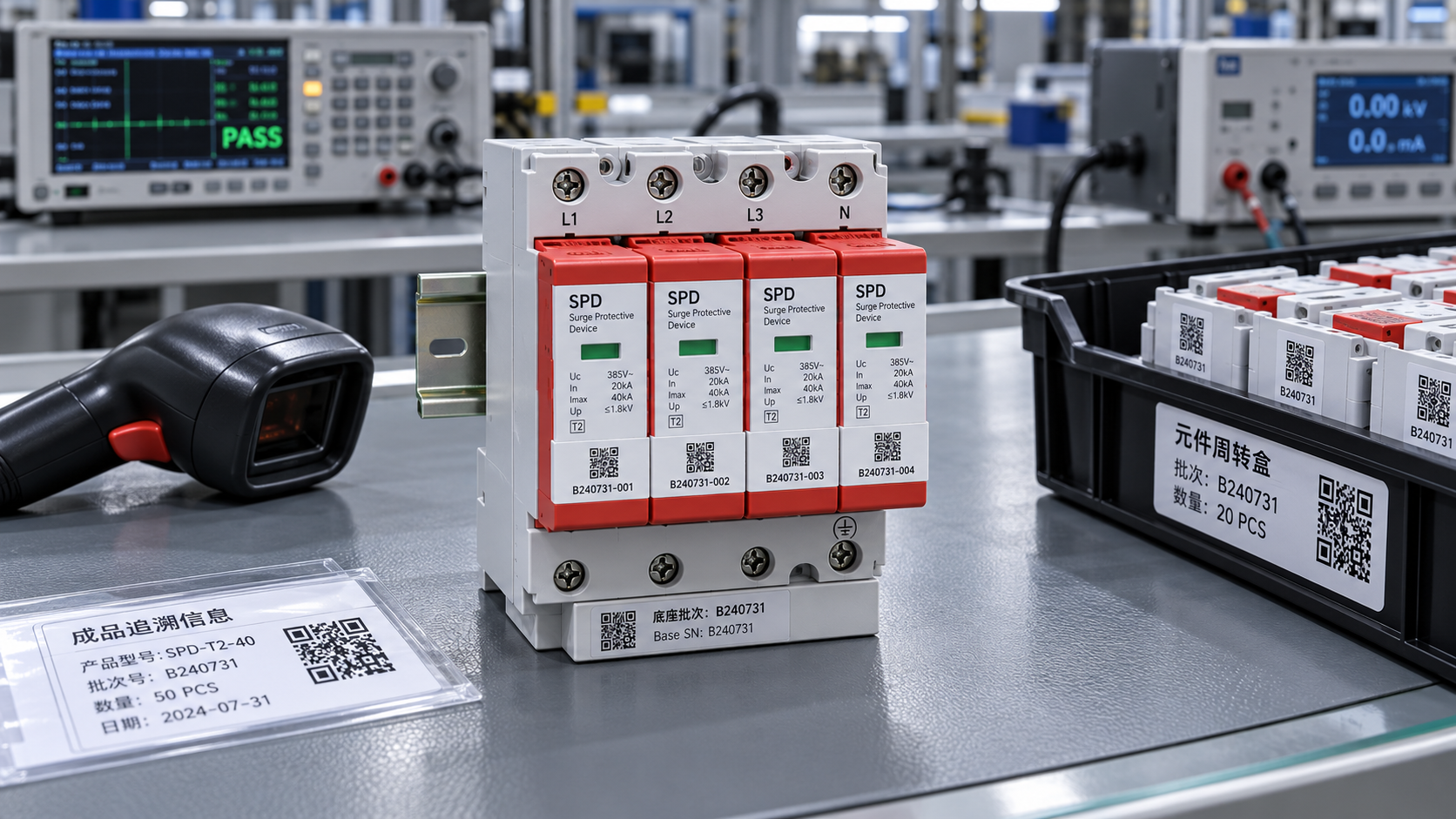
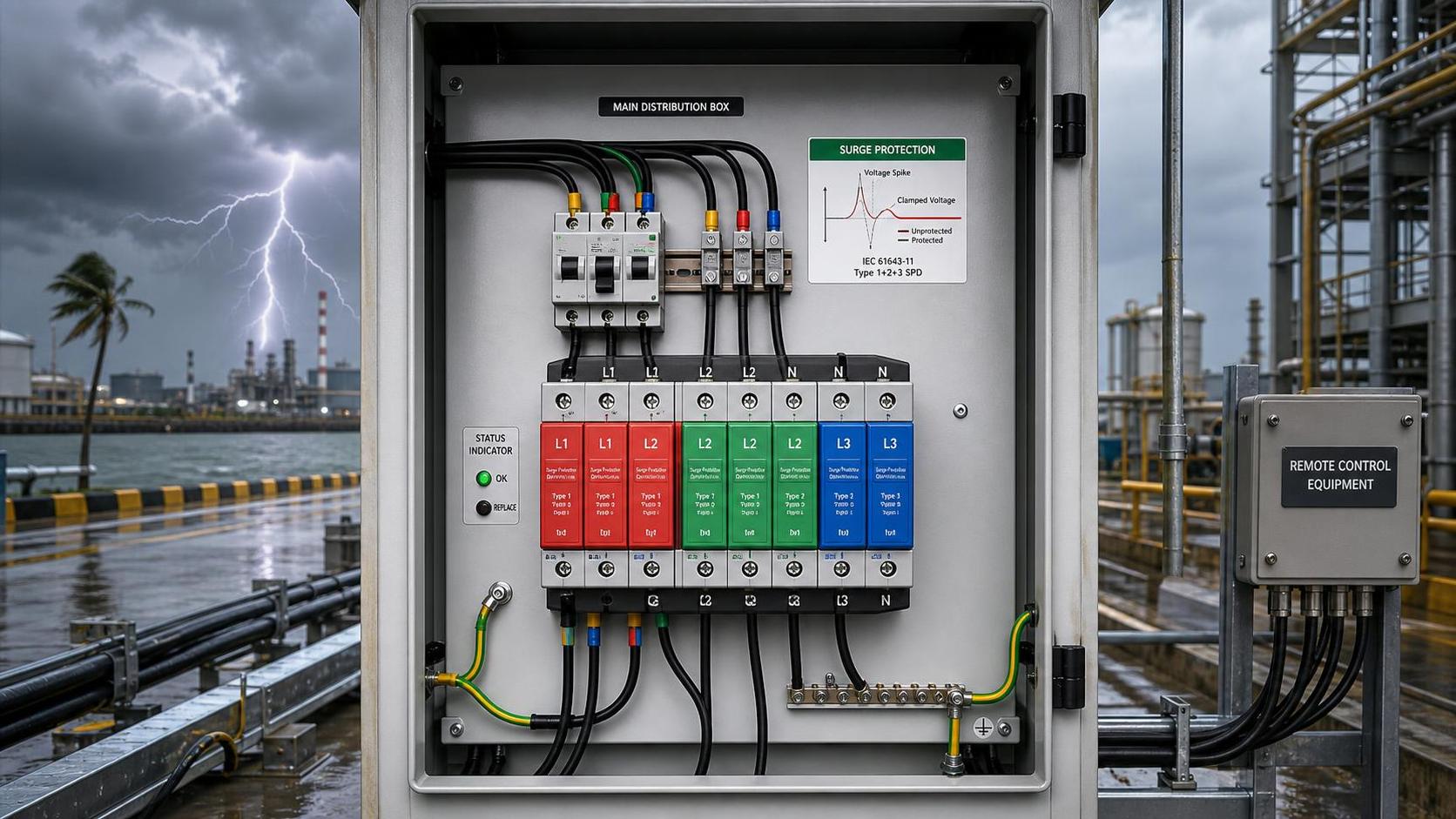
A surge protective device can look correct at receiving inspection yet differ from the design that passed laboratory testing. A substituted varistor, altered thermal disconnector, or unrecorded terminal change may not be visible on the datasheet. When comparing a surge protection devices factory with another supplier, the strongest selection criterion is whether it can connect relevant test evidence to the exact product, production location, and batch being purchased.
Start with three requirements: independently verifiable compliance evidence, documented production checks, and traceability from finished units back to critical components. Treat price comparison as a second step. Without those controls, a lower quotation can leave the buyer carrying additional inspection costs, approval delays, and uncertainty over which installed devices require action after a defect.
Define the purchased configuration before reviewing certificates
Test documentation is useful only when it applies to the intended application. Before requesting quotations, agree on a technical schedule with the responsible electrical engineer. An SPD for an AC distribution board is not interchangeable with one intended for a photovoltaic DC circuit, even when their housings look identical.
The schedule should identify the supply system, nominal voltage, earthing arrangement, installation location, required protection modes, and applicable product standard. It should also specify continuous operating voltage, relevant discharge-current ratings, protection level or voltage protection rating, and environmental conditions. Record any required remote indication and replaceable-module arrangement.
Include the installation conditions that affect approval and performance: prospective short-circuit current, required backup overcurrent protection, conductor sizes, and terminal torque. The supplier should identify restrictions rather than simply confirm that its catalog model is “suitable.”
Do not treat IEC and UL ratings as interchangeable. IEC Type 1, Type 2, and Type 3 classifications and UL SPD Types describe different classification frameworks. Likewise, IEC voltage protection level and UL voltage protection rating should not be compared as identical measurements. Ask for an engineer-reviewed compliance matrix where specifications cross between systems.
Read the evidence behind the certificate
A certificate image is an entry point, not proof that every offered configuration is covered. Request the underlying report, or sufficient controlled documentation to establish the tested construction, ratings, limitations, and relationship to the quoted model. Confidential construction details can be reviewed under an appropriate nondisclosure arrangement.
For IEC-based procurement, confirm the applicable part of the IEC 61643 series for the product and application. For a UL requirement, verify the relevant UL 1449 certification status and category through the issuing organization’s official records. A component recognition is not automatically equivalent to a listing for the complete assembly and intended installation.
Also separate quality-system evidence from product evidence. ISO 9001 certification does not establish an SPD’s electrical performance. CE marking is not a substitute for reviewing the applicable EU declaration of conformity and supporting documentation. A supplier that combines these into one generic “certification package” still needs to answer each requirement separately.
Separate design qualification from production release
Type testing evaluates representative specimens of a defined design against applicable requirements. Depending on the standard and classification, this can include impulse performance, operating duty, thermal behavior, temporary overvoltage, and fault-related safety assessments. Some tests stress or destroy specimens; they are not normally repeated on every shipped unit.
Routine production checks serve a different purpose: detecting manufacturing errors and confirming conformity within the approved process. Ask the factory to provide its inspection plan, showing each check’s method, acceptance limits, frequency, responsible person, and retained record. Distinguish checks on every unit from sampled tests and periodic verification.
Relevant production controls may include visual and marking inspection, electrical characterization of suppression elements, assembly verification, indicator operation, remote-contact function, and dielectric or insulation checks where appropriate to the design and procedure. Test voltages and methods must account for the SPD’s internal circuit; an unsuitable insulation test can activate or damage suppression components.
A statement such as “100% tested” is therefore incomplete. Ask what is measured, what constitutes failure, and how the result links to the released batch. Conversely, requiring full-rated surge testing on every finished device without an engineering basis can add cost and stress products without providing the intended assurance.
Run a traceability exercise during the factory assessment
Instead of asking whether the factory “has traceability,” select a finished-unit identifier and ask staff to retrieve its production history. Then reverse the exercise: select a critical incoming component lot and ask which finished batches contain it. This tests whether the records support containment, not merely whether labels exist.
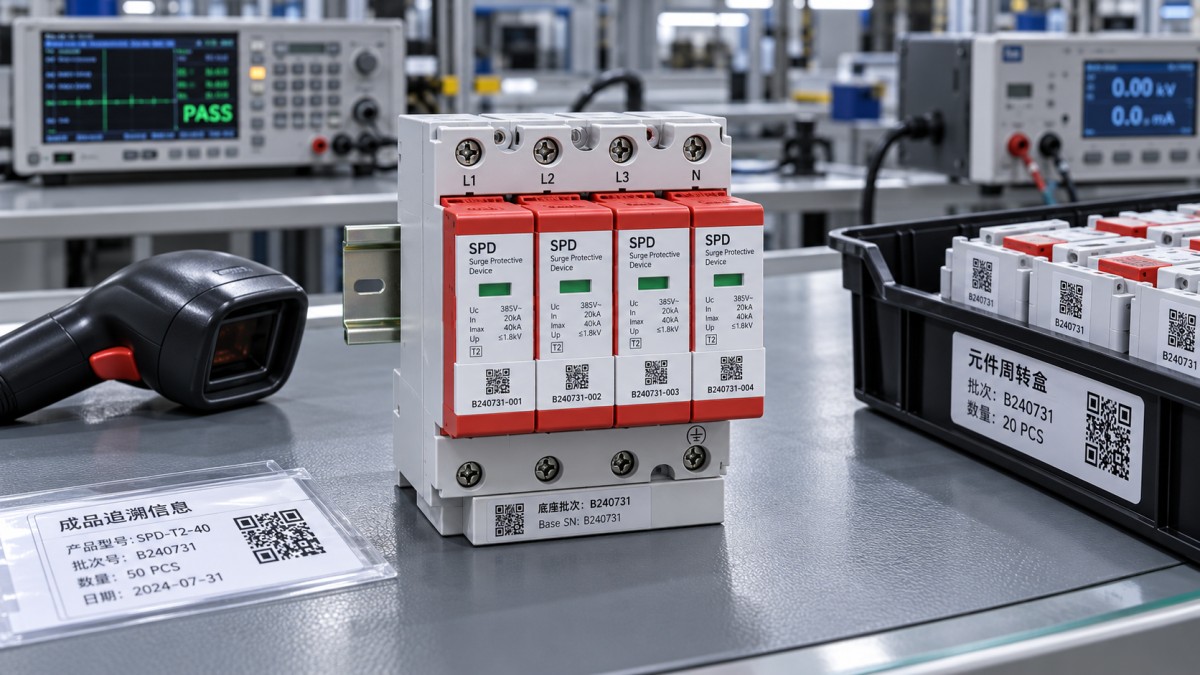
The trace should connect finished goods to the following information, at a level appropriate to the design and risk:
- Released construction: bill-of-materials revision, assembly drawing, and applicable work instructions.
- Critical components: varistor or spark-gap source and lot, thermal disconnection parts, and other safety-relevant materials identified by the design assessment.
- Production history: work order, production date, line or workstation, and relevant process records.
- Inspection evidence: measured results or controlled acceptance records, equipment identification, and release authorization.
- Disposition history: rework, deviations, rejected material, and the final shipment reference.
A unique serial number is useful, but not always necessary. Batch-level identification can be adequate when the batch is clearly bounded and component lots are controlled. The weakness is an identifier that covers mixed production without showing which component substitutions or process changes occurred inside it.
Pay particular attention to replaceable modules and bases. Their compatibility and ratings must remain clear after installation, replacement, and repackaging. A carton label alone may be insufficient once individual devices are distributed across multiple panels.
Look closely at substitutions and rework
The most revealing purchasing question is often: “What happens when an approved component becomes unavailable?” A controlled factory should distinguish an approved alternate from a new substitution and explain who evaluates the difference before production resumes.
For an SPD, matching one headline rating is not enough to establish equivalence. Changes in varistor characteristics, thermal-link behavior, enclosure material, internal spacing, or terminal construction can affect performance or safety. The evaluation should determine whether existing evidence remains applicable and whether additional testing or certification-body review is required.
Request a change-control procedure that covers both design and manufacturing changes. It should identify the affected revisions, approval authority, validation requirements, and first affected batch. Certification-related changes must follow the applicable scheme’s rules, not merely the factory’s internal purchasing approval.
Rework needs the same discipline. Ask how repaired assemblies are identified, which checks are repeated, and how records preserve their history. Repeated testing should not be used to turn an unexplained failure into a pass. Original failures and their disposition should remain visible in the quality records.
Check whether the test system can be trusted
A test station can display a pass result while applying the wrong limits. During an audit, compare the active test recipe with the approved inspection plan for the selected model. Confirm that operators cannot casually override limits, select an unrelated recipe, or release failed units without authorization.
Calibration certificates are only part of this assessment. Review equipment suitability, calibration status, maintenance, fixture condition, and the checks used to detect test-system malfunction. Where measurements determine acceptance, the factory should understand whether measurement uncertainty could affect decisions near the limit.
Ask what happens when equipment is later found out of tolerance. The response should include an impact assessment covering potentially affected production, not just recalibration of the instrument. Records must make it possible to identify which batches were tested with that equipment during the relevant period.
Compare quotations on the same assurance scope
Two offers are not commercially equivalent if one includes verifiable product evidence, controlled component sourcing, and batch records while the other provides only catalog specifications. Normalize the quotations before calculating savings.
Separate unit price from qualification testing, independent inspection, documentation, packaging identification, and any additional project-specific verification. Confirm who pays when a failed inspection leads to sorting, retesting, replacement, or shipment delay. Do not assume those obligations are covered by a general warranty.
Sampling can control inspection cost, but it does not compensate for missing design evidence. Use incoming checks to confirm identity, labeling, physical condition, and agreed measurable characteristics. More demanding verification should be defined with a competent laboratory and the responsible engineer, especially where testing is destructive or requires specialized surge equipment.
A quotation that depends on unrestricted component substitution is not directly comparable with one tied to an approved construction. Require the same technical baseline before negotiating volume discounts or payment terms.
Make release conditions part of the purchase order
Approval should close the gaps identified during review, not simply record an overall audit score. Use explicit release conditions so that commercial urgency cannot quietly replace unresolved technical requirements.
- Before supplier approval: resolve model coverage, certification status, production-site scope, and any application restrictions.
- Before production: approve the technical schedule, controlled construction reference, inspection plan, marking, and change-notification terms.
- Before shipment: receive the agreed batch-release documents and verify that identifiers match the goods and packing records.
- After a reported defect: require containment boundaries, affected-batch identification, investigation, and documented corrective action.
Set record-retention and retrieval requirements around the project’s maintenance needs and contractual obligations. Also specify how long the supplier has to provide traceability records when a field issue occurs. Records that technically exist but cannot be retrieved promptly may offer little help during containment.
Hold approval when the supplier cannot connect the offered model to valid evidence, refuses to control safety-relevant substitutions, or cannot identify affected shipments from a component lot. Minor documentation gaps may be closed through defined actions, but these failures undermine the basis for accepting the product. A low price does not resolve them; the factory must provide the missing evidence or establish the missing control before release.
Expert Insights

Chief Security Architect
Dr. Thorne specializes in the intersection of structural engineering and digital resilience. He has advised three G7 governments on industrial infrastructure security.
Related Analysis
- Oct 22, 2026Turkish Flat Steel Prices Fall Under Import PressureAuthor :
- Oct 22, 2026Choosing a Surge Protection Device Factory: Testing and Traceability ChecksAuthor :Grid Infrastructure Analyst
- Oct 21, 2026China’s Steel Industry Posts 1.7% Growth in Industrial Value Added in First Three QuartersAuthor :
Core Sector // 01
Security & Safety
- Choosing a Surge Protection Device Factory: Testing and Traceability ChecksAuthor :Grid Infrastructure Analyst

- Can SPDs Handle Repeated Voltage Spikes in Tropical Grids?Author :Grid Infrastructure Analyst

- How to Evaluate IEC-Compliant Power Protection Devices for Industrial PanelsAuthor :Grid Infrastructure Analyst

- How to Choose Smart Industrial Control Equipment for Harsh Plant EnvironmentsAuthor :Grid Infrastructure Analyst

- EU EMC Update Triggers Re-Certification for BreakersAuthor :Grid Infrastructure Analyst

- How to Select the Right SPD for Solar Inverter Protection in PV Systems?Author :Grid Infrastructure Analyst

- Industrial Valve Systems Factory Checklist: What Buyers Should Verify Before OrderingAuthor :Grid Infrastructure Analyst

- Breaker and Relay Lead Times Hit 24 WeeksAuthor :Grid Infrastructure Analyst