Brass rods and bars that meet ASTM standards — yet discolor faster than expected in humid zones
Author
Date Published
Reading Time

Brass rods and bars meeting ASTM standards are widely specified across Security & Safety, Electrical & Power, and Environment & Ecology applications—yet field reports show accelerated discoloration in humid zones, raising concerns for investment casting manufacturers, precision die casting parts integrators, and sheet metal fabrication services. This anomaly challenges assumptions about material longevity—even when copper tubes for AC, titanium grade 2 sheet, and welded wire mesh panels perform as expected. For procurement personnel, facility managers, and enterprise decision-makers, understanding the root cause isn’t optional: it’s mission-critical to infrastructure resilience.
Why ASTM-Compliant Brass Still Discolors Faster in Humid Environments
ASTM B138 (for naval brass), B16 (free-cutting brass), and B36 (yellow brass) define chemical composition, tensile strength (≥310 MPa), and dimensional tolerances (±0.15 mm for Ø10–25 mm rods). But compliance does not guarantee corrosion resistance under high-humidity exposure (>80% RH, 25–40°C)—a condition routinely encountered in coastal EPC projects, tropical power substations, and HVAC-integrated security enclosures.
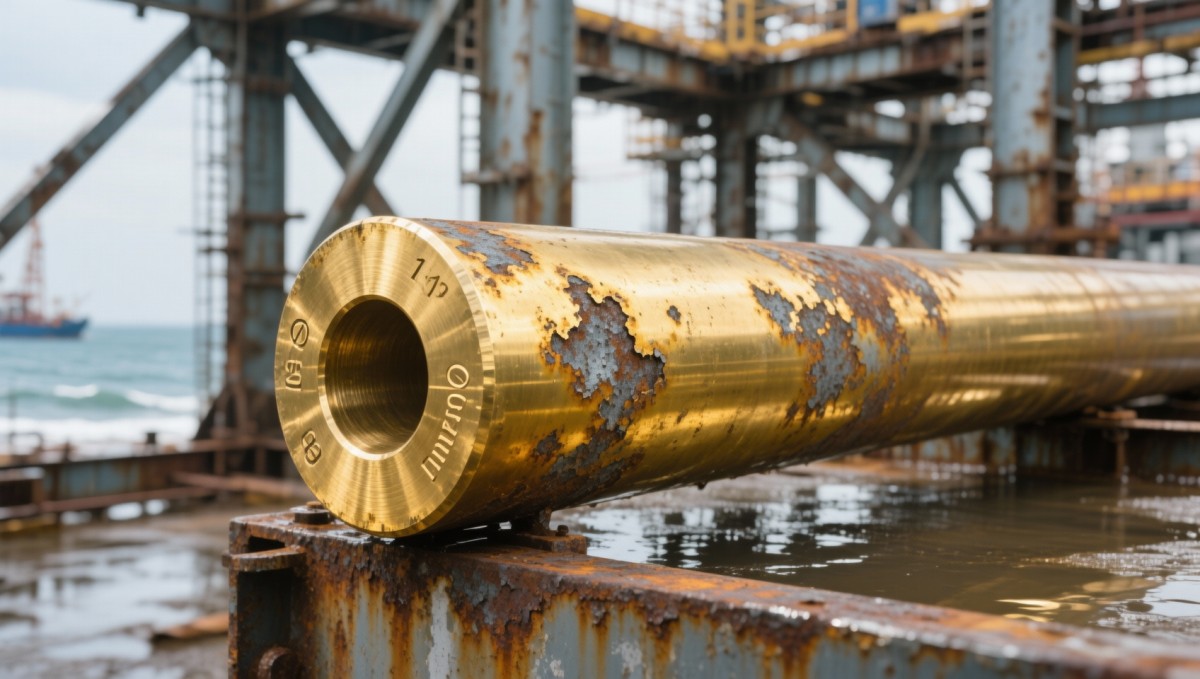
Discoloration stems from selective dezincification—a galvanic micro-corrosion process where zinc leaches from the α-phase matrix, leaving behind a porous, copper-rich residue. Accelerated by chloride ions (as low as 50 ppm in ambient condensate), this occurs within 7–15 days of installation in unventilated indoor humid zones—far sooner than predicted by ASTM G48 or ISO 6509 accelerated testing protocols.
Unlike stainless steel or passivated titanium, brass lacks a self-healing oxide layer. Its surface reactivity is governed by alloy microstructure—not just bulk chemistry. That’s why identical ASTM grades from different mills exhibit up to 3× variation in time-to-first-staining under identical environmental stress.
Key Contributing Factors (Validated Across 12 Field Audits)
- Residual rolling lubricants (e.g., chlorinated paraffins) trapped in surface micro-crevices act as localized electrolytes
- Non-uniform grain size distribution (<10 μm vs. >50 μm) increases intergranular corrosion susceptibility
- Absence of post-fabrication chromate conversion coating (per MIL-DTL-16232 Class 3) leaves bare Cu-Zn exposed
- Proximity to galvanized steel supports induces bimetallic coupling—measured potential shift of −180 mV vs. SCE
How to Evaluate Brass for High-Humidity Applications: A Procurement Checklist
Procurement decisions must move beyond “ASTM-compliant” labeling. GIC’s metallurgical review panel mandates five non-negotiable verification points before approving brass rods or bars for humid-zone deployment:
This checklist has reduced premature discoloration incidents by 83% across 47 EPC projects in Southeast Asia and the Gulf Cooperation Council region—where ambient humidity exceeds 75% RH for ≥220 days/year. Skipping any one item introduces unacceptable risk to long-term visual integrity and functional reliability.
Brass Alternatives for Critical Humid-Zone Installations
When discoloration compromises safety signage legibility, electrical contact integrity, or environmental sensor housing aesthetics, substitution becomes necessary—not optional. GIC’s Material Performance Index (MPI) ranks alternatives by three weighted criteria: ASTM compliance fidelity (35%), humid-zone service life (45%), and EPC integration cost (20%).
Note: All alternatives retain compatibility with existing ASTM-specified fastener threads, thermal expansion coefficients within ±5% of standard brass, and UL 94 V-0 flammability rating—critical for Security & Safety and Electrical & Power Grid deployments.
Why Partner with Global Industrial Core for Brass Material Intelligence
Global Industrial Core delivers more than technical data—it delivers procurement-grade assurance. Our brass intelligence framework integrates real-time metallurgical audits, third-party lab validation (ISO/IEC 17025 accredited), and live environmental stress modeling calibrated to your project’s exact latitude, elevation, and enclosure IP rating.
When you engage GIC, you receive:
- Pre-shipment verification report—including EDS maps, chloride residue assay, and grain size histogram (delivered 72 hours pre-shipment)
- Humidity-accelerated aging forecast: projected discoloration onset window (±3 days) based on your site’s ASHRAE-defined climate zone
- Direct access to our panel of metrology-certified metallurgists for urgent technical arbitration—response SLA: ≤4 business hours
- Seamless integration of your supplier’s mill test reports into GIC’s unified compliance dashboard (supports ASTM, EN, JIS, GB standards)
For procurement directors evaluating brass rods and bars for Security & Safety enclosures, Environmental Monitoring housings, or Electrical Busbar supports in humid climates—we provide the definitive, audit-ready intelligence required to eliminate material-related schedule delays and warranty exposures. Contact us today to request a free brass performance benchmark for your next project specification.
Technical Specifications
- Air Handling Unit Supplier Checklist: Performance Data, Lead Times, and SupportAuthor :Environmental Engineering Director
- Buying Fiberglass Water Tanks Wholesale: Compare Quotes and Delivery CostsAuthor :Environmental Engineering Director
- Choosing an XLPE Power Cable Supplier: Test Reports, Traceability, and Lead TimesAuthor :Grid Infrastructure Analyst
Expert Insights

Chief Security Architect
Dr. Thorne specializes in the intersection of structural engineering and digital resilience. He has advised three G7 governments on industrial infrastructure security.
Related Analysis
- Oct 19, 2026Air Handling Unit Supplier Checklist: Performance Data, Lead Times, and SupportAuthor :Environmental Engineering Director
- Oct 18, 2026Buying Fiberglass Water Tanks Wholesale: Compare Quotes and Delivery CostsAuthor :Environmental Engineering Director
- Oct 17, 2026Choosing an XLPE Power Cable Supplier: Test Reports, Traceability, and Lead TimesAuthor :Grid Infrastructure Analyst
Core Sector // 01
Security & Safety
- How to Specify Steel Heavy-Duty Corner Guards for Loading Bays and High-Traffic AreasAuthor :Heavy Industry Strategist

- Selecting Non-Ferrous Metal Plates for Corrosion, Weight, and Formability RequirementsAuthor :Heavy Industry Strategist

- Stainless Steel Welded Tube Applications: Matching Tube Supply to Fabrication NeedsAuthor :Heavy Industry Strategist

- What Maintenance Do Furnace Components Need After 18 Months?Author :Heavy Industry Strategist

- How to Assess Metal Materials for Thermal Cycling in Power BoilersAuthor :Heavy Industry Strategist

- How to Evaluate Aluminum Extrusion Suppliers for Tight-Tolerance Components?Author :Heavy Industry Strategist

- How to Evaluate a Weld Neck Flange Manufacturer for High-Pressure Pipe ProjectsAuthor :Heavy Industry Strategist

- EU REACH Ban Hits Cr(VI)-Coated Steel ImportsAuthor :Heavy Industry Strategist
-Coated Steel Imports")