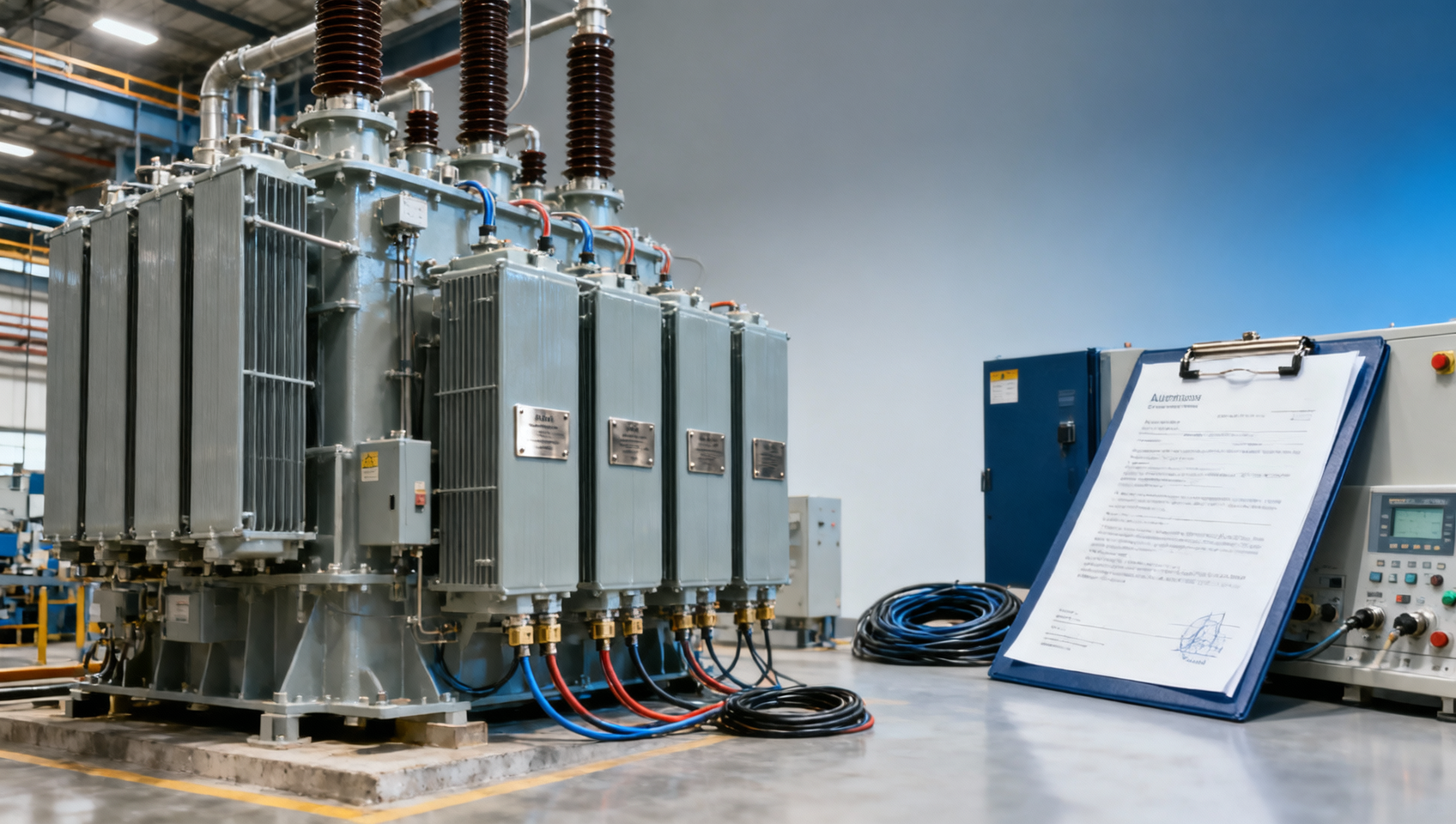
IEC 61850-90-15:2026 Published: ±100ns Time Sync for Substation SV/GOOSE
Author
Date Published
Reading Time

On April 22, 2026, the International Electrotechnical Commission (IEC) published IEC 61850-90-15:2026 — a new standard mandating ±100 ns time synchronization accuracy for sampled values (SV) and GOOSE messages in smart substation process layers, tightening the previous requirement of ±1 μs. This update directly affects export-oriented enterprises in the Transformers & Switchgears and Cables & Wiring sectors, particularly those supplying merging units (MU), intelligent electronic devices (IED), and fiber-optic cabling solutions for substations; third-party time accuracy test reports are now mandatory for new project tenders.
Event Overview
The International Electrotechnical Commission (IEC) officially released IEC 61850-90-15:2026 on April 22, 2026. The standard specifies that time synchronization accuracy for process-layer sampled value (SV) and GOOSE messages in smart substations must meet ±100 nanoseconds (ns), replacing the prior tolerance of ±1 microsecond (μs). The document is publicly available through the IEC Webstore as an official international standard.
Industries Affected by the Update
Export-Oriented Manufacturers of Transformers & Switchgears
These companies supply critical primary equipment integrated with digital interfaces (e.g., instrument transformers with embedded MU functionality). The tightened time accuracy requirement impacts firmware design, hardware clock stability validation, and system-level timing verification. Compliance now necessitates requalification of existing MU-integrated products for new bids.
Export-Oriented Manufacturers of Cables & Wiring Systems
Fiber-optic cabling solutions deployed in process-layer networks — especially those supporting IEEE 1588v2 or White Rabbit timing distribution — must now ensure end-to-end jitter and propagation delay contributions remain within budget to sustain ±100 ns alignment. Cable assembly tolerances, connector repeatability, and patch panel latency become measurable compliance parameters.
Suppliers of Merging Units (MU) and Intelligent Electronic Devices (IED)
MU and IED vendors are directly responsible for achieving and certifying the new time accuracy level. Their product development cycles, test infrastructure (e.g., precision PTP analyzers), and documentation packages must be updated to reflect the stricter threshold. Third-party testing becomes non-negotiable for tender eligibility.
Key Points for Enterprises and Practitioners to Monitor and Act Upon
Track official adoption timelines in key markets
While IEC 61850-90-15:2026 is now published, national standards bodies (e.g., SAC in China, DIN in Germany, ANSI/IEEE in the U.S.) may issue adoption notices or transitional provisions. Exporters should monitor updates from local grid operators and standardization institutes — enforcement may be phased or tied to specific project categories (e.g., ultra-high-voltage or digital twin-enabled substations).
Verify third-party test capability before bid submission
Not all accredited labs currently offer ±100 ns time accuracy validation under IEC 61850-90-15 conditions. Companies preparing for tenders should confirm lab scope, measurement uncertainty statements, and report format alignment with procurement specifications well in advance — lead times for such testing may extend beyond standard calibration cycles.
Review optical interface and timing architecture designs
Existing designs relying on legacy PHY layers, uncalibrated SFP modules, or asymmetric fiber paths may not meet the new jitter and skew budgets. Analysis should focus on deterministic delays across the full signal chain: sampling instant → FPGA timestamping → MAC/PHY serialization → fiber transmission → receiver deserialization → application-layer processing.
Distinguish between specification language and implementation readiness
The standard sets a performance target but does not prescribe implementation methods. Vendors may adopt different timing architectures (e.g., boundary clocks vs. transparent clocks, hardware timestamping vs. software-assisted correction). From a procurement perspective, it is essential to verify whether claimed compliance is based on theoretical modeling or verified under representative load and environmental conditions.
Editorial Observation / Industry Perspective
From an industry perspective, IEC 61850-90-15:2026 is best understood not as an immediate compliance deadline, but as a technical inflection point signaling growing maturity in substation-wide time-critical automation. Analysis来看, the shift from ±1 μs to ±100 ns reflects convergence between power system protection requirements and advances in industrial PTP implementation — yet widespread deployment readiness remains uneven across vendor ecosystems. Current more relevant interpretation is that this standard formalizes a capability threshold already emerging in pilot deployments, rather than introducing entirely novel technology. Continued attention is warranted as grid operators begin referencing it in RFPs and certification frameworks.
Conclusion
IEC 61850-90-15:2026 establishes a higher benchmark for time synchronization in smart substation communications — one that elevates technical expectations for exporting manufacturers of MUs, IEDs, transformers, switchgears, and fiber-optic infrastructure. Its significance lies less in immediate regulatory enforcement and more in its role as a forward-looking reference for next-generation substation tenders and interoperability frameworks. For affected stakeholders, the update is better interpreted as a strategic signal requiring targeted technical preparation — not a blanket compliance trigger.
Source Attribution
Main source: International Electrotechnical Commission (IEC), IEC 61850-90-15:2026 — Communication networks and systems for power utility automation — Part 90-15: Time synchronization for sampled values and GOOSE messages. Published April 22, 2026. Available via IEC Webstore.
Points requiring ongoing observation: National adoptions, grid operator implementation guidelines, and availability of accredited testing services meeting the ±100 ns uncertainty requirement.
Technical Specifications
- CIBF2026 Highlights Lithium Battery Recycling Equipment DemandAuthor :Environmental Engineering Director
- Canton Fair Phase II 2026 Industrial Components Zone Fully BookedAuthor :Heavy Industry Strategist
- TÜV Rheinland Updates EMC Guide for Industrial Optics DevicesAuthor :Precision Metrology Expert
Expert Insights

Chief Security Architect
Dr. Thorne specializes in the intersection of structural engineering and digital resilience. He has advised three G7 governments on industrial infrastructure security.
Related Analysis
- Apr 23, 2026CIBF2026 Highlights Lithium Battery Recycling Equipment DemandAuthor :Environmental Engineering Director
- Apr 23, 2026Canton Fair Phase II 2026 Industrial Components Zone Fully BookedAuthor :Heavy Industry Strategist
- Apr 23, 2026TÜV Rheinland Updates EMC Guide for Industrial Optics DevicesAuthor :Precision Metrology Expert
Core Sector // 01
Security & Safety
- IEC 61850-90-15:2026 Published: ±100ns Time Sync for Substation SV/GOOSEAuthor :Grid Infrastructure Analyst
![]()
- IEC 61850-90-15:2026 Released — Time Stamp Precision Upgrade Impacts Power Equipment ExportsAuthor :Grid Infrastructure Analyst
![]()
- Shanghai Yangshan Port Launches Green Clearance for Industrial EquipmentAuthor :Grid Infrastructure Analyst
![]()
- How to Vet a Power Transformer ManufacturerAuthor :Grid Infrastructure Analyst

- How to Source Distribution TransformersAuthor :Grid Infrastructure Analyst

- Cast Resin Dry Type Transformer UsesAuthor :Grid Infrastructure Analyst

- Oil Immersed Transformer vs Dry TypeAuthor :Grid Infrastructure Analyst

- Current Transformers CT Buying ChecklistAuthor :Grid Infrastructure Analyst