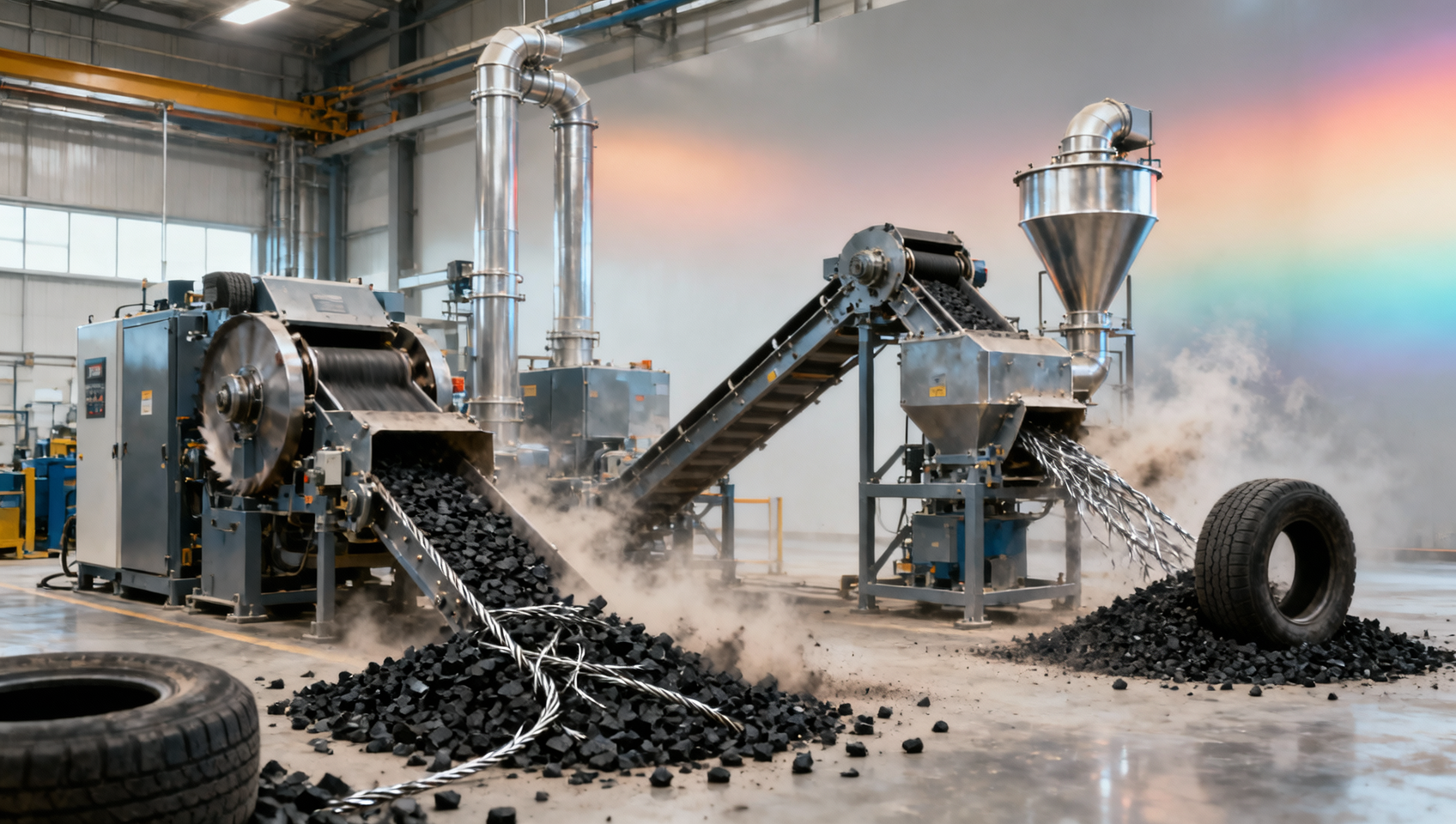
CIBF2026 Highlights Lithium Battery Recycling Equipment Demand
Author
Date Published
Reading Time

CIBF2026 — the 19th China International Battery Fair — opened in Shenzhen on April 22, 2026, under the theme ‘Zero-Carbon Together, Chain Global’. Its strong focus on zero-carbon factory construction has drawn attention from industrial equipment buyers in Europe, North America, and Southeast Asia — particularly for lithium battery recycling systems. This signals a tangible shift in cross-border procurement priorities driven by upstream decarbonization mandates.
Event Overview
The 19th China International Battery Technology Exchange Conference (CIBF2026) commenced on April 22, 2026, in Shenzhen. The official theme was ‘Zero-Carbon Together, Chain Global’. Publicly reported data from the exhibition indicated that inquiry volumes for three equipment categories — Industrial Water Treatment (electrode cleaning lines), Solid Waste Mgmt (lithium-ion battery crushing and sorting systems), and Power Transmission (second-life battery energy storage inverters) — rose 210% year-on-year among overseas buyers. Multiple Chinese equipment manufacturers received preliminary purchase order (PO) indications for battery recycling projects outside China.
Which Sub-Sectors Are Affected
Direct Exporters of Industrial Equipment
Why affected: Their product portfolios align directly with the surging overseas inquiries. The 210% YoY increase in demand signals heightened buyer scrutiny on technical compliance, CE/UL certification readiness, and modular adaptability to regional recycling regulations.
Impact: Short-term pressure on lead-time management and documentation alignment; longer-term implications for R&D roadmaps targeting EU Battery Regulation or U.S. Inflation Reduction Act–linked recycling incentives.
Raw Material Procurement Firms Serving Equipment Makers
Why affected: Rising orders for lithium battery recycling systems imply increased demand for stainless steel, high-efficiency motors, PLC controllers, and specialized filtration media — especially those meeting international corrosion or explosion-proof standards.
Impact: Shifts in material specification requirements (e.g., 316L vs. 304 stainless); tighter tolerances on delivery timing; potential need for dual-sourcing strategies to avoid bottlenecks in certified components.
Contract Manufacturers & System Integrators
Why affected: These firms often assemble or commission full-line solutions (e.g., electrode cleaning + sorting + separation). PO indications suggest clients now prioritize integrated performance validation — including water reuse rate, metal recovery yield, and dust containment — over standalone unit specs.
Impact: Greater emphasis on test protocols aligned with EN 13040 or IEC 62474; need to document traceability across subsystem vendors; rising importance of commissioning support capability in target markets.
Supply Chain & Logistics Service Providers
Why affected: Equipment for battery recycling is typically oversized, heavy, and subject to evolving hazardous goods transport rules (e.g., UN3480 for residual cells in dismantling lines). Increased export volume raises operational complexity.
Impact: Higher demand for pre-shipment compliance checks (e.g., ADR/RID/IMDG classification); need for updated insurance coverage scopes; possible delays at ports due to stricter customs verification of end-use declarations.
What Relevant Companies or Practitioners Should Focus On Now
Monitor regulatory implementation timelines — not just policy announcements
EU’s Battery Regulation enforcement begins in stages from 2027; U.S. state-level recycling mandates (e.g., Maine, California) are advancing independently. Current PO indications likely reflect early-stage procurement aligned with upcoming compliance deadlines — not just voluntary ESG initiatives. Track national transposition schedules, not only EU-level texts.
Prioritize technical documentation readiness for key export markets
Overseas buyers increasingly request OEM-certified performance test reports, CE/UKCA declarations, and material safety data sheets (MSDS) in local language. Absence of these — even with functional equipment — delays tender evaluations. Verify documentation status for electrode cleaning lines and sorting systems before engaging with new regional distributors.
Distinguish between inquiry volume and actual order conversion
The 210% YoY inquiry growth reflects market interest, but does not guarantee near-term revenue. Many PO indications remain conditional on final site audits, financing closure, or permitting approvals. Avoid scaling production capacity solely on inquiry trends without confirming buyer creditworthiness and project stage.
Prepare for extended pre-sales technical engagement
Buyers from regulated markets are conducting deeper due diligence: requesting third-party verification of metal recovery rates, validating water recycling efficiency claims, and auditing cybersecurity features in PLC-based control systems. Sales teams should coordinate early with engineering and QA departments to standardize response packages for such requests.
Editorial Perspective / Industry Observation
From industry perspective, CIBF2026’s equipment demand surge is better understood as an early signal of supply chain decarbonization moving downstream — from battery cell producers to their equipment suppliers. It reflects growing pressure on OEMs and recyclers to meet Scope 3 emissions targets, which in turn triggers procurement-level adjustments. Analysis来看, this is not yet a mature commercial wave — evidenced by the prevalence of PO indications rather than firm contracts — but it does indicate where technical and compliance investments will be most consequential over the next 12–24 months. Observation来看, the strongest traction is currently in mid-scale systems (50–200 tons/year capacity), suggesting market entry barriers remain lower for modular, containerized solutions versus fully customized plants.
This development matters because it reveals how zero-carbon factory goals — once seen as primarily affecting energy sourcing — are now reshaping capital equipment specifications, certification pathways, and global logistics planning. It also highlights a widening gap between equipment makers who treat compliance as documentation overhead versus those embedding regulatory logic into system architecture.
Current more appropriate interpretation is that this is a structural inflection point in procurement criteria — not merely cyclical demand. The fact that inquiries span water treatment, solid waste, and power transmission segments suggests buyers are evaluating holistic line integration, not isolated machines. That implies a longer-term shift in how recycling infrastructure is designed, specified, and sourced globally.
Information Source: Official CIBF2026 exhibition data release (April 22, 2026); publicly reported inquiry and PO indication metrics from participating Chinese equipment manufacturers. Note: PO indications remain non-binding and subject to further due diligence; actual order conversion rates and regional distribution breakdowns are pending further disclosure.
Technical Specifications
- CIBF2026 Highlights Lithium Battery Recycling Equipment DemandAuthor :Environmental Engineering Director
- Canton Fair Phase II 2026 Industrial Components Zone Fully BookedAuthor :Heavy Industry Strategist
- TÜV Rheinland Updates EMC Guide for Industrial Optics DevicesAuthor :Precision Metrology Expert
Expert Insights

Chief Security Architect
Dr. Thorne specializes in the intersection of structural engineering and digital resilience. He has advised three G7 governments on industrial infrastructure security.
Related Analysis
- Apr 23, 2026CIBF2026 Highlights Lithium Battery Recycling Equipment DemandAuthor :Environmental Engineering Director
- Apr 23, 2026Canton Fair Phase II 2026 Industrial Components Zone Fully BookedAuthor :Heavy Industry Strategist
- Apr 23, 2026TÜV Rheinland Updates EMC Guide for Industrial Optics DevicesAuthor :Precision Metrology Expert
Core Sector // 01
Security & Safety
- CIBF2026 Highlights Lithium Battery Recycling Equipment DemandAuthor :Environmental Engineering Director
![]()
- RCEP Industrial Waste Equipment Mutual Recognition LaunchesAuthor :Environmental Engineering Director
![]()
- RCEP Launches Industrial Waste Equipment Mutual RecognitionAuthor :Environmental Engineering Director
![]()
- How to choose an organic fertilizer machine for wet raw materialsAuthor :Environmental Engineering Director

- What affects output stability in a hydraulic briquetting pressAuthor :Environmental Engineering Director

- Waste paper baler wholesale prices vary for reasons beyond tonnageAuthor :Environmental Engineering Director

- When a scrap metal baler becomes too small for daily loading needsAuthor :Environmental Engineering Director

- Tire recycling machine layouts that reduce dust and wire lossAuthor :Environmental Engineering Director