IEC 62271-100:2026 Ed.4.0 Adds Digital Twin Interface Requirement
Author
Date Published
Reading Time
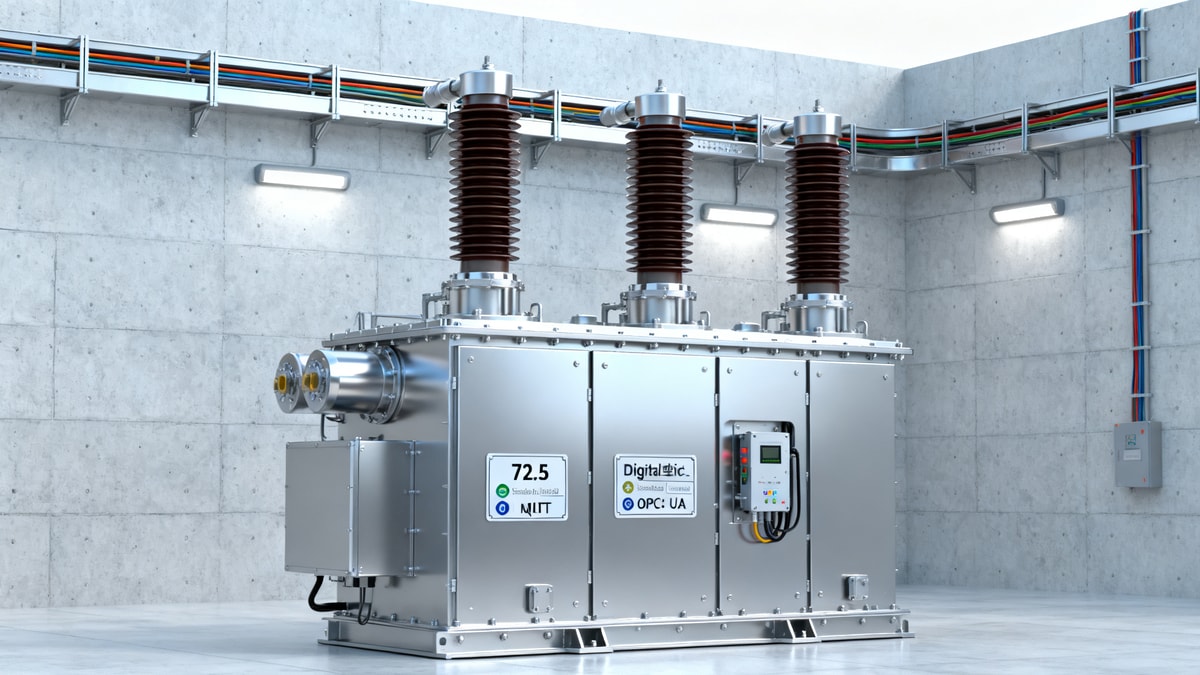
On 29 April 2026, the International Electrotechnical Commission (IEC) published IEC 62271-100:2026 Ed.4.0 — the first edition of this high-voltage circuit breaker standard to mandate a digital twin communication interface as a compulsory functional requirement for devices rated at 72.5 kV and above. This update directly affects manufacturers, system integrators, grid operators, and certification bodies engaged in high-voltage power equipment design, supply, or deployment.
Event Overview
The IEC officially released IEC 62271-100:2026 Ed.4.0 on 29 April 2026. The standard introduces a new mandatory requirement for ‘digital twin communication interface’ in high-voltage circuit breakers (≥72.5 kV). It specifies support for MQTT and OPC UA protocols, aligned with the IEC 61850-90-8 data model. The standard applies immediately to all new product certifications. Leading Chinese manufacturers have already initiated firmware upgrades to comply.
Industries Affected by This Update
High-Voltage Equipment Manufacturers
Manufacturers producing circuit breakers for transmission and substation applications are directly affected because compliance is now required for new type certifications. Impact includes revised hardware architecture (e.g., embedded edge controllers), firmware development cycles, and extended validation against protocol interoperability and data model conformance.
Power System Integrators & Automation Providers
Integrators deploying digital substation solutions must ensure compatibility between newly certified breakers and existing SCADA, DMS, or asset monitoring platforms. Impact manifests in updated integration testing procedures, potential reconfiguration of data ingestion pipelines, and increased demand for OPC UA– or MQTT-enabled gateway configurations.
Grid Operators & Transmission Asset Managers
Utilities managing aging infrastructure face implications for long-term procurement planning and digital twin strategy alignment. While retrofits are not mandated, future tender specifications for HV circuit breakers will increasingly reference IEC 62271-100:2026 Ed.4.0 — affecting lifecycle replacement timelines and data readiness assessments.
What Enterprises and Practitioners Should Monitor and Do Now
Track official interpretations from national standards bodies
Analysis shows that adoption timelines may vary regionally. National committees (e.g., SAC/TC 65 in China, DIN/ETG in Germany) may issue implementation guidelines or transitional provisions. Monitoring these updates helps avoid premature investment in non-aligned interfaces.
Verify protocol stack and data model conformance in procurement specifications
Current more appropriate action is to explicitly require MQTT v3.1.1/v5.0 and OPC UA Part 4–5–10 compliance — plus IEC 61850-90-8 object naming conventions — in technical bids and qualification documents, especially for projects entering design phase after Q3 2026.
Distinguish between certification compliance and operational deployment readiness
Observably, meeting the interface requirement does not guarantee seamless integration into utility digital twin environments. Enterprises should assess whether their internal data governance frameworks, cybersecurity policies (e.g., TLS 1.2+, device authentication), and time-synchronized data ingestion capabilities align with the standard’s implied operational context.
Prepare firmware and test environment upgrades for R&D and QA teams
Manufacturers and third-party test labs need to update validation toolsets to cover MQTT/OPC UA message structure, topic hierarchy, and semantic consistency with IEC 61850-90-8. Early preparation avoids delays in certification submissions scheduled for H2 2026 onward.
Editorial Perspective / Industry Observation
This update is best understood not as a standalone technical revision but as a signal of accelerating convergence between physical grid assets and standardized industrial IoT frameworks. Analysis shows that IEC 62271-100:2026 Ed.4.0 reflects a broader strategic shift — one where interoperability is no longer optional for critical protection devices. From an industry perspective, it marks the point at which digital twin readiness transitions from a competitive differentiator to a baseline eligibility criterion for high-voltage equipment markets. However, full ecosystem maturity — including vendor-agnostic platform support and utility-level data policy harmonization — remains a work in progress. Continuous observation is warranted, particularly regarding how regional certification bodies implement conformity assessment clauses.
Conclusion
This standard revision formalizes a foundational step toward interoperable, data-driven high-voltage asset management. It does not yet represent full digital twin operationalization across utilities, but rather establishes the minimum communication layer required for future scalability. For stakeholders, the current interpretation should emphasize compliance preparedness over immediate system-wide transformation — treating the update as a necessary enabler, not a completed outcome.
Information Sources
Main source: International Electrotechnical Commission (IEC), IEC 62271-100:2026 Ed.4.0 (published 29 April 2026).
Points requiring ongoing observation: Implementation guidance from national standards bodies (e.g., SAC, DIN, ANSI), and real-world certification case reports from notified bodies such as KEMA, CESI, or SGS.
Technical Specifications
Expert Insights

Chief Security Architect
Dr. Thorne specializes in the intersection of structural engineering and digital resilience. He has advised three G7 governments on industrial infrastructure security.
Related Analysis
- Apr 30, 2026Egypt SMIIC Mandates Arabic Energy Labels for Industrial PumpsAuthor :Heavy Industry Strategist
- Apr 30, 2026TÜV SÜD Launches China Industrial Optics Fast TrackAuthor :Precision Metrology Expert
- Apr 30, 2026LME Nickel Surges 5.2% on April 29, 2026: Impact on Stainless Bearings & SealsAuthor :Heavy Industry Strategist
Core Sector // 01
Security & Safety
- IEC 62271-100:2026 Ed.4.0 Adds Digital Twin Interface RequirementAuthor :Grid Infrastructure Analyst

- EU CE新规: Industrial Circuit Breakers Must Pass IEC 60947-2 Annex Q Test from May 1, 2026Author :Grid Infrastructure Analyst

- INMETRO Mandates IEC 60947-2 Annex Q Waveform for Circuit BreakersAuthor :Grid Infrastructure Analyst

- When to Use Vacuum Circuit Breakers VCBAuthor :Grid Infrastructure Analyst

- Wholesale Lightning Arresters: What Matters MostAuthor :Grid Infrastructure Analyst

- How to Size a Surge Protective Device SPDAuthor :Grid Infrastructure Analyst

- Solid State Relays SSR: Best Use CasesAuthor :Grid Infrastructure Analyst

- INMETRO Mandates New IEC 60947-2 Annex Q Short-Circuit Test for Industrial Circuit BreakersAuthor :Grid Infrastructure Analyst
![]()