INMETRO Mandates IEC 60947-2 Annex Q Waveform for Circuit Breakers
Author
Date Published
Reading Time
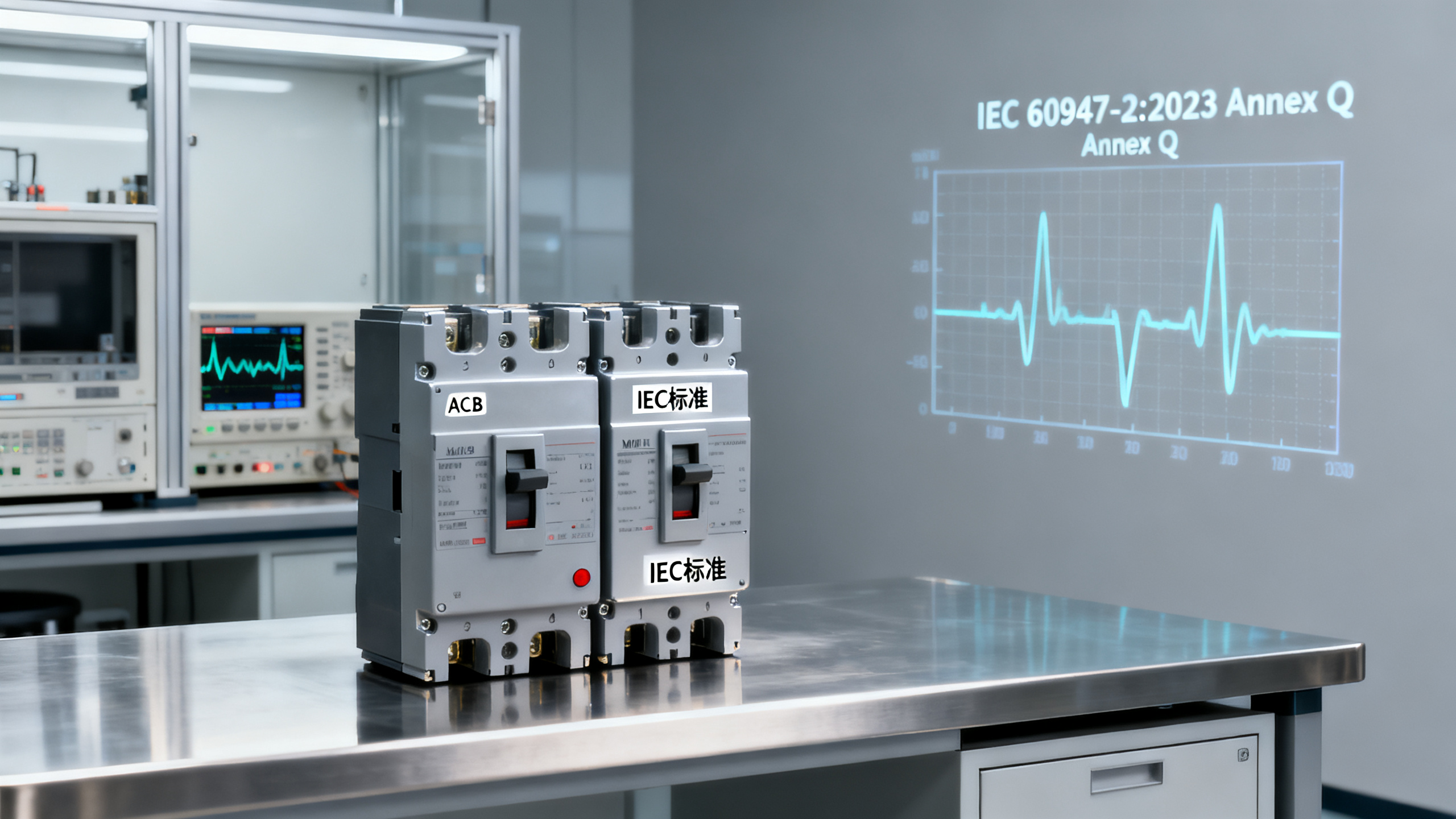
On 28 April 2026, Brazil’s National Institute of Metrology, Standardization and Industrial Quality (INMETRO) issued Portaria INMETRO No. 112/2026 — an urgent amendment requiring industrial circuit breakers (ACBs and MCCBs) seeking INMETRO certification to undergo short-circuit testing using the asymmetric double-peaked current waveform defined in IEC 60947-2:2023 Annex Q. This change directly affects manufacturers, exporters, and testing service providers supplying the Brazilian market — particularly those based in China, where most labs lack compatible surge generators.
Event Overview
INMETRO published Portaria INMETRO No. 112/2026 on 28 April 2026. The amendment mandates that, effective 1 October 2026, all new applications for INMETRO certification of air circuit breakers (ACBs) and moulded case circuit breakers (MCCBs) must pass short-circuit verification using the ‘asymmetric double-peaked short-circuit current waveform’ specified in Annex Q of IEC 60947-2:2023. The waveform is designed to replicate high-frequency resonance characteristics observed in South American power grids. No transitional period or grandfathering provisions are stated in the publicly available text of the Portaria.
Industries Affected by Segment
Direct Exporters to Brazil
Exporters of ACBs and MCCBs to Brazil will face mandatory revalidation of type tests under the new waveform requirement. Because the test condition differs significantly from conventional IEC 60947-2 short-circuit verification (e.g., standard symmetrical or fully asymmetrical waveforms), previously certified models may not meet the revised criteria without retesting — even if unchanged in design or construction.
Manufacturers Relying on Chinese Testing Labs
Many Chinese-based manufacturers depend on domestic laboratories for pre-certification validation. As noted in the official summary, most such labs currently lack surge generators capable of reproducing the Annex Q waveform. This gap may delay test scheduling, extend certification timelines, and increase reliance on overseas facilities — raising both cost and logistical complexity.
Supply Chain & Certification Service Providers
Third-party certification bodies, conformity assessment organizations, and local representatives supporting INMETRO applications must update technical documentation, test planning protocols, and client advisories. Their capacity to coordinate Annex Q-compliant testing — especially across time zones and lab availability constraints — becomes a critical bottleneck in the application workflow.
What Enterprises and Practitioners Should Monitor and Do Now
Track official implementation guidance from INMETRO
While Portaria No. 112/2026 establishes the requirement, it does not yet specify test lab accreditation procedures, acceptable deviation tolerances, or interpretation rules for borderline cases. Observably, stakeholders should monitor INMETRO’s official notices and updates through its website and accredited certification bodies.
Identify models scheduled for renewal or new submission before October 2026
Analysis shows that products with certification expirations between July and September 2026 are at highest risk of disruption — as they may fall into a ‘gap window’ where legacy test reports expire just before the new rule takes effect, but Annex Q-capable testing is not yet scheduled. Prioritizing these models for early test planning is advisable.
Verify lab capability — not just accreditation status
Accreditation to IEC 60947-2 alone does not guarantee Annex Q compliance. Enterprises should explicitly confirm whether their chosen lab owns and has validated a generator capable of producing the asymmetric double-peaked waveform per Annex Q. A written capability statement — including waveform verification records — is recommended before initiating test contracts.
Update internal technical files and communication with Brazilian importers
Manufacturers should proactively revise product datasheets, type test summaries, and declaration of conformity documents to reflect Annex Q applicability. Brazilian importers and distributors need advance notice to adjust procurement timelines and customer delivery commitments — especially for projects with tight commissioning schedules.
Editorial Perspective / Industry Observation
This amendment is better understood as a regulatory signal than an immediate operational outcome. While the 1 October 2026 deadline is firm, full enforcement depends on the readiness of accredited labs, clarity in INMETRO’s interpretation of Annex Q, and responsiveness of international testing infrastructure. From an industry perspective, the move reflects a broader trend toward region-specific electrical stress modeling — particularly where grid dynamics differ markedly from European or North American baselines. It also highlights growing interdependence between certification policy and specialized test equipment availability. Continuous monitoring is warranted, as minor clarifications issued over the next 3–6 months may significantly affect implementation feasibility.
In summary, this INMETRO amendment introduces a technically specific, time-bound compliance shift for industrial circuit breaker exporters targeting Brazil. Its significance lies less in novelty and more in executional friction — especially given the current mismatch between regulatory mandate and widespread test infrastructure. For now, it is best interpreted as a procedural inflection point demanding proactive coordination across manufacturing, testing, and certification channels — rather than a fundamental redesign trigger.
Source: Portaria INMETRO No. 112/2026, published 28 April 2026. Official text available via INMETRO’s legal notices portal. Note: Lab accreditation pathways and waveform validation protocols remain pending clarification and are subject to ongoing observation.
Technical Specifications
- 6th National Auto Standards Committee Launched, Impacts Optical Test Equipment ExportAuthor :Precision Metrology Expert
- Copper Price Surge Impacts Industrial Components BOM CostsAuthor :Grid Infrastructure Analyst
- EU CE Update: ULPA Filters Require MVR Testing from Jan 2027Author :Environmental Engineering Director
Expert Insights

Chief Security Architect
Dr. Thorne specializes in the intersection of structural engineering and digital resilience. He has advised three G7 governments on industrial infrastructure security.
Related Analysis
- Apr 29, 20266th National Auto Standards Committee Launched, Impacts Optical Test Equipment ExportAuthor :Precision Metrology Expert
- Apr 29, 2026Copper Price Surge Impacts Industrial Components BOM CostsAuthor :Grid Infrastructure Analyst
- Apr 29, 2026EU CE Update: ULPA Filters Require MVR Testing from Jan 2027Author :Environmental Engineering Director
Core Sector // 01
Security & Safety
- INMETRO Mandates IEC 60947-2 Annex Q Waveform for Circuit BreakersAuthor :Grid Infrastructure Analyst

- When to Use Vacuum Circuit Breakers VCBAuthor :Grid Infrastructure Analyst

- Wholesale Lightning Arresters: What Matters MostAuthor :Grid Infrastructure Analyst

- How to Size a Surge Protective Device SPDAuthor :Grid Infrastructure Analyst

- Solid State Relays SSR: Best Use CasesAuthor :Grid Infrastructure Analyst

- INMETRO Mandates New IEC 60947-2 Annex Q Short-Circuit Test for Industrial Circuit BreakersAuthor :Grid Infrastructure Analyst
![]()
- Copper Price Surge Impacts Electrical Equipment BOM CostsAuthor :Grid Infrastructure Analyst
![]()
- INMETRO New Rule: Industrial Circuit Breakers Must Pass IEC 60947-2 Annex Q Test from Sep 2026Author :Grid Infrastructure Analyst
![]()