What NEC Requirements Apply to Electrical Safety Gear in Plants?
Author
Date Published
Reading Time
What NEC Requirements Apply to Electrical Safety Gear in Plants?
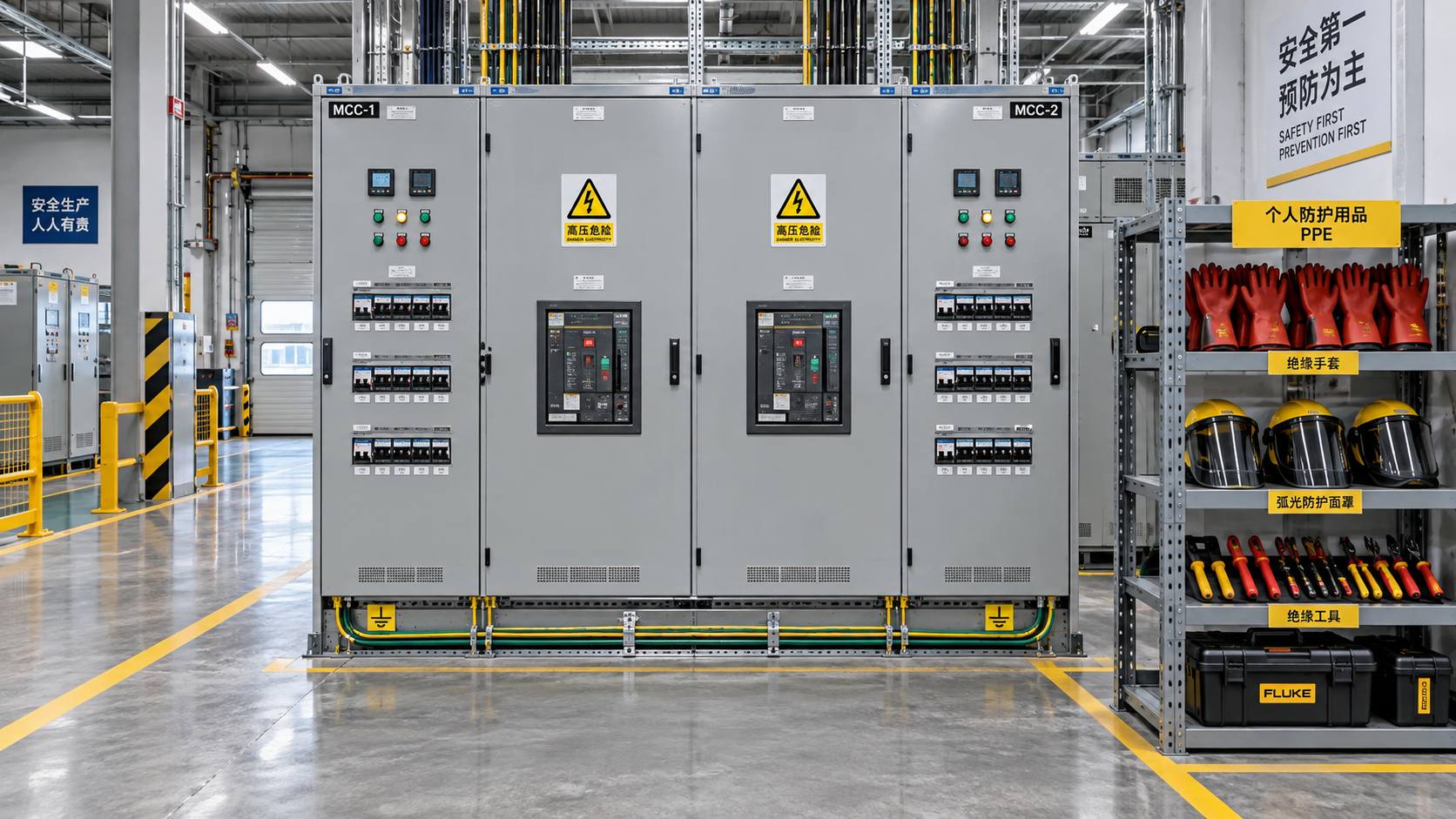
Specifying NEC compliant electrical safety gear industrial plants can rely on starts with distinguishing installation requirements from worker protection rules. The National Electrical Code, NFPA 70, governs electrical installations, including equipment suitability, working clearances, and applicable arc-flash warning labels. It does not prescribe a complete personal protective equipment program. Safe decisions also require attention to OSHA requirements and NFPA 70E practices.
That distinction matters at the purchasing stage. A properly listed switchboard can still be installed with inadequate maintenance access. An arc-rated suit can be appropriate for one task but insufficient for another. Neither a supplier’s “NEC compliant” statement nor a cabinet warning label, by itself, establishes that workers can safely perform the planned job.
Separate installed equipment from the gear people wear
In plant purchasing, “electrical safety gear” often covers two different categories: installed protective equipment, such as disconnects, circuit breakers, enclosures, and grounding components; and worker protection, such as insulating gloves, arc-rated clothing, face protection, and insulated tools. They belong in the same safety strategy, but they do not follow the same compliance path.
The NEC addresses the installation. OSHA establishes enforceable workplace obligations within its jurisdiction. NFPA 70E provides a framework for electrical safety work practices, risk assessment, and PPE selection. NFPA 70E is not automatically law everywhere, although employers commonly use it to support their electrical safety programs. OSHA requirements remain independently applicable.
For a U.S. general-industry facility, relevant OSHA provisions may include 29 CFR 1910.303 for installations, 1910.333 for electrical work practices, and 1910.335 for personnel safeguards. Electrical protective equipment is also addressed in 1910.137. Utilities, construction activities, and specialized operations can involve different or additional rules.
The NEC edition is part of the specification
Before requesting quotations, establish which NEC edition the jurisdiction has adopted, what local amendments apply, and who serves as the authority having jurisdiction, or AHJ. The newest published edition is not necessarily the legally applicable edition at the plant.
This affects more than paperwork. Requirements for arc-flash markings, maintenance provisions, and particular equipment arrangements can change between editions. Existing installations may also receive different treatment from new construction or substantial modifications. Do not assume an older installation must meet every new provision—or that its age excuses an unsafe condition.
A useful specification identifies the adopted edition and amendments, supply voltage, available fault current, environmental conditions, and intended use. “Meets NEC” is too broad to resolve a bid disagreement after equipment arrives.
Where the NEC directly affects equipment selection
Approval, listing, and installation instructions
NEC 110.2 addresses approval, while 110.3 covers examination, identification, installation, and use of equipment. Under 110.3(B), listed or labeled equipment must be installed and used according to instructions included in its listing or labeling.
The practical issue is the complete assembly, not just its components. A panel built from individually listed breakers, terminals, and power supplies is not automatically a listed panel. Likewise, replacing a breaker with a physically compatible alternative does not establish that the replacement is acceptable for that assembly.
Ask for evidence covering the supplied configuration, including relevant installation instructions. A CE marking or an ISO management-system certificate does not substitute for applicable U.S. product approval. UL is one certification organization; other OSHA-recognized nationally recognized testing laboratories may certify products within their recognized scope.
Fault-current ratings that match the installation
NEC 110.9 and 110.10 address interrupting capability and circuit characteristics relevant to fault protection. Buyers need to distinguish a protective device’s interrupting rating from an assembly’s short-circuit current rating, or SCCR.
Consider a motor-control panel moved nearer to a larger transformer. Its operating voltage may remain unchanged while the available fault current increases. The existing rating must therefore be reassessed. A higher-rated upstream breaker does not automatically increase the panel’s SCCR; any reliance on current limitation or a tested combination needs appropriate supporting documentation.
Incident energy is a separate question. It depends partly on fault current and protective-device clearing time. An interrupting rating is not an arc-flash PPE rating.
Enclosures and hazardous locations
Water, conductive dust, corrosive vapors, and temperature can make otherwise suitable equipment unacceptable for a particular location. Match enclosure performance to actual exposure, including cleaning procedures. Equipment suitable for occasional splashing may not suit repeated chemical washdown.
Where combustible dusts, flammable gases, or vapors are present, the applicable hazardous-location provisions become central. Articles 500 through 506 address major classification systems, with other articles covering specific occupancies and equipment. A weather-resistant enclosure is not automatically suitable for a classified location. Classification and equipment selection require a documented engineering basis.
Working space is a safety requirement, not spare floor area
For equipment within its scope, NEC 110.26 establishes working-space and access requirements. Required dimensions depend on voltage, exposure conditions, and the equipment arrangement. The familiar “three feet in front of the panel” rule is not a universal design criterion.
A common layout conflict occurs when a new conveyor, pipe rack, or storage area occupies the space needed to inspect and service electrical equipment. The cabinet still functions, so the restriction may go unnoticed until maintenance personnel need to open it. Required working space must not become storage space.
Review working depth, width, headroom, door opening, access, illumination, and applicable entrance or egress provisions against the adopted code. Dedicated equipment-space requirements also need attention. These checks belong in layout approval, before mechanical services and production equipment fix the available space.
Arc-flash labels: what they establish—and what they do not
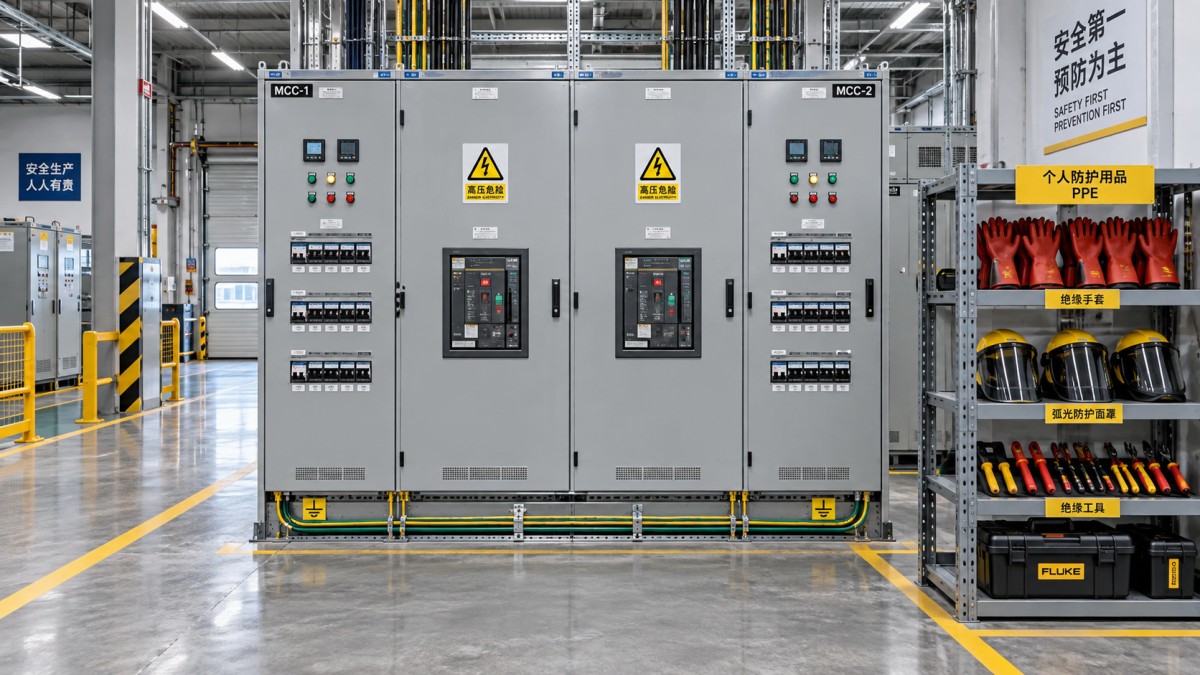
NEC 110.16 addresses arc-flash hazard warning markings for specified equipment likely to require examination, adjustment, servicing, or maintenance while energized. Additional marking requirements can apply to particular equipment under the adopted edition. Verify the applicable wording rather than copying a label specification from another project.
The basic NEC warning requirement should not be confused with NFPA 70E equipment-labeling provisions used within a workplace electrical safety program. A generic warning identifies a hazard; it does not tell a technician which gloves or clothing are appropriate for a specific task.
Where incident-energy information is used, it must correspond to the actual electrical system. Transformer changes, revised protective-device settings, alternate supplies, and major circuit modifications can affect the assessment. Installing replacement labels without checking the underlying study can leave outdated information looking current.
PPE selection starts with the task, not the catalog
The NEC does not provide a universal clothing category for industrial plants. Under NFPA 70E practices, shock and arc-flash risks require assessment, with PPE selected through the applicable incident-energy method or PPE-category method and their respective limitations.
Do not mix the methods casually. The table method is valid only when its equipment, task, fault-current, clearing-time, and other stated conditions are met. If those conditions are unknown or exceeded, selecting a category by resemblance is not a defensible shortcut.
Shock protection and arc-flash protection are also distinct. Arc-rated clothing does not replace voltage-rated insulating gloves where shock protection is required. Gloves need an appropriate voltage class, inspection, care, and testing under applicable requirements. An arc rating does not mean clothing protects against every electrical hazard.
The safer starting point is establishing an electrically safe work condition where required. OSHA 1910.333 generally requires exposed live parts to be deenergized before work, subject to specified exceptions. PPE does not justify energized work merely because a production shutdown is inconvenient.
What to request before approving a purchase
Keep the installation evidence and worker-protection evidence connected, but separate. A practical review should request:
- For installed equipment: applicable approval or certification documentation, electrical ratings, assembly SCCR where relevant, environmental suitability, and installation instructions.
- For the system design: available fault-current information, protective-device settings, required coordination or energy-reduction provisions where applicable, and access drawings.
- For PPE: the applicable product standard, arc rating or voltage class, sizing, inspection and testing requirements, and care instructions.
- For handover: updated drawings, equipment identification, label information, and responsibility for keeping assessments current.
There are legitimate trade-offs. Arc-resistant switchgear can provide protection under specified test conditions, but that protection depends on the equipment’s rating and installation arrangement, including doors, covers, and exhaust provisions. Remote operation may reduce exposure for a particular task, but it does not remove every maintenance hazard. Evaluate the proposed safeguard against the work people will actually perform.
For Global Industrial Core (GIC), the useful connection between electrical infrastructure and safety sourcing is this evidence trail: what was approved, where it may be installed, how it must be maintained, and what protection each task requires. A supplier’s technical documentation should answer those questions more clearly than its compliance slogan.
Before releasing the order, resolve three items: the locally adopted code requirements, the equipment’s suitability for the actual system, and the worker-protection plan for operation and maintenance. If any remains unclear, obtain a documented review from the responsible electrical professional and, where approval questions arise, the AHJ. Better PPE cannot correct an unsuitable installation.
Technical Specifications
- Nucor Raises Hot-Rolled Coil Spot Price by $15 to $1,270 per Short TonAuthor :
- Choosing an Industrial Electrical Infrastructure Supplier: Compliance and Lead TimesAuthor :Grid Infrastructure Analyst
- US Commerce Opens Changed Circumstances Review of Mexican Heavy-Walled Rectangular Welded Carbon Steel PipeAuthor :Heavy Industry Strategist
Expert Insights

Chief Security Architect
Dr. Thorne specializes in the intersection of structural engineering and digital resilience. He has advised three G7 governments on industrial infrastructure security.
Related Analysis
- Oct 27, 2026Nucor Raises Hot-Rolled Coil Spot Price by $15 to $1,270 per Short TonAuthor :
- Oct 27, 2026Choosing an Industrial Electrical Infrastructure Supplier: Compliance and Lead TimesAuthor :Grid Infrastructure Analyst
- Oct 26, 2026US Commerce Opens Changed Circumstances Review of Mexican Heavy-Walled Rectangular Welded Carbon Steel PipeAuthor :Heavy Industry Strategist
Core Sector // 01
Security & Safety
- Vetting a Fall Protection Harness Supplier: Test Reports and TraceabilityAuthor :Safety Compliance Lead

- What NEC Requirements Apply to Electrical Safety Gear in Plants?Author :Safety Compliance Lead

- Can One Supplier Provide Both IEC- and ATEX-Certified Safety Equipment?Author :Safety Compliance Lead

- Are Dual IEC and NEC Safety Certifications Worth the Cost?Author :Safety Compliance Lead

- What Is the Difference Between Class I and Class II PPE?Author :Safety Compliance Lead

- Which Oil and Gas Safety Standards Should Contractors Meet Before Site Mobilization?Author :Safety Compliance Lead

- EU REACH Adds PFAS Cap for PPE WorkwearAuthor :Safety Compliance Lead

- How to Evaluate a Chemical Resistant Suit Supplier for Industrial Safety ProcurementAuthor :Safety Compliance Lead