Vetting a Fall Protection Harness Supplier: Test Reports and Traceability
Author
Date Published
Reading Time
Vetting a Fall Protection Harness Supplier: Test Reports and Traceability
A harness can look compliant while its supporting documentation tells a different story. For procurement teams, vetting a fall protection harness supplier means checking more than price, delivery times, or a certification logo. Model-specific test reports, applicable standards, and traceable production records help establish whether the equipment offered matches the evidence supplied. The difficult part is not collecting documents. It is checking that they describe the same product, production source, and intended use.
Consider a quotation supported by a convincing laboratory report. The report names one harness model, the sample carries another designation, and the commercial offer uses a private-label code. That mismatch does not automatically prove noncompliance. It does mean the supplier must provide a documented connection before the order proceeds. A verbal assurance that “they are all the same harness” is not enough for safety-critical equipment.
Define the compliance requirement before comparing prices
Start with the destination market, site rules, and work activity. A full-body harness intended for fall arrest is not interchangeable with a positioning belt, and an attachment point suitable for one purpose may not be approved for another. Ask the site safety lead to confirm attachment requirements, user mass limits including carried equipment, environmental exposure, and compatibility with the proposed connecting system.
Market requirements also need separating. In the United States, OSHA requirements and ANSI/ASSP Z359.11 serve different functions: OSHA sets applicable workplace obligations, while Z359.11 addresses full-body harness requirements. OSHA does not issue product approval certificates for harnesses. A supplier offering an “OSHA certificate” should explain exactly who issued it and what it establishes.
For the EU market, fall-protection PPE falls under Regulation (EU) 2016/425 and Category III conformity assessment. EN 361 is the relevant European standard for full-body fall-arrest harnesses, but a test report alone does not complete the regulatory process. Review the EU declaration of conformity, EU type-examination documentation, and applicable ongoing production conformity arrangements. Confirm the standard edition and current requirements rather than accepting “latest standard” in a quotation.
An ISO 9001 certificate may support confidence in a manufacturer's quality management system. It does not establish that a particular harness meets fall-protection requirements. Keep factory-system evidence and product-conformity evidence in separate review categories.
Read the report as evidence, not as a certificate-shaped attachment
Request the complete report, including appendices, product photographs, results, and any referenced amendments. A cover page marked “PASS” cannot show whether all relevant requirements were assessed. Some reports cover only selected tests, development samples, or individual components. Webbing strength results, for example, do not establish the performance of a complete harness with its stitching, buckles, adjusters, and attachment elements.
Read these fields together rather than checking each in isolation:
- Product identity: model, size range, construction description, photographs, and identifying markings.
- Test basis: standard and edition, clauses assessed, conditioning, deviations, and exclusions.
- Sample history: who supplied the samples, when they were received, and whether they were independently selected.
- Results: recorded outcomes and observations, not just a summary statement.
- Document control: report number, issue date, authorized approval, and references to revisions.
Pay attention to qualifications. “Results apply only to the samples tested” is normal laboratory language. The procurement question is how the manufacturer demonstrates that current production remains equivalent to those samples. Similarly, one tested size does not automatically support every size offered. Ask how size variants and optional configurations are covered by the applicable assessment.
Age alone does not make a report invalid. An older report may remain relevant to an unchanged design under an applicable assessment route. Conversely, a recent report can be irrelevant if the production harness uses different buckles or a revised stitch pattern. Evaluate design continuity and current conformity status, not simply the date on the first page.
Verify the laboratory and the certification body separately
Where accredited testing is claimed, check the laboratory's ISO/IEC 17025 accreditation through the accreditation body's directory. Review the relevant scope: accreditation for unrelated mechanical testing does not establish competence for the harness tests in question. Check status at the time of testing and whether subcontracted work is identified.
For EU documentation, verify the notified body's identity and relevant designation through the European Commission's NANDO database. The body conducting type examination and the body responsible for production surveillance may differ. A genuine laboratory logo is not a substitute for checking these roles. Where authenticity is uncertain, use independently obtained contact details to confirm the document with its issuer.
Make the evidence follow the physical harness
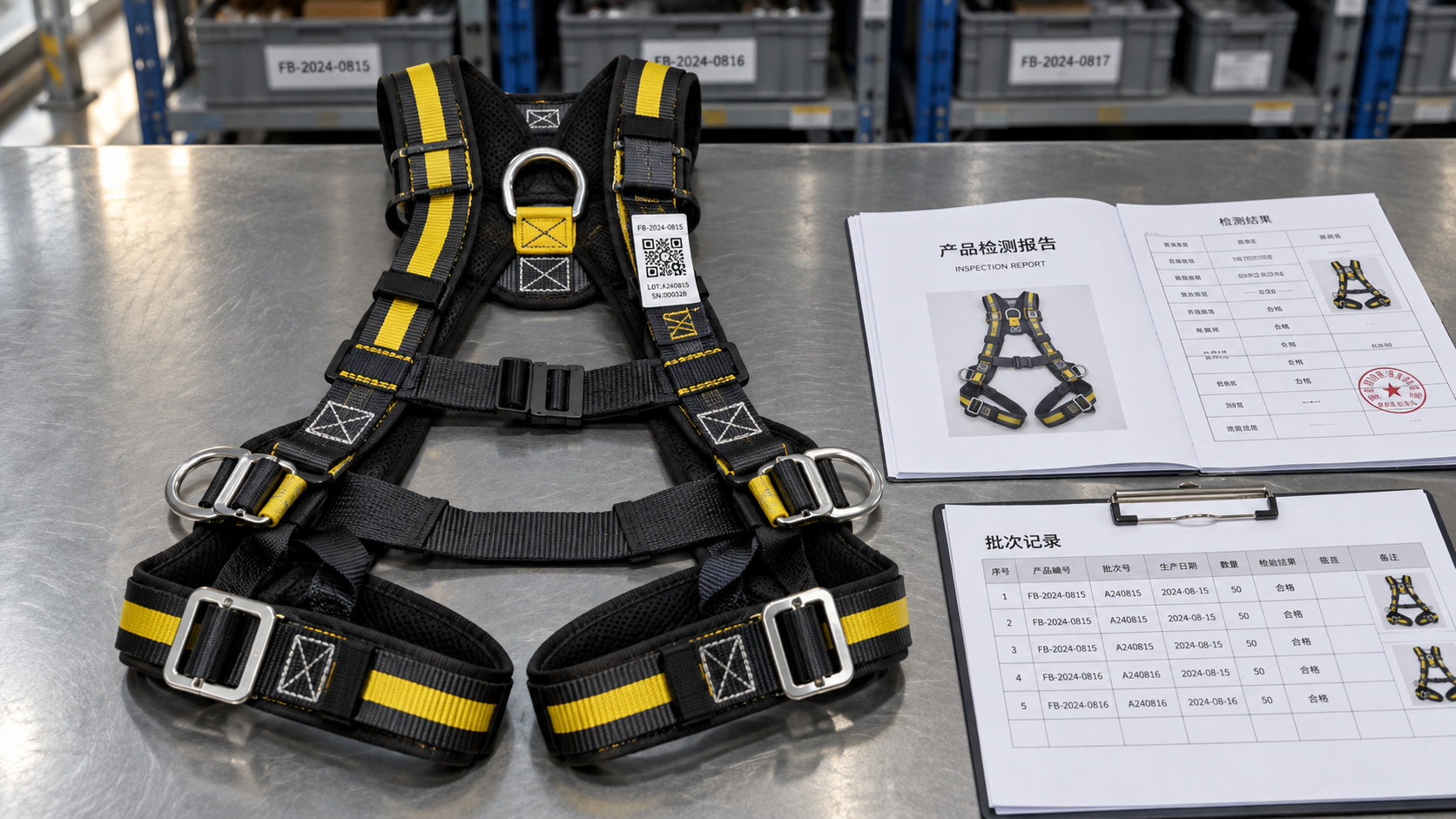
Traceability needs a usable chain: the ordered product must connect to its approved design, production records, and conformity evidence. That chain may use an individual serial number, a batch identifier, or both, depending on the manufacturer's system and applicable requirements. Do not prescribe a particular numbering format without understanding what it retrieves.
Request a label photograph from the actual offered configuration, not a generic catalog rendering. Compare the model designation, manufacturer identity, size, date information, identifiers, and required markings with the report, instructions, and declaration where applicable. Private-label products need a controlled cross-reference explaining how the sales designation relates to the assessed product.
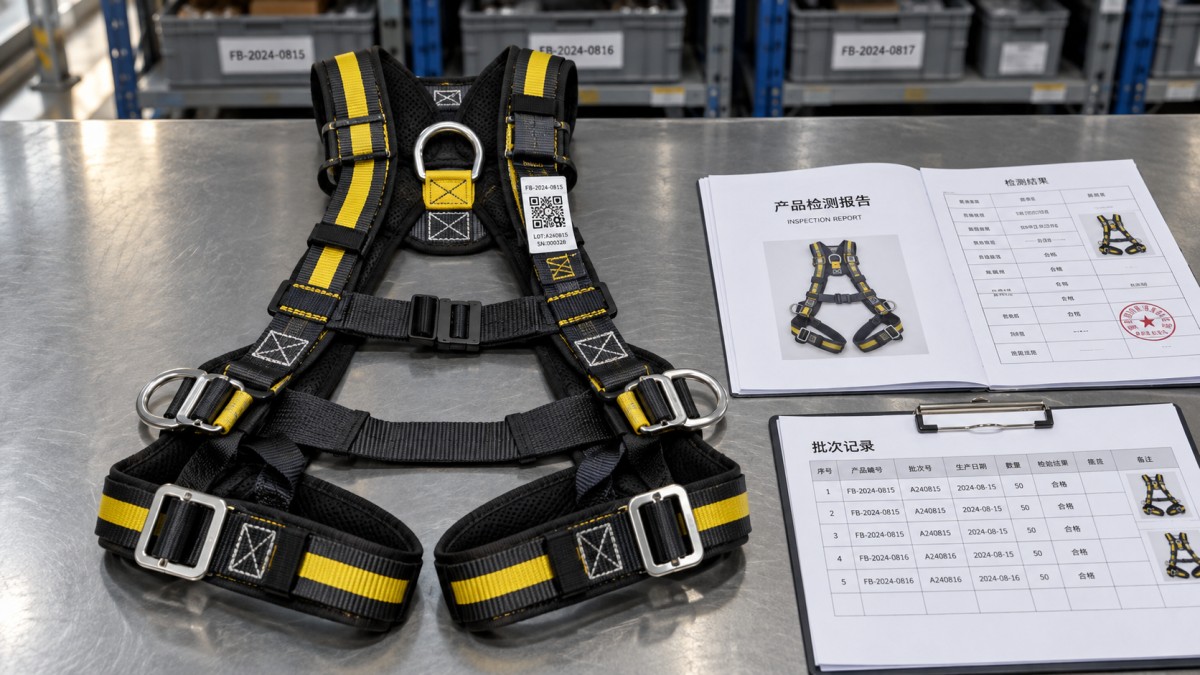
Then run a retrieval exercise. Give the supplier an identifier from a sample and ask what records it can recover. Depending on its production controls, useful records may include the assembly location, webbing and hardware lots, inspection status, and release authorization. Commercially sensitive details can be reviewed under confidentiality arrangements; procurement still needs enough evidence to judge whether traceability works.
The practical test is whether the supplier could identify and contain affected stock if a component defect emerged. If it cannot connect finished units to relevant production inputs, a narrow defect may become a much wider quarantine. That matters when harnesses have already been distributed across several contractors or sites.
Ask what happens when production changes
A sound initial document pack can lose relevance after an uncontrolled substitution. Procurement should ask how the manufacturer evaluates changes to webbing, thread, hardware, stitch patterns, manufacturing locations, and subcontractors. Not every change requires identical action, but safety-relevant changes need a documented assessment and, where required, involvement of the conformity-assessment body.
Put notification and approval requirements into the purchase agreement. Otherwise, the buyer may receive a visibly similar product made to a revised specification without realizing the evidence needs review. Avoid an unrestricted “equivalent materials permitted” clause for load-bearing components.
Distributors need scrutiny too. Establish who is the legal manufacturer, who controls the design, who maintains the technical evidence, and who handles complaints or recalls. A distributor need not own the factory to be dependable. It does need an effective route back to the organization responsible for the product.
Compare the cost of an accepted delivery
The cheapest quotation can become expensive if stock arrives without usable identification or documentation. Compare suppliers on the same acceptance basis: exact configuration, required records, packaging, instructions, inspection access, and the remedy for nonconforming deliveries. Documentation supplied only after final payment leaves the buyer with avoidable leverage problems.
Costs worth making visible include:
- Review costs: independent verification, technical assessment, and any agreed additional testing.
- Receiving costs: label reconciliation, sample inspection, and recording serial or batch identifiers.
- Disruption exposure: quarantine, replacement freight, and delayed equipment availability.
- Lifecycle administration: obtaining instructions, managing inspection records, and responding to safety notices.
For a new source, a controlled initial order can limit exposure while receiving checks and document retrieval are proven. It cannot replace conformity assessment, and visually acceptable samples do not validate an entire production process. Agree the inspection plan and acceptance criteria before shipment; routine receiving checks should not involve improvised loading or destructive testing.
Fit and usability also affect purchasing value. A technically supported harness may still be unsuitable for the workforce, work clothing, or task. Arrange a supervised fit evaluation with the safety team, checking adjustment, attachment access, and the manufacturer's instructions. Product conformity and practical suitability are separate decisions; both must be satisfactory.
Set a release gate, not a paperwork collection target
Global Industrial Core's sourcing focus spans safety equipment and the industrial systems around it. For EPC and facility purchasing, the useful connection is straightforward: safety-critical procurement requires evidence tied to delivered equipment, not merely a well-presented supplier profile.
Before approving a fall protection harness supplier, require closure on three questions: Does the evidence cover the exact product and intended market? Can the supplier trace delivered units through controlled production records? Are substitutions, nonconformities, and safety notices governed by clear responsibilities?
An unexplained model mismatch, unverifiable issuer, or missing production link should keep the order on hold. A clerical discrepancy may be resolvable through corrected, issuer-controlled documentation. Treat those situations differently, but record both decisions. Release the purchase only when the safety reviewer and procurement owner can point to the evidence supporting acceptance—and repeat the identity check when the goods arrive.
Technical Specifications
- Steel Dynamics Reports Q3 2026 Results: Record Shipments and Strong EarningsAuthor :
- Vetting a Fall Protection Harness Supplier: Test Reports and TraceabilityAuthor :Safety Compliance Lead
- Air Handling Unit Supplier Checklist: Performance Data, Lead Times, and SupportAuthor :Environmental Engineering Director
Expert Insights

Chief Security Architect
Dr. Thorne specializes in the intersection of structural engineering and digital resilience. He has advised three G7 governments on industrial infrastructure security.
Related Analysis
- Oct 20, 2026Steel Dynamics Reports Q3 2026 Results: Record Shipments and Strong EarningsAuthor :
- Oct 20, 2026Vetting a Fall Protection Harness Supplier: Test Reports and TraceabilityAuthor :Safety Compliance Lead
- Oct 19, 2026Air Handling Unit Supplier Checklist: Performance Data, Lead Times, and SupportAuthor :Environmental Engineering Director
Core Sector // 01
Security & Safety
- Vetting a Fall Protection Harness Supplier: Test Reports and TraceabilityAuthor :Safety Compliance Lead

- Can One Supplier Provide Both IEC- and ATEX-Certified Safety Equipment?Author :Safety Compliance Lead

- Are Dual IEC and NEC Safety Certifications Worth the Cost?Author :Safety Compliance Lead

- What Is the Difference Between Class I and Class II PPE?Author :Safety Compliance Lead

- Which Oil and Gas Safety Standards Should Contractors Meet Before Site Mobilization?Author :Safety Compliance Lead

- EU REACH Adds PFAS Cap for PPE WorkwearAuthor :Safety Compliance Lead

- How to Evaluate a Chemical Resistant Suit Supplier for Industrial Safety ProcurementAuthor :Safety Compliance Lead

- EU REACH Sets 50 ppb PFAS Cap for PPE WorkwearAuthor :Safety Compliance Lead