How to Choose Confined Space Equipment for Entry, Monitoring, and Rescue
Author
Date Published
Reading Time
Choosing the right confined space equipment is critical for safe entry, accurate atmospheric monitoring, and fast, compliant rescue response. For quality control teams and safety managers, the challenge is balancing regulatory requirements, site conditions, and equipment reliability. This guide outlines how to evaluate essential systems and make practical, standards-aware decisions that reduce risk and support safer industrial operations.
What Safety Managers Really Need to Decide First
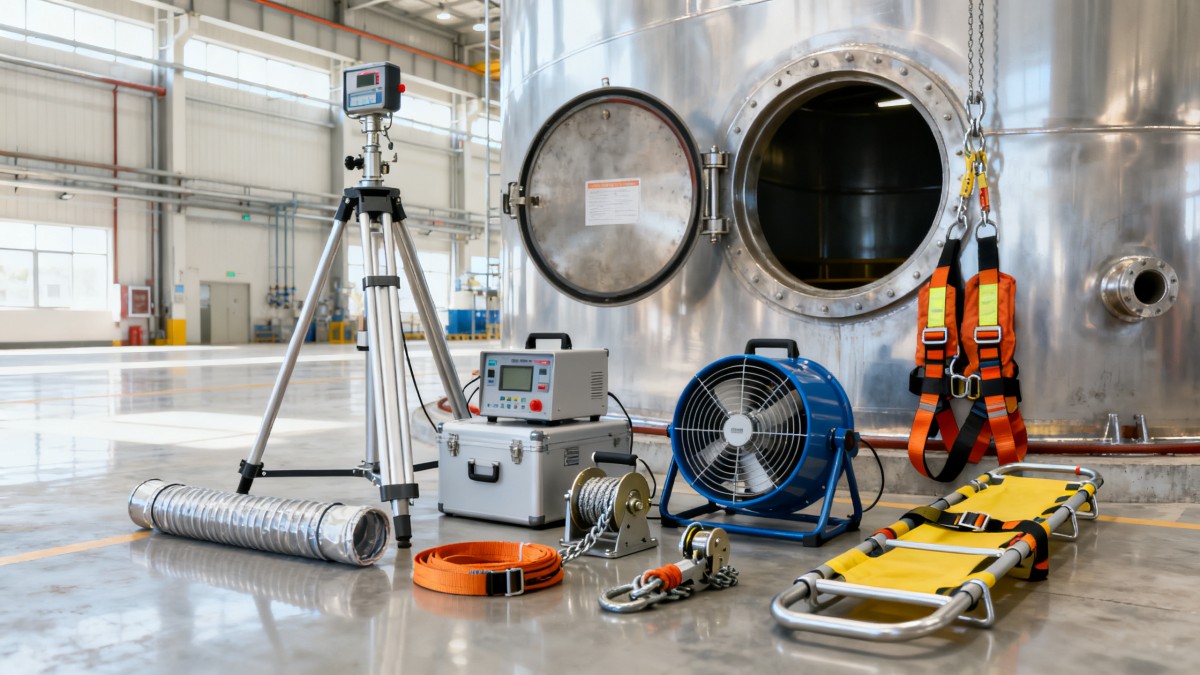
The core search intent behind confined space equipment is practical selection guidance. Readers are not looking for theory alone. They want to know what to buy, how to compare options, and how to avoid unsafe or noncompliant choices.
For quality control personnel and safety managers, the biggest concern is whether equipment will perform reliably during entry, continuous work, and emergency rescue. A weak decision here can lead to exposure, downtime, failed audits, or severe injury.
The best starting point is this: do not choose confined space equipment as a single product category. Choose it as a complete system covering hazard assessment, entry control, atmospheric monitoring, communication, retrieval, and rescue readiness.
That system approach matters because many confined space incidents do not come from one obvious failure. They result from gaps between equipment types, such as good gas detection but poor retrieval setup, or strong procedures but unreliable communication.
Start With the Hazard Profile, Not the Catalog
Before comparing brands or specifications, define the actual confined space conditions at your site. Tanks, silos, vaults, pits, sewers, boilers, and process vessels create very different hazards and equipment needs.
Some spaces primarily present atmospheric risk, including oxygen deficiency, toxic gases, or flammable vapors. Others introduce mechanical hazards, engulfment, poor visibility, heat stress, falling objects, or restricted access that complicates rescue.
Safety managers should classify each space by entry frequency, duration, vertical or horizontal access, likely contaminants, worker mobility, and the feasibility of non-entry rescue. This profile becomes the foundation for equipment selection and procurement.
Quality control teams should also review whether the chosen equipment matches internal permit requirements, calibration practices, inspection records, and relevant standards used by customers, insurers, or external auditors.
How to Choose Equipment for Safe Entry
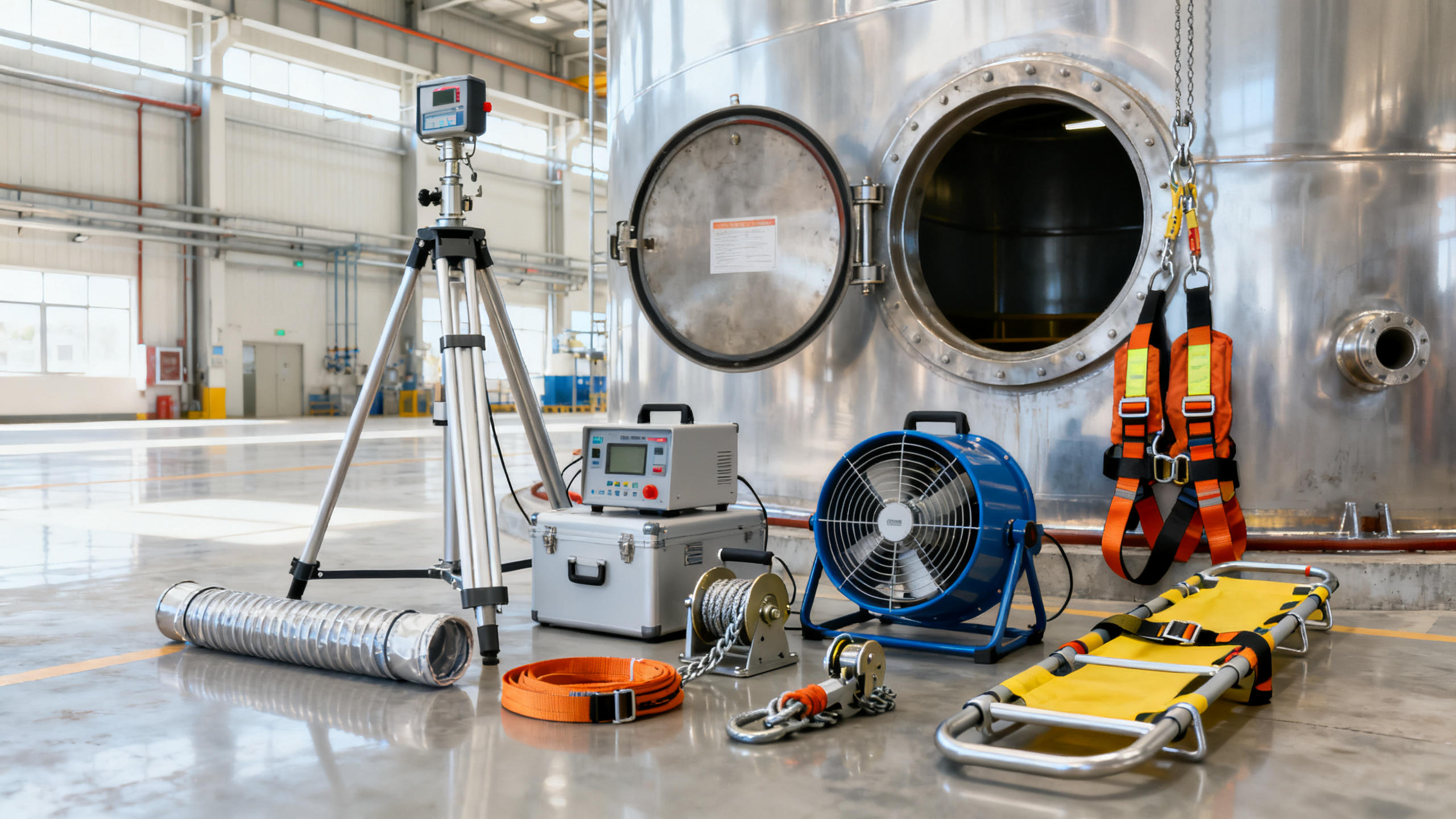
Entry equipment should first support controlled access and worker stability. Depending on the opening and depth, this may include tripod systems, davit arms, winches, self-retracting lifelines, ladder access systems, and anchorage components.
Do not evaluate these items only by load rating. Check compatibility with the actual opening diameter, edge conditions, worker body movement, and the need to lift or retrieve a worker without delay.
For vertical entries, tripods and retrieval devices are common, but they are not universally suitable. Narrow openings, offset entries, or obstructed topside areas may require a davit system with a more adaptable base arrangement.
Harness selection is equally important. A confined space harness should support retrieval without causing unsafe body position during lifting. D-rings, shoulder lift points, comfort, and compatibility with breathing equipment all affect real-world performance.
Lighting is often overlooked during entry planning. Intrinsically safe portable lighting may be necessary where flammable atmospheres are possible. Inadequate visibility increases trip hazards, slows work, and makes emergency response more difficult.
Ventilation equipment should also be treated as an entry enabler, not an optional accessory. Blowers, ducting, and negative or positive airflow arrangements must be sized for the space volume and contaminant behavior.
What Matters Most in Atmospheric Monitoring Equipment
For many buyers, gas detection is the most visible part of confined space equipment. It is also one of the most misunderstood. The right monitor is not simply the model with the most sensors.
You should begin with the expected atmospheric hazards. Many industrial sites require at minimum measurement of oxygen, combustible gases, carbon monoxide, and hydrogen sulfide. Other environments may demand sensors for VOCs, ammonia, sulfur dioxide, or PID-based detection.
Sensor technology matters because response time, cross-sensitivity, temperature tolerance, and maintenance burden vary significantly. A monitor that performs well in a clean utility vault may not be ideal in humid wastewater or chemical processing conditions.
Diffusion monitors may be suitable for some applications, but pump-driven units are often better when pre-entry testing from outside the space is required. Remote sampling helps evaluate stratified atmospheres before workers are exposed.
Continuous monitoring is usually more valuable than a single pre-entry reading. Conditions change during hot work, cleaning, product transfer, sludge disturbance, or ventilation failure. Equipment should support real-time alarms that are audible, visual, and vibrating.
Data logging is another major selection factor for safety managers and quality teams. Logged readings help verify compliance, investigate incidents, and demonstrate that monitoring was active throughout entry operations.
Calibration and bump testing should strongly influence purchasing decisions. A high-spec instrument is a poor investment if your team cannot realistically maintain the testing schedule. Choose monitors with accessible docking, clear records, and manageable service intervals.
Battery life should match the longest likely shift, including delays and standby time. In multi-shift or remote operations, charging logistics can become a hidden weakness in the confined space equipment program.
Do Not Overlook Communication and Worker Accountability
Many confined space events escalate because attendants lose clear contact with entrants. Communication equipment should be chosen based on noise level, signal obstruction, respiratory protection use, and whether workers operate around metal or concrete barriers.
Basic voice contact may be enough for simple entries, but complex spaces often require wired or wireless communication systems integrated with hearing protection or helmets. The key question is whether workers can communicate clearly under stress.
Worker accountability tools can also improve response time. Depending on site risk, this may include entry boards, electronic permit systems, monitor-linked user IDs, or remote alarm notifications to supervisors and rescue teams.
For high-risk facilities, integrated systems that combine gas data, worker status, and location awareness may justify the higher cost. Their value increases where multiple contractors, simultaneous entries, or large shutdown operations create coordination challenges.
How to Evaluate Rescue Equipment Before an Emergency Happens
Rescue capability is where many confined space equipment decisions fail. Organizations may own retrieval devices, stretchers, or breathing apparatus, but still lack a rescue setup that works in the actual space geometry.
The first question is whether non-entry rescue is realistically possible. If it is, retrieval systems should be selected and tested to confirm they can lift a worker through the opening without snagging, rollover, or dangerous body compression.
If entry rescue may be required, equipment planning becomes more demanding. Rescue teams may need supplied-air respiratory protection, escape cylinders, patient packaging equipment, hauling systems, descent devices, and specialized lighting.
Compatibility matters more than quantity. A rescue tripod, harness, winch, stretcher, and breathing system must function together in the limited dimensions of the space. Mixed components from different suppliers can create connection or clearance problems.
Response time is another procurement issue. If your site relies on a municipal rescue service, verify whether that arrangement satisfies local regulations and actual incident conditions. In many industrial settings, internal or contracted standby rescue is necessary.
Safety managers should insist on practical drills before approving any rescue equipment package. Paper compliance is not enough. A rescue system should be proven by timed exercises using realistic access points, dummy loads, and communication constraints.
Compliance, Certification, and Documentation Should Guide Procurement
When selecting confined space equipment, compliance should be treated as a purchasing filter, not a post-purchase checkbox. Requirements may vary by jurisdiction, but equipment must align with applicable occupational safety rules and recognized consensus standards.
For global or multi-site operations, buyers should check whether products carry relevant certifications such as CE marking, UL listing, ATEX ratings, or other approvals needed for hazardous environments and electrical safety expectations.
Documentation quality is a strong indicator of supplier reliability. Look for clear user instructions, inspection criteria, calibration procedures, training support, spare parts availability, and traceable test certificates where applicable.
Quality control personnel should also review serial number traceability, maintenance records, and the supplier’s change control discipline. Consistency matters when equipment is deployed across multiple teams or contractor groups.
A lower purchase price can become expensive if replacement sensors, annual servicing, proprietary batteries, or calibration gas requirements raise total lifecycle cost. Procurement should compare ownership cost, not just initial unit price.
How to Build a Practical Equipment Selection Checklist
A useful confined space equipment checklist should translate risk into buying criteria. Start with the space type, hazard class, access orientation, worker duration, monitoring needs, and rescue method.
Then review equipment by function: access, fall protection, retrieval, gas detection, ventilation, lighting, communication, respiratory protection, and rescue. For each category, confirm compatibility, inspection needs, training demands, and site-specific limitations.
Next, involve the people who actually use the equipment. Entrants, attendants, maintenance supervisors, and rescue personnel often identify issues missed in procurement reviews, such as glove usability, display readability, or poor setup speed.
Field trials are highly valuable before standardizing equipment. A short pilot under realistic conditions can reveal whether alarms are noticeable, pumps respond fast enough, tripods fit common openings, or communication units fail in noisy spaces.
Finally, define acceptance criteria in advance. Safety managers should know what counts as a pass or fail, including detection performance, setup time, retrieval smoothness, documentation quality, and service support responsiveness.
Common Buying Mistakes That Increase Risk
One common mistake is buying confined space equipment by brand familiarity alone. Strong general reputation does not guarantee suitability for your specific hazards, access geometry, or maintenance capacity.
Another is treating monitors as the entire solution. Gas detection is essential, but it does not replace ventilation, communication, harness fit, retrieval planning, or rescue capability.
Many teams also underestimate training burden. Advanced equipment can improve safety, but only if users understand sensor limits, alarm responses, inspection routines, and rescue deployment steps.
A further mistake is separating purchasing from emergency planning. If the rescue team was not consulted during selection, the final equipment package may be technically compliant but operationally ineffective.
Lastly, some organizations fail to revisit assumptions after process changes. New chemicals, altered cleaning methods, temporary shutdown work, or contractor activity can quickly make an older equipment selection inadequate.
Conclusion: Choose a System That Works Under Real Conditions
The right confined space equipment is not defined by the largest feature list or lowest price. It is defined by how well the full system supports safe entry, reliable atmospheric monitoring, and fast, workable rescue in your actual operating environment.
For safety managers and quality control professionals, the strongest approach is to begin with hazards, verify compliance, test equipment compatibility, and evaluate lifecycle support. That method reduces both operational risk and procurement uncertainty.
If a selection decision improves worker protection, stands up to audit review, and performs effectively during drills, it is likely the right one. In confined space safety, practical reliability is the standard that matters most.
Technical Specifications
- How to Select Electronic Hotel Key Card Locks for Guest Rooms and Staff AreasAuthor :Safety Compliance Lead
- How to Select Lab Instruments for Reliable Chemical Analysis WorkflowsAuthor :Precision Metrology Expert
- How to Size a UPS for Server Rooms: Load, Runtime, and Redundancy FactorsAuthor :Grid Infrastructure Analyst
Expert Insights

Chief Security Architect
Dr. Thorne specializes in the intersection of structural engineering and digital resilience. He has advised three G7 governments on industrial infrastructure security.
Related Analysis
- Sep 17, 2026How to Select Electronic Hotel Key Card Locks for Guest Rooms and Staff AreasAuthor :Safety Compliance Lead
- Sep 16, 2026How to Select Lab Instruments for Reliable Chemical Analysis WorkflowsAuthor :Precision Metrology Expert
- Sep 15, 2026How to Size a UPS for Server Rooms: Load, Runtime, and Redundancy FactorsAuthor :Grid Infrastructure Analyst
Core Sector // 01
Security & Safety
- Can One Supplier Provide Both IEC- and ATEX-Certified Safety Equipment?Author :Safety Compliance Lead

- Are Dual IEC and NEC Safety Certifications Worth the Cost?Author :Safety Compliance Lead

- What Is the Difference Between Class I and Class II PPE?Author :Safety Compliance Lead

- Which Oil and Gas Safety Standards Should Contractors Meet Before Site Mobilization?Author :Safety Compliance Lead

- EU REACH Adds PFAS Cap for PPE WorkwearAuthor :Safety Compliance Lead

- How to Evaluate a Chemical Resistant Suit Supplier for Industrial Safety ProcurementAuthor :Safety Compliance Lead

- EU REACH Sets 50 ppb PFAS Cap for PPE WorkwearAuthor :Safety Compliance Lead

- EU Tightens PFOA Limit for PPE and Industrial Filter MediaAuthor :Safety Compliance Lead