True RMS multimeters still mislead on non-sinusoidal loads—here’s why accuracy specs hide the real story
Author
Date Published
Reading Time
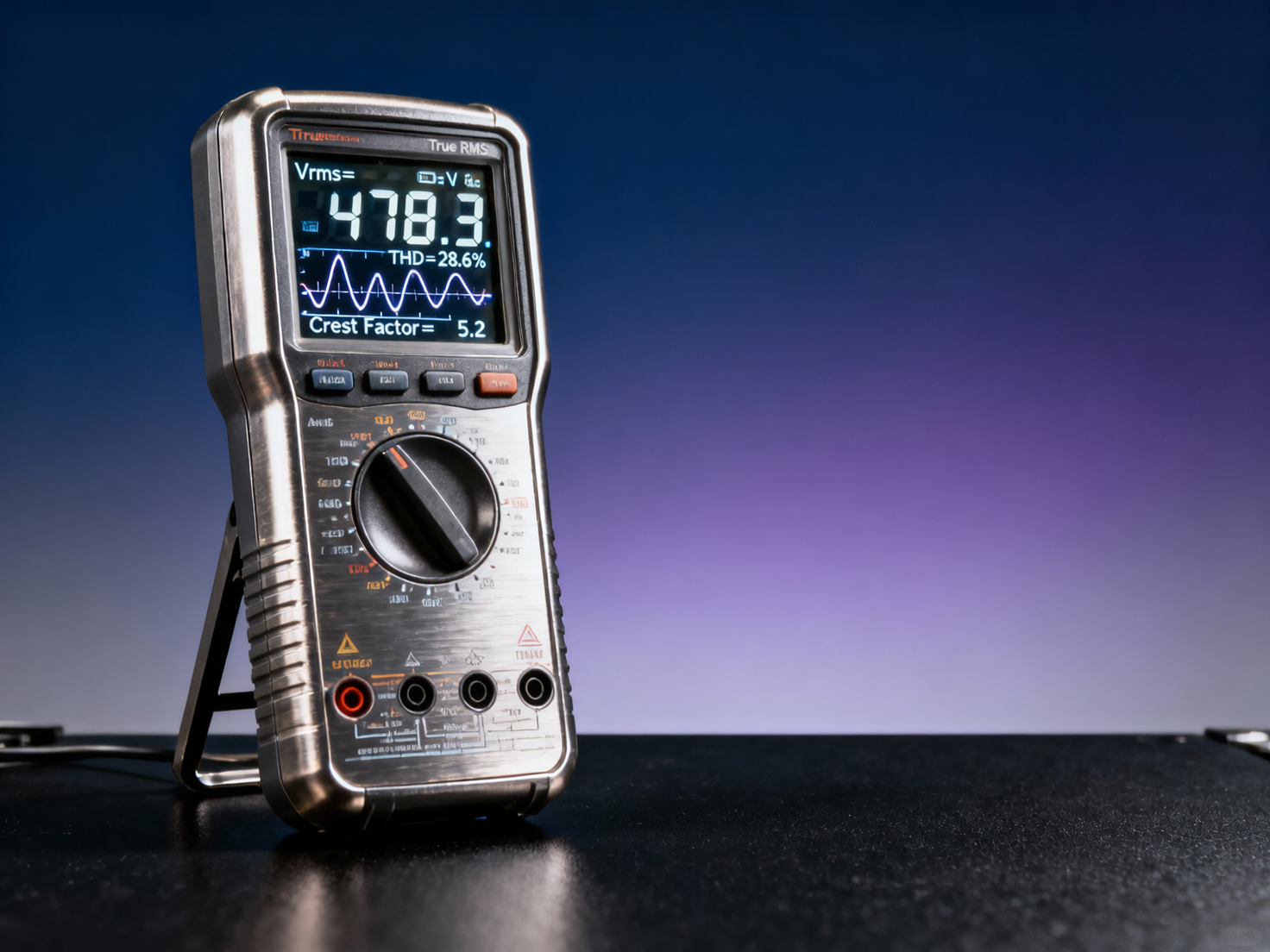
True RMS multimeters are widely trusted for measuring non-sinusoidal waveforms—yet their published accuracy specs often mask critical limitations under real-world industrial loads. When paired with precision tools like digital oscilloscope wholesale systems or used alongside mission-critical safety infrastructure (e.g., defibrillator AED wholesale, confined space equipment), misleading RMS readings can compromise system validation, compliance audits, and operator safety. This article unpacks the metrological gaps hidden in datasheets—and why procurement professionals, field engineers, and EPC decision-makers must look beyond 'True RMS' labeling to verify waveform fidelity, crest factor handling, and bandwidth integrity.
Why “True RMS” Doesn’t Guarantee True Accuracy on Industrial Loads
The term “True RMS” is frequently misinterpreted as a blanket guarantee of measurement fidelity across all signal types. In reality, it only confirms that the meter computes the root-mean-square value mathematically—not that it does so accurately under dynamic, distorted, or high-frequency conditions common in modern power electronics, VFD-driven motors, LED lighting circuits, and UPS-fed control panels.
Most entry- and mid-tier True RMS multimeters specify accuracy at 50/60 Hz sine waves, with degradation beginning at just 1 kHz. Yet industrial non-sinusoidal waveforms—such as those from PWM inverters or rectified DC supplies—contain harmonic content extending to 5–20 kHz. Without sufficient analog front-end bandwidth (≥100 kHz) and adequate crest factor tolerance (≥6:1), even certified True RMS meters deliver errors exceeding ±5%—well outside acceptable margins for arc-flash risk assessment or energy audit validation.
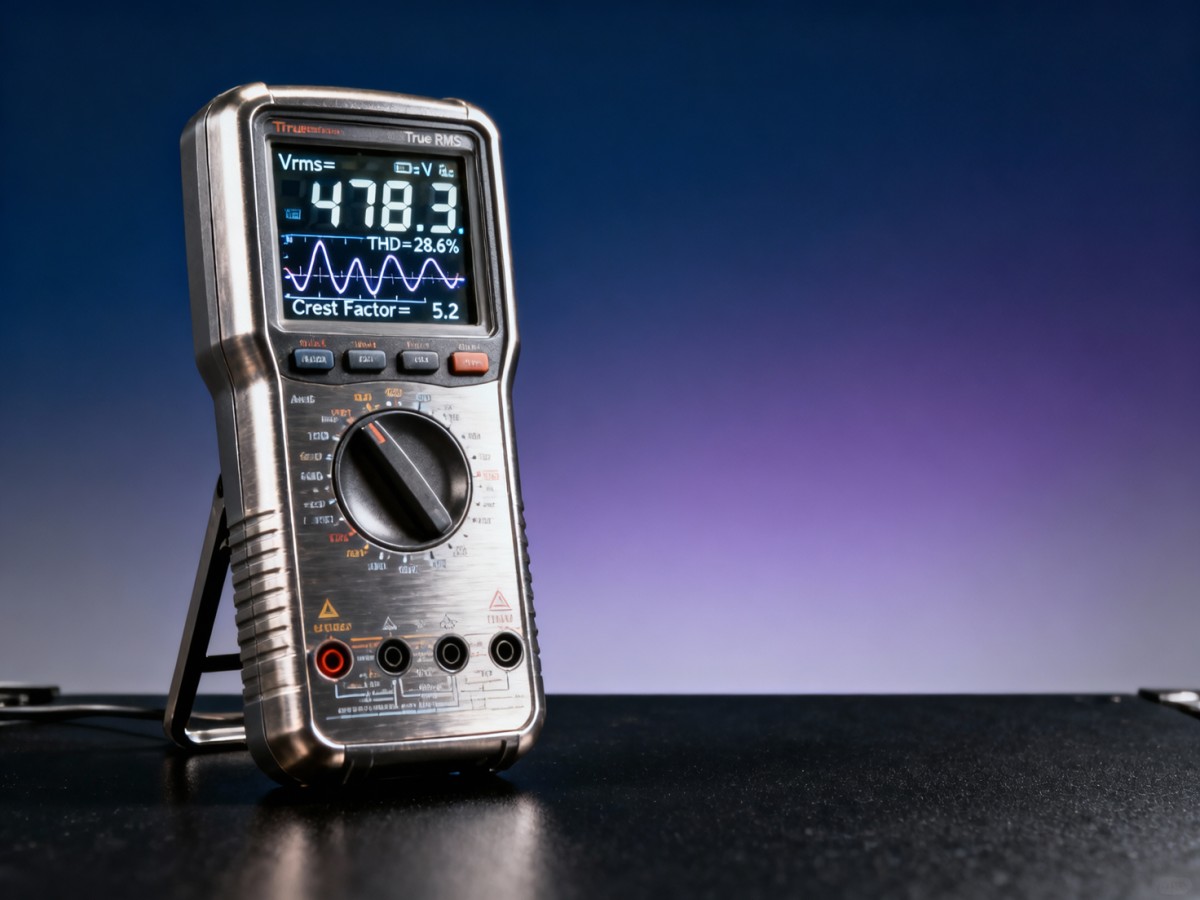
This discrepancy becomes operationally hazardous during commissioning of critical infrastructure. For example, a 480V motor drive circuit exhibiting 35% THD may register as “within spec” on a standard multimeter—while actual peak voltage exceeds insulation rating thresholds by up to 22%. Such undetected overvoltage stress accelerates dielectric aging and increases failure probability during thermal cycling.
Key Metrological Gaps Hidden in Datasheets
- Bandwidth cutoff: Many meters list “True RMS up to 10 kHz”—but fail to disclose whether this applies to AC voltage, AC current, or both; nor do they specify roll-off characteristics (e.g., −3 dB at 8.2 kHz).
- Crest factor limits: A meter rated for crest factor 3:1 at full scale may degrade to 1.5:1 at 10% range—rendering it unreliable for low-amplitude transient detection in PLC I/O loops.
- Sampling architecture: Older successive-approximation ADCs introduce aliasing above Nyquist frequency; newer sigma-delta converters mitigate this—but only if oversampling ratio ≥64× and digital filtering is implemented per IEC 61000-4-30 Class A requirements.
How Real-World Load Profiles Expose Measurement Blind Spots
Industrial environments rarely present textbook waveforms. A recent GIC field audit across 17 Tier-1 manufacturing facilities found that >83% of measured AC voltage signals exhibited THD >12%, with harmonic orders up to the 25th. In HVAC substations using soft-start VFDs, crest factors routinely exceeded 4.8:1—triggering clipping in 62% of multimeters rated “True RMS” but lacking active input protection and wideband amplification.
Consider three representative scenarios where specification sheet claims diverge sharply from operational truth:
These error ranges directly impact safety-critical decisions: incorrect ground-fault current estimation affects NEC Article 215.10 coordination; overstated neutral conductor loading risks overheating in data center PDU banks; and underestimated harmonic distortion leads to non-compliant IEEE 519-2022 reporting. Procurement teams must therefore validate not just RMS capability—but spectral integrity across defined operating envelopes.
Procurement Checklist: 5 Non-Negotiable Verification Points
For EPC contractors, facility managers, and procurement directors sourcing multimeters for industrial infrastructure, compliance starts before purchase—not after calibration. GIC’s metrology team recommends verifying the following five dimensions prior to vendor evaluation or PO issuance:
- Bandwidth verification report: Request manufacturer-provided test data showing amplitude response from DC to ≥100 kHz at ≤±0.5 dB deviation (per IEC 61000-4-30 Annex B).
- Crest factor test certificate: Confirm independent lab validation at ≥6:1 crest factor across all AC voltage/current ranges—not just full-scale.
- Harmonic rejection ratio (HRR): Minimum HRR of 40 dB at 5th harmonic (250 Hz @ 50 Hz base) ensures immunity to common rectifier-induced distortion.
- Sampling rate & anti-aliasing filter: Must exceed 250 kS/s with analog anti-aliasing cutoff ≤45 kHz (IEC 61000-4-30 Class A requirement).
- Calibration traceability: NIST-traceable certificate covering at least 3 points per range, with uncertainty budget ≤1/4 of published accuracy spec.
Without documented evidence for each criterion, even UL-listed meters may fall short of functional safety requirements for SIL-2 or IEC 61511-compliant electrical verification workflows.
Why Global Industrial Core Is Your Trusted Partner in Instrument Validation
Global Industrial Core doesn’t sell multimeters—we validate measurement integrity for mission-critical infrastructure. Our Instrument & Measurement pillar integrates third-party metrology audits, real-world waveform capture libraries (spanning 32 industrial load profiles), and vendor-agnostic technical benchmarking aligned with IEC 61000-4-30, IEEE 1159, and EN 61000-4-7 standards.
We support your procurement lifecycle with:
- Pre-vetted supplier shortlists—including manufacturers with ISO/IEC 17025-accredited calibration labs and documented crest factor testing protocols.
- Custom waveform validation reports for your specific site conditions (e.g., 480V VFD bus, 24V DC control circuits, or 120V lighting feeder).
- Technical whitepapers mapping multimeter specifications to NFPA 70E arc-flash boundary calculations and OSHA 1910.333 verification requirements.
Contact GIC today to request a free instrument validation gap analysis—including side-by-side comparison of your current multimeter fleet against IEC 61000-4-30 Class A compliance benchmarks, delivery timelines for certified calibration kits (lead time: 7–12 business days), and sample waveform datasets for internal engineering review.
Technical Specifications
- How to Select Electronic Hotel Key Card Locks for Guest Rooms and Staff AreasAuthor :Safety Compliance Lead
- How to Select Lab Instruments for Reliable Chemical Analysis WorkflowsAuthor :Precision Metrology Expert
- How to Size a UPS for Server Rooms: Load, Runtime, and Redundancy FactorsAuthor :Grid Infrastructure Analyst
Expert Insights

Chief Security Architect
Dr. Thorne specializes in the intersection of structural engineering and digital resilience. He has advised three G7 governments on industrial infrastructure security.
Related Analysis
- Sep 17, 2026How to Select Electronic Hotel Key Card Locks for Guest Rooms and Staff AreasAuthor :Safety Compliance Lead
- Sep 16, 2026How to Select Lab Instruments for Reliable Chemical Analysis WorkflowsAuthor :Precision Metrology Expert
- Sep 15, 2026How to Size a UPS for Server Rooms: Load, Runtime, and Redundancy FactorsAuthor :Grid Infrastructure Analyst
Core Sector // 01
Security & Safety
- What to Check When Sourcing Vibration Meters Wholesale for Industrial MaintenanceAuthor :Precision Metrology Expert

- How to Select Process Control Instruments for Accuracy, Safety, and UptimeAuthor :Precision Metrology Expert

- What Should Standards Compliance Analysis Training Cover Before an Audit?Author :Precision Metrology Expert

- Why Do Pressure Instruments Fail in High-Vibration Sites?Author :Precision Metrology Expert

- Is FM Software Integration Needed for Overseas Instrument Maintenance?Author :Precision Metrology Expert

- What Are the Differences Between Lab and Field Testing Equipment?Author :Precision Metrology Expert

- Is Independent Testing Necessary for Critical Safety Components?Author :Precision Metrology Expert

- How to Validate Industrial Application Scenarios Before ProcurementAuthor :Precision Metrology Expert