Common Wood Moisture Tester Errors and How to Get Reliable Readings on Different Wood Species
Author
Date Published
Reading Time
Common Wood Moisture Tester Errors and How to Get Reliable Readings on Different Wood Species
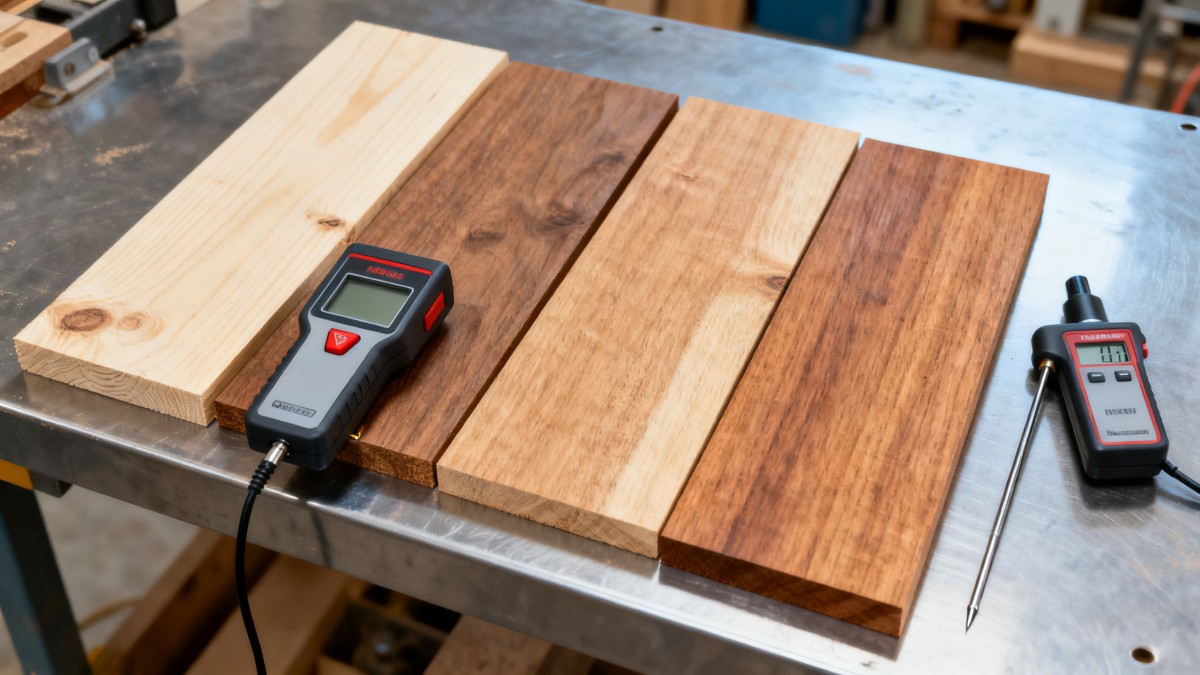
A wood moisture tester can save time, reduce waste, and protect product quality. Still, many readings go wrong for simple reasons.
The biggest issue is not always the device itself. In many cases, the operator uses the right tool in the wrong way.
Wood is not uniform. Species, grain density, temperature, finish, and surface moisture all affect the final number.
That also means one reading alone rarely tells the full story. Reliable results come from method, not guesswork.
This guide explains the most common wood moisture tester errors and how to get dependable readings across softwoods, hardwoods, and mixed stock.
Why wood species changes the reading
A wood moisture tester does not read every species the same way. Density and electrical behavior vary from one wood type to another.
Pine, oak, maple, teak, and walnut can produce different values under similar moisture conditions. That is a common source of confusion.
Pin-type models measure resistance. Pinless models respond to electromagnetic properties. Both can shift when wood structure changes.
If the species correction is skipped, the wood moisture tester may report moisture that looks precise but is actually misleading.
In practical work, this often leads to bad drying decisions, rejected batches, or installation problems later.
What to do
- Check whether the wood moisture tester supports species adjustment.
- Use the correct setting for each species before testing.
- If species is unknown, test a sample area and compare with reference data.
- Keep separate reading records for softwood and hardwood batches.
The most common wood moisture tester errors
Most reading problems come from a handful of repeated mistakes. Once these are controlled, measurement quality improves quickly.
1. Testing only the surface
Surface moisture can be very different from internal moisture. This is common after storage changes, recent machining, or outdoor exposure.
A wood moisture tester may show safe values while the core remains too wet for use.
2. Ignoring temperature effects
Wood temperature affects electrical response. Cold material moved into a warm area often gives unstable or biased results.
This becomes more obvious in winter storage, container unloading, or unconditioned workshops.
3. Using worn or damaged pins
A pin-type wood moisture tester depends on clean contact. Bent, oxidized, or loose pins reduce consistency fast.
The meter may still power on normally, but the measurement path is already compromised.
4. Measuring over coatings or contamination
Paint, oil, dust, adhesive residue, and water droplets can distort readings. Pinless devices are especially sensitive to surface conditions.
If the surface is not clean, the wood moisture tester may reflect the coating more than the wood below.
5. Taking too few measurements
One board can vary from end to end. A single reading is rarely enough for acceptance, drying control, or process release.
This matters even more in mixed species inventory or reclaimed wood.
How to get reliable readings with a wood moisture tester
Better readings usually come from better routine. A few disciplined steps improve repeatability across almost every job.
Start with the right meter type
A pin-type wood moisture tester is useful for depth checks and smaller sections. A pinless model works well for scanning larger surfaces quickly.
If surface marking is unacceptable, pinless testing may be the safer option. If gradient detection matters, pins often help more.
Let the material stabilize
Before testing, let wood adjust to the testing area. Rapid temperature differences reduce confidence in the result.
Even a reliable wood moisture tester cannot fully correct poor sample conditioning.
Test more than one location
Check the center, edges, and ends. For thicker stock, test both faces when possible.
Use the average, then note the highest reading separately. That gives a more realistic view of moisture risk.
Keep the contact consistent
Apply steady pressure with a pinless meter. Insert pins at the correct depth and angle with a pin meter.
Small changes in technique can create surprisingly large differences on dense hardwoods.
Best practices for different wood species
Different species need slightly different habits. The goal is not complexity. The goal is fewer bad calls.
Softwoods
Pine, fir, and spruce often test quickly, but resin pockets and growth variation can affect local readings.
Use several points per board. Avoid relying on one clean-looking area only.
Dense hardwoods
Oak, hickory, maple, and similar hardwoods often need careful species settings. They can punish sloppy technique.
With a wood moisture tester, pressure, pin depth, and calibration matter more as density increases.
Tropical or oily species
Teak and other oily woods can behave differently from domestic species. Surface preparation becomes especially important.
Wipe the test area clean and confirm the meter’s species range before trusting the number.
Engineered or mixed wood stock
Layered products may contain adhesives, veneers, or mixed densities. A wood moisture tester can still help, but interpretation needs caution.
Use multiple scans and compare zones rather than treating one number as absolute.
A simple workflow that improves accuracy
A repeatable process makes the wood moisture tester far more useful in daily work. The steps below are simple but effective.
- Identify the species or the closest valid setting.
- Inspect the surface for coating, dirt, or visible water.
- Allow the wood to reach the test area temperature.
- Take readings from several points on each piece.
- Record average, high point, and unusual variation.
- Recheck any board that shows unexpected spread.
This routine helps spot abnormal boards early. It also reduces disagreement between teams, shifts, or locations.
Quick reference table for better decisions
Final takeaway
A wood moisture tester is only as reliable as the method behind it. Species correction, surface preparation, and repeated measurement make the difference.
When readings guide drying, machining, storage, or installation, small mistakes become expensive very quickly.
Use a consistent workflow, compare multiple points, and treat unusual numbers as signals to investigate, not numbers to force.
That approach helps the wood moisture tester deliver results you can trust across different wood species and real working conditions.
Technical Specifications
- Air Handling Unit Supplier Checklist: Performance Data, Lead Times, and SupportAuthor :Environmental Engineering Director
- Buying Fiberglass Water Tanks Wholesale: Compare Quotes and Delivery CostsAuthor :Environmental Engineering Director
- Choosing an XLPE Power Cable Supplier: Test Reports, Traceability, and Lead TimesAuthor :Grid Infrastructure Analyst
Expert Insights

Chief Security Architect
Dr. Thorne specializes in the intersection of structural engineering and digital resilience. He has advised three G7 governments on industrial infrastructure security.
Related Analysis
- Oct 19, 2026Air Handling Unit Supplier Checklist: Performance Data, Lead Times, and SupportAuthor :Environmental Engineering Director
- Oct 18, 2026Buying Fiberglass Water Tanks Wholesale: Compare Quotes and Delivery CostsAuthor :Environmental Engineering Director
- Oct 17, 2026Choosing an XLPE Power Cable Supplier: Test Reports, Traceability, and Lead TimesAuthor :Grid Infrastructure Analyst
Core Sector // 01
Security & Safety
- Choosing a Bluetooth Total Station: Software Compatibility and Connection RangeAuthor :Precision Metrology Expert

- Material Testing Standards: ASTM E8 vs. ISO 6892-1 for Metal Tensile TestsAuthor :Precision Metrology Expert

- How to Verify Accuracy in Industrial Measurement Data and Test ReportsAuthor :Precision Metrology Expert

- Selecting a Steam Vortex Flow Meter: Sizing, Pressure, and Temperature LimitsAuthor :Precision Metrology Expert

- How to Select an Industrial Infrared Thermometer for Hot, Moving EquipmentAuthor :Precision Metrology Expert

- How to Evaluate a Precision Measurement Equipment Manufacturer for Critical TolerancesAuthor :Precision Metrology Expert

- How to Select an Emissions Monitoring System Analyzer for Compliance ReportingAuthor :Precision Metrology Expert

- Portable Gas Monitor Calibration: How Often Is It Needed for Safe Confined-Space Work?Author :Precision Metrology Expert