Choosing an ELISA Microplate Reader: Wavelengths, Throughput and Plate Formats
Author
Date Published
Reading Time
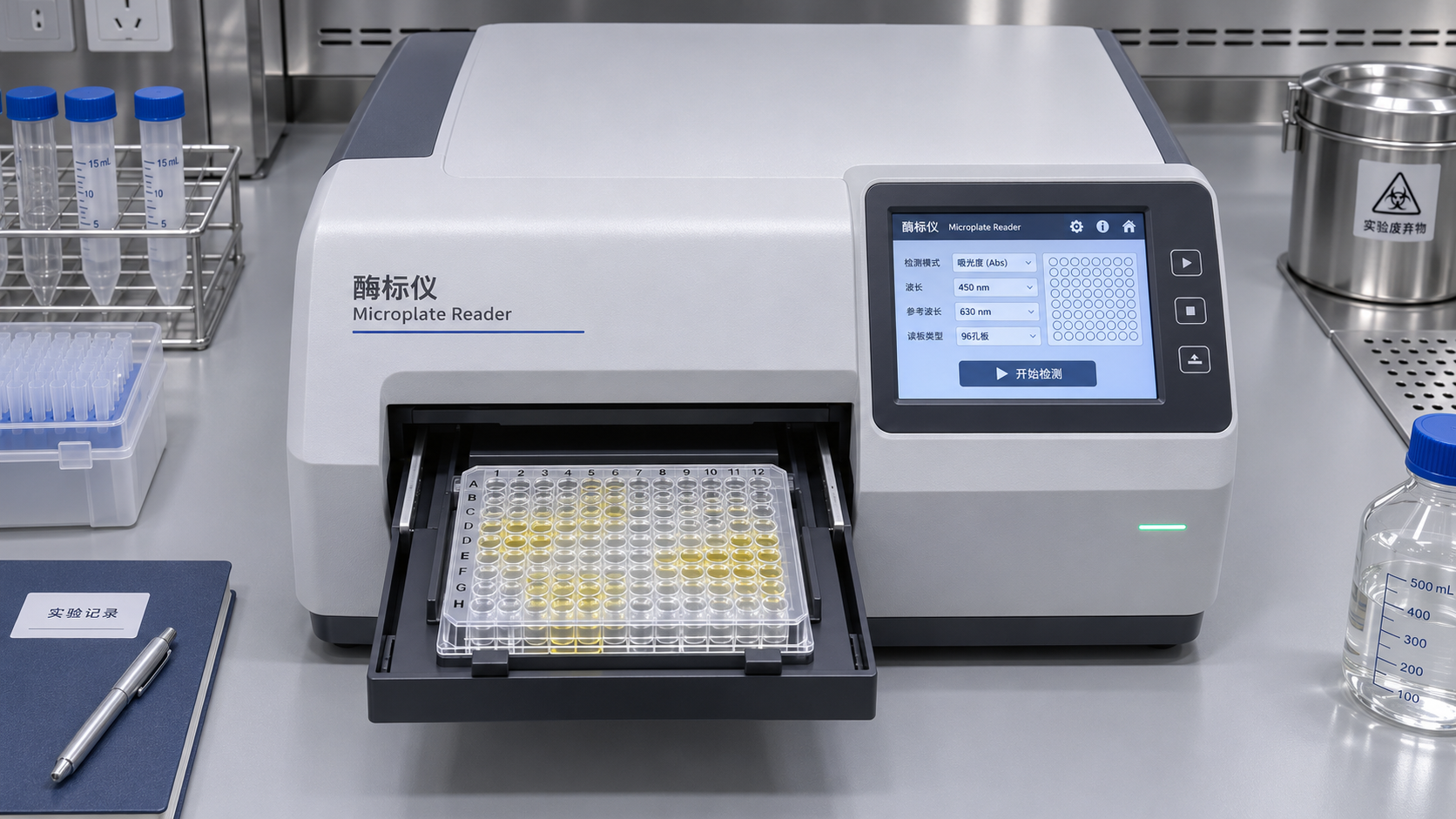
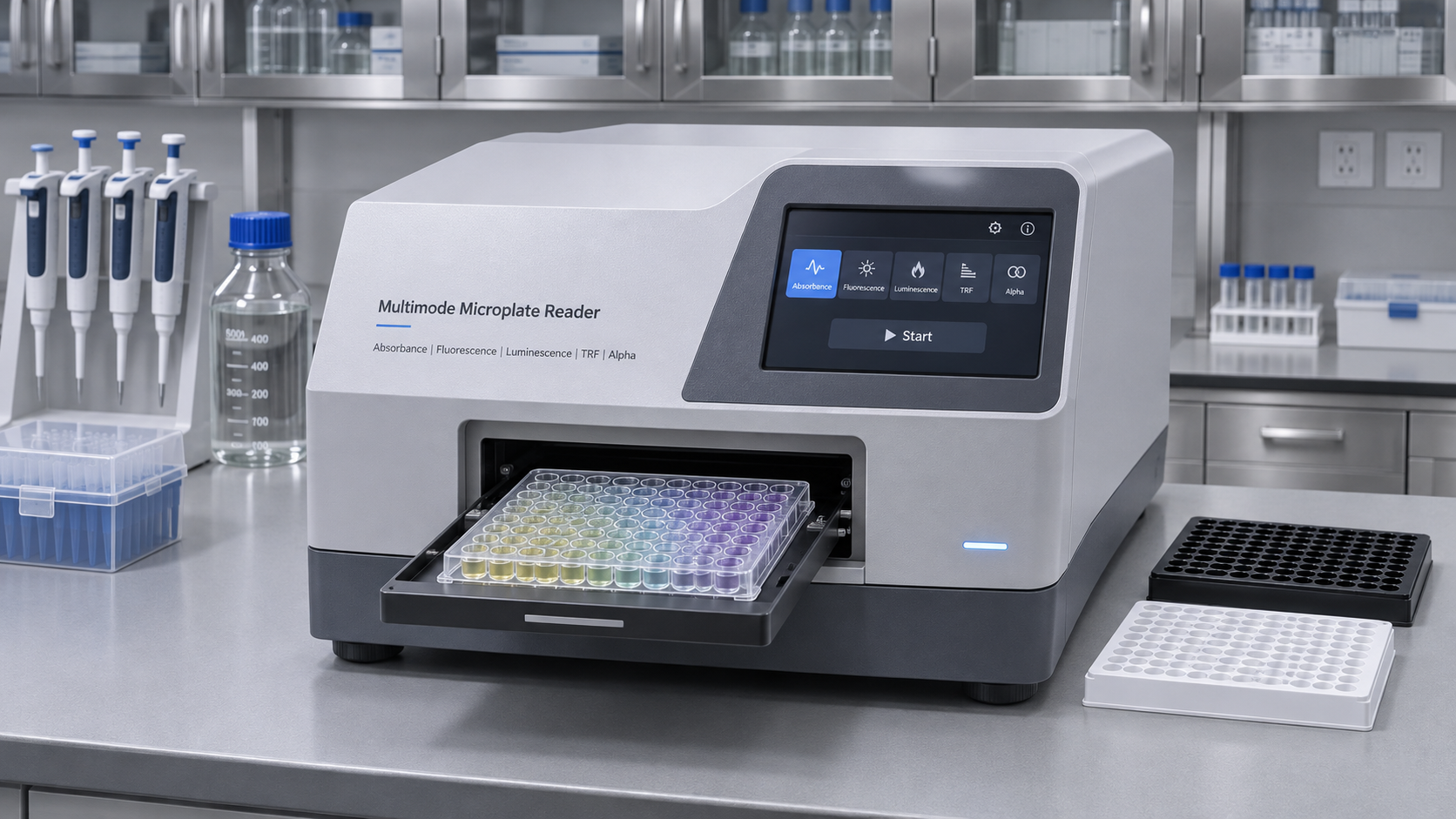
Choosing an ELISA microplate reader requires more than checking its headline specifications. Technical evaluators must determine whether its wavelength range, optical performance, throughput, and plate-format compatibility match current assays and anticipated workloads.
A reader that meets today’s requirements may still limit future methods or create bottlenecks as sample volumes grow. This guide examines the key specifications and practical trade-offs to help you compare instruments with confidence and select a system suited to your laboratory’s needs.
Start with the assay methods your laboratory must run. A suitable reader needs the correct absorbance wavelengths, validated plate compatibility, and sufficient performance across the expected measurement range.
Then assess the complete workflow, including plate preparation, reading, analysis, and reporting. The fastest instrument is rarely the best investment if another step determines daily capacity.
Which wavelengths does an ELISA microplate reader need?
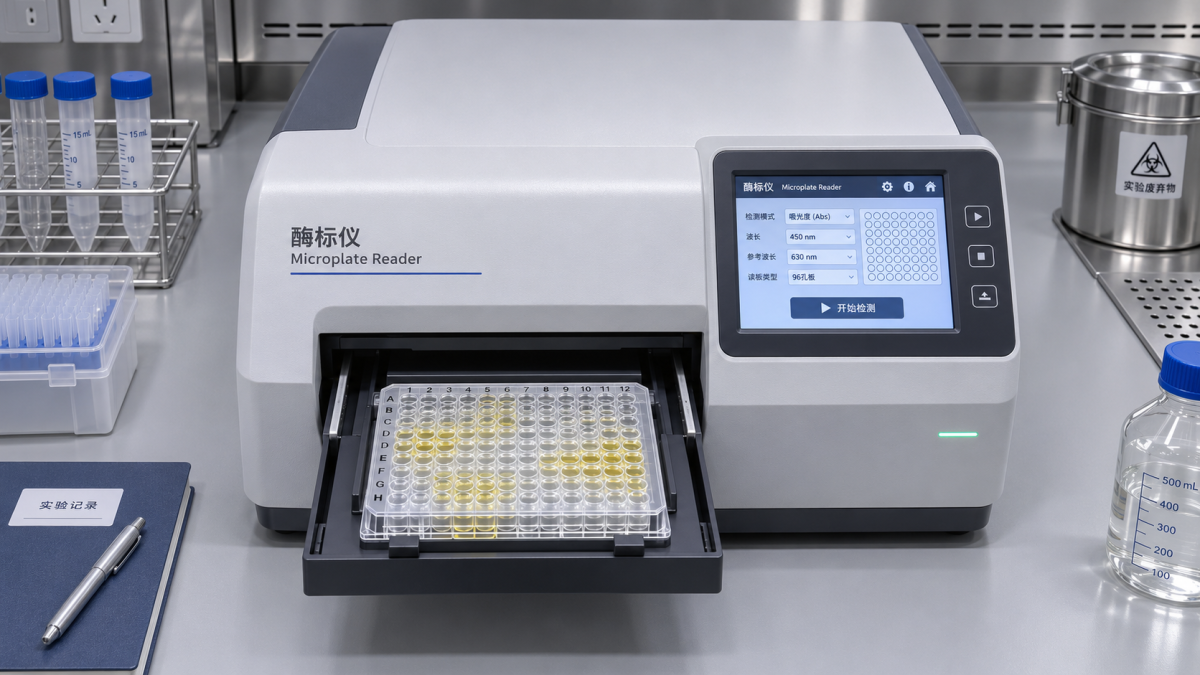
Most conventional ELISAs use absorbance detection: the reader measures how much light passes through each well after an enzyme produces a colored reaction product.
For a common horseradish peroxidase assay using TMB substrate, the stopped reaction is typically measured at 450 nm. Always follow the specific kit instructions.
Other assays may require different wavelengths. For example, alkaline phosphatase assays using pNPP commonly read near 405 nm, depending on the protocol and reaction conditions.
Some protocols also specify a reference wavelength, often around 620–650 nm, to compensate for certain optical effects. The appropriate reference depends on the assay and plate.
A reference reading does not correct every source of error. Bubbles, fingerprints, condensation, inconsistent liquid volumes, and unsuitable plates can still compromise results.
Before requesting quotations, list every primary and reference wavelength required by current methods. Include less common assays and planned protocols, along with their acceptable wavelength tolerances.
Compare that list with the instrument’s installed capabilities. A stated wavelength range alone does not confirm that the required filters are included or that performance is adequate.
Should you choose a filter-based or monochromator-based reader?
Filter-based readers select light using optical filters. They can be a practical choice for laboratories with established assays and a stable set of required wavelengths.
Check which filters are supplied, their center wavelengths and bandwidths, and the cost and availability of additional filters. Confirm how many filters the instrument can hold.
Monochromator-based readers select wavelengths electronically across a specified range. This flexibility can help laboratories developing assays or accommodating protocols with changing wavelength requirements.
Flexibility does not automatically mean better assay performance. Optical design, bandwidth, measurement speed, and sensitivity differ between instruments and should be assessed against actual methods.
Ask vendors to demonstrate performance at your required wavelengths using the intended plates and sample volumes. Compare total ownership costs, including future filters or service requirements.
Which optical specifications affect ELISA results?
Wavelength compatibility is only the starting point. Accuracy, precision, linearity, and usable absorbance range determine whether the instrument can distinguish samples reliably across your assay’s working range.
Photometric accuracy describes how closely a measured absorbance agrees with a known reference. Review the test conditions and absorbance levels behind any published accuracy claim.
Precision describes repeatability under specified conditions. Poor precision makes it harder to distinguish samples near a decision threshold or detect small differences between replicates.
Linearity indicates how consistently reported absorbance tracks changes in signal over a stated range. Performance at low absorbance does not guarantee reliable results near the upper limit.
Compare these specifications with your calibration curves, quality controls, and expected samples. Request data at relevant absorbance levels rather than relying only on headline values.
At high absorbance, little light reaches the detector, making measurements more vulnerable to stray light and other limitations. Confirm the instrument’s validated working range.
If samples exceed the assay or reader’s reliable range, follow the validated dilution or retesting procedure. Do not assume the highest displayed number is analytically useful.
For laboratories handling low signals, ask for repeatability data near the assay’s lower working range. Assess instrument performance alongside the assay’s own variability and detection limits.
How much throughput does your laboratory actually need?
Instrument throughput should be calculated from the entire workflow, not just the manufacturer’s plate read time. Washing, incubation, reagent addition, analysis, and review all consume capacity.
Begin with the number of samples arriving each day, expected peaks, replicate requirements, and the controls and standards needed on each plate.
A 96-well plate has 96 wells, but not all are available for patient or test samples. Duplicates, blanks, standards, and controls reduce usable sample capacity.
For example, if controls and standards occupy 16 wells, the remaining 80 wells accommodate 40 samples in duplicate. Retests and unusable wells reduce practical capacity further.
Next, map the longest steps and any fixed timing requirements. In stopped ELISAs, the interval between adding stop solution and reading can affect consistency if protocols specify limits.
Compare quoted read times under matching conditions: plate format, number of wavelengths, shaking, and any required positioning or analysis. Vendor figures may use different assumptions.
A faster reader helps most when reading is the bottleneck. If washing or manual pipetting limits capacity, improving those steps may deliver a greater benefit.
For variable workloads, test peak-day capacity as well as average demand. Include time for maintenance, quality checks, remeasurement, and unexpected interruptions.
Which plate formats and well types are supported?
Most routine ELISAs use 96-well microplates, but a reader should support the actual plates specified or validated for your methods, not merely the nominal well count.
Confirm compatibility with plate dimensions, height, well geometry, bottom material, and optical clarity. Ask whether lids must be removed and whether adapters are required.
Standard clear, flat-bottom plates are common for absorbance assays. Colored or opaque plates used for other detection methods may be unsuitable for conventional absorbance measurements.
Some instruments support 384-well plates, which can reduce reagent consumption and increase density. However, the assay, pipetting process, and plate must also be validated for that format.
Smaller wells can make dispensing consistency, evaporation, and handling more challenging. A reader’s 384-well capability alone does not establish that an existing 96-well assay will transfer successfully.
Absorbance in a microplate depends partly on the optical path length through the liquid. Changes in well geometry or fill volume can change readings even at identical concentrations.
Some instruments offer pathlength correction, but its suitability depends on the method, sample, and instrument. Follow the assay instructions and validate any correction before routine use.
If using strip wells, half plates, or nonstandard plates, verify mechanical support and software layout options. Test plates from your actual supplier during evaluation.
How should you compare instruments using your own assays?
A vendor demonstration is most useful when it reproduces routine conditions. Prepare a representative test plan before reviewing instruments so every candidate faces the same requirements.
Use the same assay kit or validated method, plate type, volumes, incubation times, and acceptance criteria. Include relevant concentrations across the intended reporting range.
Run blanks, calibration standards, controls, and replicate samples. Where possible, include low and high samples and specimens close to any important decision threshold.
Compare replicate variation, standard-curve behavior, control recovery, and results against your established method. Investigate differences rather than assuming that either instrument is automatically correct.
Document plate position, timing, operator, and environmental conditions. Edge effects and preparation differences can resemble reader problems, so a controlled comparison matters.
Ask the vendor to explain failed or borderline results and repeat testing when justified. Agree in advance on who supplies consumables and interprets the data.
For a new method, establish acceptance criteria with the assay owner or quality team. An instrument comparison does not replace method validation or laboratory-specific verification.
What software and data controls should you check?
The reader’s software should support your plate layouts, blank subtraction, reference readings, standard curves, and result calculations without forcing unnecessary manual transcription.
Review the available curve-fitting models and weighting options against your protocols. Common ELISA analyses may use four-parameter or five-parameter logistic fits, where appropriate.
Check how the software handles replicates, outliers, dilution factors, reruns, and results outside the calibration range. Confirm that exported data retains the necessary context.
For controlled environments, assess user permissions, audit trails, electronic signatures, backup, and data retention against applicable requirements. A vendor claim alone does not establish compliance.
If integration with a laboratory information management system is needed, verify export formats, interfaces, compatibility, and implementation costs. Test a representative data transfer before purchase.
Also confirm licensing terms, supported operating systems, update policies, and access to raw data if a computer or software license must be replaced.
What costs and service risks belong in the comparison?
Compare quotations over the expected service life, including installation, training, qualification, software licenses, filters, preventive maintenance, calibration checks, and service contracts.
Ask which optical verification tools are available, what they check, and how often the laboratory should use them. Distinguish routine user checks from manufacturer servicing.
Review warranty coverage, response times, spare-parts availability, and the location of qualified service personnel. A low purchase price can be costly if downtime disrupts reporting.
For regulated or accredited work, identify the documentation needed for installation, operational checks, and ongoing performance monitoring. Agree responsibilities and costs with the supplier.
Finally, check instrument dimensions, power requirements, network restrictions, cleaning instructions, and environmental operating conditions. Confirm that the proposed location supports reliable daily use.
How to make the final selection
Choose the ELISA microplate reader that satisfies mandatory assay wavelengths, optical performance, and plate compatibility first. Treat these as requirements rather than optional scoring advantages.
Among qualifying instruments, compare demonstrated workflow capacity, software usability, service support, and total ownership cost. Give additional capability weight only when a credible future method needs it.
Base the final decision on documented results from representative assays and plates. This approach connects specifications to reliable measurements and a workflow your laboratory can sustain.
Technical Specifications
- Security and Safety Equipment Standards: How to Identify Applicable RequirementsAuthor :Safety Compliance Lead
- Visayas Grid Again Under Red Alert as Power Supply TightensAuthor :Grid Infrastructure Analyst
- World’s First 35 kV IGBT Static Full-Power Generator Enters OperationAuthor :Grid Infrastructure Analyst
Expert Insights

Chief Security Architect
Dr. Thorne specializes in the intersection of structural engineering and digital resilience. He has advised three G7 governments on industrial infrastructure security.
Related Analysis
- Nov 25, 2026Security and Safety Equipment Standards: How to Identify Applicable RequirementsAuthor :Safety Compliance Lead
- Nov 24, 2026Visayas Grid Again Under Red Alert as Power Supply TightensAuthor :Grid Infrastructure Analyst
- Nov 24, 2026World’s First 35 kV IGBT Static Full-Power Generator Enters OperationAuthor :Grid Infrastructure Analyst
Core Sector // 01
Security & Safety
- Choosing an ELISA Microplate Reader: Wavelengths, Throughput and Plate FormatsAuthor :Precision Metrology Expert

- Choosing a Multimode Microplate Reader: Detection Modes and Assay NeedsAuthor :Precision Metrology Expert

- Choosing a Lint-Free Wipes Factory: How to Evaluate Quality and CapacityAuthor :Precision Metrology Expert

- Buying Lab Incubators Wholesale: MOQs, Lead Times, and Warranty TermsAuthor :Precision Metrology Expert

- Choosing a 5-Part Hematology Analyzer: Throughput, Sample Volume, and QCAuthor :Precision Metrology Expert

- Wholesale Borosilicate Lab Glassware: How Buyers Verify Quality, Specs, and Supply ReliabilityAuthor :Precision Metrology Expert

- How to Select Lab Instruments for Reliable Chemical Analysis WorkflowsAuthor :Precision Metrology Expert

- Buying Lint-Free Wipes in Bulk: How to Match Material and Packaging to Cleanroom UseAuthor :Precision Metrology Expert