SE Asia Raises Tariffs on Industrial Dust Monitors
Author
Date Published
Reading Time
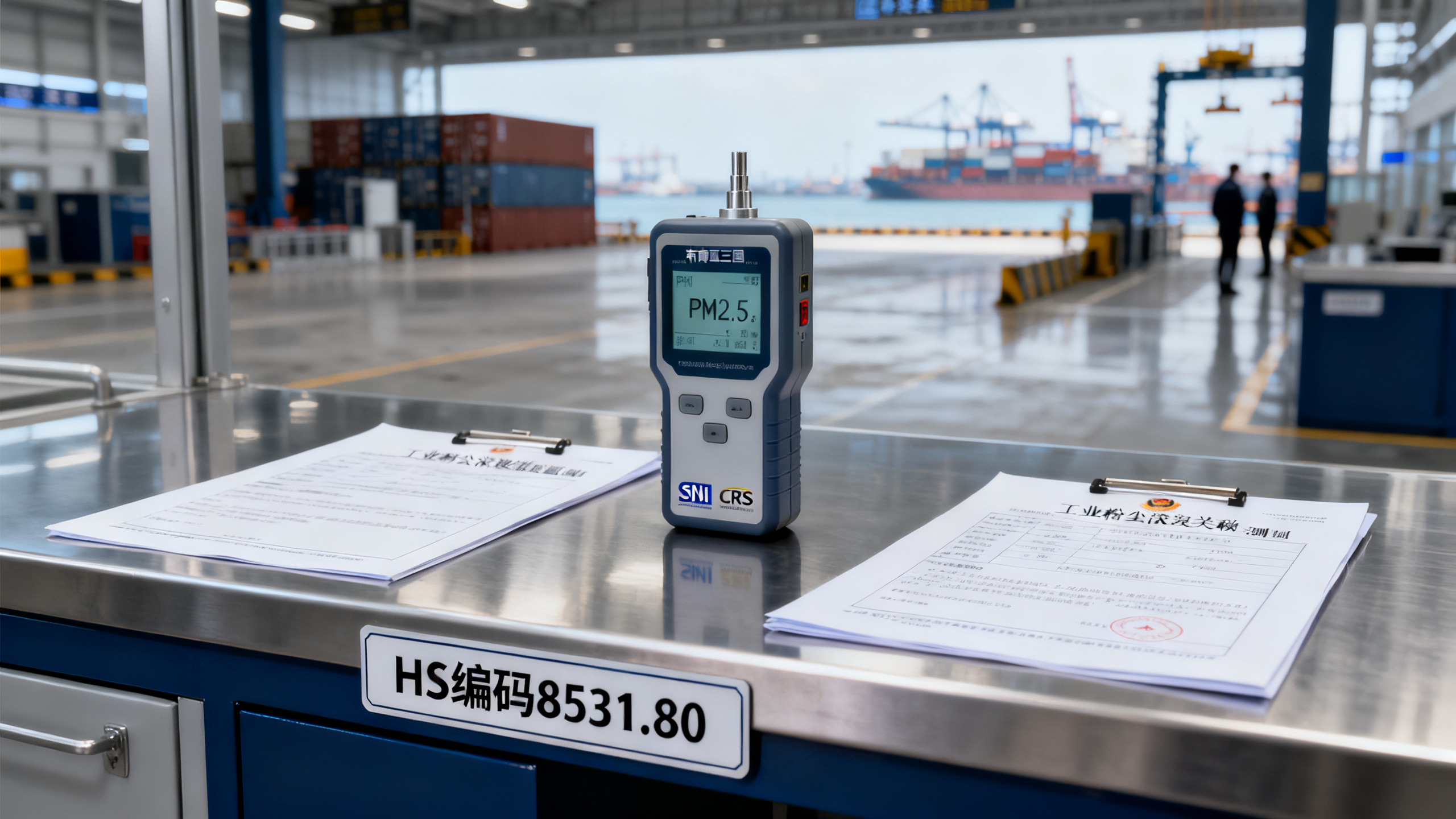
On May 14, 2026, customs authorities in Indonesia, Vietnam, and Thailand jointly increased import duties on industrial dust concentration monitors classified under HS code 8531.80. The move—coupled with newly enforced local conformity assessment requirements—has raised the landed cost for Chinese exporters of air purifiers and dust control equipment by 8–12%, prompting strategic recalibrations across regional supply chains.
Event Overview
On May 14, 2026, the customs administrations of Indonesia, Vietnam, and Thailand simultaneously adjusted import tariff rates for industrial dust concentration monitoring instruments (HS code 8531.80), raising them by 3.5 to 5.2 percentage points. Concurrently, mandatory local certification schemes—including Indonesia’s SNI and Vietnam’s CRS—entered full enforcement. These measures apply uniformly to all imports of such devices, regardless of origin.
Industries Affected
Direct Exporters (Trade Enterprises): Chinese manufacturers and trading companies exporting dust monitors or integrated air purification systems face higher landed costs due to both tariff hikes and extended lead times for local certification. Margins are compressed, especially for mid-tier OEMs without in-country compliance teams; quotation cycles have lengthened by an average of 12–18 days.
Raw Material Procurement Firms: Companies sourcing sensor modules, optical particulate detectors, or calibrated reference components from China for final assembly in ASEAN must now factor in revised landed cost structures. Import declarations under HS 8531.80 now trigger additional documentation reviews, increasing procurement overhead and inventory holding risk.
Contract Manufacturing & Assembly Firms: EMS providers and ODMs operating in Vietnam or Thailand—and previously importing fully assembled monitors from China—are encountering stricter classification scrutiny. Customs authorities are increasingly distinguishing between ‘monitor-only’ units and ‘integrated air system controllers’, leading to inconsistent tariff application and classification disputes.
Supply Chain Service Providers: Logistics firms offering customs brokerage, type-approval facilitation, or lab coordination services report a 30% uptick in client inquiries related to SNI/CRS pathway navigation. However, capacity constraints persist: only four accredited SNI testing labs in Indonesia currently accept third-party submissions for dust monitor calibration validation.
Key Considerations and Response Measures
Review HS Code Classification and Product Scope
Exporters should verify whether their devices fall strictly under HS 8531.80—or may qualify for alternative classifications (e.g., 9027.10 for general-purpose analyzers) based on functional design, data output capability, and integration level. Retrospective classification audits have increased since May 2026.
Accelerate Local Certification Readiness
Firms targeting sustained market access must initiate SNI or CRS applications *before* shipment—not upon arrival. Pre-submission technical dossier reviews (available via authorized representatives) reduce approval timelines from 14 weeks to under 8 weeks in verified cases.
Evaluate Hybrid Sourcing Models
Given rising import costs and certification friction, some exporters are piloting semi-knockdown (SKD) shipments—sending core sensors and firmware separately from enclosures and power modules—to leverage lower-duty categories (e.g., HS 8543.70) while retaining local value-add and certification ownership.
Editorial Perspective / Industry Observation
Observably, this tariff alignment reflects a broader regional shift—not toward protectionism per se, but toward regulatory sovereignty in environmental monitoring infrastructure. Analysis shows that all three countries introduced new national ambient air quality standards in Q1 2026, mandating real-time, certified particulate data for industrial permits. The tariff increase is therefore better understood as a fiscal lever supporting domestic conformity assessment capacity building, rather than a standalone trade barrier. From an industry perspective, the timing suggests policy coordination among ASEAN members on technical regulation is deepening faster than formal tariff harmonization under ATIGA.
Conclusion
This development signals a structural inflection point: compliance is no longer a post-sale administrative step but a core input cost and time variable in market-entry planning. For air quality technology suppliers, success will hinge less on price competitiveness alone and more on embedded regulatory intelligence—spanning classification strategy, certification agility, and local partnership depth.
Source Attribution
Official tariff notices published by: Directorate General of Customs and Excise (Indonesia), General Department of Vietnam Customs, Royal Thai Customs Department. Certification requirements confirmed via SNI Regulation No. 7652:2026 (Indonesia), Decision No. 24/2026/TT-BKHCN (Vietnam), and TISI Announcement 112/2026 (Thailand). Note: Implementation guidance for borderline product classifications remains under consultation; updates expected by August 2026.
Technical Specifications
- How to Select Electronic Hotel Key Card Locks for Guest Rooms and Staff AreasAuthor :Safety Compliance Lead
- How to Select Lab Instruments for Reliable Chemical Analysis WorkflowsAuthor :Precision Metrology Expert
- How to Size a UPS for Server Rooms: Load, Runtime, and Redundancy FactorsAuthor :Grid Infrastructure Analyst
Expert Insights

Chief Security Architect
Dr. Thorne specializes in the intersection of structural engineering and digital resilience. He has advised three G7 governments on industrial infrastructure security.
Related Analysis
- Sep 17, 2026How to Select Electronic Hotel Key Card Locks for Guest Rooms and Staff AreasAuthor :Safety Compliance Lead
- Sep 16, 2026How to Select Lab Instruments for Reliable Chemical Analysis WorkflowsAuthor :Precision Metrology Expert
- Sep 15, 2026How to Size a UPS for Server Rooms: Load, Runtime, and Redundancy FactorsAuthor :Grid Infrastructure Analyst
Core Sector // 01
Security & Safety
- Environmental Technologies for Heavy Industry: Choosing Cleaner Production SolutionsAuthor :Environmental Engineering Director

- Selecting Air Compliance Equipment for Dust, Fumes, and VOC ControlAuthor :Environmental Engineering Director

- EU Rule Tightens EN 1822-2 for Industrial Air PurifiersAuthor :Environmental Engineering Director

- EU Eco-Design Rules Tighten for Air PurifiersAuthor :Environmental Engineering Director

- Low-Maintenance Dust and Fume Control Systems: Best Options for Welding ShopsAuthor :Environmental Engineering Director

- EPA Sets VOC Labeling Rule for Air PurifiersAuthor :Environmental Engineering Director

- Saudi SASO Rule Adds Real-Time Logging for Air SystemsAuthor :Environmental Engineering Director

- Saudi SASO Rules Tighten for Air PurifiersAuthor :Environmental Engineering Director