Ozone Generator Commercial Sizing Guide for Odor Control in Hotels and Offices
Author
Date Published
Reading Time
Why sizing decisions change from one building to another
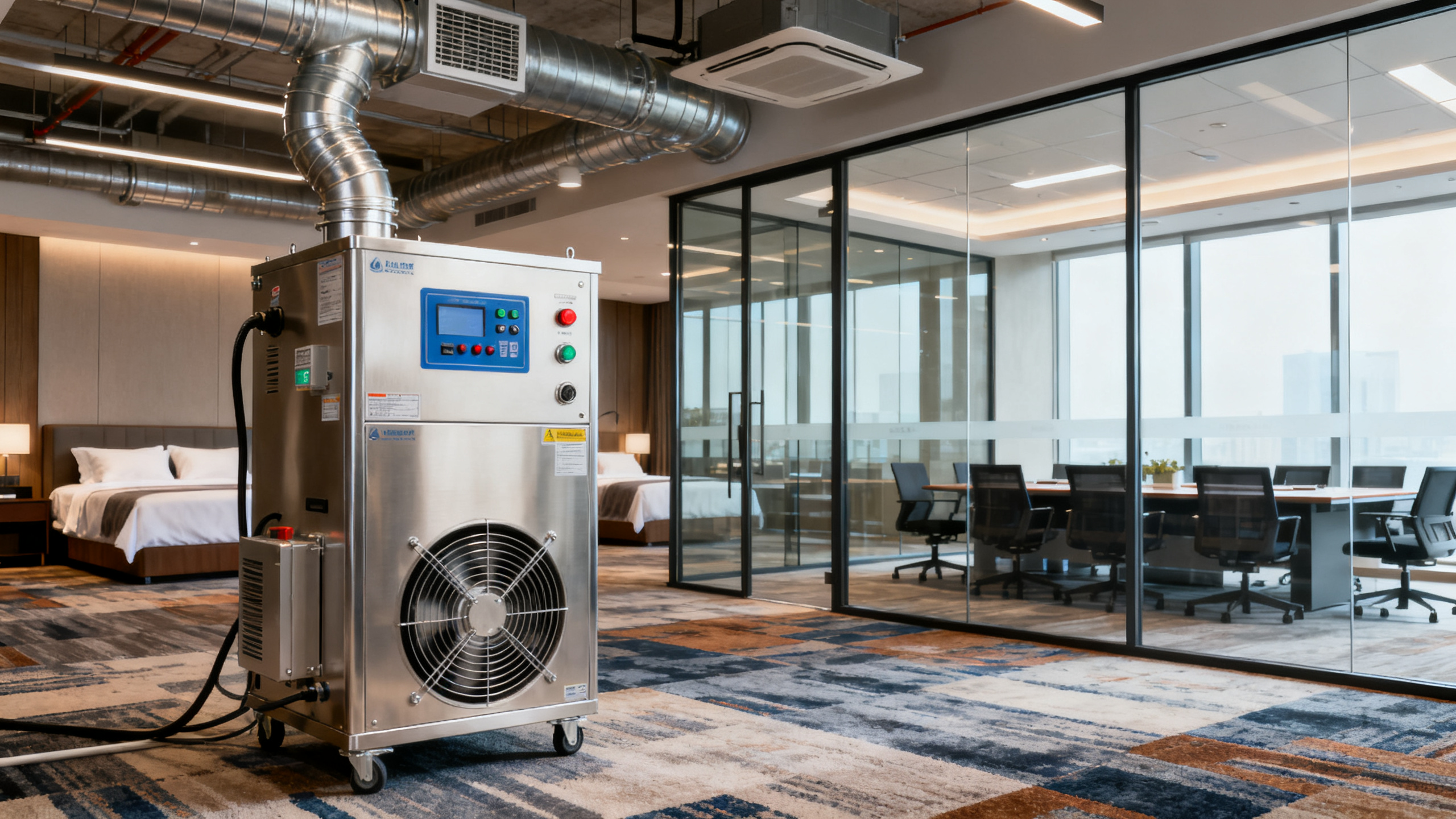
An ozone generator commercial system is often selected too quickly.
Many teams start with floor area, then stop there.
In hotels and offices, odor control rarely behaves that simply.
Air exchange, occupancy rhythm, soft furnishings, and source intensity all change the required output.
That is why a properly sized ozone generator commercial unit affects more than smell reduction.
It also influences treatment time, safety controls, maintenance intervals, and energy use.
In practice, the right choice depends on how the space is used, when treatment can occur, and what standards the site must follow.
This is especially relevant in the broader industrial ecosystem tracked by Global Industrial Core.
Reliable environmental equipment must align with compliance expectations, operational resilience, and measurable performance.
Hotel odor control usually starts with source patterns, not room size alone
Hotels present mixed odor sources within one property.
Guest rooms, corridors, laundry zones, waste rooms, and fitness spaces behave very differently.
A guest room with occasional smoke residue needs a different ozone generator commercial approach than a linen handling area with persistent moisture odor.
The first question is usually exposure pattern.
Is the odor event occasional, repeated, or continuous across the week?
For turnover-based spaces, treatment windows are often short.
That pushes sizing toward faster output, but only with strict vacancy control.
For back-of-house zones, slower and more frequent treatment may be safer and easier to schedule.
Another factor is material load.
Carpets, upholstered headboards, curtains, and mattresses absorb odors and release them gradually.
In these cases, an ozone generator commercial unit that looks adequate on paper may underperform in real use.
Rooms with heavy textile content often need longer treatment cycles rather than simply bigger output.
Where hotels tend to misjudge capacity
- Treating all guest rooms as identical despite different smoking history or humidity levels.
- Ignoring HVAC dilution, which can lower effective ozone concentration during treatment.
- Choosing maximum output without planning re-entry time and ventilation clearance.
- Overlooking rubber, artwork, and sensitive finishes that may react to repeated ozone exposure.
Office environments need a more selective ozone strategy
Offices usually involve lower odor intensity but higher occupancy continuity.
That changes the sizing logic immediately.
A large ozone generator commercial system may remove lingering smells after water intrusion, renovation dust, or pantry-related odor.
Yet it also demands tighter isolation procedures than many office schedules allow.
Open-plan floors are especially tricky.
Odor may seem evenly spread, but the source is often localized.
Using an oversized ozone generator commercial unit across the entire floor can create unnecessary downtime.
A more practical approach is to isolate problem zones.
Meeting rooms, storage areas, copy rooms, and break spaces often have different ventilation patterns.
That means the same rated machine can behave differently from one enclosed zone to another.
In office settings, treatment scheduling matters as much as output range.
Night use, weekend use, and post-renovation use each support different sizing decisions.
The most useful comparison is operational, not just technical
The table below highlights why hotels and offices rarely need the same ozone generator commercial selection logic.
This comparison matters because equipment ratings alone do not describe operational fit.
A technically strong ozone generator commercial unit can still be a poor site match if clearance time disrupts the building routine.
Before choosing output, confirm the conditions that change real performance
In actual projects, four conditions usually reshape sizing assumptions.
- Air changes per hour, including fresh-air intake and leakage paths.
- Odor source type, such as smoke, mold residue, food waste, or chemical off-gassing.
- Surface load, especially porous materials that retain odor compounds.
- Access restrictions, re-entry protocols, and local safety requirements.
These checks are consistent with the evidence-based procurement mindset promoted by Global Industrial Core.
Environmental technology should be judged through measurable operating conditions, not only brochure capacity.
It is also worth confirming certification pathways.
For any ozone generator commercial investment, CE, UL, and documented safety controls support better risk management.
Timer functions, remote shutdown, warning indicators, and maintenance access are not secondary details.
They directly affect whether the machine can be used consistently without operational friction.
Common sizing mistakes usually come from oversimplified assumptions
One common mistake is treating ozone output as a direct substitute for root-cause correction.
If drainage, moisture intrusion, or waste handling remains unresolved, even a strong ozone generator commercial setup will deliver temporary results.
Another mistake is selecting one machine size for every building zone.
That may simplify purchasing, but it often complicates use.
Portable mid-range units can be more adaptable than one oversized device when layouts vary widely.
A third issue is ignoring maintenance burden.
Plate cleaning, filter condition, fan reliability, and spare part access affect long-term treatment consistency.
For multi-site operators, this becomes a lifecycle issue rather than a simple purchase decision.
A practical review checklist
- Map spaces by odor severity, occupancy pattern, and ventilation profile.
- Define acceptable treatment time and re-entry delay for each zone.
- Check material compatibility and protection needs for sensitive finishes.
- Compare service access, consumables, and expected maintenance frequency.
- Verify safety documentation and operating controls before approval.
A better next step is to build a site-specific sizing standard
The most reliable ozone generator commercial decision usually comes from a short internal sizing framework.
Start with zone categories rather than a single building-wide assumption.
Then match each category to odor intensity, ventilation behavior, vacancy access, and material sensitivity.
That approach makes it easier to compare options on real operating value.
For hotels, focus on turnover timing, soft-surface load, and repeat-treatment practicality.
For offices, focus on localized deployment, after-hours use, and clearance management.
If the goal is resilient odor control, the decision should combine output, safety, maintenance, and workflow fit.
That is where a well-evaluated ozone generator commercial system becomes part of smarter facility management rather than a short-term fix.
The next useful move is simple.
Document the actual spaces, compare the constraints, and test sizing assumptions against real treatment windows before final selection.
Technical Specifications
- How to Select Electronic Hotel Key Card Locks for Guest Rooms and Staff AreasAuthor :Safety Compliance Lead
- How to Select Lab Instruments for Reliable Chemical Analysis WorkflowsAuthor :Precision Metrology Expert
- How to Size a UPS for Server Rooms: Load, Runtime, and Redundancy FactorsAuthor :Grid Infrastructure Analyst
Expert Insights

Chief Security Architect
Dr. Thorne specializes in the intersection of structural engineering and digital resilience. He has advised three G7 governments on industrial infrastructure security.
Related Analysis
- Sep 17, 2026How to Select Electronic Hotel Key Card Locks for Guest Rooms and Staff AreasAuthor :Safety Compliance Lead
- Sep 16, 2026How to Select Lab Instruments for Reliable Chemical Analysis WorkflowsAuthor :Precision Metrology Expert
- Sep 15, 2026How to Size a UPS for Server Rooms: Load, Runtime, and Redundancy FactorsAuthor :Grid Infrastructure Analyst
Core Sector // 01
Security & Safety
- Environmental Technologies for Heavy Industry: Choosing Cleaner Production SolutionsAuthor :Environmental Engineering Director

- Selecting Air Compliance Equipment for Dust, Fumes, and VOC ControlAuthor :Environmental Engineering Director

- EU Rule Tightens EN 1822-2 for Industrial Air PurifiersAuthor :Environmental Engineering Director

- EU Eco-Design Rules Tighten for Air PurifiersAuthor :Environmental Engineering Director

- Low-Maintenance Dust and Fume Control Systems: Best Options for Welding ShopsAuthor :Environmental Engineering Director

- EPA Sets VOC Labeling Rule for Air PurifiersAuthor :Environmental Engineering Director

- Saudi SASO Rule Adds Real-Time Logging for Air SystemsAuthor :Environmental Engineering Director

- Saudi SASO Rules Tighten for Air PurifiersAuthor :Environmental Engineering Director