India Waives Cotton Duty, Lifting Filter Media Demand
Author
Date Published
Reading Time
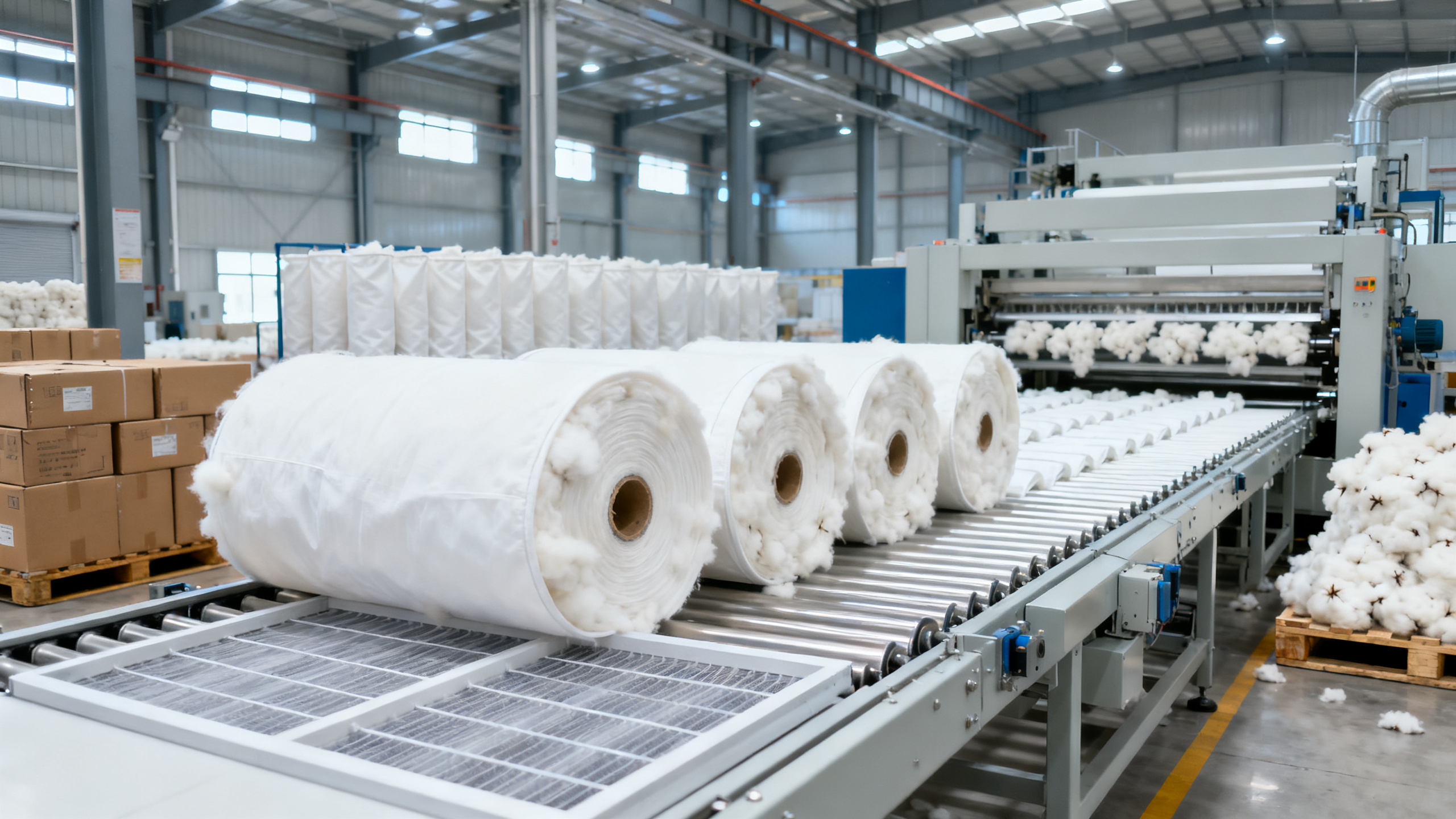
On June 1, 2026, India announced a temporary waiver of the 11% import duty on raw cotton through October 30 to address a domestic shortfall of 4.5 million bales. For the filtration and protective materials market, the move deserves attention because it directly affects cotton-based industrial filter media costs, may accelerate local sourcing around air purification, dust control, and PPE manufacturing in India, and creates a near-term OEM opportunity window for Chinese filter material exporters.
What the policy change confirms
According to the provided information, the Indian government has temporarily removed the 11% import tariff on raw cotton from June 1 to October 30, 2026. The stated purpose is to ease a domestic cotton gap of 4.5 million bales. The same information indicates that lower raw cotton costs are expected to reduce the cost of cotton-based industrial filtration materials, including primary-efficiency air filter bags and base materials used in PPE mask meltblown-related applications. It also states that the measure may support faster localization of supporting supply chains in India for Air Purifiers & Dust and PPE & Workwear, while opening an OEM order window for Chinese filter media exporters.
Where the impact may appear first
Raw material and filter media procurement
From an industry perspective, procurement teams are likely to be the first to react because the policy directly changes the landed cost logic for cotton inputs. The main business impact may appear in quotation cycles, sourcing decisions, and the timing of purchase commitments for cotton-based filtration materials.
Manufacturing linked to air and dust filtration
Analysis shows that processors serving air purification and dust-control applications may pay closer attention to whether lower input costs improve the feasibility of local conversion and assembly in India. What deserves closer attention is not only material cost, but also whether customers begin adjusting product mix toward cotton-based or cotton-linked filtration components.
PPE and workwear supply chains
Observably, suppliers connected to PPE and workwear may see changes in inquiry patterns if lower raw cotton costs improve the economics of related protective material sourcing. The immediate effect, if any, would likely be felt in sample requests, OEM discussions, and local supporting arrangements rather than in confirmed long-term structural change.
Chinese OEM and export-oriented suppliers
For Chinese filter material exporters, the provided information points to a possible OEM window. Analysis shows that this matters mainly at the customer-development and order-conversion stage: suppliers may receive more interest from buyers seeking short-cycle cooperation while India’s local supporting network adjusts to the policy period.
What companies should monitor now
Watch the exact policy implementation window
The temporary nature of the waiver is a practical issue. Companies should track whether official wording, applicable product treatment, or implementation details change during the June 1 to October 30 period, because a short-term tariff adjustment does not automatically translate into stable long-term procurement planning.
Separate policy signal from actual order flow
Analysis shows that a supportive policy headline and real purchasing conversion are not the same thing. Businesses should pay attention to whether inquiries turn into repeat orders, whether customers accelerate sampling or OEM negotiations, and whether demand is concentrated in a few product categories such as primary filter bags or PPE-related material inputs.
Prepare documentation and delivery communication
For suppliers pursuing India-related business, operational readiness may matter as much as pricing. What deserves closer attention is whether supplier qualification files, product specifications, shipment documentation, and delivery-cycle communication are ready for buyers that may move faster during a temporary sourcing window.
Review customer conversations around localization
The information provided suggests faster localization support in India may be encouraged. Companies should therefore pay attention to whether customers are asking only for exports, or for broader OEM and local-support arrangements that could affect production planning, cooperation models, and after-order coordination.
Why this looks like a tactical signal, not a settled trend
Analysis shows that this development is better understood as a short-cycle industry signal rather than a fully established long-term shift. The policy has a defined time frame, and the current information confirms intent and potential direction, but not the final scale of downstream demand changes. From an industry perspective, the key reason to keep watching is that raw material relief can influence sourcing behavior quickly, while deeper supply-chain restructuring usually requires more evidence from actual orders, execution pace, and follow-up policy signals.
How to read the development at this stage
At this stage, the most balanced reading is that India’s temporary cotton duty waiver may improve cost conditions for cotton-based industrial filtration and protective materials and may create a practical opening for OEM and sourcing activity tied to India. It is more appropriate to understand this as a near-term market adjustment with meaningful implications for procurement, quotations, and customer engagement, while reserving judgment on whether it becomes a broader structural trend.
Basis of this article and points for follow-up
This article is generated from the user-provided news title, event date, and event summary. For developments of this type, commonly relevant source categories may include official government announcements, company disclosures, industry association updates, authoritative media reporting, and standard-setting documents. A specific official source link was not provided in the input, so the precise source path still requires ongoing verification. Follow-up attention should remain on any updated official wording, implementation details during the waiver period, and whether downstream sourcing and OEM activity shows sustained conversion.
Technical Specifications
- How to Select Electronic Hotel Key Card Locks for Guest Rooms and Staff AreasAuthor :Safety Compliance Lead
- How to Select Lab Instruments for Reliable Chemical Analysis WorkflowsAuthor :Precision Metrology Expert
- How to Size a UPS for Server Rooms: Load, Runtime, and Redundancy FactorsAuthor :Grid Infrastructure Analyst
Expert Insights

Chief Security Architect
Dr. Thorne specializes in the intersection of structural engineering and digital resilience. He has advised three G7 governments on industrial infrastructure security.
Related Analysis
- Sep 17, 2026How to Select Electronic Hotel Key Card Locks for Guest Rooms and Staff AreasAuthor :Safety Compliance Lead
- Sep 16, 2026How to Select Lab Instruments for Reliable Chemical Analysis WorkflowsAuthor :Precision Metrology Expert
- Sep 15, 2026How to Size a UPS for Server Rooms: Load, Runtime, and Redundancy FactorsAuthor :Grid Infrastructure Analyst
Core Sector // 01
Security & Safety
- Environmental Technologies for Heavy Industry: Choosing Cleaner Production SolutionsAuthor :Environmental Engineering Director

- Selecting Air Compliance Equipment for Dust, Fumes, and VOC ControlAuthor :Environmental Engineering Director

- EU Rule Tightens EN 1822-2 for Industrial Air PurifiersAuthor :Environmental Engineering Director

- EU Eco-Design Rules Tighten for Air PurifiersAuthor :Environmental Engineering Director

- Low-Maintenance Dust and Fume Control Systems: Best Options for Welding ShopsAuthor :Environmental Engineering Director

- EPA Sets VOC Labeling Rule for Air PurifiersAuthor :Environmental Engineering Director

- Saudi SASO Rule Adds Real-Time Logging for Air SystemsAuthor :Environmental Engineering Director

- Saudi SASO Rules Tighten for Air PurifiersAuthor :Environmental Engineering Director