Choosing Self-Locking Nylon Cable Ties: Strength, Size and UV Exposure
Author
Date Published
Reading Time
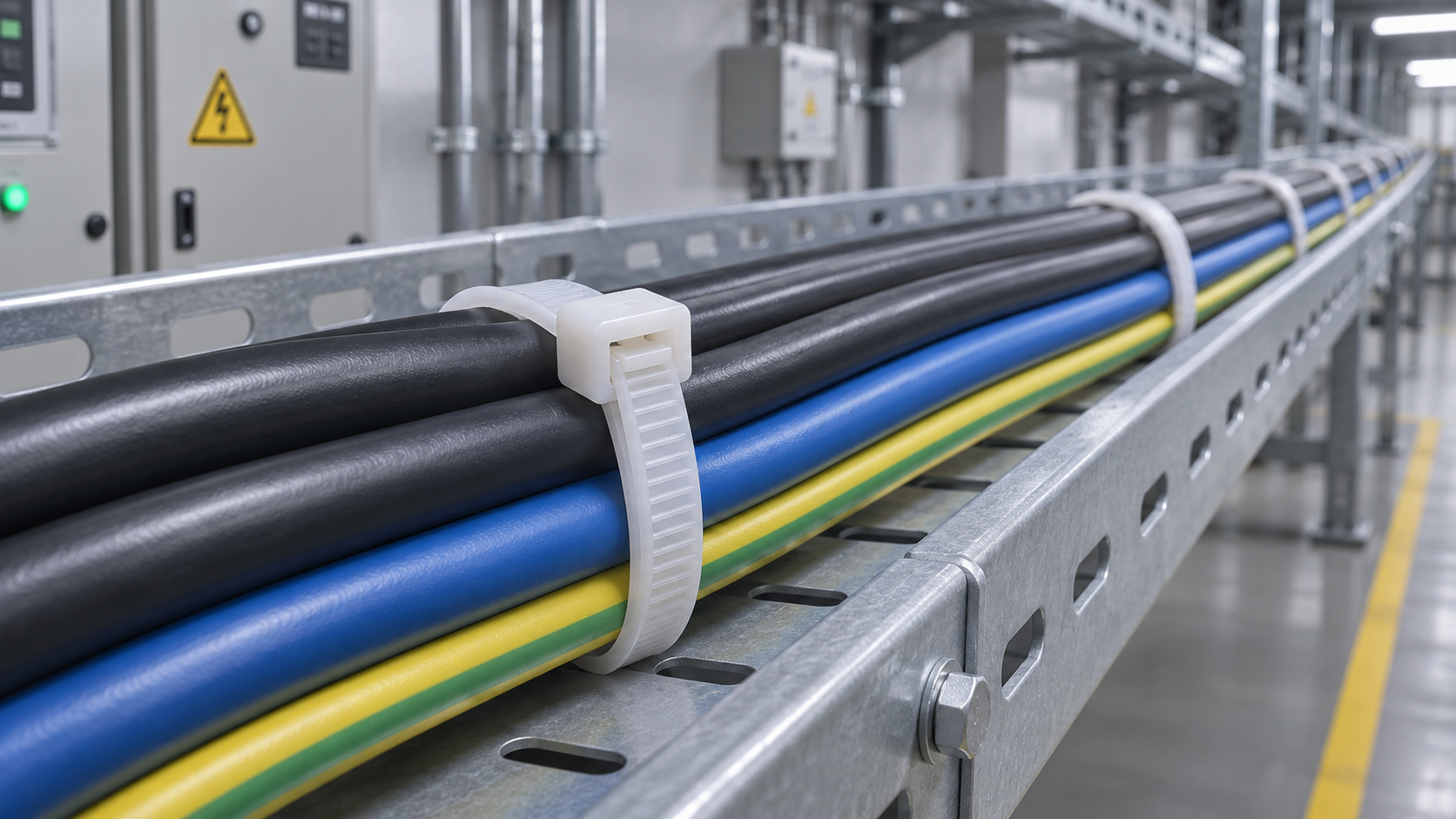
Choose self locking nylon cable ties by starting with the service conditions, not just the bundle diameter. A tie must fit around the bundle, retain enough strength for the forces applied to it, and remain suitable for its environment over the intended service life. A general-purpose indoor tie may be the right choice inside an enclosure but a poor choice for an exposed rooftop installation.
For technical evaluation, the most useful sequence is to define what the tie must hold, identify the maximum bundle size, assess environmental exposure, and then compare products using the same test and approval criteria. A higher tensile rating or a black color alone does not establish suitability.
Start with what the tie is expected to hold
A cable tie can serve different purposes. It may keep conductors grouped neatly, retain a lightweight hose against a frame, or help route a cable along a tray. Those applications do not necessarily put the same force on the locking head.
For a bundle resting on a tray, the tie may mainly resist the tendency of cables to spread. For a vertical run or a suspended bundle, it may also be exposed to sustained weight, movement, vibration, or occasional pulling during maintenance. A tie selected only for neatness may be inadequate when it is expected to carry or restrain a load.
Distinguish between bundling and supporting. Cable ties can be part of a cable-management system, but they should not automatically be treated as the primary structural support. Where falling cables, dropped components, or loss of containment could create a safety hazard, use a support method designed for the load and installation conditions.
Document the expected load path before comparing products. Consider the weight of the bundle, the direction of force on each tie, vibration, movement during operation, and any force applied when cables are added or removed. A tie can be strong in a standard test while being poorly positioned for the actual application.
Understand what the tensile strength rating tells you
Manufacturers commonly publish a minimum loop tensile strength: a measure of the force required to break a tie assembled into a loop under a defined test method. It is useful for comparing ties, but it is not automatically a permissible working load or a promise of long-term performance in the field.
Test conditions matter. The test method, conditioning of the nylon, loading rate, and configuration can influence the reported value. When comparing products, look for ratings established using comparable methods. A figure on one data sheet is less informative if the corresponding test basis is missing or differs from the other product.
Service conditions introduce stresses that a single tensile figure cannot describe. Sustained tension, elevated temperature, repeated movement, chemical exposure, and aging can affect performance. Force may also be concentrated at the locking head or where the strap bends around a sharp edge. Select a tie with an appropriate margin for these conditions rather than matching its published minimum strength directly to the anticipated load.
Load sharing deserves particular care. Several ties around a bundle do not necessarily carry equal force: spacing, installation tension, bundle movement, and support geometry all affect how the load is distributed. If a failure would have serious consequences, the attachment system should be assessed as an assembly, including its supports and the surface to which it is attached.
Size the tie for the installed bundle
Length determines whether the strap can pass around the bundle and engage securely in the head. Width influences the tie’s strength and contact area, but it also affects how easily the strap fits through mounting points and around tight bends. Select the two dimensions together.
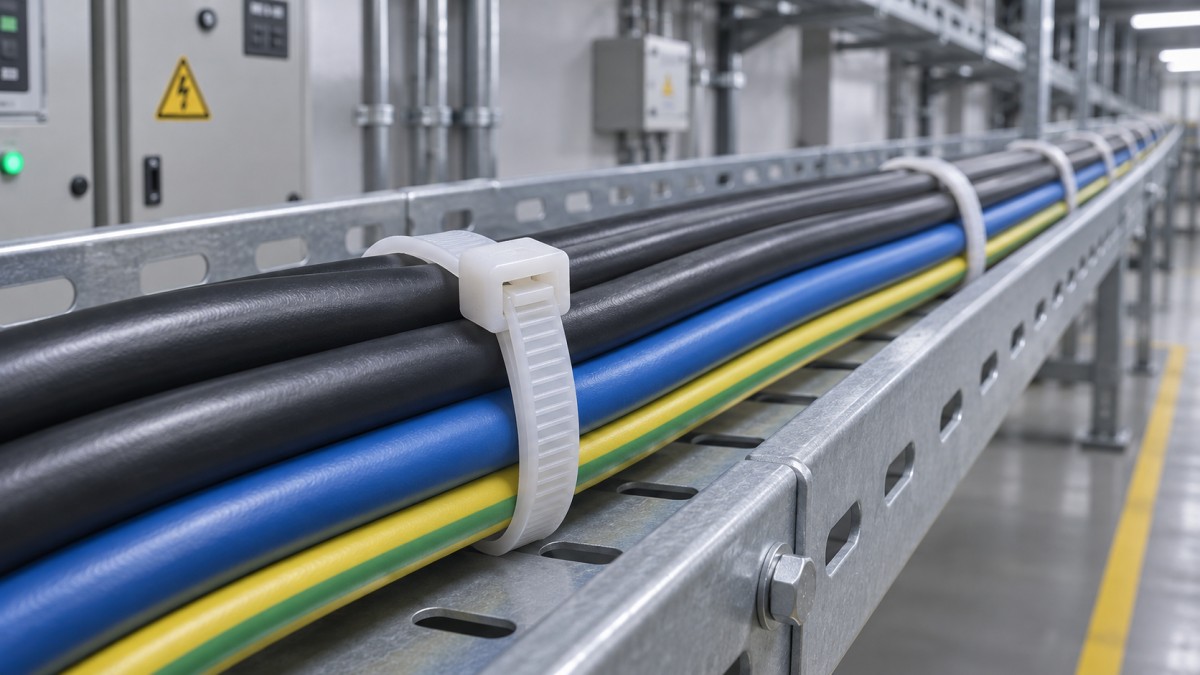
Measure the bundle at its largest expected diameter, including protective sleeves, labels, connectors, and any planned future additions that will remain inside the tie. A tie that fits the current cable group with almost no tail left may be difficult to install consistently and may not allow sufficient strap engagement through the locking head.
Do not calculate suitability from overall tie length alone. Part of the length is occupied by the head and the tail needed for installation. The manufacturer’s maximum bundle diameter is a more useful starting point. Allow extra working length where access is restricted or installers need to use a tensioning tool.
Also check the minimum bundle diameter. A long tie wrapped around a small bundle may bottom out before it can be tightened, leaving the contents loose. Choosing a much longer tie than necessary can also create more waste and leave more tail to manage.
Width involves a trade-off. A wider strap generally spreads contact over a larger area and may be available with a higher strength rating, but it can be less convenient in confined spaces. For delicate cables or soft insulation, the answer is not simply to tighten a stronger tie harder. Use a suitable width, controlled installation tension, and a retention method that does not deform the cable.
UV exposure: look beyond the color
Outdoor exposure can gradually change the properties of nylon. Sunlight, temperature cycling, moisture, and the way a tie is loaded all influence how it ages. For an exposed installation, choose a product specifically identified by its manufacturer for UV or outdoor exposure and review the stated conditions of that claim.
Black ties are often associated with outdoor use, but color alone is not a UV rating. Formulations differ, and a black tie may have been colored for identification rather than formulated for sustained sunlight exposure. Conversely, a product’s intended outdoor performance must be established from its material and product documentation, not from appearance.
Consider the installation as a whole. A tie on the shaded underside of a covered tray has a different exposure profile from one on an uncovered rooftop. Reflection from nearby surfaces, seasonal changes in sunlight, and local operating temperatures may also affect the selection. Outdoor suitability does not automatically mean suitability for high heat, chemicals, or continuous mechanical loading.
For long-life installations, ask how the manufacturer describes UV resistance and what evidence supports the claim. Useful information may include the applicable test method, exposure conditions, and the properties assessed after exposure. These details help compare products, but an accelerated exposure test should not be treated as a direct guarantee of a specific field lifetime.
Check the material against the surrounding environment
Nylon is widely used for self-locking ties because it offers a practical combination of flexibility and strength. Its properties, however, vary with formulation and environment. Nylon absorbs moisture, and its stiffness and handling characteristics can change as moisture content changes. That matters when a tie is stored in dry conditions, installed in cold weather, or expected to remain under tension for a long period.
Review both the installation temperature and the continuous service temperature. A tie may be difficult to handle during a cold installation even if the finished installation will operate in a warmer environment. Near motors, luminaires, process equipment, or hot pipework, use a grade with a stated temperature range appropriate to the actual exposure, including credible temperature excursions.
Chemical compatibility is equally specific. Contact with oils, cleaners, fuels, acids, or other substances may affect the strap or locking mechanism. Identify the substance, concentration, temperature, and duration of contact when comparing compatibility information. A general label such as “chemical resistant” does not establish suitability for every chemical environment.
Where several exposures occur together, evaluate them together. A UV-stabilized tie beside a hot process line may still be unsuitable because of heat; a temperature-rated product may still be unsuitable for the cleaning chemical used in that area. If the environment exceeds the available nylon product specifications, consider an alternative fastening system selected for those conditions.
Installation can determine whether the selected tie works
A sound specification can be undermined by inconsistent installation. Pulling ties excessively tight can damage cable insulation, compress hoses, or make later changes difficult. Leaving them too loose can allow movement and abrasion. Set tension according to the cable or hose manufacturer’s requirements and the purpose of the fastening; a controlled-tension tool can improve consistency where the application calls for it.
Place the locking head where it will not press against a vulnerable surface or obstruct maintenance. Avoid routing the strap across sharp edges, and use suitable edge protection or a different mounting arrangement where contact cannot be avoided. Cut the tail cleanly with an appropriate tool so that it does not leave a sharp projection.
Standard self-locking ties are generally intended to remain closed until cut. Do not assume they can be released and reused without affecting the lock. Where a bundle will be opened frequently, a releasable fastener or another cable-management method may be more practical, provided it meets the retention and environmental requirements.
Match approvals and documentation to the application
Product markings and certifications answer different questions. A listing, recognition, material rating, or declaration may apply to a particular product, use, or set of test conditions. It should not be treated as a blanket approval for every installation.
For an electrical project, establish which product approvals and installation requirements apply to the location and intended use. For other industrial applications, the project specification may call for particular material, traceability, fire-performance, or environmental documentation. Request the documents for the exact product and material grade being purchased, not just a general statement about the supplier’s range.
When comparing bids, use a common schedule that identifies:
- Bundle diameter range, tie length, width, and required installation clearance.
- Minimum loop tensile strength and the test method used to establish it.
- Material grade and stated temperature limits for installation and service.
- UV exposure, chemical contact, moisture, and other relevant environmental conditions.
- Required product approvals, markings, and supporting documentation.
- Installation method, inspection access, and consequences of failure.
Before releasing a large order, assess a representative sample on the actual bundle and mounting arrangement. Check that the head engages properly, the tie can be tensioned without damaging the contents, and the tail can be trimmed safely. For demanding service, include the fastener in the project’s relevant environmental or assembly qualification process. This turns a data-sheet comparison into a decision about the complete installation.
Expert Insights

Chief Security Architect
Dr. Thorne specializes in the intersection of structural engineering and digital resilience. He has advised three G7 governments on industrial infrastructure security.
Related Analysis
- Nov 22, 2026McKinsey: India Needs Up to $400 Billion to Meet Steel Capacity Growth GoalAuthor :
- Nov 22, 2026Choosing Geotextile Fabric for Landfill Drainage and Liner ProtectionAuthor :Environmental Engineering Director
- Nov 21, 2026Japan's Steel Exports Could Fall to Lowest Level Since 1999 in 2026Author :
Core Sector // 01
Security & Safety
- Choosing Self-Locking Nylon Cable Ties: Strength, Size and UV ExposureAuthor :Grid Infrastructure Analyst

- Choosing Flexible PVC Copper Wire: Size, Voltage and Temperature RatingsAuthor :Grid Infrastructure Analyst

- Choosing an XLPE Power Cable Supplier: Test Reports, Traceability, and Lead TimesAuthor :Grid Infrastructure Analyst

- How to Select XLPO Insulated Solar Cable for UV, Heat, and High-Voltage PV SystemsAuthor :Grid Infrastructure Analyst

- Selecting PTFE Insulated Hookup Wire for High-Temperature Control PanelsAuthor :Grid Infrastructure Analyst

- How Contractors Can Evaluate EPC Sourcing Solutions for Cost, Lead Time, and RiskAuthor :Grid Infrastructure Analyst

- What Drives Silicone Cable Bulk Price in Industrial Orders?Author :Grid Infrastructure Analyst

- EN 61000-6-4:2026 Takes Effect for EU-Bound ControlsAuthor :Grid Infrastructure Analyst