Selecting PTFE Insulated Hookup Wire for High-Temperature Control Panels
Author
Date Published
Reading Time
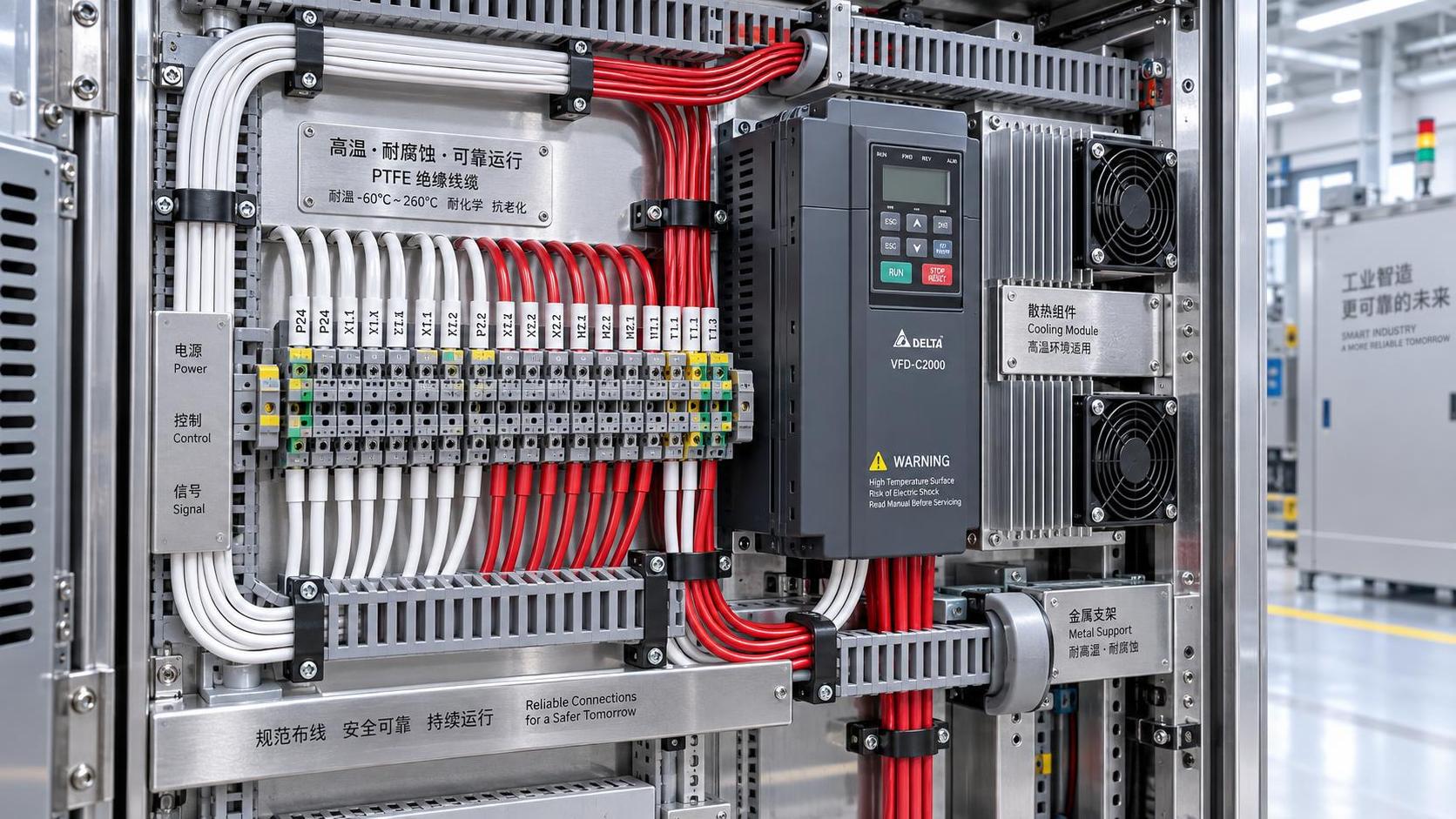
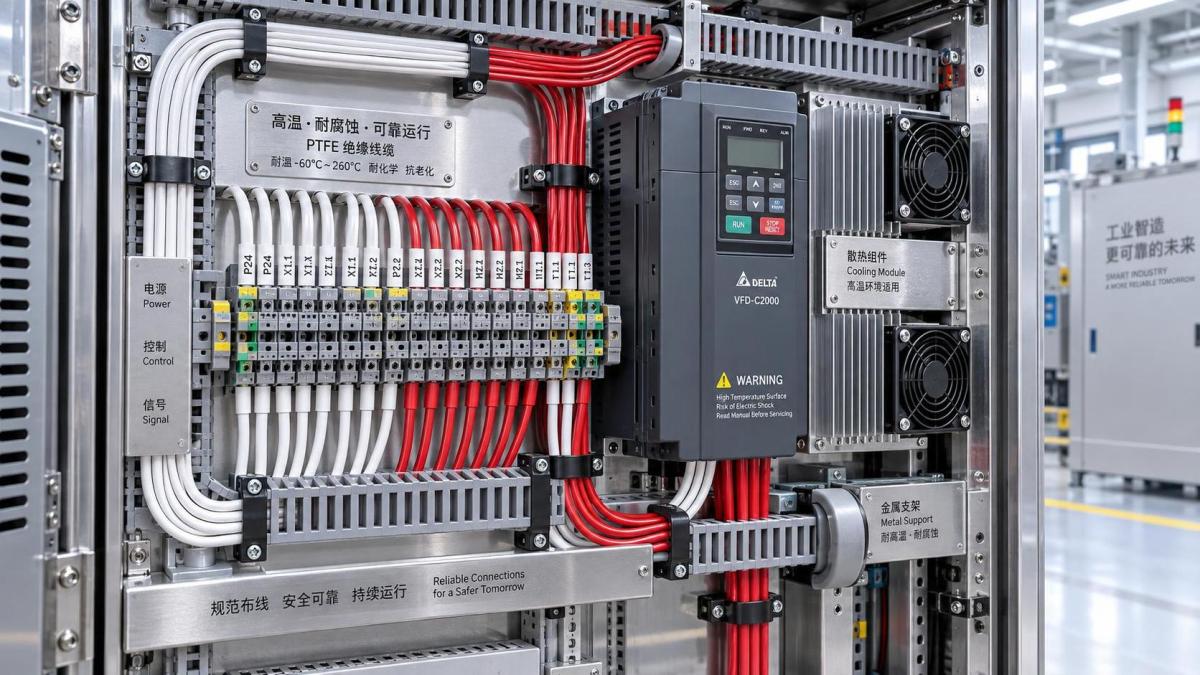
Selecting PTFE insulated hookup wire for a high-temperature control panel starts with a simple rule: size the conductor for the electrical load, but select the insulation for the complete operating environment. A wire can carry the required current and still become the weak point in a panel if sustained heat, sharp routing, chemical exposure, vibration, or termination practices exceed what its construction can tolerate.
PTFE insulation is often chosen where ordinary PVC or general-purpose thermoplastic wire becomes a long-term reliability concern. Its value is not just a high heat rating on a datasheet. PTFE can retain useful dielectric and mechanical properties under demanding thermal conditions, resists many industrial chemicals, and has a low-friction surface that can make wire pulling and routing easier. Those benefits matter only when the selected wire style, conductor construction, wall thickness, marking, and approvals match the actual panel design.
Begin with the thermal profile, not the maximum air temperature
Control-panel specifications often state an ambient temperature, but the wire does not experience one uniform temperature. Conductors near power supplies, VFDs, braking resistors, transformers, terminal blocks, heaters, and densely packed cable bundles may operate considerably hotter than the general cabinet air. Localized heating is especially relevant in compact enclosures with limited airflow.
Evaluate the expected temperature at the wire route and at the termination, then consider how long that condition persists. A brief elevated temperature during an abnormal event is different from continuous operation beside a heat-generating component. The conductor also creates heat when carrying current, so the insulation decision should account for both ambient heat and conductor temperature rise.
PTFE is a strong candidate when heat exposure is sustained, when a wiring route must pass close to hot equipment, or when margin against insulation aging is valuable. It is not automatically the right answer for every warm enclosure. If temperatures are moderate, wire runs are protected, and the project does not need PTFE's chemical or flame-related characteristics, a different approved insulation system may be more practical and economical.
Choose wire size from the installed condition
American Wire Gauge or metric conductor area is only one part of the selection. The installed ampacity of hookup wire depends on how it is routed and terminated. A single conductor in open space dissipates heat differently from multiple conductors tightly bundled in a wire duct. Grouping, enclosure temperature, duty cycle, and connection quality can all change the practical thermal loading.
For power circuits, start with the load current, expected inrush or cycling behavior, permitted voltage drop, and the applicable panel standard or project rule. Then review derating for the enclosure environment and conductor grouping. For low-level signals, the conductor may carry very little current, but gauge still matters for mechanical durability, terminal compatibility, voltage drop over long runs, and resistance to damage during maintenance.
Do not treat a larger conductor as a universal improvement. Oversizing can make termination difficult, reduce routing space, increase bending stress, and create poor fit in ferrules, crimp terminals, or connector contacts. The correct conductor is the smallest size that satisfies electrical, thermal, mechanical, and termination requirements with suitable margin.
Insulation thickness and dielectric performance affect panel layout
A frequent mistake is to compare PTFE wires only by conductor gauge. Two wires with the same copper area can have different insulation thicknesses, outside diameters, voltage ratings, and approved applications. Thin-wall PTFE can be useful where wireway space is constrained, but it may not provide the same mechanical protection or voltage capability as a heavier-wall construction.
Dielectric strength is important, but it should not be used as a substitute for proper spacing and segregation. In a control panel, dependable insulation coordination comes from the whole system: conductor insulation, wire routing, terminal barriers, creepage and clearance at components, cable management, and the expected contamination level. A high-performance insulation does not justify mixing circuits that should remain physically separated.
For example, a wire selected for internal point-to-point control wiring may not be suitable for an interface that leaves the enclosure, enters a field junction box, or is exposed to a different voltage environment. Specify the use case clearly rather than assuming one PTFE wire type can serve every connection in the project.
Stranding, flexibility, and termination quality are linked
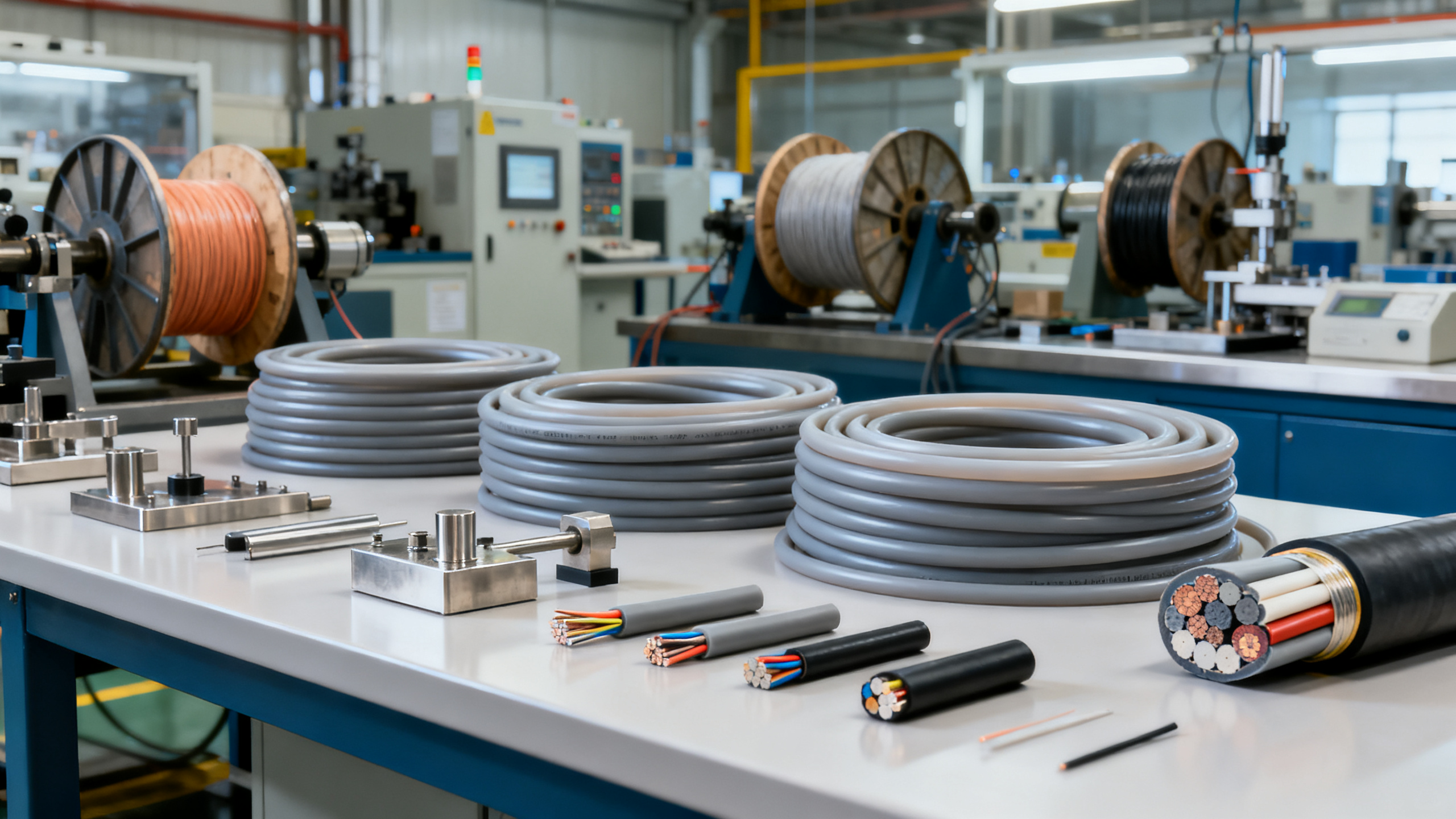
PTFE insulated hookup wire is available with different conductor constructions. A solid conductor can be appropriate for fixed, well-protected wiring where shape retention is useful. Stranded conductors are generally easier to route through crowded ducts and are more tolerant of installation bending. Fine-stranded constructions can improve flexibility further, but they require terminals and crimp practices designed for that conductor class.
Flexibility should be judged at the installed bend radius, not by handling a short sample on a bench. PTFE insulation has a distinctive feel and does not behave like softer PVC insulation. Excessively tight bends, repeated repositioning, or forcing conductors into overcrowded ducts can stress the insulation and concentrate load at terminal entries.
Termination quality often determines whether an otherwise suitable wire performs reliably. Confirm that the terminal, ferrule, crimp contact, or connector accepts the conductor size and stranding. Strip tools must be appropriate for the insulation construction; damaged strands reduce current-carrying capacity and can produce unreliable terminations. Avoid nicking the insulation immediately behind the stripped section, where vibration and handling tend to concentrate stress.
Chemical resistance is valuable, but exposure must be defined
PTFE is widely valued for resistance to many chemicals and industrial fluids. That makes it useful in panels associated with process equipment, laboratories, industrial washdown-adjacent systems, oil-handling equipment, and applications where cleaning agents or vapors may be present. However, chemical resistance should be evaluated as an exposure question, not as a blanket statement that the wire is immune to its surroundings.
Consider whether the wire is exposed to occasional splashes, persistent vapor, condensation, fluid accumulation, or routine cleaning. Also distinguish insulation compatibility from the compatibility of the entire assembly. Cable ties, labels, grommets, terminals, heat-shrink materials, gland seals, and enclosure components may be less resistant than the PTFE insulation itself. A durable wire does not prevent failure elsewhere in the wiring system.
Do not overlook abrasion and wire-management practices
PTFE has low surface friction, which can help when pulling conductors through channels. That same characteristic does not eliminate abrasion risk. A conductor rubbing against a sharp knockout edge, an unprotected metal bracket, or a vibrating component can still suffer damage over time. Thin insulation is particularly dependent on sound routing and edge protection.
Use grommets, bushings, strain relief, clips, and adequate bend radius wherever a run changes direction or passes through metalwork. Keep wire duct fill realistic. A duct that can be closed only by compressing wires aggressively creates future maintenance problems and may deform conductors during service work. Separate power wiring from sensitive analog, communication, and measurement circuits according to the panel design requirements; insulation selection cannot solve electromagnetic interference caused by poor routing.
Approvals and markings should be checked early
For a control panel intended for a defined market or customer, the wire's approval status can be as important as its material properties. Technical evaluators should review the actual wire marking and manufacturer documentation for the relevant wire style, temperature and voltage designation, conductor identification, and applicable recognition or certification pathway. Project specifications may call for particular UL, CE-related, IEC, or other regional compliance evidence, depending on the equipment and destination.
The practical point is to match the wire's documented use to the panel's intended installation. A material description such as “PTFE insulated” is not, by itself, a compliance designation. Procurement substitutions should be controlled carefully because visually similar fluoropolymer wires can differ in approved application, construction, markings, and traceability.
A practical specification sequence
When comparing suppliers or wire families, define the circuit and installation first, then use the following sequence to avoid selecting by headline rating alone:
- Map each wire route: identify local heat sources, bundle density, vibration, movement, and possible chemical exposure.
- Classify the circuit: power, control, safety-related, analog signal, communication, or measurement wiring may need different construction and routing rules.
- Set conductor requirements: determine current, voltage drop, required flexibility, terminal range, and available wireway capacity.
- Select the insulation construction: compare temperature suitability, wall thickness, voltage designation, outside diameter, and mechanical protection.
- Check the full assembly: confirm compatibility with terminals, ferrules, labels, ties, glands, edge protection, and installation tools.
- Validate documentation before release: ensure the proposed wire markings and records meet the project specification and sourcing controls.
This approach is more reliable than approving a wire because it is rated for a high temperature or because PTFE appears on the product description. It also makes substitutions easier to assess, since the decision record identifies which requirements are essential and which are preferences.
When PTFE is the wrong upgrade
PTFE insulation is not a replacement for panel cooling, sensible component spacing, proper conductor derating, or effective wire routing. If the enclosure temperature is excessive because of a thermal design problem, changing to a higher-temperature wire may preserve the insulation while other components continue to operate outside their suitable range.
It can also be an unnecessary choice for protected, low-temperature internal wiring where project requirements are met by a less specialized wire type. PTFE can introduce higher material cost and may require more deliberate handling and termination planning. The best selection is not the most heat-resistant wire available; it is the wire construction that meets the full electrical, environmental, compliance, and manufacturability requirements of the panel.
For high-temperature control panels, the decision should end with a route-by-route review rather than a single blanket specification. That is where thermal exposure, conductor loading, insulation wall, flexibility, termination method, and documentation become one defensible selection instead of a collection of isolated ratings.
Technical Specifications
- How to Select Electronic Hotel Key Card Locks for Guest Rooms and Staff AreasAuthor :Safety Compliance Lead
- How to Select Lab Instruments for Reliable Chemical Analysis WorkflowsAuthor :Precision Metrology Expert
- How to Size a UPS for Server Rooms: Load, Runtime, and Redundancy FactorsAuthor :Grid Infrastructure Analyst
Expert Insights

Chief Security Architect
Dr. Thorne specializes in the intersection of structural engineering and digital resilience. He has advised three G7 governments on industrial infrastructure security.
Related Analysis
- Sep 17, 2026How to Select Electronic Hotel Key Card Locks for Guest Rooms and Staff AreasAuthor :Safety Compliance Lead
- Sep 16, 2026How to Select Lab Instruments for Reliable Chemical Analysis WorkflowsAuthor :Precision Metrology Expert
- Sep 15, 2026How to Size a UPS for Server Rooms: Load, Runtime, and Redundancy FactorsAuthor :Grid Infrastructure Analyst
Core Sector // 01
Security & Safety
- Selecting PTFE Insulated Hookup Wire for High-Temperature Control PanelsAuthor :Grid Infrastructure Analyst

- How Contractors Can Evaluate EPC Sourcing Solutions for Cost, Lead Time, and RiskAuthor :Grid Infrastructure Analyst

- What Drives Silicone Cable Bulk Price in Industrial Orders?Author :Grid Infrastructure Analyst

- EN 61000-6-4:2026 Takes Effect for EU-Bound ControlsAuthor :Grid Infrastructure Analyst

- How to Choose Low Smoke Cables and Wiring for Safer Commercial Buildings?Author :Grid Infrastructure Analyst

- Medium Voltage Armored Cable Selection Guide: Voltage Rating, Armor Type, and InstallationAuthor :Grid Infrastructure Analyst

- EU Publishes EN IEC 61000-6-4:2026 for Industrial EMCAuthor :Grid Infrastructure Analyst

- Choosing an XLPE Power Cable Manufacturer: 7 Checks for Voltage Class and ComplianceAuthor :Grid Infrastructure Analyst