Buying Low-RPM Alternators in Bulk: What Output Data Should Suppliers Provide?
Author
Date Published
Reading Time
Buying Low-RPM Alternators in Bulk: What Output Data Should Suppliers Provide?
Buying low rpm alternators wholesale requires more than comparing nameplate ratings and unit prices. The real question is whether each supplier can prove usable output at your specified shaft speed, load, and operating temperature. Voltage and current curves, continuous power ratings, efficiency data, and documented test conditions matter far more than a peak-output claim.
A machine can reach the advertised voltage on an unloaded test bench and still fail to deliver useful power after connection to a battery bank, rectifier, or inverter. Across a bulk order, that mismatch becomes a system-cost problem: larger drives, additional cooling, controller changes, or equipment that never reaches its intended operating point.
For Global Industrial Core (GIC), the useful sourcing distinction is between a component specification and evidence that the component will work within the intended system. Low-speed generation makes that distinction particularly important.
Define the operating point before requesting output curves
“Low RPM” is not a complete specification. A supplier may use the term for a machine whose useful operating speed is well above the speed available from your turbine, engine, or mechanical drive. Start the RFQ with minimum, normal, and maximum shaft speeds, including how long the machine operates at each.
Then define the electrical destination. Direct AC loads, battery charging, and inverter-fed systems impose different requirements. A permanent-magnet alternator feeding a rectifier cannot be assessed solely from its open-circuit AC voltage. The downstream equipment’s input range, current limits, and control behavior affect what can actually be harvested.
Specify the required continuous output, ambient temperature, cooling arrangement, duty cycle, and installation constraints. Where the application remains undecided, ask suppliers to state their assumptions rather than allowing each quotation to describe a different machine under a similar headline rating.
Demand loaded performance—not just a voltage-versus-speed graph
Open-circuit voltage is useful for checking speed relationships and potential overvoltage. It does not establish power capability. Once current flows, winding resistance, internal reactance, temperature, and the connected load influence terminal voltage and losses.
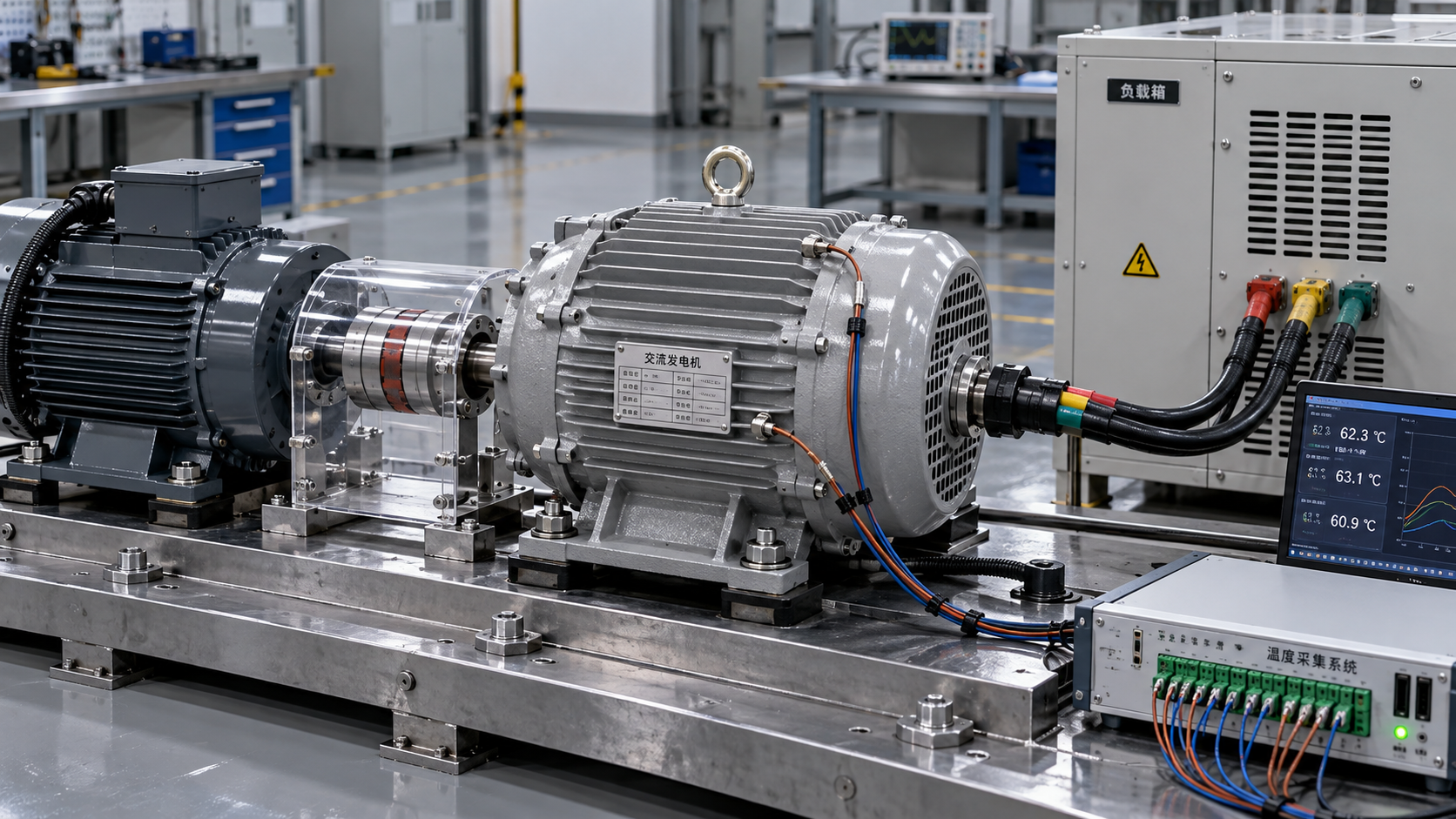
Ask for a performance map covering your operating range. At each agreed shaft speed, the supplier should show voltage, current, and measured electrical power across several load points. The data must identify whether readings were taken at the alternator terminals, after a rectifier, or at the output of a controller.
For AC output, require real power in watts alongside voltage and current. Apparent power in volt-amperes is not interchangeable with usable watts. A simple voltage-times-current calculation can be misleading for three-phase systems or non-unity-power-factor loads, especially when a rectifier produces distorted current waveforms.
For a battery-charging application, ask for charging current versus RPM at defined battery voltages. “Charging starts at low speed” may mean only that a small current begins flowing. It says little about whether the machine supplies the required charging power during normal operation.
Separate continuous output from a cold-machine peak
A brief bench demonstration can flatter an alternator. As copper windings heat up, resistance increases, changing losses and potentially the output available within allowable temperature limits. Magnet characteristics, cooling effectiveness, and controller limits can also affect performance.
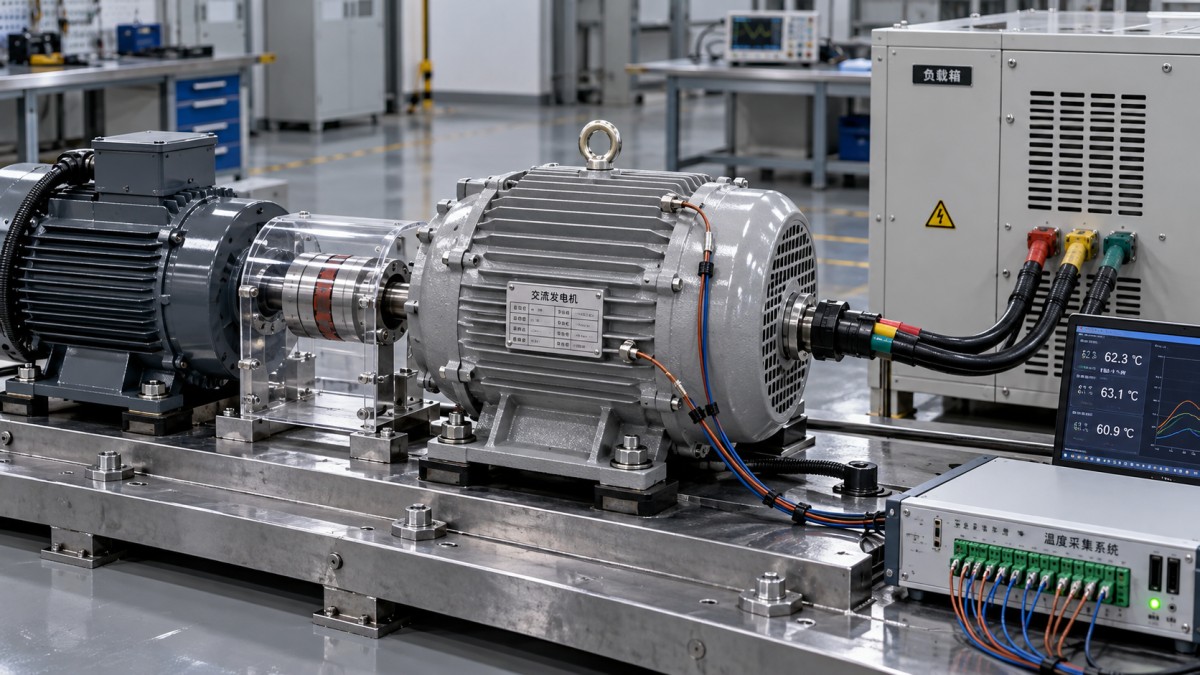
Require a continuous-duty result at the operating point you intend to purchase against. The report should record winding temperature using a stated measurement method, ambient temperature, speed, load, and the criterion used to establish thermal stabilization. A housing-temperature reading alone does not establish winding temperature.
Cooling deserves explicit treatment. An exposed machine on a ventilated test stand is not equivalent to one inside a compact enclosure. Likewise, a shaft-mounted fan provides different airflow as speed changes. Ask whether the quoted continuous output depends on external forced air, a particular mounting arrangement, or a maximum ambient temperature.
If overload capability matters, request its duration, starting thermal condition, recovery requirements, and permitted repetition. Keep it separate from the continuous rating in both the bid comparison and purchase contract. Otherwise, a temporary capability can quietly become the basis for the whole order.
Use efficiency and torque data to uncover hidden costs
An alternator does not produce electrical power simply because its shaft reaches the specified RPM. The prime mover must also supply sufficient torque. At lower speeds, delivering the same mechanical power requires more torque, which affects couplings, shafts, gearboxes, and the drive itself.
Request running torque at every important load point, together with no-load losses and any relevant breakaway or cogging-torque information. For wind and small hydro installations, starting behavior can matter as much as rated output. A machine that performs well once spinning may still be poorly matched to the available starting torque.
Efficiency should be reported as a map, not just one maximum percentage. Ask how shaft power was measured and whether the stated efficiency includes excitation, rectification, and controller losses. Those boundaries must match before suppliers can be compared fairly.
The commercial implication is straightforward: a cheaper alternator may require a more expensive mechanical drive or reject more heat at the operating point used most often. Compare usable energy over the expected duty profile, not only purchase price divided by nameplate kilowatts.
Check the output envelope against connected equipment
Useful output data should also identify conditions that downstream equipment cannot tolerate. Request maximum open-circuit voltage at the highest credible speed, including relevant overspeed conditions. This helps the system designer check rectifier ratings, controller input limits, and protective measures.
For AC applications, confirm whether quoted voltage is line-to-line or line-to-neutral, whether it is RMS, and which winding connection was tested. Frequency varies with shaft speed and pole count unless power electronics decouple the load from the generator. If the load needs fixed-frequency AC, a low-speed alternator alone may not provide the required supply.
Ask for waveform or harmonic information where sensitive loads or power-electronic interfaces make it relevant. For regulated systems, voltage regulation and response to load changes may also need testing. These are application-specific requests, not reasons to burden every small procurement with an oversized test program.
Make the evidence apply to the shipment
A strong prototype report does not automatically prove consistency across a production lot. The tested unit must match the quoted winding, magnet configuration, cooling arrangement, and supplied electronics. Ask suppliers to identify the test sample, drawing revision, and configuration in the report.
The test record should name the instruments used, their calibration status, and the measurement uncertainty or accuracy relevant to acceptance decisions. This matters when competing offers differ by only a small amount: the apparent advantage may be smaller than the measurement uncertainty.
For bulk orders, distinguish between design-validation tests and routine production checks. A full thermal performance test may be appropriate for qualification samples, while agreed electrical checks can be applied to each production unit. The inspection plan should state which tests cover every machine, which use sampling, and what happens after a failure.
- Set numerical acceptance limits at the required speed and load, including allowable output variation.
- Agree the test method, stabilization conditions, and treatment of measurement uncertainty before placing the order.
- Link serial numbers or batch identifiers to inspection records.
- Require approval before changes to windings, magnets, bearings, or supplied power electronics that could affect performance.
- Define retesting, corrective action, and responsibility for rejected units.
Compliance documents remain necessary where applicable, but they answer different questions. A conformity declaration, safety evaluation, or quality-management certificate does not by itself prove output at your specified RPM. Verify both the scope of the documentation and the performance evidence.
Compare quotations at one agreed operating point
Before negotiating volume discounts, issue a common data schedule. Have every shortlisted supplier return continuous usable output at the same shaft speed, ambient temperature, cooling condition, and electrical interface. Keep unverified claims separate from guaranteed values.
Then compare the complete package: alternator, rectifier, controller, cooling provisions, coupling requirements, testing, spares, and warranty remedies. A lower unit price is not a saving if essential equipment has been excluded or output must be substantially derated after installation.
If the supplier cannot provide convincing data, a representative sample test can be a sensible next step before a large commitment. Put the qualified configuration and its acceptance limits into the purchase documents. The evidence worth paying for is not the highest number on a brochure; it is repeatable output at the conditions your installation will actually impose.
Expert Insights

Chief Security Architect
Dr. Thorne specializes in the intersection of structural engineering and digital resilience. He has advised three G7 governments on industrial infrastructure security.
Related Analysis
Core Sector // 01
Security & Safety
- Buying Low-RPM Alternators in Bulk: What Output Data Should Suppliers Provide?Author :Heavy Industry Strategist

- Does Power Transmission Maintenance Differ in Desert and Arctic Sites?Author :Heavy Industry Strategist

- Can Industrial Engineering Solutions Reduce Petrochemical Downtime?Author :Heavy Industry Strategist

- What Drives Industrial Roller Chains Price: Material, Pitch, Load, and Supplier FactorsAuthor :Heavy Industry Strategist

- How to Choose a Three Phase Soft Starter for Pumps, Fans, and ConveyorsAuthor :Heavy Industry Strategist

- How to Evaluate a Conveyor Roller Belts Manufacturer for Load, Speed, and Service LifeAuthor :Heavy Industry Strategist

- Power Transmission Systems Pricing: 7 Cost Drivers Buyers Should CompareAuthor :Heavy Industry Strategist

- India Expands BIS ISI Rule for Imported Belts and ChainsAuthor :Heavy Industry Strategist