EU Mandates 'Made-in-Europe' Priority for Lab Consumables from 2027
Author
Date Published
Reading Time

On 14 May 2026, the European Commission issued the Strategic Health Supplies Procurement Reinforcement Directive, introducing binding procurement requirements for laboratory and analytical consumables used in public healthcare and third-party testing labs across EU member states — with direct implications for global suppliers, particularly those based in China.
Key Regulatory Requirements Effective from 2027
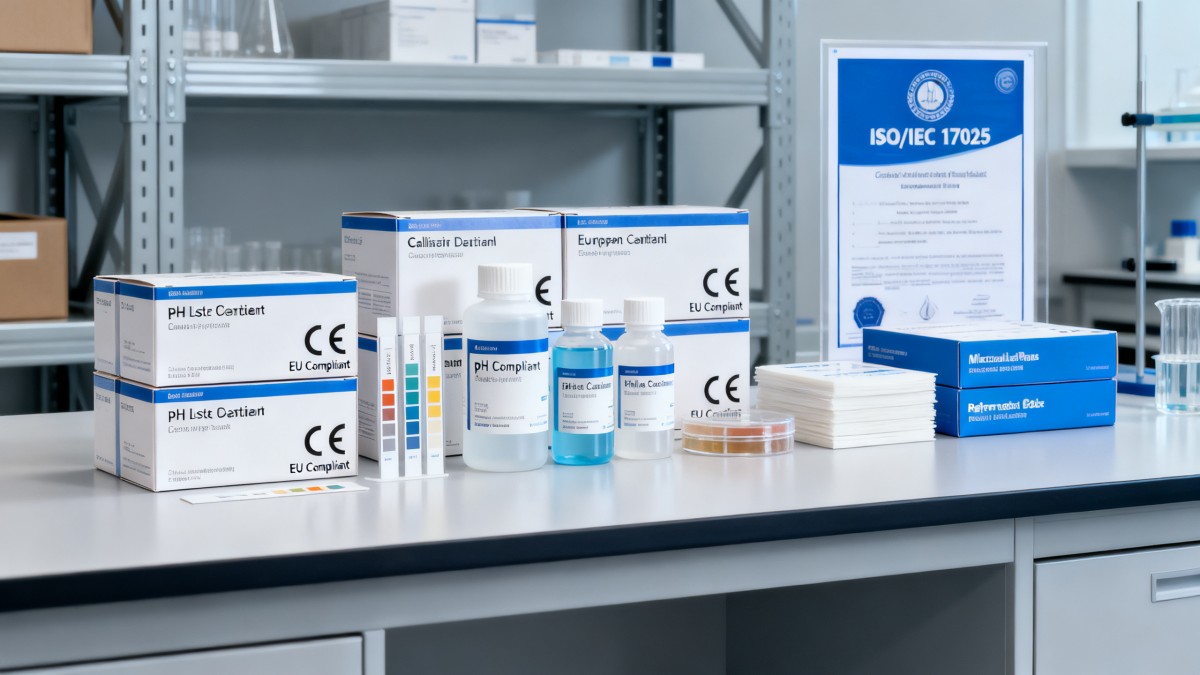
The Directive mandates that, starting 1 January 2027, public health institutions and accredited third-party laboratories within the EU must apply a 'Made-in-Europe priority' principle when procuring core Lab & Analytics consumables — including pH test strips, calibration solutions, certified reference materials, and microbiological culture media. In parallel, the frequency of on-site audits under CE-IVDR (for in vitro diagnostic devices) and ISO/IEC 17025 (for testing and calibration laboratories) will be increased. Non-EU manufacturers supplying such products are required to appoint an EU-based authorized representative and complete local quality management system certification aligned with EU regulatory expectations.
Impact Across Supply Chain Roles
Direct Exporters
Companies exporting lab consumables directly to EU public tenders face stricter eligibility criteria. Bidding documents will increasingly require proof of EU authorization, CE-IVDR conformity (where applicable), and ISO/IEC 17025 accreditation scope covering the supplied items — not just the lab performing analysis, but also the manufacturer’s quality assurance processes.
Raw Material Suppliers
Suppliers of critical inputs — such as high-purity salts for calibration solutions or selective agar components for culture media — may experience heightened traceability and documentation demands. EU buyers will likely require full substance declarations, origin verification, and compliance evidence aligned with REACH and CLP regulations.
Contract Manufacturers & Assemblers
Firms engaged in OEM or ODM production for EU-facing brands must now ensure their manufacturing sites undergo formal ISO/IEC 17025-relevant process validation and maintain audit-ready records — even if final product labeling carries another entity’s name. Localized quality documentation in English or official EU languages becomes essential.
Supply Chain & Compliance Service Providers
Consultancies, testing labs, and regulatory support firms will see rising demand for EU representative appointment services, technical file reviews, CE-IVDR classification guidance (especially for borderline IVD-related consumables), and gap assessments against ISO/IEC 17025 Clause 4–7 requirements.
Critical Actions for Affected Manufacturers
Accelerate EU Authorized Representative Appointment
This is no longer optional: non-EU manufacturers must designate and formally register an EU-based legal entity capable of assuming regulatory responsibility — including maintaining technical documentation, handling vigilance reporting, and cooperating with market surveillance authorities.
Align Quality Systems with ISO/IEC 17025 Principles
While full ISO/IEC 17025 accreditation applies to testing labs, the Directive signals an extension of its operational rigor to manufacturers of reference materials and calibrated consumables. Companies should review internal procedures for measurement uncertainty estimation, inter-laboratory comparison participation, and documented method validation — especially for pH standards and microbial enumeration kits.
Prepare for Enhanced CE-IVDR Scrutiny
Products previously classified as general lab supplies — e.g., certain calibrators or control materials used in diagnostic workflows — may now fall under CE-IVDR’s broader definition of 'accessory to an IVD'. Classification reassessment and potential involvement of a Notified Body are strongly advised ahead of 2027.
Industry Perspective: Beyond Compliance Toward Strategic Localization
Analysis shows this Directive reflects a structural shift — not merely a procurement tweak. From an industry perspective, it signals growing convergence between health security policy and industrial policy in the EU. What deserves closer attention is the implied timeline pressure: achieving both authorized representative setup *and* substantive quality system upgrades typically requires 9–15 months. Observably, the 2027 deadline leaves little margin for iterative certification attempts. It is more appropriate to understand this as a catalyst accelerating regionalization of analytical supply chains — where 'European manufacturing' increasingly means not only physical production, but embedded regulatory accountability, real-time audit readiness, and traceable material provenance.
Strategic Implications for Global Lab Suppliers
This regulation marks a decisive step toward embedding sovereignty criteria into routine procurement — transforming lab consumables from generic commodities into regulated health infrastructure components. For non-EU manufacturers, success hinges less on cost competitiveness alone and more on demonstrable integration into EU regulatory frameworks. The long-term implication is not market exclusion, but a higher, more transparent threshold for participation — one that rewards proactive compliance investment over reactive adaptation.
Source Information & Ongoing Monitoring
This article is based exclusively on the user-provided title, event date (14 May 2026), and summary describing the European Commission’s Strategic Health Supplies Procurement Reinforcement Directive. Specific official source links were not provided in the input and should be verified continuously. Stakeholders are advised to monitor upcoming implementing acts, national transposition timelines by EU member states, updates to MDCG guidance on CE-IVDR classification of accessories, and evolving tender specifications issued by national health agencies and reference laboratories.
Technical Specifications
- How to Select Electronic Hotel Key Card Locks for Guest Rooms and Staff AreasAuthor :Safety Compliance Lead
- How to Select Lab Instruments for Reliable Chemical Analysis WorkflowsAuthor :Precision Metrology Expert
- How to Size a UPS for Server Rooms: Load, Runtime, and Redundancy FactorsAuthor :Grid Infrastructure Analyst
Expert Insights

Chief Security Architect
Dr. Thorne specializes in the intersection of structural engineering and digital resilience. He has advised three G7 governments on industrial infrastructure security.
Related Analysis
- Sep 17, 2026How to Select Electronic Hotel Key Card Locks for Guest Rooms and Staff AreasAuthor :Safety Compliance Lead
- Sep 16, 2026How to Select Lab Instruments for Reliable Chemical Analysis WorkflowsAuthor :Precision Metrology Expert
- Sep 15, 2026How to Size a UPS for Server Rooms: Load, Runtime, and Redundancy FactorsAuthor :Grid Infrastructure Analyst
Core Sector // 01
Security & Safety
- How to Select Electronic Hotel Key Card Locks for Guest Rooms and Staff AreasAuthor :Safety Compliance Lead

- How to Select Lab Instruments for Reliable Chemical Analysis WorkflowsAuthor :Precision Metrology Expert

- How to Size a UPS for Server Rooms: Load, Runtime, and Redundancy FactorsAuthor :Grid Infrastructure Analyst

- Stainless Steel Welded Tube Applications: Matching Tube Supply to Fabrication NeedsAuthor :Heavy Industry Strategist

- Selecting Low-Friction Pneumatic Seals for High-Cycle, Low-Pressure CylindersAuthor :Heavy Industry Strategist

- Selecting Spherical Roller Bearings for Mining: Load, Contamination, and Service LifeAuthor :Heavy Industry Strategist

- What to Check When Sourcing Vibration Meters Wholesale for Industrial MaintenanceAuthor :Precision Metrology Expert

- How to Size a Wafer Butterfly Valve for HVAC Chilled-Water and Heating LoopsAuthor :Environmental Engineering Director