Security & Safety solutions that fix weak points in older facilities
Author
Date Published
Reading Time

Aging plants, warehouses, and utility sites often hide critical vulnerabilities that put operators at risk and disrupt productivity. The right Security & Safety solutions can close these gaps by improving hazard detection, access control, emergency response, and compliance performance. This article explores practical ways older facilities can strengthen protection, reduce incidents, and create safer, more reliable working environments for everyday users and frontline teams.
Where do older facilities usually fail first?

In many industrial environments, weak points do not start with dramatic equipment breakdowns. They begin with small gaps: blind spots at loading bays, outdated fire alarms, poorly zoned access routes, unmarked emergency shutdowns, or control rooms with limited visibility over field operations. For operators, these issues create daily uncertainty. A simple task such as entering a storage room, isolating a machine, or responding to an alarm can become slower and more dangerous than it should be.
Older facilities also tend to accumulate layers of modifications. A warehouse may have added temporary partitions. A plant may have expanded utility lines without redesigning evacuation paths. A substation may still rely on legacy monitoring devices that were never integrated into a centralized alert system. This is why Security & Safety solutions in mature sites must address both physical hazards and system fragmentation.
For users and operators, the real pain points are practical:
- Alarms that trigger too late or produce too many false events, causing people to ignore them.
- Access points that cannot clearly separate staff, contractors, and visitors.
- Insufficient lighting, surveillance, or hazard labeling in transition zones.
- Emergency response plans that exist on paper but are difficult to execute on shift.
- Compliance checks that consume time because records, devices, and procedures are not aligned.
A practical upgrade strategy starts with identifying the operational weak points that affect people first, not only the assets. That is especially important in mixed-use industrial sites where security, worker safety, and continuity of operations overlap every day.
What Security & Safety solutions make the biggest difference?
Not every site needs a full rebuild. In older facilities, the most effective Security & Safety solutions are usually targeted upgrades that improve detection, control, response time, and operator confidence. The priority is to close high-risk gaps while keeping installation disruption manageable.
Core upgrade areas to assess first
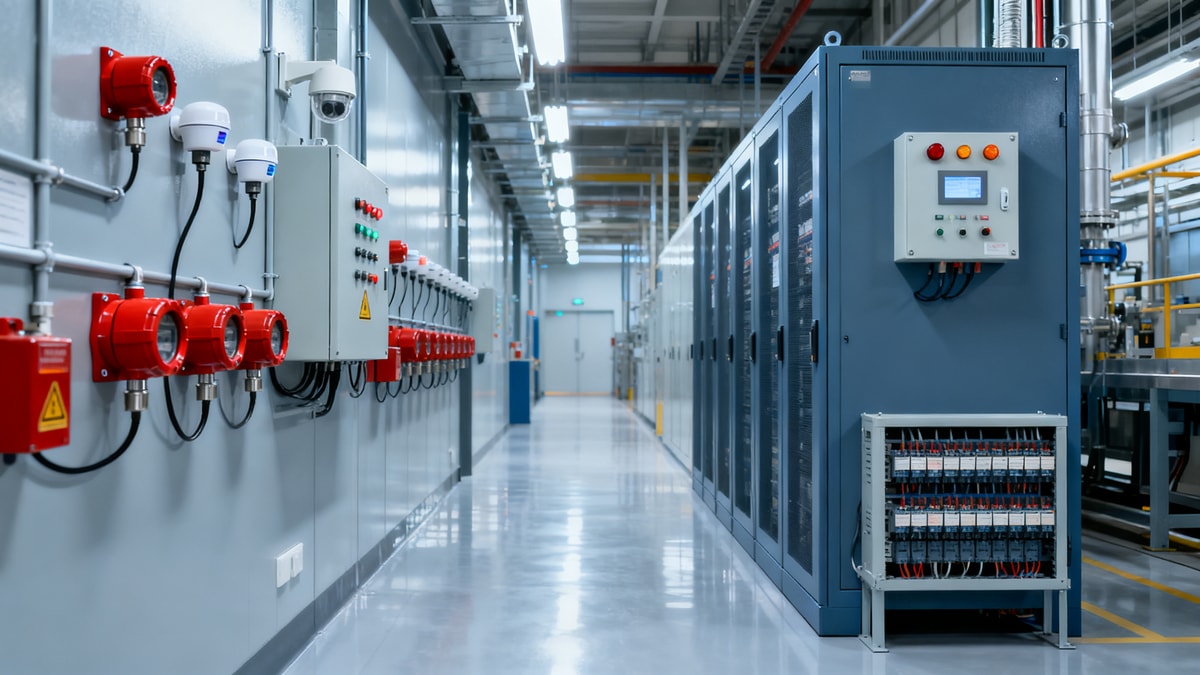
- Hazard detection: smoke, heat, gas, intrusion, leak, and abnormal environmental conditions should be detected early and reported clearly.
- Access control: doors, gates, cage zones, and restricted corridors should reflect actual user roles and shift patterns.
- Video and visibility: cameras, lighting, and remote viewing should support incident confirmation, not just recording.
- Emergency communication: alarms, beacons, paging, and call points must remain usable in noisy, dusty, or low-visibility conditions.
- System integration: isolated devices create delay. Linking alerts, controls, and reporting improves decision speed.
The table below shows how common vulnerabilities in older facilities can be matched with fit-for-purpose Security & Safety solutions and the direct benefit to frontline teams.
The key lesson is that Security & Safety solutions should not be selected as isolated products. They should be chosen as connected controls that help operators identify risk, confirm the situation, and respond without hesitation.
Which applications matter most in plants, warehouses, and utility sites?
Different industrial settings expose different weak points. A warehouse may struggle with unauthorized access and forklift interaction. A process plant may prioritize gas detection and emergency shutdown logic. A utility site may need secure perimeter management and dependable alarm communication in remote areas. Good Security & Safety solutions are never one-size-fits-all.
Application priorities by facility type
This comparison helps operators and site managers avoid a common mistake: buying identical controls for very different environments. A better approach is to rank risks by frequency, severity, and response difficulty, then build the solution set around actual use patterns.
Global Industrial Core supports this process by connecting operational needs with sourcing logic. Instead of looking at one device category at a time, buyers can compare cross-functional implications such as environmental durability, installation compatibility, maintenance burden, and compliance impact across the full facility workflow.
How should operators and buyers compare solution options?
When budgets are limited, decision quality matters more than purchase volume. Security & Safety solutions for older facilities should be judged on how well they solve the highest-risk operational problem with the least disruption to production and maintenance routines.
Five decision filters that improve selection
- Environment fit: confirm whether the device must tolerate dust, vibration, humidity, corrosion, temperature swings, or electrical interference.
- Integration difficulty: check if the new component can work with existing panels, networks, or supervisory systems without major redesign.
- User clarity: alarms, displays, and control points must be understandable during stress, including for shift workers and temporary staff.
- Maintenance access: if calibration, cleaning, battery service, or inspection is difficult, reliability will decline over time.
- Compliance relevance: selection should support applicable CE, UL, ISO, or other site-required standards without overbuying features that do not add protection.
The next table offers a practical procurement view for comparing Security & Safety solutions in retrofit projects.
A disciplined comparison prevents overspending on attractive but impractical features. In retrofits, the best solution is often the one that integrates cleanly, meets site risk priorities, and remains easy for operators to trust and use every shift.
What standards and compliance points should not be overlooked?
Compliance is not only a procurement checkbox. In older facilities, it is often the fastest way to reveal hidden gaps in risk control. When evaluating Security & Safety solutions, buyers should verify whether the selected devices and system design align with the site’s regulatory obligations, insurance requirements, and internal operating procedures.
Key compliance checks before purchase
- Confirm whether CE, UL, ISO-related documentation, or equivalent market-specific conformity evidence is required for the site or export destination.
- Check if hazardous zones, fire system design rules, electrical isolation practices, or emergency lighting obligations affect the specification.
- Review maintenance and inspection record requirements so the solution remains auditable after installation.
- Make sure operator training materials and alarm response procedures are updated together with the equipment.
This is where structured sourcing guidance matters. GIC helps industrial buyers narrow options based on real-world conditions: certification expectations, engineering compatibility, supply continuity, and operational risk. That reduces the chance of selecting a product that looks acceptable on paper but fails during commissioning or audit review.
How can older facilities upgrade without major downtime?
A common fear is that improving Security & Safety solutions will interrupt production. In practice, retrofit success depends on sequencing. Sites that phase upgrades by risk zone and operational calendar usually achieve faster adoption with fewer shutdown conflicts.
A workable implementation path
- Survey the weak points: map blind spots, delayed alarms, uncontrolled access routes, and difficult emergency actions.
- Rank by consequence: prioritize risks that could injure users, stop production, or trigger non-compliance.
- Separate quick wins from engineering changes: signage, lighting, and access logging may move faster than panel upgrades or network integration.
- Test with operator involvement: drills and pilot areas reveal usability issues that technical reviews can miss.
- Document and train: revised procedures, inspection schedules, and response maps must match the installed solution.
This staged approach is especially valuable for mixed industrial estates and legacy sites that cannot stop operations for a full redesign. It also supports better budgeting because teams can fund high-impact corrections first, then expand coverage as results become visible.
Common mistakes and practical FAQ
Is replacing old equipment enough to improve safety?
No. Replacing devices without reviewing workflows often leaves the original weakness in place. A new camera does not solve a poor line of sight. A new alarm does not help if operators cannot distinguish its priority. Effective Security & Safety solutions combine equipment, placement, procedures, and training.
What should operators report before a retrofit decision?
Operators should report delayed response points, frequently bypassed routes, unclear control labels, nuisance alarms, poor lighting areas, and locations where contractors or visitors often need help. These observations are valuable because they reveal how the site functions under real shift conditions, not just during audits.
How do buyers avoid over-specifying a solution?
Start with the hazard, not the catalog. Define what must be detected, who must respond, how fast they must act, and what environment the device must survive. Then compare options against those needs. Over-specification usually happens when teams buy advanced features that do not improve response quality or compliance readiness.
Are low-cost alternatives worth considering?
Sometimes, but only for low-consequence gaps. Basic signage, route marking, local barriers, or improved task lighting can deliver strong value when used correctly. However, lower-cost substitutes should not replace essential detection, access control, or emergency alert functions in high-risk zones. Cost savings are meaningful only when they do not transfer risk back to the operator.
Why work with GIC when evaluating Security & Safety solutions?
Industrial buyers rarely struggle because there are too few options. They struggle because there are too many options with unclear fit. GIC helps EPC teams, facility managers, procurement leaders, and frontline stakeholders cut through that complexity with focused guidance across security, safety, electrical, measurement, environmental, and mechanical considerations.
If you are reviewing weak points in an older plant, warehouse, utility site, or mixed industrial facility, you can consult GIC for practical support on:
- Parameter confirmation for detection, access, and alarm requirements in harsh operating conditions.
- Product and solution selection based on site layout, retrofit compatibility, and operator use patterns.
- Delivery cycle discussions for urgent maintenance windows or phased upgrade plans.
- Custom solution reviews where compliance, environmental durability, and integration constraints must be balanced.
- Certification and documentation questions related to CE, UL, ISO, or project-specific sourcing expectations.
- Sample support and quotation communication for shortlist evaluation and procurement planning.
The most effective Security & Safety solutions do more than patch old infrastructure. They help operators work with greater clarity, reduce avoidable exposure, and keep essential industrial environments resilient. When the risks are real and the facility is aging, informed sourcing is not optional. It is part of safe operation.
Technical Specifications
- Hidden Environment & Ecology cost after project approvalAuthor :Environmental Engineering Director
- When does an Environment & Ecology impact assessment need updating?Author :Environmental Engineering Director
- Security & Safety standards that affect product approval speedAuthor :Safety Compliance Lead
Expert Insights

Chief Security Architect
Dr. Thorne specializes in the intersection of structural engineering and digital resilience. He has advised three G7 governments on industrial infrastructure security.
Related Analysis
- May 07, 2026Hidden Environment & Ecology cost after project approvalAuthor :Environmental Engineering Director
- May 07, 2026When does an Environment & Ecology impact assessment need updating?Author :Environmental Engineering Director
- May 07, 2026Security & Safety standards that affect product approval speedAuthor :Safety Compliance Lead
Core Sector // 01
Security & Safety
- Security & Safety standards that affect product approval speedAuthor :Safety Compliance Lead

- How to assess a Security & Safety manufacturer beyond certificationsAuthor :Safety Compliance Lead

- Security & Safety solutions that fix weak points in older facilitiesAuthor :Safety Compliance Lead

- What makes a Security & Safety supplier reliable after delivery?Author :Safety Compliance Lead

- DIN SPEC 91492:2026 Enforces Dynamic PL for Collaborative Safety Light CurtainsAuthor :Safety Compliance Lead

- DIN SPEC 91492:2026 Enforces Dynamic PL for Collaborative Safety Light CurtainsAuthor :Safety Compliance Lead

- DIN SPEC 91492:2026 Released: Safety Light Curtains Must Support Dynamic PL Adjustment in Human-Robot CollaborationAuthor :Safety Compliance Lead

- DIN SPEC 91492:2026 Mandates PL Dynamic Verification for Safety Light Curtains in GermanyAuthor :Safety Compliance Lead