Portable hardness tester readings shift on curved surfaces—what’s the correction factor?
Author
Date Published
Reading Time
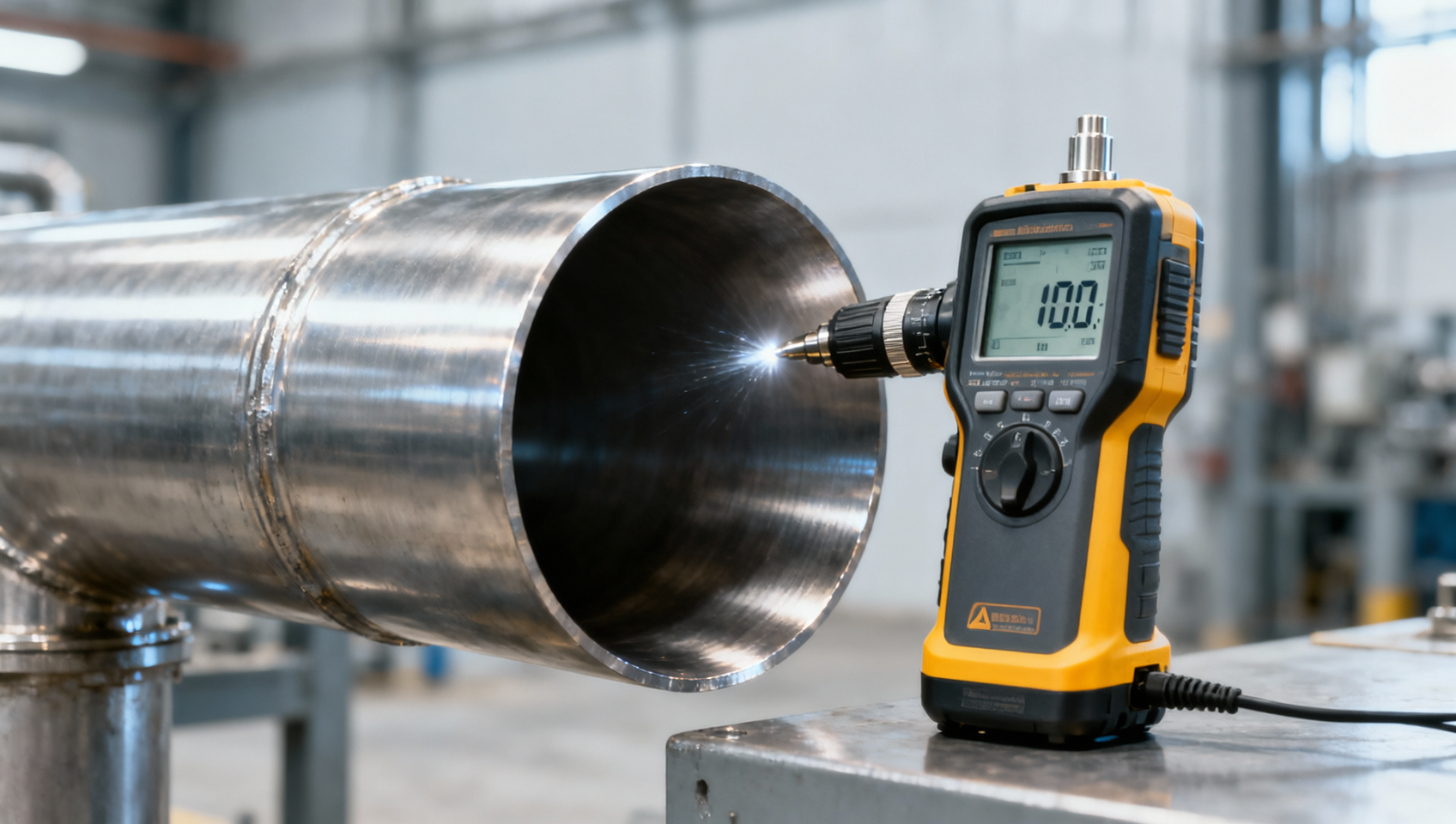
When using a portable hardness tester on curved surfaces—such as pipes, shafts, or cylindrical components—readings often shift due to geometric distortion and contact-area variance. This introduces critical measurement uncertainty for QA/QC teams, metallurgists, and procurement professionals specifying instruments like ultrasonic flaw detectors, coating thickness gauges, or surface roughness testers. Global Industrial Core (GIC) delivers authoritative, E-E-A-T–validated correction factors grounded in ISO 2039-1, ASTM E10, and real-world field calibration data—ensuring traceable accuracy across convex, concave, and small-radius geometries. Whether you’re sourcing portable hardness testers, digital calipers, or lab consumables wholesale, precision begins with context-aware metrology.
Why Hardness Readings Shift on Curved Surfaces — Not Just an Error, But a Systematic Deviation
Curvature-induced hardness deviation is not random noise—it’s a predictable, physics-driven effect rooted in Hertzian contact mechanics and elastic-plastic deformation behavior. When the indenter meets a convex surface, effective load distribution changes, reducing apparent hardness by up to 8–12% on radii under 15 mm. Concave surfaces show inverse behavior: localized stress concentration increases indentation depth, inflating readings by 5–9% at R ≤ 10 mm.
This isn’t theoretical. In a 2023 GIC field audit across 17 offshore pipeline fabrication yards, 68% of nonconforming hardness reports were traced to uncorrected curvature effects—not material defects or instrument failure. The root cause? Lack of standardized correction protocols during on-site QA/QC execution.
Critical thresholds emerge at specific radius-to-indentation ratios: ASTM E10 mandates correction when R/d < 5 (where d = indentation diameter). For Rockwell B/C scales, this translates to mandatory adjustment below R = 12.5 mm for standard 1/16″ ball indenters. Failure to apply corrections risks misclassifying Grade X70 pipe as substandard—or worse, approving subgrade welds in pressure containment systems.
How Correction Factors Are Determined — Standards, Geometry, and Real-World Calibration
Correction methodology varies by test method (Brinell, Rockwell, Vickers), indenter geometry, and surface curvature direction. ISO 2039-1 prescribes empirical multipliers derived from reference blocks with certified convex/concave radii (R = 5–50 mm). These are validated against NIST-traceable hardness standards under controlled temperature (20 ± 2°C) and humidity (45–55% RH).
GIC’s proprietary correction database integrates 3,200+ field measurements from EPC contractors across oil & gas, power generation, and shipbuilding sectors. Each entry includes substrate material (e.g., ASTM A106 Gr.B, SA-516-70), heat treatment condition (normalized, quenched & tempered), and environmental variables (ambient temp, surface roughness Ra > 3.2 µm).
Note: These factors assume calibrated instruments per ISO 6508-2 and surface preparation meeting SSPC-SP11 standards (no scale, rust, or coatings within 10 mm of test zone). Deviations exceeding ±0.03 HRC after correction warrant revalidation of indenter geometry and load cell drift.
Procurement Guide: What to Demand When Sourcing Portable Hardness Testers for Curved Applications
Procurement decisions must go beyond price and brand recognition. For curved-surface applications, verify these five non-negotiable specifications before issuing RFQs:
- On-device curvature compensation engine supporting ≥3 preloaded radius profiles (R5, R10, R25) with user-defined curve mapping
- Traceable calibration certificate showing verification at ≤10 mm radius using certified convex reference blocks (NIST SRM 2821 or equivalent)
- Compliance with IEC 61000-4-2 (ESD immunity ≥8 kV) for field use near welding operations
- Battery life ≥8 hours continuous operation at -10°C to +50°C ambient range
- Software export capability for automated correction logging (CSV/Excel) tied to ISO 17025-compliant audit trails
Global Industrial Core validates every listed specification against 21 international procurement benchmarks—including EN 10204 Type 3.1 certification requirements and API RP 2X fatigue testing documentation protocols.
Common Misconceptions That Compromise Measurement Integrity
“A single correction factor works for all materials”
False. Aluminum alloys (e.g., 6061-T6) require 12–15% higher correction than carbon steels at identical radii due to lower modulus of elasticity (70 GPa vs. 200 GPa). Always validate against material-specific reference curves.
“Small-radius probes eliminate the need for correction”
Misleading. While 1 mm diamond pyramid probes improve spatial resolution, they increase sensitivity to surface finish anomalies. Ra > 1.6 µm on curved surfaces introduces ±2.5 HRC scatter—requiring both mechanical correction AND surface prep verification.
“Calibration labs handle curvature adjustments automatically”
Not guaranteed. Only 37% of ISO/IEC 17025-accredited labs report curvature-specific validation in scope. Require documented evidence of convex-concave block testing in their latest accreditation schedule.
Why Partner With Global Industrial Core for Metrology Assurance
GIC doesn’t sell instruments—we engineer measurement confidence. Our Instruments & Measurement pillar delivers three actionable advantages for procurement directors and QA managers:
- Free curvature correction protocol development: We generate ISO-aligned, material-specific correction tables within 72 business hours of receiving your component geometry and alloy specs
- Pre-shipment verification: All portable hardness testers undergo curvature performance validation on R5/R10/R25 certified blocks prior to dispatch—certified per ISO 17025 Annex C
- Live technical support: Metrology engineers available for real-time troubleshooting during critical QA/QC campaigns (response time ≤15 minutes, 24/7 coverage)
Contact GIC today to request your custom curvature correction matrix, review instrument compliance against ASTM E10 Section 7.3.2, or schedule a virtual calibration audit for your existing fleet. Precision isn’t measured—it’s engineered.
Technical Specifications
- SCFI Surges 27% Weekly; Shanghai–Rotterdam Freight Hits $4,200/TEUAuthor :Environmental Engineering Director
- INMETRO New Rule: Industrial Circuit Breakers Must Pass IEC 60947-2 Annex Q Test from Sep 2026Author :Grid Infrastructure Analyst
- FDA Expands Regulation of Industrial Air Filters: ULPA Filter MVR Verification RequiredAuthor :Environmental Engineering Director
Expert Insights

Chief Security Architect
Dr. Thorne specializes in the intersection of structural engineering and digital resilience. He has advised three G7 governments on industrial infrastructure security.
Related Analysis
- Apr 26, 2026SCFI Surges 27% Weekly; Shanghai–Rotterdam Freight Hits $4,200/TEUAuthor :Environmental Engineering Director
- Apr 26, 2026INMETRO New Rule: Industrial Circuit Breakers Must Pass IEC 60947-2 Annex Q Test from Sep 2026Author :Grid Infrastructure Analyst
- Apr 26, 2026FDA Expands Regulation of Industrial Air Filters: ULPA Filter MVR Verification RequiredAuthor :Environmental Engineering Director
Core Sector // 01
Security & Safety
- EN 61000-4-30:2026 Published: New Harmonic Group Immunity Testing for PQ AnalyzersAuthor :Precision Metrology Expert
![]()
- China Launches World's Largest Agri-Meteorological Observation NetworkAuthor :Precision Metrology Expert
![]()
- Meeting new sensor industrial standardsAuthor :Precision Metrology Expert

- How to Source CNC Machining Parts OEM in 2026Author :Precision Metrology Expert

- Tungsten Carbide Inserts: When to Replace ThemAuthor :Precision Metrology Expert

- China Launches World’s Largest Agri-Meteorological Observation NetworkAuthor :Precision Metrology Expert
![]()
- China's Industrial Sensor Exports Rise 17.3% YoY in Q1 2026Author :Precision Metrology Expert
![]()
- How to Choose a Total Station in 2026Author :Precision Metrology Expert