Environment & Ecology Exporter Requirements for Air Purifiers & Dust Control Equipment in EU Markets
Author
Date Published
Reading Time
Exporting air purifiers and dust control equipment to the EU demands rigorous compliance—not just with CE marking, but with evolving Environment & Ecology exporter obligations under REACH, RoHS, and the EU Ecodesign Directive. For procurement teams, EPC contractors, and technical evaluators, understanding Environment & Ecology cost drivers, Security & Safety supplier vetting, and Electrical & Power manufacturer certifications is non-negotiable. This guide delivers authoritative, E-E-A-T-validated insights—curated by environmental engineers and compliance leads—to help decision-makers navigate regulatory risk, optimize quotations (Electrical & Power quotation, Security & Safety price), and select trusted partners aligned with industrial resilience standards.
What EU Environment & Ecology Exporter Requirements Actually Cover
EU Environment & Ecology exporter requirements for air purifiers and dust control equipment go far beyond product performance. They constitute a layered compliance architecture governing chemical safety, energy efficiency, end-of-life responsibility, and supply chain transparency. These obligations apply equally to manufacturers outside the EU and their authorized representatives—especially critical for industrial-grade systems used in EPC projects, power plants, or heavy manufacturing facilities.
Key regulatory pillars include REACH (Registration, Evaluation, Authorisation and Restriction of Chemicals), which mandates full substance disclosure for all components above 0.1% w/w; RoHS 3 (Restriction of Hazardous Substances), restricting 10 substances including lead, cadmium, and four phthalates; and the Ecodesign Directive (EU) 2019/2021, which sets minimum energy efficiency thresholds and noise limits for ventilation units—including integrated air purification modules.
Non-compliance triggers immediate market withdrawal, customs rejection, and liability for remediation costs—often exceeding €50,000 per incident. Industrial buyers report an average of 7–15 days delay in project commissioning due to incomplete documentation or unverified declarations. That’s why GIC’s compliance verification framework includes 6 mandatory checkpoints before shipment clearance.
How Industrial Buyers Assess Supplier Readiness
Procurement directors and EPC contractors do not evaluate suppliers on marketing claims—they validate against traceable, auditable evidence. A compliant supplier must provide, at minimum: (1) a signed EU Declaration of Conformity referencing Annex IV of Regulation (EU) 2019/1020; (2) third-party test reports from an ISO/IEC 17025-accredited lab covering EMC, LVD, and Ecodesign parameters; and (3) a complete SCIP database submission ID for REACH SVHC reporting.
GIC’s industrial procurement audit protocol identifies 5 red flags in supplier documentation: missing harmonized standard references (e.g., EN 60335-2-69 for dust extractors); unverified “CE self-declaration” without Notified Body involvement where required; inconsistent material declarations across batches; absence of a designated EU Authorized Representative; and lack of updated RoHS compliance statements post-2021 revision.
Critical Compliance Documentation Checklist
- EU Declaration of Conformity with Annex IV sign-off (valid for 5 years)
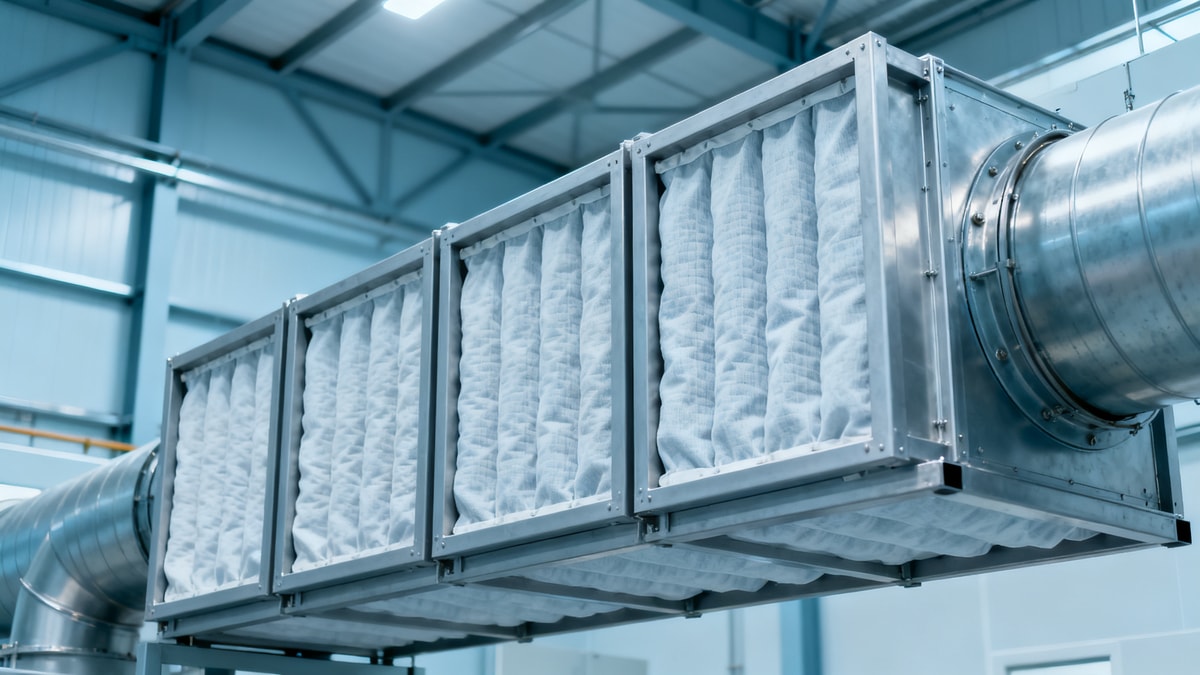
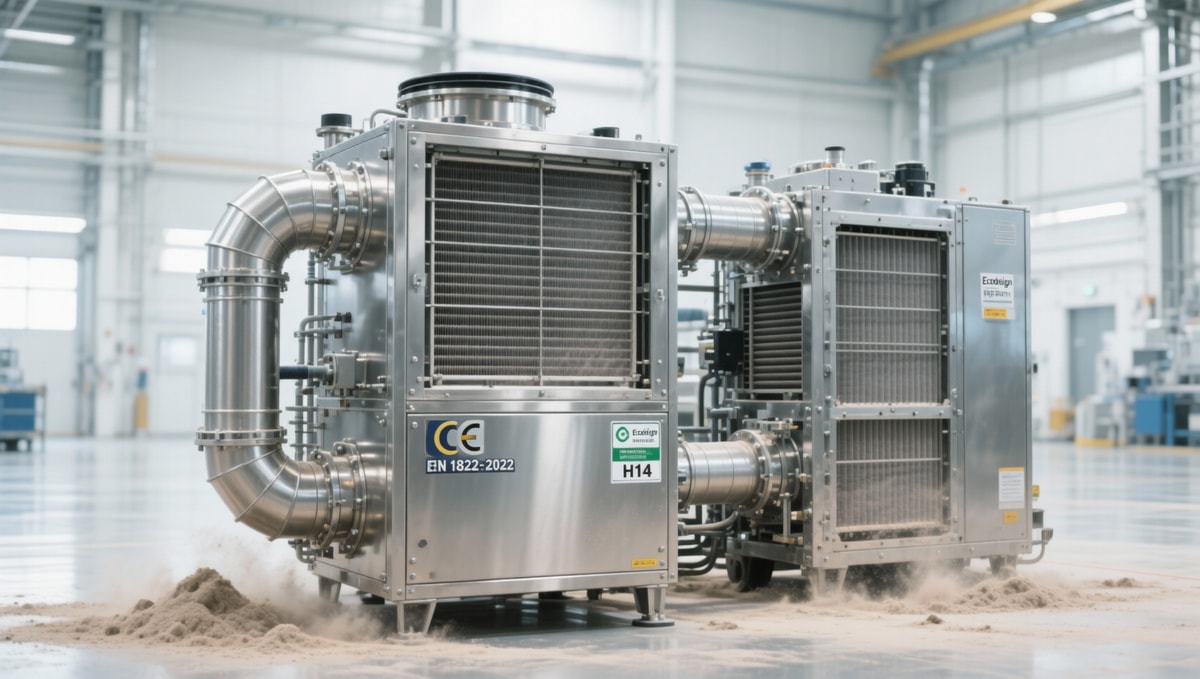
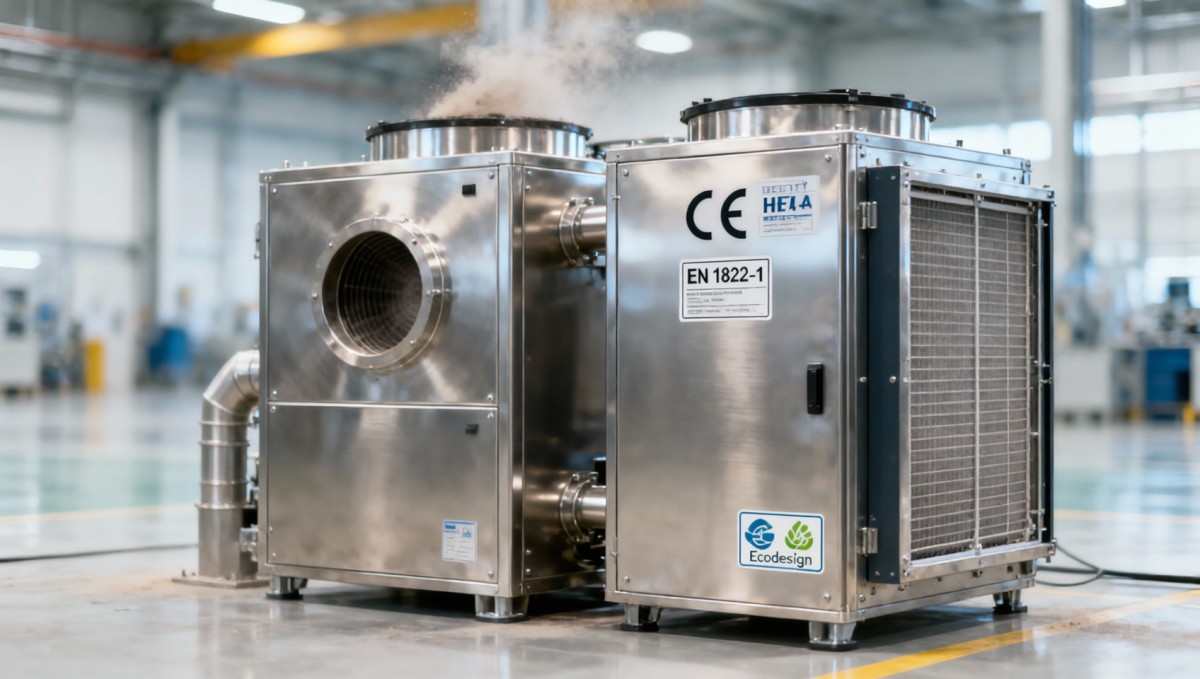
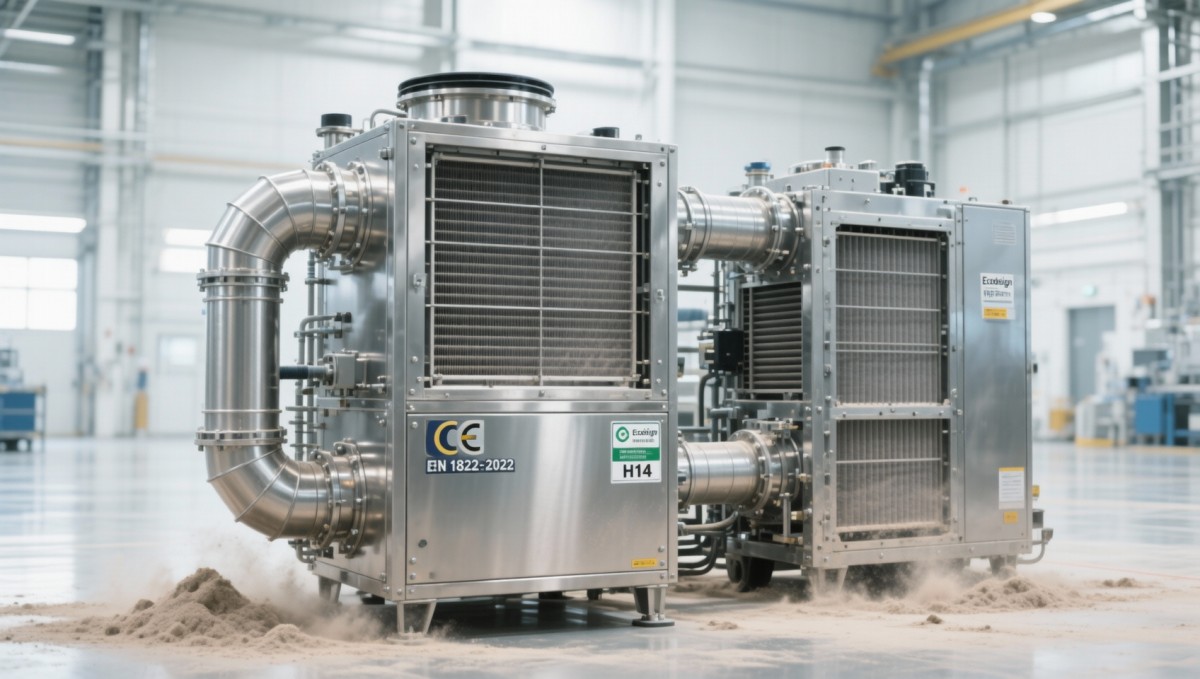
- EN 1822-1:2022 test report for HEPA filters (H13/H14 class verification)
- SCIP submission ID + full BOM-level SVHC screening (≤0.1% w/w threshold)
- RoHS 3 test report covering DEHP, BBP, DBP, DIBP (not just legacy 6-substance list)
- Ecodesign verification: energy efficiency ≥75% (for fan-integrated units), sound power ≤65 dB(A)
Comparing Certification Pathways for Industrial vs. Consumer Equipment
Industrial air purifiers and dust control systems face stricter conformity assessment than consumer-grade equivalents. While Class I consumer devices may use self-certification for CE, most industrial units fall under Module D (production quality assurance) or Module H (full quality assurance)—requiring active oversight by a Notified Body such as TÜV Rheinland (NB 0197) or SGS (NB 0036).
This distinction directly impacts procurement timelines: industrial certification requires 4–8 weeks of testing and documentation review versus 3–5 days for consumer self-declaration. GIC advises EPC contractors to require Notified Body certificate numbers—and verify them via NANDO database—before issuing purchase orders.
Why Global Industrial Core Is Your Trusted Compliance Partner
Global Industrial Core doesn’t just list regulations—we translate them into actionable procurement intelligence. Our Environment & Ecology compliance service integrates real-world engineering constraints with algorithmic trust validation: every certified partner undergoes 3-stage verification—technical dossier audit, factory capability review, and live sample testing against EN 1822-1 and EN 60335-2-69.
For procurement teams evaluating air purifier or dust control suppliers, we deliver: (1) pre-vetted supplier shortlists with verified Notified Body IDs and SCIP IDs; (2) side-by-side comparison matrices covering Ecodesign efficiency, filter class longevity (≥12 months at 85% nominal airflow), and electrical safety certification scope (UL 61000-3-2/3, EN 61000-6-3/4); and (3) rapid-response support for urgent documentation gaps—typically resolved within 72 business hours.
Contact GIC today to request: (a) your customized EU Environment & Ecology compliance readiness scorecard; (b) a benchmarked quotation analysis for Security & Safety pricing and Electrical & Power quotation alignment; or (c) access to our verified supplier registry—including 12+ manufacturers with full EN 1822-1:2022 + Ecodesign 2019/2021 certification coverage.
Frequently Asked Questions
Do dust collectors for metalworking require additional ATEX certification?
Yes—if installed in Zone 21 or 22 combustible dust environments, ATEX 2014/34/EU applies alongside Environment & Ecology requirements. GIC verifies dual compliance status (ATEX + Ecodesign) for all listed industrial dust control partners.
Can a single CE certificate cover both air purifier and dust extractor functions?
Only if tested as an integrated system per EN 60335-2-69 and EN 1822-1. Most hybrid units require separate conformity assessments—GIC’s technical team confirms integration validity within 48 hours.
What’s the typical delivery lead time for CE-compliant industrial units?
Standard lead time is 8–12 weeks post-documentation approval. GIC-verified suppliers maintain 3-week buffer stock for HEPA H14 filter modules and explosion-proof motor variants.
Technical Specifications
- Hidden Environment & Ecology cost after project approvalAuthor :Environmental Engineering Director
- When does an Environment & Ecology impact assessment need updating?Author :Environmental Engineering Director
- Security & Safety standards that affect product approval speedAuthor :Safety Compliance Lead
Expert Insights

Chief Security Architect
Dr. Thorne specializes in the intersection of structural engineering and digital resilience. He has advised three G7 governments on industrial infrastructure security.
Related Analysis
- May 07, 2026Hidden Environment & Ecology cost after project approvalAuthor :Environmental Engineering Director
- May 07, 2026When does an Environment & Ecology impact assessment need updating?Author :Environmental Engineering Director
- May 07, 2026Security & Safety standards that affect product approval speedAuthor :Safety Compliance Lead
Core Sector // 01
Security & Safety
- Global Industrial Air Filter Lead Times Extend to 24 WeeksAuthor :Environmental Engineering Director

- Indonesia BPOM Fast-Tracks Chinese Dust PurifiersAuthor :Environmental Engineering Director

- Global Industrial HEPA Filter Base Fabric Lead Times Extend to 24 WeeksAuthor :Environmental Engineering Director

- Global Industrial Air Filter Lead Times Extend to 24 WeeksAuthor :Environmental Engineering Director

- Indonesia BPOM Fast-Tracks Chinese Dust PurifiersAuthor :Environmental Engineering Director

- Global Industrial HEPA Filter Base Fabric Lead Times Extend to 24 WeeksAuthor :Environmental Engineering Director

- Global Industrial HEPA Filter Lead Times Extend to 24 WeeksAuthor :Environmental Engineering Director

- Indonesia BPOM Accelerates Approval for Chinese Dust PurifiersAuthor :Environmental Engineering Director