SASO Mandates Dual Energy Labels for Industrial Transformers in Saudi Arabia from May 2026
Author
Date Published
Reading Time
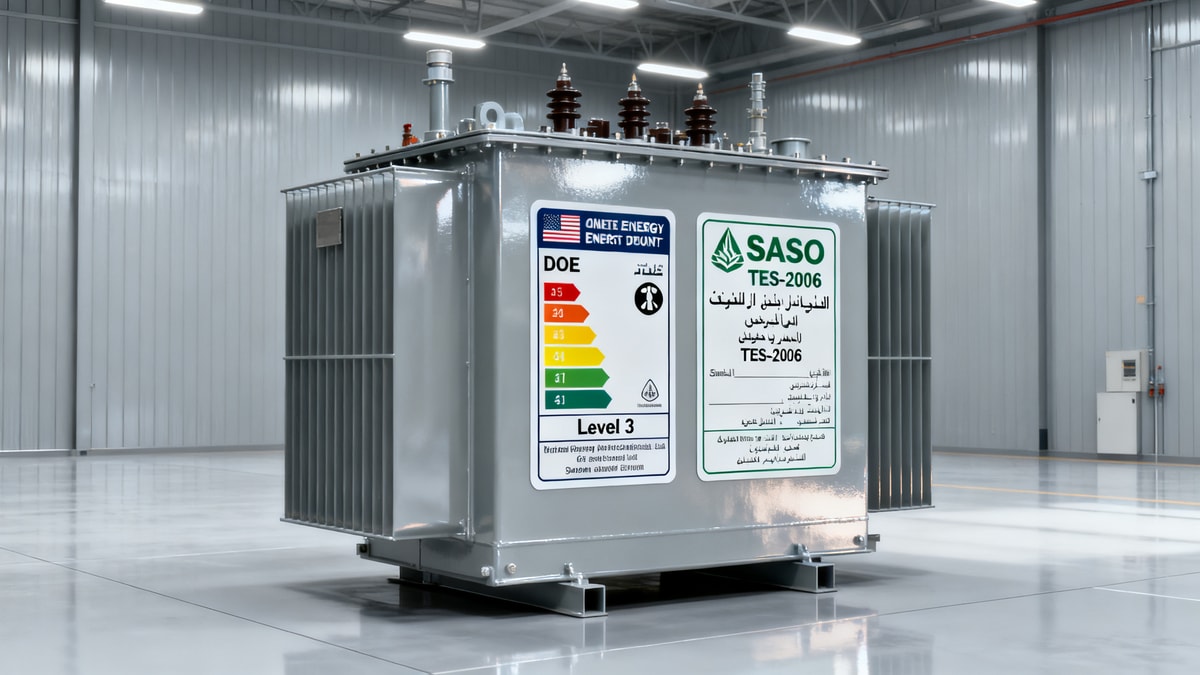
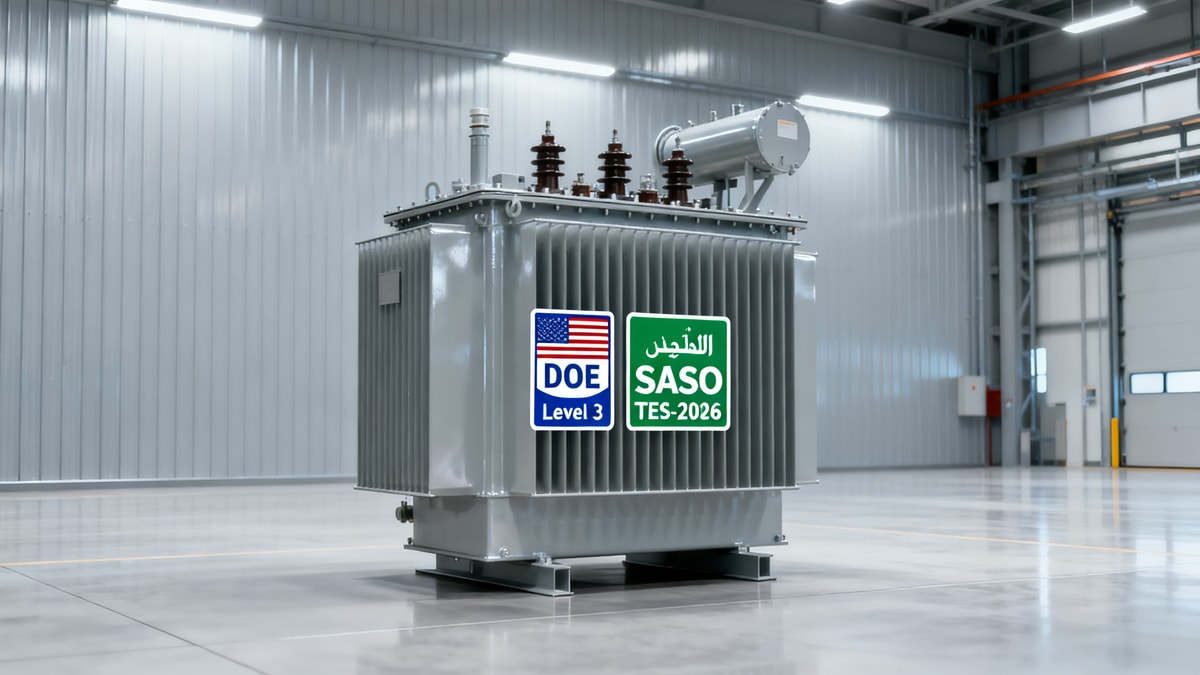
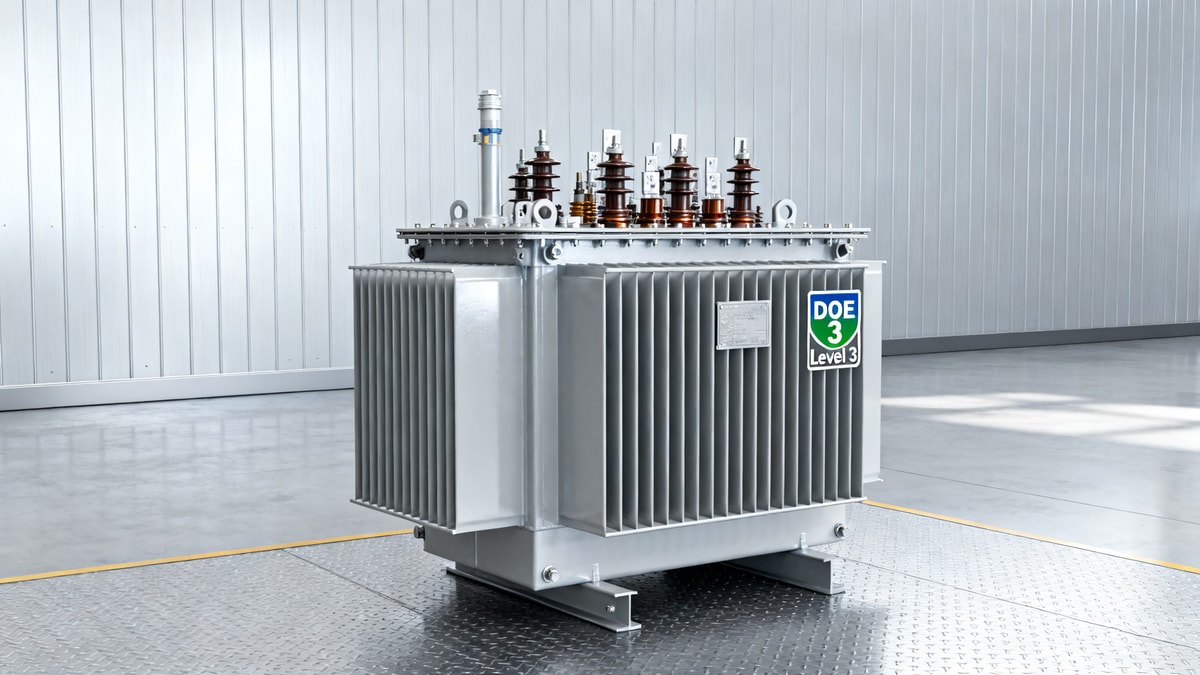
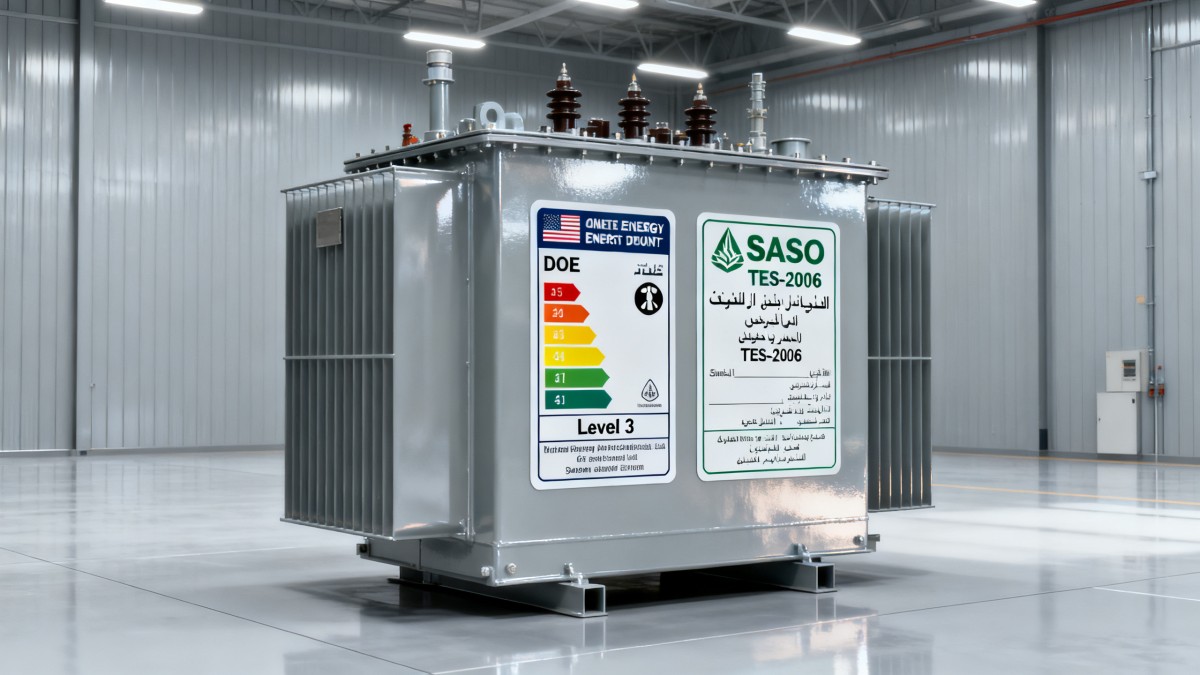
Starting 15 May 2026, industrial transformers placed on the Saudi market must carry both the U.S. Department of Energy (DOE) Level 3 and the newly updated Saudi SASO TES-2026 energy efficiency labels — a requirement introduced by the Saudi Standards, Metrology and Quality Organization (SASO) on 3 May 2026. This dual-labeling mandate directly affects manufacturers, exporters, and distributors of power and distribution transformers supplying to Saudi Arabia, signaling a tightening of compliance expectations for energy performance transparency and verification.
Event Overview
On 3 May 2026, SASO published an update to its SASO Energy Efficiency Labeling Regulation. The revision stipulates that, effective 15 May 2026, all industrial transformers sold in Saudi Arabia must display two concurrent energy efficiency labels: the U.S. DOE Level 3 label and the national SASO TES-2026 label. The regulation strengthens enforcement by increasing on-site抽查 (spot checks) of actual copper loss and iron loss values — not just declared or certified figures. No transitional period or grandfathering clause has been publicly announced.
Industries and Roles Affected
Direct Exporters and Trade Enterprises
Exporters — particularly those based in China and other major transformer-supplying countries — are directly affected because the dual-label requirement applies at the point of customs clearance and market placement. Non-compliant units risk rejection at Saudi ports or post-import suspension from sale. Label design, printing, and documentation must now reflect two distinct regulatory frameworks simultaneously, increasing labeling complexity and pre-shipment verification workload.
Transformer Manufacturers and OEMs
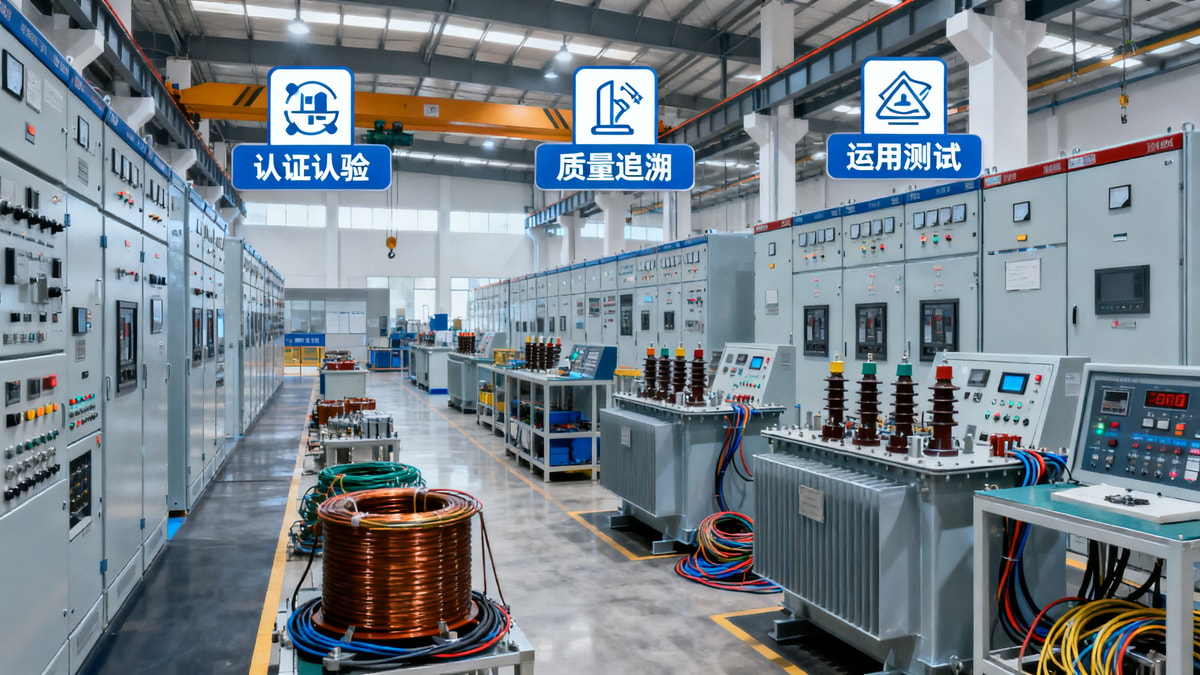
Manufacturers producing industrial transformers for export to Saudi Arabia must ensure product designs meet both DOE Level 3 and TES-2026 efficiency thresholds — which may differ in test methodology, load conditions, or loss calculation assumptions. Since the regulation emphasizes real-world copper/iron loss validation, production-line testing protocols and factory calibration systems may require alignment with both standards’ measurement requirements.
Supply Chain and Certification Service Providers
Certification bodies, testing laboratories, and labeling system vendors serving transformer exporters must adapt their service offerings to support dual-certification workflows. This includes issuing separate test reports per standard, managing parallel label database updates, and verifying label placement compliance (e.g., font size, bilingual content, positioning) under both regimes. Delays in certification harmonization could bottleneck shipment schedules.
What Relevant Enterprises Should Monitor and Do Now
Track official SASO implementation guidance and DOE-SASO alignment notices
While the regulation’s effective date is confirmed, SASO has not yet published detailed technical implementation guidelines — such as accepted test labs, label layout specifications, or equivalency clauses between DOE Level 3 and TES-2026 metrics. Enterprises should monitor SASO’s official portal and authorized notification channels for updates before finalizing label artwork or certification applications.
Verify current product models against both DOE Level 3 and TES-2026 efficiency limits
DOE Level 3 (7 C.F.R. Part 431, Subpart K) defines minimum efficiency levels based on kVA rating and winding configuration. TES-2026 may apply different reference temperatures, load profiles, or loss weighting. Manufacturers should conduct side-by-side gap analysis using latest versions of both standards — not rely on prior SASO-only certifications.
Update labeling systems and quality control checkpoints for dual-label compliance
Label generation software, packaging templates, and QC checklists must be revised to enforce inclusion of both labels — including correct version numbers, valid certification marks, and mandatory Arabic/English bilingual elements required under SASO. Pre-shipment audits should explicitly verify physical label presence, legibility, and positional accuracy per regulation annexes.
Engage with accredited labs early to secure overlapping test capacity
Given increased field抽查 frequency, SASO may prioritize verification at ports or warehouses. Having recent, SASO-recognized test reports for both standards — ideally conducted by labs accredited for both DOE and TES-2026 — reduces exposure to delays or retesting demands. Lab scheduling lead times should be factored into Q2–Q3 2026 production planning.
Editorial Perspective / Industry Observation
Observably, this dual-labeling rule reflects a broader trend among Gulf Cooperation Council (GCC) regulators toward adopting internationally recognized benchmarks — in this case, leveraging DOE’s widely referenced efficiency framework — while retaining national technical sovereignty via TES-2026. Analysis shows it is less a standalone policy shift and more a signal of deeper regulatory convergence: future SASO energy labeling updates may follow similar hybrid models for motors, pumps, or HVAC equipment. From an industry perspective, the immediate challenge lies not in technical feasibility but in synchronization — aligning certification timelines, label governance, and supply chain communication across two independent regulatory ecosystems. Current enforcement emphasis on measured losses (not just nameplate claims) further elevates the importance of traceable, lab-validated data over self-declared conformity.
Conclusion
This regulation marks a formal escalation in Saudi Arabia’s enforcement of transformer energy performance accountability. It does not introduce new efficiency thresholds per se, but significantly raises the bar for evidence-based compliance. For exporters and manufacturers, it is best understood not as a one-time labeling update, but as an operational inflection point requiring coordinated adjustments across product engineering, certification strategy, and labeling execution — with implications likely extending beyond transformers to other energy-consuming equipment regulated under SASO’s labeling regime.
Information Sources
Main source: Official announcement issued by the Saudi Standards, Metrology and Quality Organization (SASO), dated 3 May 2026, referencing the updated SASO Energy Efficiency Labeling Regulation.
Note: Technical annexes, lab accreditation lists, and label layout specifications under TES-2026 remain pending publication and are subject to ongoing observation.
Technical Specifications
- SASO Mandates Dual Energy Label for Industrial Transformers in Saudi Arabia from May 2026Author :Grid Infrastructure Analyst
- EN 61000-4-30:2026 Enforced: Class A Harmonic Traceability Mandatory for EU PQ AnalyzersAuthor :Precision Metrology Expert
- US DOE Level 3 Transformer Efficiency Standard Effective July 1, 2026Author :Grid Infrastructure Analyst
Expert Insights

Chief Security Architect
Dr. Thorne specializes in the intersection of structural engineering and digital resilience. He has advised three G7 governments on industrial infrastructure security.
Related Analysis
- May 06, 2026SASO Mandates Dual Energy Label for Industrial Transformers in Saudi Arabia from May 2026Author :Grid Infrastructure Analyst
- May 06, 2026EN 61000-4-30:2026 Enforced: Class A Harmonic Traceability Mandatory for EU PQ AnalyzersAuthor :Precision Metrology Expert
- May 06, 2026US DOE Level 3 Transformer Efficiency Standard Effective July 1, 2026Author :Grid Infrastructure Analyst
Core Sector // 01
Security & Safety
- SASO Mandates Dual Energy Label for Industrial Transformers in Saudi Arabia from May 2026Author :Grid Infrastructure Analyst

- US DOE Level 3 Transformer Efficiency Standard Effective July 1, 2026Author :Grid Infrastructure Analyst

- SASO Mandates Dual Energy Labels for Industrial Transformers in Saudi Arabia from May 2026Author :Grid Infrastructure Analyst

- US DOE Level 3 Transformer Efficiency Rule Takes Effect July 1, 2026Author :Grid Infrastructure Analyst

- How to assess an Electrical & Power manufacturer beyond catalog claimsAuthor :Grid Infrastructure Analyst

- How to request an Electrical & Power quotation without missing costsAuthor :Grid Infrastructure Analyst

- What to check before hiring EPC contractors for power plantsAuthor :Grid Infrastructure Analyst

- Engineering procurement process mistakes that delay plant deliveryAuthor :Grid Infrastructure Analyst