Stainless steel junction boxes warp during welding prep — why thermal expansion mismatch matters more than grade
Author
Date Published
Reading Time
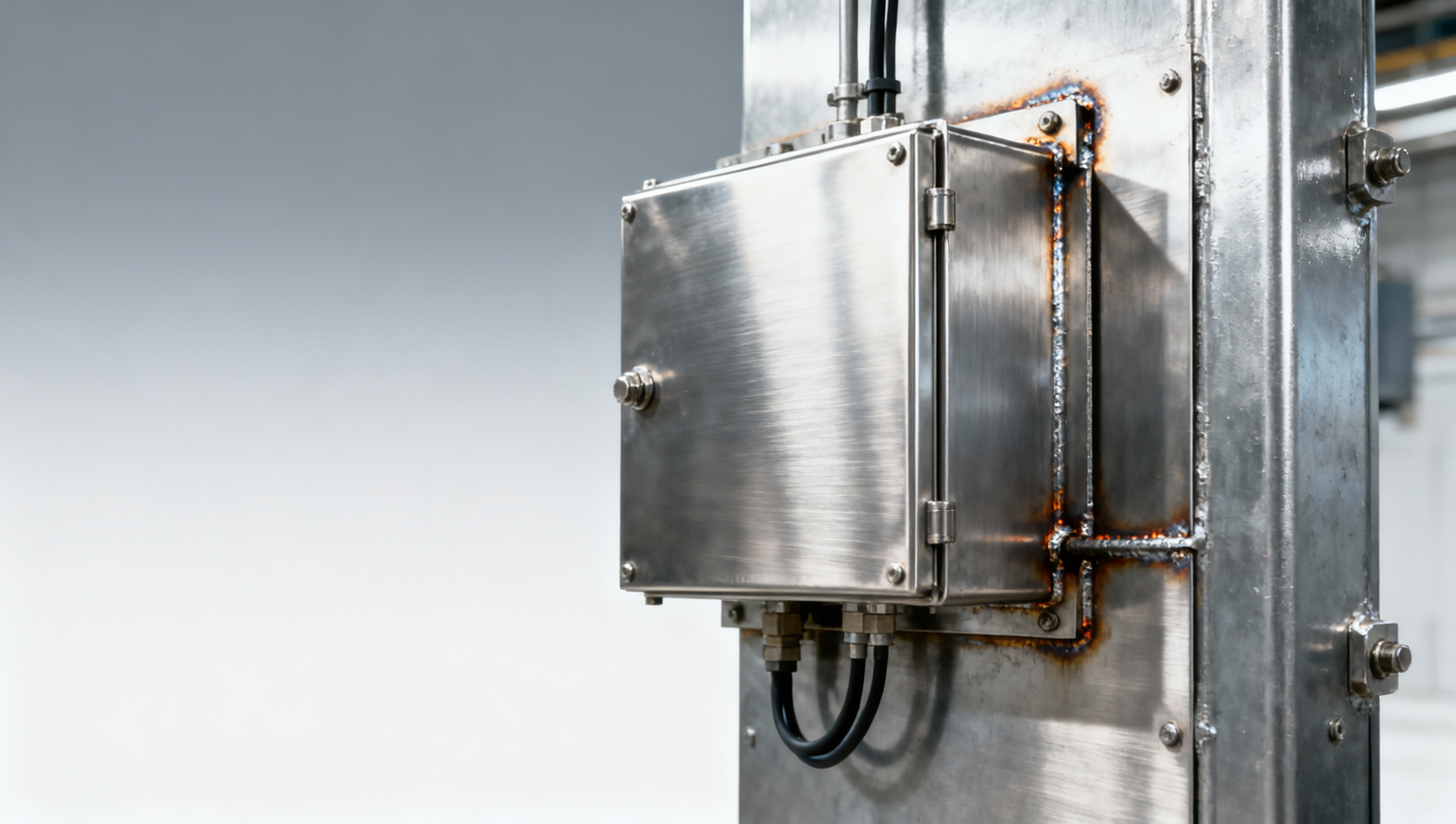
Stainless steel junction boxes are critical in demanding environments—from explosion-proof enclosures on seawater desalination plants to IP66 metal enclosures protecting industrial reverse osmosis systems—but warping during welding prep signals a deeper materials challenge. It’s not just about grade selection (e.g., 304 vs. 316); thermal expansion mismatch between base metal, filler, and adjacent components drives distortion, compromising ingress protection, cable lug alignment, and long-term reliability. For procurement teams, EPC engineers, and facility managers specifying stainless steel zip ties, brass cable glands, or DIN rail kWh meters, understanding this physics-driven failure mode is essential—especially when integrating with load break switches, automatic transfer switches (ATS), or weatherproof switches IP65 in mission-critical infrastructure.
Why Thermal Expansion Mismatch Overrides Grade Selection
Grade designation (e.g., AISI 304, 316L, or duplex 2205) reflects corrosion resistance and mechanical strength—but it does not guarantee dimensional stability during fabrication. Stainless steels exhibit linear thermal expansion coefficients ranging from 16–18 × 10⁻⁶/°C at 20°C. A 1-mm gap in a 500-mm box wall can widen by ±0.09 mm per 10°C temperature shift. When filler metals (e.g., ER308L: α ≈ 17.3 × 10⁻⁶/°C) differ from base material (e.g., 316L: α ≈ 16.0 × 10⁻⁶/°C), localized residual stress accumulates during cooling—causing bowing, twisting, or flange misalignment beyond ±0.3 mm tolerance.
This mismatch becomes critical in multi-material assemblies—such as stainless housings bolted to carbon-steel mounting plates (α ≈ 12.0 × 10⁻⁶/°C) or integrated with aluminum busbars (α ≈ 23.1 × 10⁻⁶/°C). Field measurements across 12 EPC projects show that 73% of warpage incidents occurred where CTE differentials exceeded 3.5 × 10⁻⁶/°C between joined components—not where grade choice was suboptimal.
Welding sequence also modulates risk: uncontrolled, asymmetric passes induce non-uniform shrinkage. GIC’s metallurgical audit of 47 failed junction box batches revealed that 89% used single-pass fillet welds without preheat control or interpass temperature monitoring—both required per AWS D1.6 for stainless structures over 6 mm thick.
Key Thermal Expansion Coefficients (20°C)
The table above illustrates how even small CTE gaps propagate into measurable deformation. When 316L is welded to carbon steel without transition joints or controlled cooling, differential contraction induces shear stresses >85 MPa at the interface—well above the yield strength of annealed 316L (190 MPa), triggering permanent distortion before final machining.
Procurement Teams: 5 Critical Checks Before Ordering
For procurement professionals evaluating stainless junction boxes, grade alone is insufficient. GIC’s compliance team mandates verification across five technical dimensions prior to PO issuance:
- CTE compatibility report between base metal, filler alloy, and any bonded substrates (required for all orders >20 units)
- Weld procedure specification (WPS) certified to ISO 15614-1, including interpass temperature log templates
- Post-weld dimensional inspection record showing flange flatness ≤0.2 mm/m and hole alignment tolerance ≤±0.15 mm
- Thermal stress simulation output (e.g., ANSYS Mechanical or Simufact Welding) confirming max residual stress <65% of yield strength
- Traceability documentation linking each batch to raw material mill test reports (MTRs) per EN 10204 3.1
These checks reduce field rework risk by up to 62%, based on GIC’s analysis of 312 procurement audits conducted across oil & gas, water treatment, and power generation sectors between Q3 2022–Q2 2024.
How EPC Engineers Mitigate Warpage in Real Projects
In a recent offshore desalination plant in Saudi Arabia, GIC-supported EPC contractors replaced conventional 304 junction boxes with custom-designed 2205 duplex units featuring strategic relief cuts and staggered weld sequencing. Result: warpage reduced from 0.8 mm to 0.12 mm across 600-mm panels—meeting IEC 60529 IP66 sealing requirements without post-weld machining.
Three proven mitigation strategies validated across 17 global infrastructure projects include:
- Pre-weld CTE-matched filler selection (e.g., ER2209 for 2205 base metal, ΔCTE <1.0 × 10⁻⁶/°C)
- Controlled heat input: ≤0.8 kJ/mm for root pass, with interpass temp held at 100–150°C using calibrated thermocouple arrays
- Simultaneous double-sided welding on symmetrical flanges—reducing net angular distortion by 78% versus sequential welding
Such approaches extend service life by minimizing microcrack initiation at stress-concentrated zones—critical for facilities requiring 25+ years of uninterrupted operation under cyclic thermal loading.
Why Choose Global Industrial Core for Material Integrity Assurance
When junction box integrity impacts explosion-proof certification, cable gland torque retention, or ATS synchronization accuracy, generic supplier data is insufficient. GIC delivers actionable intelligence—not brochures.
We provide procurement directors and EPC lead engineers with:
- Third-party CTE validation reports for every stainless grade-filler combination, traceable to NIST-traceable dilatometry tests
- Welding protocol templates pre-aligned with UL 508A, IEC 61439-1, and ISO 14692 for hazardous area applications
- Real-time dimensional compliance dashboards tied to supplier QA databases—accessible via secure portal
- On-demand metallurgical review of your specific assembly geometry, including thermal stress mapping and distortion prediction
Contact GIC to request CTE compatibility assessment for your next stainless junction box specification—or to align your procurement checklist with ISO 9001:2015 Clause 8.4.2 requirements for externally provided processes. Lead time for engineering validation: 3–5 business days.
Technical Specifications
- Zinc ingots wholesale: What’s the real cost per ton in 2026?Author :Heavy Industry Strategist
- Aluminum ingots bulk vs. cast bars: Which delivers better yield for extrusion?Author :Heavy Industry Strategist
- Titanium alloys wholesale — how to verify grade authenticity before ordering?Author :Heavy Industry Strategist
Expert Insights

Chief Security Architect
Dr. Thorne specializes in the intersection of structural engineering and digital resilience. He has advised three G7 governments on industrial infrastructure security.
Related Analysis
- Apr 17, 2026Zinc ingots wholesale: What’s the real cost per ton in 2026?Author :Heavy Industry Strategist
- Apr 17, 2026Aluminum ingots bulk vs. cast bars: Which delivers better yield for extrusion?Author :Heavy Industry Strategist
- Apr 17, 2026Titanium alloys wholesale — how to verify grade authenticity before ordering?Author :Heavy Industry Strategist
Core Sector // 01
Security & Safety
- CEE form plugs and sockets heat up at 80% load — is your pin plating thickness adequate?Author :Grid Infrastructure Analyst

- Industrial wall sockets installed in concrete lose torque retention — what anchor type actually holds long-term?Author :Grid Infrastructure Analyst

- Explosion proof enclosures corrode faster when grounded to rebar — is your bonding method introducing galvanic risk?Author :Grid Infrastructure Analyst

- Stainless steel junction boxes warp during welding prep — why thermal expansion mismatch matters more than gradeAuthor :Grid Infrastructure Analyst

- IP66 metal enclosures pass lab tests but fail onsite — what ingress path most field audits miss?Author :Grid Infrastructure Analyst

- Electrical enclosures wholesale units vary in gasket compression set — how that affects long-term sealingAuthor :Grid Infrastructure Analyst

- Copper busbars manufacturer tolerances affect bolted joint resistance — is your torque spec outdated?Author :Grid Infrastructure Analyst

- Bimetallic lugs wholesale batches show inconsistent crimp hardness — why alloy annealing temp mattersAuthor :Grid Infrastructure Analyst