How to Vet a Wholesale CO2 Extinguisher Supplier for Certified Bulk Orders
Author
Date Published
Reading Time
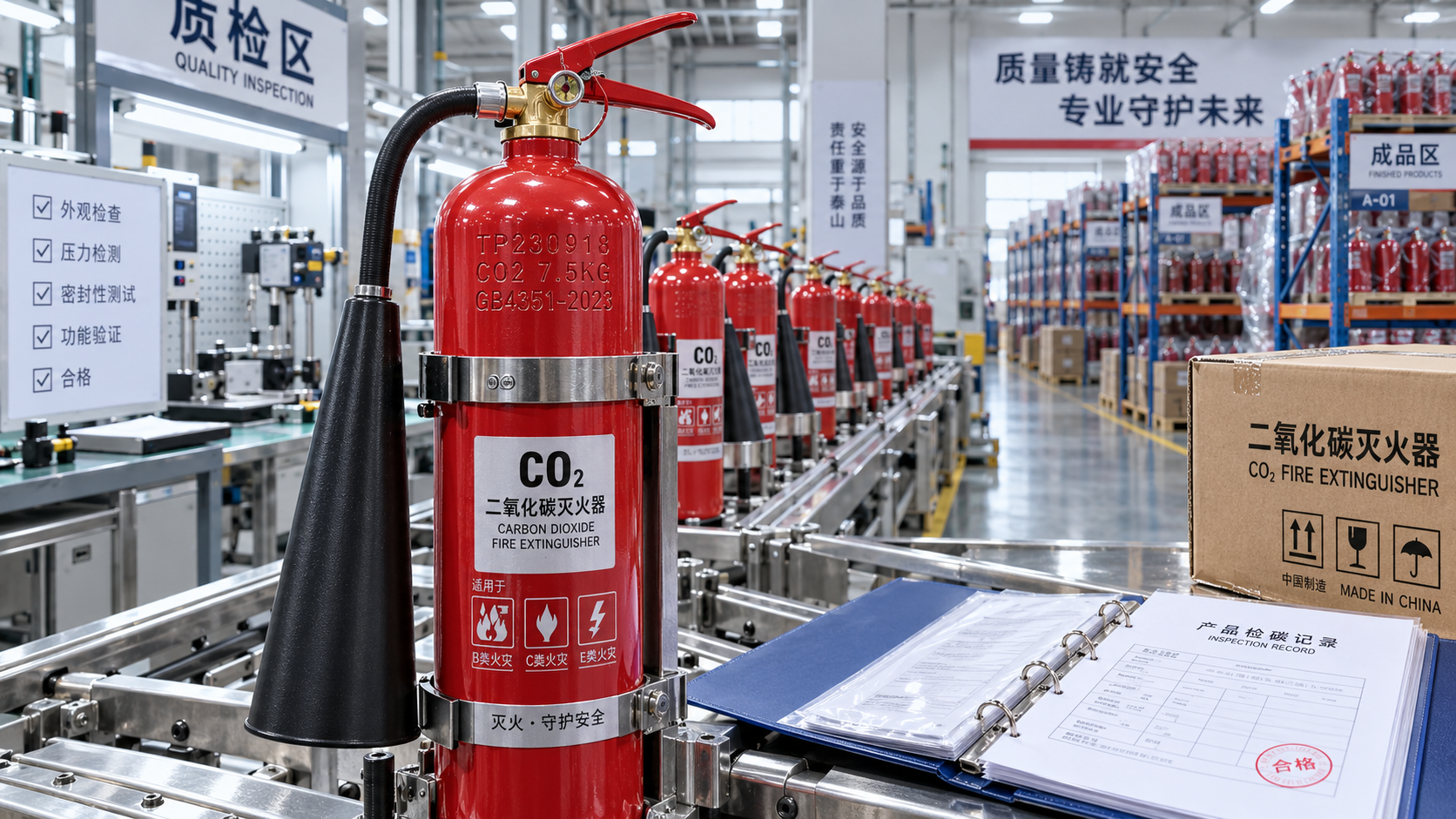
A wholesale CO2 extinguisher supplier should be approved for a certified bulk order only after the buyer has verified that the quoted units, their cylinders, and the accompanying documentation all match the legal and site-specific requirements of the destination market. A low unit price can become expensive quickly when extinguishers arrive with invalid approvals, inconsistent production batches, incomplete cylinder records, or labels that local inspectors will not accept.
For procurement teams, the practical question is not whether a supplier can provide a certificate. Most can provide documents. The question is whether the supplier can prove that the exact extinguisher configuration being shipped has been manufactured, tested, marked, packed, and delivered under a controlled system. That distinction matters most on large orders, where one documentation or quality failure can affect multiple facilities, handover schedules, and fire-safety compliance reviews.
Start with the fire-risk and jurisdiction, not the supplier quotation
CO2 extinguishers are commonly selected for energized electrical equipment, server rooms, laboratories, control panels, certain machinery areas, and flammable-liquid risks where a clean, non-conductive agent is useful. They are not a universal substitute for other extinguisher types. Carbon dioxide provides limited cooling, has a short discharge duration, and can present an asphyxiation risk in confined or poorly ventilated spaces. A buyer who orders by extinguisher size alone can easily acquire equipment that is unsuitable for the actual hazard assessment.
Before asking suppliers for a final bulk quote, define the requirement in procurement language that can be audited. This should cover the intended hazard class, extinguisher capacity, required rating or performance classification, installation environment, operating-temperature range, mounting arrangement, signage and label language, and the country or region where units will be commissioned.
The approval route must follow the destination and the project specification. An approval accepted for one country, owner, insurer, or EPC contract may not satisfy another. Buyers should avoid treating broad claims such as “CE certified,” “UL quality,” or “ISO approved” as interchangeable evidence of market access. ISO certification often concerns the manufacturer’s management system; it does not automatically demonstrate that each extinguisher model is approved for a particular application. Likewise, a certificate for one model, agent fill, valve arrangement, or cylinder size does not automatically extend to every product in a catalogue.
A sound request for quotation identifies the required approval scheme or named project standard, then asks the supplier to show how the offered model maps to it. Where the contractor, authority having jurisdiction, insurer, or end user has a specific approved-products list, resolve that point before placing the purchase order. Retrofitting compliance after shipment is usually much more difficult than qualifying the supply source early.
Verify the approval as a product-level record
Certification review should be performed against the actual model proposed for supply, not against a generic company certificate or a scanned document with no connection to the quotation. A capable wholesale CO2 extinguisher supplier should be able to provide a coherent documentation set that links the commercial offer to the physical extinguisher.
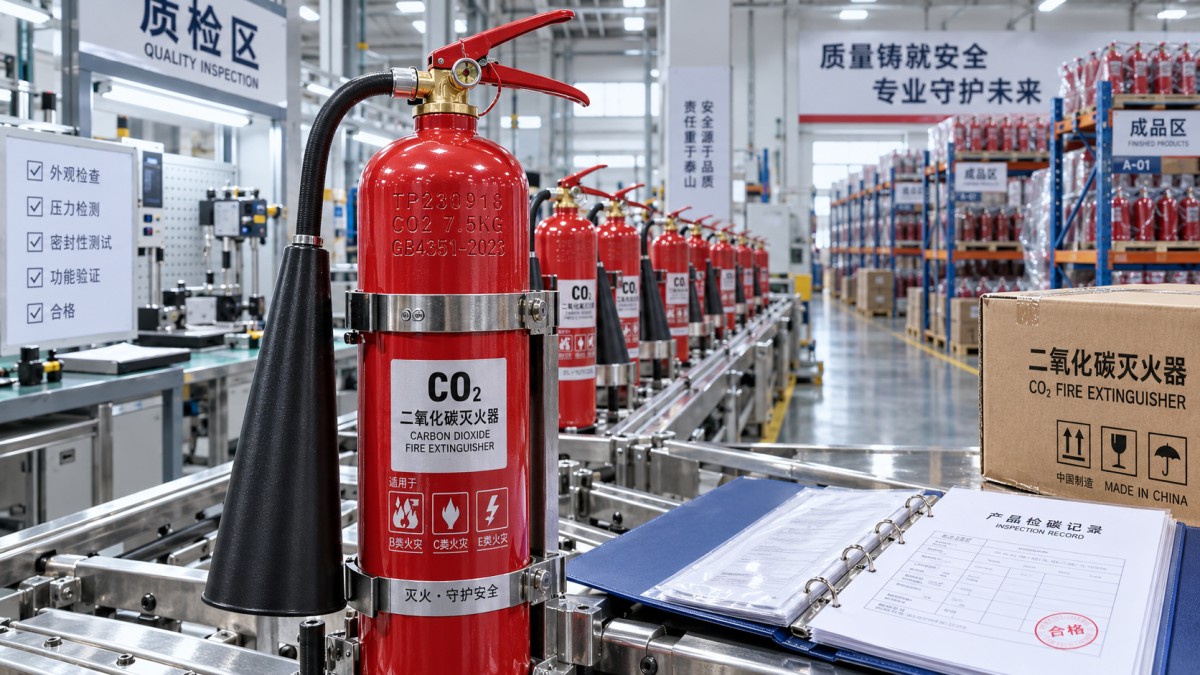
Ask for the model number, capacity, fire rating where applicable, agent specification, cylinder identification, valve type, hose or horn configuration, and proposed labeling artwork. Those details should be consistent across the quotation, data sheet, approval record, production markings, packing list, and final inspection report. Small discrepancies are not always disqualifying, but they should be explained before award. A change from one valve or cylinder source to another, for example, may affect the scope of a prior approval.
- Approval scope: Confirm the issuing body, certificate or listing number, model coverage, manufacturing location, validity status, and any limitations stated in the approval.
- Rating evidence: Check that claimed fire ratings correspond to the offered extinguisher capacity and configuration, rather than a related product variant.
- Factory controls: Review the manufacturer’s quality-system certificate as supporting evidence, while keeping it separate from product certification.
- Label and marking samples: Require clear images or artwork showing approval marks, model designation, operating instructions, manufacture date or traceability code, and service information.
- Change control: Ask whether cylinder, valve, nozzle, hose, powder coating, or filling-process changes are controlled and whether they require notification or reapproval.
Document authenticity deserves more than a visual check. Buyers should use the issuing body’s official verification route where one is available, and should compare document details with the legal manufacturer named on the offer. Certificates that list a different factory, expired scope, or a vague trade name create a risk that the product has been assembled outside the certified arrangement.
The cylinder is the high-consequence component
In a CO2 extinguisher, the cylinder is a pressure vessel containing liquefied gas. Its construction, material, neck finish, threads, test history, corrosion protection, and filling controls therefore deserve closer attention than cosmetic details such as paint finish or handle shape.
A supplier should identify the cylinder manufacturer and explain the applicable cylinder standard or transport-pressure-vessel requirement for the intended market. The correct route varies by jurisdiction. Buyers may encounter requirements associated with transportable pressure equipment, national transportation rules, or project-specific pressure-vessel specifications. The relevant question is whether the supplied cylinder is legal and suitable for transport, storage, charging, and service where it will be used.
For a bulk order, request traceability at batch level at minimum, and at individual-cylinder level where the project, local regulation, or asset-management system requires it. The documentation should make it possible to connect the extinguisher serial number or cylinder mark to manufacturing records, inspection results, and filling records. If a supplier cannot identify how it would isolate an affected production lot, its quality system may not be strong enough for a critical-site order.
Inspect the proposed marking format carefully. Permanent markings should not be obscured by paint, labels, brackets, or packaging. Buyers should also establish who is responsible for confirming service intervals, periodic inspection obligations, and retesting requirements after handover. These obligations are often governed locally and may differ from the factory’s normal export market. A supplier that offers a long shelf-life claim without discussing ongoing inspection and maintenance is not giving a complete operational picture.
Evaluate samples and pre-shipment inspection against the purchase order
Sample approval is valuable, but only when the approved sample represents the production configuration. A polished pre-production unit can conceal variation in cylinders, valves, discharge horns, brackets, labeling, or filling weights later used on the order. The purchase order should therefore identify the approved configuration and prohibit substitutions without written authorization.
Inspection criteria should be specific enough for an independent inspector, project quality team, or receiving warehouse to apply. The goal is to prevent subjective acceptance of equipment that “looks similar.” Typical checks include physical condition, cylinder markings, gross weight or agent fill verification, valve and safety-device installation, hose and horn condition, bracket compatibility, instruction label legibility, carton markings, and batch traceability.
Functional discharge testing is not normally appropriate for every finished unit because it consumes the agent and may alter the product condition. Instead, agree on the supplier’s routine production tests, sampling method, leak-testing approach, and documentation for the batch. For projects with unusual requirements, establish the witness or third-party inspection scope in advance. Do not leave this to a broad instruction such as “inspection required”; it gives both parties too much room to interpret the acceptance standard differently.
The buyer should also confirm whether the supplier fills cylinders in-house or relies on a third party. Outsourced filling is not automatically a problem, but it changes the chain of control. The party responsible for fill weight, gas quality, valve torque, sealing, leak verification, and final release should be clearly identified. The final certificate pack should name the production batch and shipment lot, not simply state that products were inspected at some point.
Price comparison should include the cost of compliance and readiness
Comparing a CO2 extinguisher by unit price can distort the procurement decision. One supplier’s quote may include export-ready cartons, brackets, certification copies, final inspection, multilingual labels, and properly declared dangerous-goods handling, while another assumes those items are outside the base price. The apparent price gap may disappear once missing compliance work and rework are added.
Build a like-for-like comparison that separates equipment cost from the commercial conditions surrounding it. At a minimum, compare the quoted model, approval package, cylinder source, accessories, documentation, packaging, Incoterms, shipment readiness date, minimum order quantity, payment terms, and warranty or defect-resolution process. A supplier should state whether spare hoses, horns, valves, brackets, tamper seals, and wall-fixing hardware are available for the expected service life.
Freight planning requires special attention because charged CO2 extinguishers are pressurized articles. Packaging, markings, transport documentation, carrier acceptance, and destination import requirements can influence lead time and delivered cost. Procurement should involve the logistics team before the order is released, particularly for cross-border shipments, remote sites, or phased deliveries. A factory may be able to produce the goods on time yet still lack the export experience needed to move them without delay.
For major orders, it is often sensible to divide cost review into three layers: the purchase price, the cost to deliver compliant units to site, and the cost of managing defects or rejected documentation. The third layer is where low-cost offers tend to become uncertain. A supplier with clear traceability, stable production control, and a defined corrective-action process may offer lower procurement risk even when its initial quote is not the lowest.
Test the supplier’s ability to support the order after shipment
Bulk buyers need a supplier that can respond when field issues arise, not merely dispatch a container. Ask for the escalation path for missing certificates, transit damage, leakage concerns, incorrect labeling, and suspected batch defects. The response should identify who has authority to approve replacements, how affected serial numbers will be traced, and what evidence is needed to start a claim.
Availability of service parts matters where extinguishers will be maintained locally. Some purchasers prefer fully replaceable units; others require components compatible with an established maintenance network. Either approach can work, but compatibility should not be assumed from visual similarity. Valve threads, horn connections, bracket geometry, and service procedures can differ across manufacturers.
A short supplier audit, whether remote or on-site, can be more informative than an extended sales presentation. Focus on the production line, cylinder receipt and identification, filling controls, leak-testing station, quarantine process, calibration records for weighing equipment, finished-goods segregation, and document-release workflow. The purpose is to determine whether the factory can repeatedly build the quoted product, not whether it can produce one compliant sample.
A practical qualification path for a bulk order
Procurement teams can reduce avoidable delays by qualifying in sequence. First, freeze the technical and jurisdictional requirement. Second, screen suppliers using model-specific approvals and cylinder traceability evidence. Third, review a representative sample and label set. Fourth, write inspection, documentation, delivery, and substitution controls into the purchase order. Finally, verify the shipment documents and sampled units before final release or acceptance.
The strongest purchasing decision is usually the one supported by a clean chain of evidence: the site requires a defined extinguisher; the offered model is approved for that requirement; the cylinder and fill are traceable; the batch was inspected against agreed criteria; and the supplier can resolve an issue after delivery. When those links are in place, price negotiations become more meaningful because the buyer is comparing viable sources rather than comparing uncertain promises.
Technical Specifications
- Air Handling Unit Supplier Checklist: Performance Data, Lead Times, and SupportAuthor :Environmental Engineering Director
- Buying Fiberglass Water Tanks Wholesale: Compare Quotes and Delivery CostsAuthor :Environmental Engineering Director
- Choosing an XLPE Power Cable Supplier: Test Reports, Traceability, and Lead TimesAuthor :Grid Infrastructure Analyst
Expert Insights

Chief Security Architect
Dr. Thorne specializes in the intersection of structural engineering and digital resilience. He has advised three G7 governments on industrial infrastructure security.
Related Analysis
- Oct 19, 2026Air Handling Unit Supplier Checklist: Performance Data, Lead Times, and SupportAuthor :Environmental Engineering Director
- Oct 18, 2026Buying Fiberglass Water Tanks Wholesale: Compare Quotes and Delivery CostsAuthor :Environmental Engineering Director
- Oct 17, 2026Choosing an XLPE Power Cable Supplier: Test Reports, Traceability, and Lead TimesAuthor :Grid Infrastructure Analyst
Core Sector // 01
Security & Safety
- How to Vet a Wholesale CO2 Extinguisher Supplier for Certified Bulk OrdersAuthor :Safety Compliance Lead

- How to Select a Conventional Fire Alarm Panel by Zone Capacity and Building RiskAuthor :Safety Compliance Lead

- Steel Rescue Tripods Wholesale: Key Load Ratings, Standards, and Buying MistakesAuthor :Safety Compliance Lead

- India Lifts Duty on Fire Rescue Imports to 22%Author :Safety Compliance Lead

- IEC 62061 Amendment 2 Targets Fire & Rescue ControllersAuthor :Safety Compliance Lead

- IEC 62819-2:2026 Sets New Cybersecurity CheckpointAuthor :Safety Compliance Lead

- When to Use a Quick Deployment Oil Boom for Spill Control in Ports and Inland WatersAuthor :Safety Compliance Lead

- Saudi SASO Adds Cybersecurity Annex to Fire Equipment CertificationAuthor :Safety Compliance Lead