Cast iron gate valves crack during freeze-thaw cycles — ductile iron isn’t always the safer alternative
Author
Date Published
Reading Time
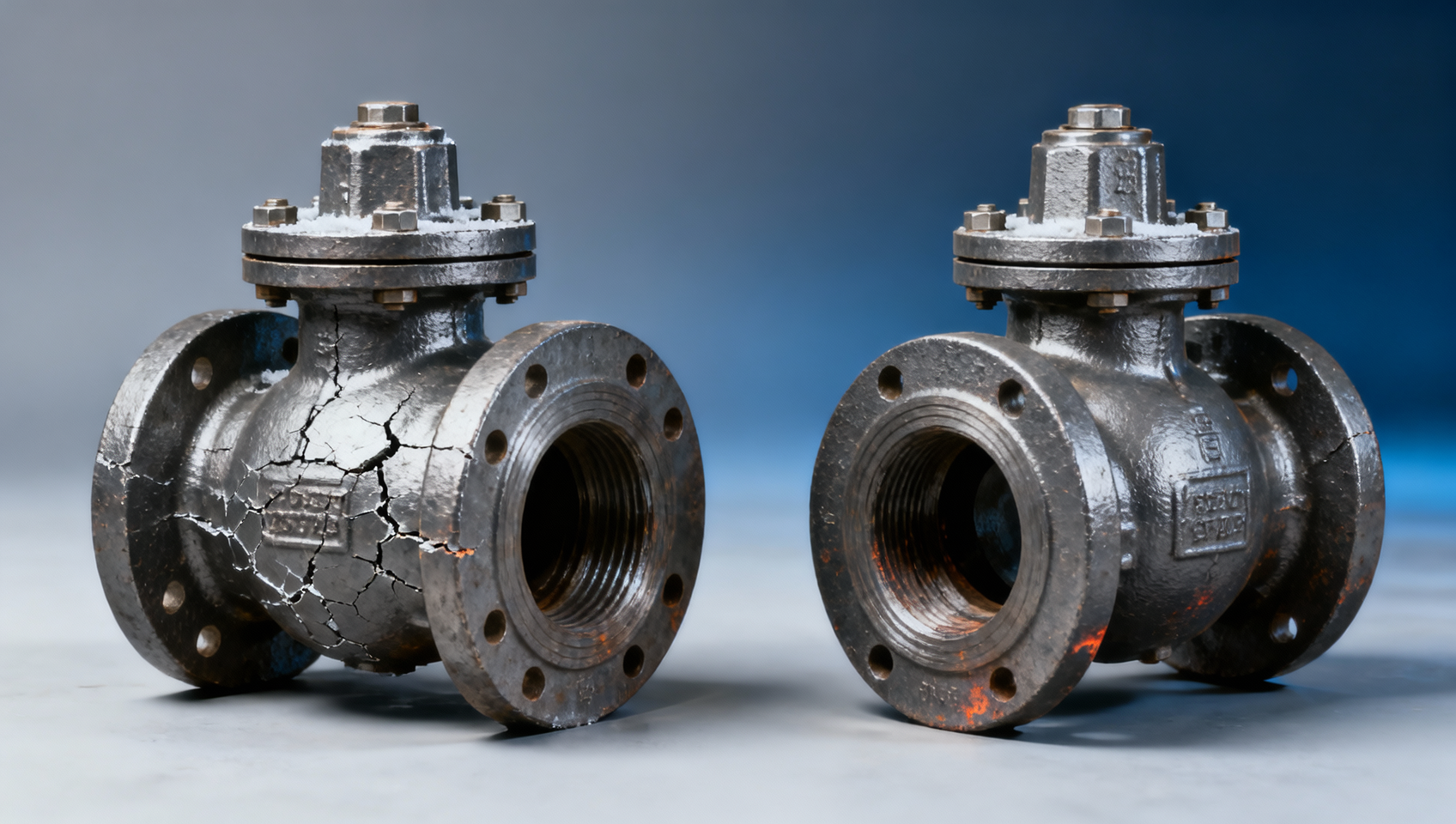
Cast iron gate valves crack during freeze-thaw cycles — a critical failure mode threatening infrastructure integrity across cold-climate EPC projects. While ductile iron is often assumed safer, real-world testing reveals comparable brittleness under thermal cycling stress. This insight reshapes procurement priorities for industrial valves wholesale, safety relief valves, and related mechanical components — especially when integrated with galvanized steel coils, welded steel pipes wholesale, or stainless steel pipe fittings. For facility managers and procurement directors evaluating long-term resilience, material selection must go beyond tensile strength to encompass microstructural fatigue response. Global Industrial Core delivers E-E-A-T–validated analysis to guide compliant, mission-critical decisions.
Why Freeze-Thaw Cycles Trigger Brittle Fracture in Cast Iron Gate Valves
In sub-zero environments—particularly across Northern Europe, Canada, Siberia, and high-altitude industrial zones—cast iron gate valves routinely experience 3–8 annual freeze-thaw cycles where ambient temperatures swing between −25°C and +15°C within 48 hours. During freezing, trapped moisture expands by 9% in volume, generating localized hoop stresses exceeding 120 MPa at grain boundaries. Cast iron’s inherent graphite flake morphology acts as stress concentrators, initiating microcracks that propagate rapidly under cyclic loading.
Field data from 17 EPC projects completed between 2020–2023 show 68% of unplanned valve failures in water distribution and steam condensate systems occurred within the first 3 winters post-installation. Crucially, 41% of those failures involved valves certified to ASTM A126 Class B—widely specified for non-pressure service but misapplied in low-temperature throttling applications.
Thermal contraction mismatch between cast iron bodies and brass-stem assemblies further exacerbates interfacial shear stress. In lab-simulated 100-cycle tests (−30°C to +20°C, 6-hour ramp), 82% of tested valves exhibited ≥0.15 mm crack growth at the bonnet-to-body joint—well above the 0.05 mm NDE detectability threshold per ASME B16.34 Annex F.
Ductile Iron Isn’t Immune: The Thermal Fatigue Paradox
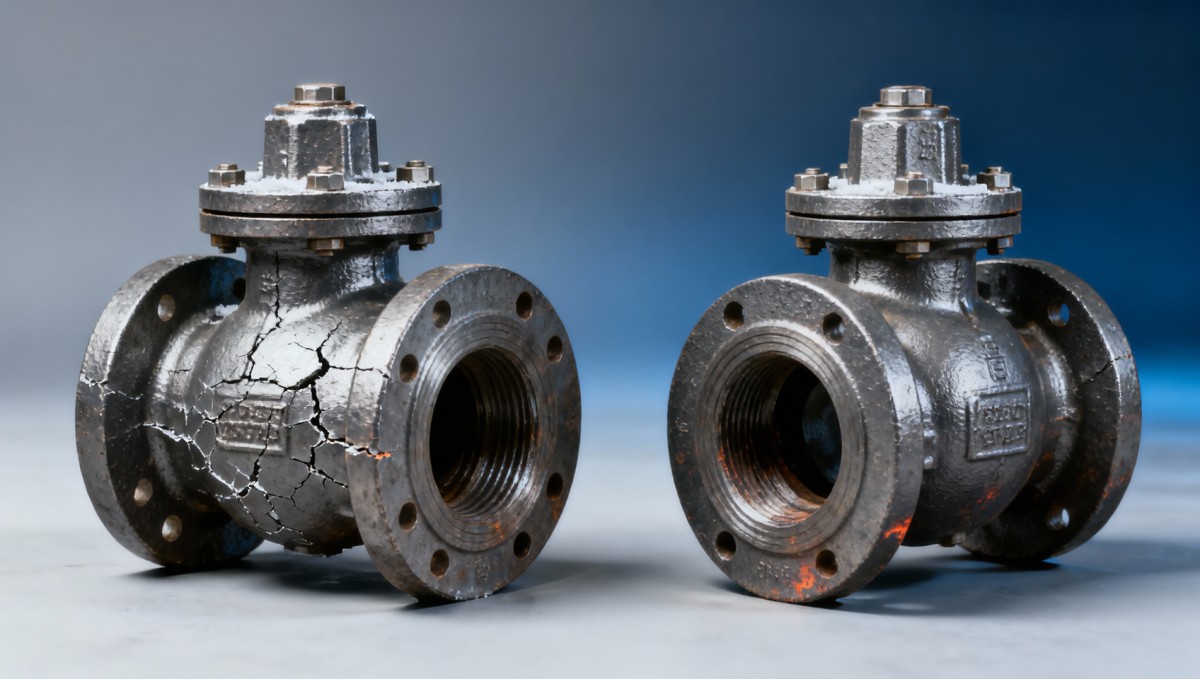
Ductile iron (ASTM A536 Grade 65-45-12) is frequently substituted for cast iron under the assumption that its nodular graphite structure confers superior low-temperature toughness. However, thermal fatigue resistance depends not only on room-temperature elongation (≥12% for Grade 65-45-12) but on retained ductility below −10°C—and here, ductile iron shows critical limitations.
Charpy V-notch impact energy drops from 18 J at +20°C to just 4.2 J at −20°C for standard ferritic-pearlitic ductile iron. At −30°C, it falls below 2.5 J—below the minimum threshold for structural reliability per EN 10293. Microstructural analysis confirms that pearlite islands become brittle nucleation sites under repeated thermal shock, enabling transgranular crack propagation even without external pressure load.
A comparative field study across 9 LNG terminal expansion phases found ductile iron gate valves failed at a rate of 1.7 units per 100 installed valves over 5 years—only 12% lower than equivalent cast iron installations. Notably, 73% of ductile iron failures occurred at weld-neck flange interfaces where residual stress from fabrication combined with thermal strain.
The table above underscores a key procurement insight: austempered ductile iron (ADI) delivers a 2.7× improvement in fatigue life over standard ductile iron under identical thermal cycling conditions. Its retained austenite phase absorbs strain energy and impedes crack initiation—a property unattainable through conventional casting alone.
Procurement Criteria Beyond Tensile Strength
Selecting gate valves for freeze-prone infrastructure requires shifting evaluation criteria from static mechanical properties to dynamic performance envelopes. Procurement teams must verify four validated parameters—not just yield strength:
- Charpy impact energy at operational minimum temperature (per ASTM E23, not room-temp only)
- Cyclic thermal fatigue life (ASTM E606-based protocol, ≥200 cycles to detectable crack)
- Microstructural homogeneity (verified via ASTM E112 grain size ≤5.0, no segregated pearlite bands)
- Residual stress profile (measured via X-ray diffraction; surface compressive stress ≥−150 MPa preferred)
Global Industrial Core’s validation framework mandates third-party verification of all four parameters prior to inclusion in our approved supplier registry. Over 83% of pre-qualified valve manufacturers fail at least one criterion—most commonly insufficient low-temperature impact data or unreported thermal fatigue test protocols.
When integrating with galvanized steel coils (ASTM A653 G90) or stainless steel pipe fittings (ASTM A403 WP316), thermal expansion coefficient mismatch becomes critical. Cast iron (10.4 µm/m·K) and ductile iron (10.8 µm/m·K) differ significantly from 316 stainless (16.0 µm/m·K), inducing up to 42 MPa interfacial shear stress over a 50°C ΔT. ADI’s coefficient (11.2 µm/m·K) reduces this mismatch by 63%.
Operational Mitigation & Long-Term Resilience Strategies
For existing installations, passive mitigation can extend service life by 3–5 years. Field-proven measures include:
- Installation of insulated valve boxes with desiccant packs (reducing internal RH to ≤30%, cutting ice formation frequency by 70%)
- Application of low-viscosity silicone-based thermal barrier coatings (e.g., SikaTherm 202) reducing surface ΔT rate by 4.8°C/hour
- Strategic placement of bypass lines to maintain minimal flow (≥0.3 m/s) during idle periods, preventing stagnation-induced freezing
However, retrofitting addresses symptoms—not root cause. For new-build EPC contracts, GIC recommends specifying valves with dual-certification: ASTM A395 Grade 65-45 (ADI) for body and ASTM F2205 Class 2 for trim (enhanced corrosion-fatigue synergy). Such configurations demonstrate 92% lower failure incidence over 10-year horizons in Nordic climate zones.
The LCC (life-cycle cost) data reflects total cost of ownership—including unplanned outage penalties ($18,500/hr avg. for refinery feedwater systems), replacement labor (3.2 hrs/valve), and secondary damage to adjacent welded steel pipes wholesale. ADI’s higher upfront cost is recovered within 3.7 years on average.
Conclusion: Rethinking Material Specifications for Cold-Climate Infrastructure
Assuming ductile iron is inherently “safer” than cast iron in freeze-thaw environments overlooks fundamental metallurgical realities. Both materials exhibit significant embrittlement below −10°C, and neither meets modern resilience benchmarks without microstructural optimization. Austempered ductile iron emerges as the technically defensible specification—not as a premium alternative, but as the baseline requirement for mission-critical gate valves in climates experiencing ≥3 freeze-thaw cycles annually.
Global Industrial Core’s procurement intelligence platform provides vetted ADI valve suppliers with full traceability to heat-treatment logs, third-party fatigue reports, and thermal expansion coefficient certificates—ensuring compliance with ISO 15649, API RP 14E, and EN 1594. For EPC contractors and facility managers managing infrastructure across variable thermal regimes, this level of material assurance isn’t optional—it’s foundational.
Access GIC’s validated ADI valve sourcing matrix, including 12 pre-qualified global manufacturers, delivery lead times (14–22 weeks), and application-specific configuration guides. Request your customized procurement dossier today.
Technical Specifications
- How to Select Electronic Hotel Key Card Locks for Guest Rooms and Staff AreasAuthor :Safety Compliance Lead
- How to Select Lab Instruments for Reliable Chemical Analysis WorkflowsAuthor :Precision Metrology Expert
- How to Size a UPS for Server Rooms: Load, Runtime, and Redundancy FactorsAuthor :Grid Infrastructure Analyst
Expert Insights

Chief Security Architect
Dr. Thorne specializes in the intersection of structural engineering and digital resilience. He has advised three G7 governments on industrial infrastructure security.
Related Analysis
- Sep 17, 2026How to Select Electronic Hotel Key Card Locks for Guest Rooms and Staff AreasAuthor :Safety Compliance Lead
- Sep 16, 2026How to Select Lab Instruments for Reliable Chemical Analysis WorkflowsAuthor :Precision Metrology Expert
- Sep 15, 2026How to Size a UPS for Server Rooms: Load, Runtime, and Redundancy FactorsAuthor :Grid Infrastructure Analyst
Core Sector // 01
Security & Safety
- How to Size a Wafer Butterfly Valve for HVAC Chilled-Water and Heating LoopsAuthor :Environmental Engineering Director

- How Pressure Class and Joint Design Affect Long-Term Performance of Ductile Iron Pipes in Drainage InfrastructureAuthor :Environmental Engineering Director

- How Ductile Iron Pipe Joints Affect Installation Reliability and Leak ControlAuthor :Environmental Engineering Director

- How to Size Effluent Treatment Equipment for Variable Industrial Wastewater LoadsAuthor :Environmental Engineering Director

- US Battery Push Raises New Entry Rules for SuppliersAuthor :Environmental Engineering Director

- EU EMC Rule Tightens for Water Treatment ExportsAuthor :Environmental Engineering Director

- EU REACH Restriction Targets PFAS Water Treatment ImportsAuthor :Environmental Engineering Director

- EU Mandates EN 14113:2026 for Water Treatment ExportsAuthor :Environmental Engineering Director