CPSC Recall Puts UL 867 Compliance Under Focus
Author
Date Published
Reading Time
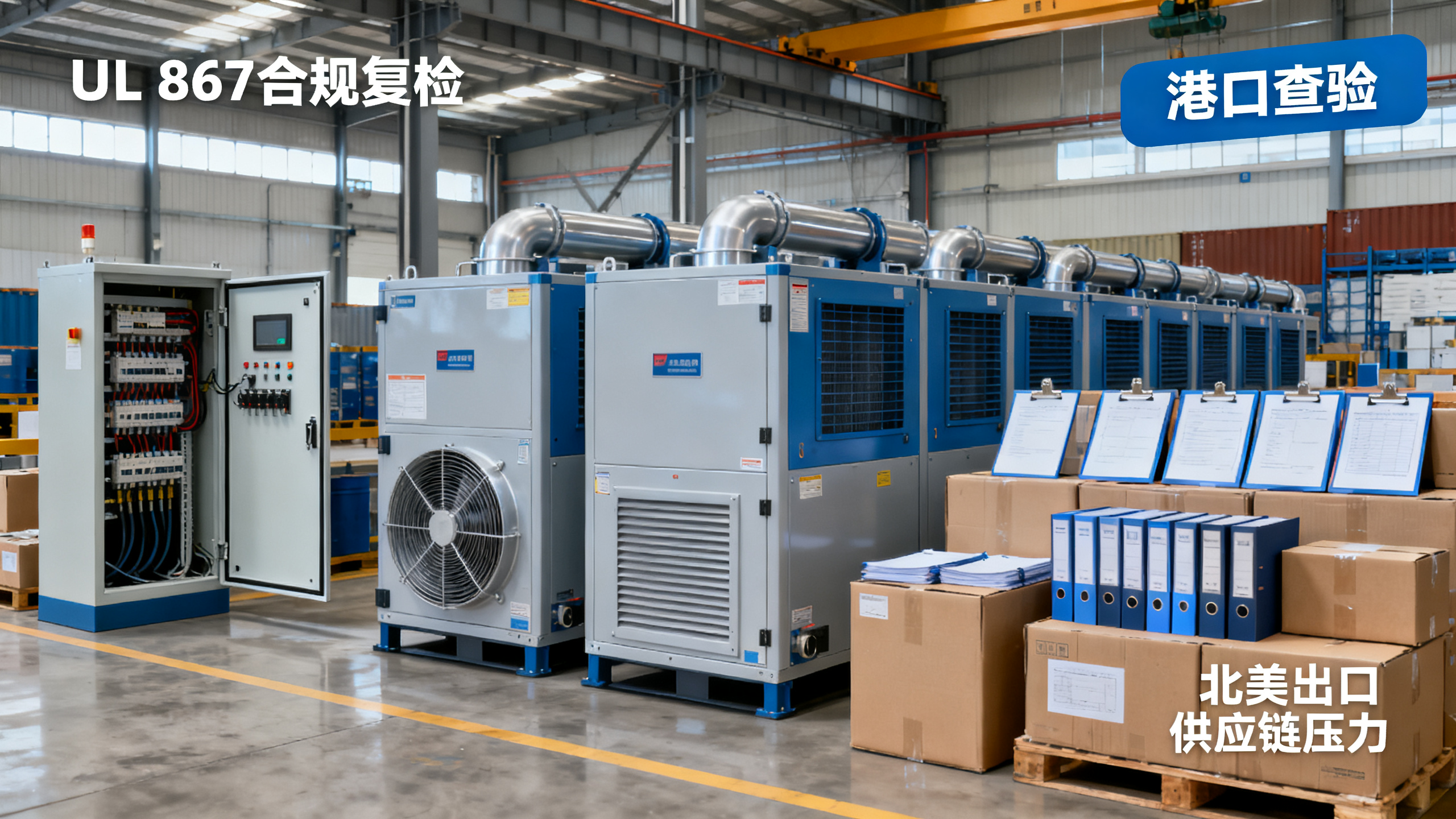
On June 16, 2026, a CPSC recall involving 32 models of China-made industrial air purifiers and dust collection modules brought renewed attention to how product certification validity, port enforcement, and delivery schedules can shift at the same time. The issue is not only the recall itself, but the fact that third-party retesting found the products did not continue to meet UL 867-2024 requirements for arc protection and grounding continuity, while U.S. authorities also moved to apply 100% port inspections to similar import batches. For manufacturers, exporters, distributors, certification-related service providers, and buyers serving North American markets, this is a practical compliance and supply-chain signal rather than a routine product incident.
What the June 16 notice confirms
The U.S. Consumer Product Safety Commission announced on June 16, 2026 an urgent recall covering 32 models of industrial-grade air purification equipment and dust collection modules made in China. According to the provided event summary, the trigger was third-party laboratory retesting, which found that the products' high-voltage electrostatic modules did not continuously satisfy the arc protection and grounding continuity requirements in UL 867-2024. The products had already been sold through more than 140 distributors across the United States, Canada, and Mexico. The same event also led to 100% port inspections for similar imported batches, with estimated customs clearance delays of 7 to 12 working days.
Where the pressure now appears in the supply chain
Export shipments face a more immediate clearance burden
From an industry perspective, exporters and direct trading companies are likely to feel the impact first because the event has already triggered 100% port inspections for similar imported batches. The practical effect is not limited to border checks themselves; it extends to shipment scheduling, handover timing, and customer delivery commitments. What deserves closer attention is whether product files, certification-related materials, and technical documentation can support customs and compliance review without creating further delay.
Manufacturing and sourcing teams need to revisit certification continuity
For manufacturers and procurement teams, the key issue is not only whether a product once obtained certification, but whether the relevant design and components can continue to meet the stated standard under retesting. Analysis shows that the event puts more weight on consistency in high-voltage electrostatic modules, especially where arc protection and grounding continuity are concerned. Companies involved in component sourcing, model maintenance, or production changes may need to pay closer attention to whether technical documentation, test records, and supplier controls remain aligned with the certified configuration.
Distributors and downstream buyers may face delivery and after-sales exposure
Channel operators, industrial buyers, and after-sales service providers may be affected through inventory review, order timing, and customer communication. Because the recalled products had already reached distributors in the United States, Canada, and Mexico, market participants handling similar categories may need to watch for changes in buyer-side review requirements, product acceptance conditions, and after-sales traceability expectations. This is especially relevant where procurement decisions depend on certification status and delivery certainty.
Testing and certification service providers may see tighter review expectations
For laboratories, testing service firms, and certification-related businesses, the event highlights a more sensitive compliance environment around continued conformity rather than one-time approval. Observably, clients may place greater emphasis on retest readiness, file consistency, and the ability to explain how certified products remain aligned with applicable standard requirements over time.
What companies should watch next in practice
Check whether current technical files still match certified products
Companies dealing with similar product categories should focus on whether shipped goods, current production units, and certification-related technical files remain consistent, particularly for high-voltage electrostatic modules. The event summary does not provide broader enforcement detail, so this should be understood as a practical compliance checkpoint rather than a confirmed new universal rule.
Prepare for longer lead times in North American deliveries
Because the provided information states that similar import batches are now subject to 100% port inspections and that customs clearance may be extended by 7 to 12 working days, exporters, distributors, and buyers should pay close attention to delivery planning, buffer stock arrangements, and order timing. Analysis shows that even without a formal rule change beyond the stated inspection action, execution risk can already increase in cross-border fulfillment.
Review supplier qualification and supporting documents
Procurement teams and brand-side sourcing managers should examine whether supplier qualification files, test reports, product specifications, and shipment documentation can support customer review or compliance checks. What deserves closer attention is not just possession of a certificate reference, but whether supporting records can withstand scrutiny when a product category becomes more sensitive at the border or in downstream purchasing.
Monitor official wording and market-side implementation
The current input confirms the recall, the standard-related compliance issue, and the inspection action, but it does not provide fuller detail on follow-up implementation language, expanded scope, or additional market instructions. It is therefore more appropriate to understand this stage as one requiring continued monitoring of official statements, buyer-side requirements, and any adjustment in certification review practice.
Why this reads as an enforcement signal, not just a recall notice
Analysis shows that the most important point is the combination of three elements appearing together: certification-related nonconformity identified in retesting, a cross-border product footprint across three North American markets, and immediate 100% port inspections for similar import batches. This makes the development more than a standalone quality incident. It is more appropriate to understand this as an execution-level signal that continued conformity under UL 867-2024 can influence not only compliance status, but also customs handling and delivery reliability. At the same time, the available facts remain limited to the recall notice and the inspection consequence stated in the input, so wider regulatory implications still require observation rather than assumption.
How the market should read the development for now
At this stage, the event is best read as a concrete compliance and trade execution warning for companies connected to industrial air purification and dust collection products entering North American channels. The confirmed facts already point to impacts on certification credibility, customs timing, and downstream delivery arrangements. A balanced view is that the recall itself is an established development, while the broader market response—including procurement standards, document review intensity, and implementation consistency—still needs to be tracked through subsequent official wording and industry feedback.
Basis of this article and what still needs verification
This article is generated from the user-provided news title, event date, and event summary. For this type of development, relevant source categories usually include official notices, regulator releases, customs or trade authority updates, industry association information, standard-setting documents, and reporting by authoritative media. A specific official source link was not provided in the input, so the exact source document link still requires follow-up verification. Further observation is also needed on any detailed enforcement language, certification interpretation, procurement document changes, market feedback, and company-level implementation responses.
Technical Specifications
- How to Select Electronic Hotel Key Card Locks for Guest Rooms and Staff AreasAuthor :Safety Compliance Lead
- How to Select Lab Instruments for Reliable Chemical Analysis WorkflowsAuthor :Precision Metrology Expert
- How to Size a UPS for Server Rooms: Load, Runtime, and Redundancy FactorsAuthor :Grid Infrastructure Analyst
Expert Insights

Chief Security Architect
Dr. Thorne specializes in the intersection of structural engineering and digital resilience. He has advised three G7 governments on industrial infrastructure security.
Related Analysis
- Sep 17, 2026How to Select Electronic Hotel Key Card Locks for Guest Rooms and Staff AreasAuthor :Safety Compliance Lead
- Sep 16, 2026How to Select Lab Instruments for Reliable Chemical Analysis WorkflowsAuthor :Precision Metrology Expert
- Sep 15, 2026How to Size a UPS for Server Rooms: Load, Runtime, and Redundancy FactorsAuthor :Grid Infrastructure Analyst
Core Sector // 01
Security & Safety
- Environmental Technologies for Heavy Industry: Choosing Cleaner Production SolutionsAuthor :Environmental Engineering Director

- Selecting Air Compliance Equipment for Dust, Fumes, and VOC ControlAuthor :Environmental Engineering Director

- EU Rule Tightens EN 1822-2 for Industrial Air PurifiersAuthor :Environmental Engineering Director

- EU Eco-Design Rules Tighten for Air PurifiersAuthor :Environmental Engineering Director

- Low-Maintenance Dust and Fume Control Systems: Best Options for Welding ShopsAuthor :Environmental Engineering Director

- EPA Sets VOC Labeling Rule for Air PurifiersAuthor :Environmental Engineering Director

- Saudi SASO Rule Adds Real-Time Logging for Air SystemsAuthor :Environmental Engineering Director

- Saudi SASO Rules Tighten for Air PurifiersAuthor :Environmental Engineering Director