EU Imposes 50% Anti-Dumping Duty on Chinese Steel Products
Author
Date Published
Reading Time
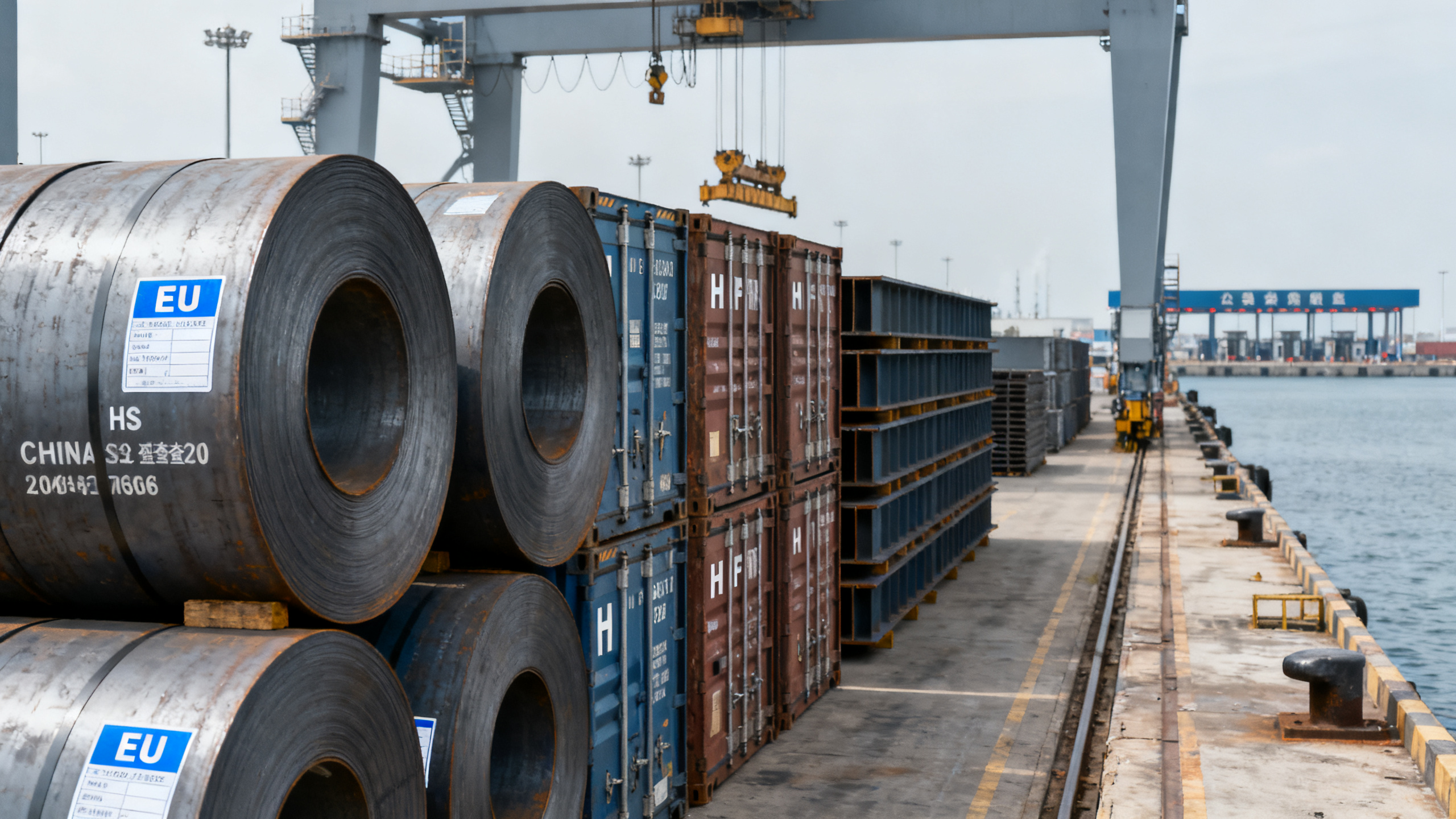
On 21 May 2026, the European Union formally imposed a final anti-dumping duty of up to 50% on selected steel products imported from China — including hot-rolled coils, H-beams, and hollow structural sections — significantly affecting export competitiveness and supply chain planning for industrial steel users across Europe.
Final Tariff Measures Take Effect
Effective 21 May 2026, the European Commission applied definitive anti-dumping duties of up to 50% on specific categories of steel originating in China. The scope explicitly covers hot-rolled coils, H-beams, and hollow structural sections — key materials used in structural engineering and industrial fabrication. These duties apply to imports entering the EU customs territory and are binding on all importers and customs authorities.
Impact Across the Industrial Supply Chain
Direct Trading Enterprises
Exporters and trading firms engaged in cross-border steel shipments face immediate cost escalations and reduced price competitiveness in EU tenders. Margin compression and contract renegotiation pressures are expected, particularly for fixed-price agreements signed prior to the duty’s implementation.
Raw Material Procurement Entities
Companies sourcing structural steel as input for downstream manufacturing must reassess landed cost models. The new duty increases procurement lead times and complicates landed-cost forecasting, especially where just-in-time inventory strategies were previously applied.
Industrial Fabrication & Manufacturing Firms
Manufacturers of Steel & Metal Profiles, Power Transmission equipment, Bearings & Seals — all reliant on standardized structural steel components — now confront dual challenges: compliance verification for imported parts and recalibration of bill-of-materials (BOM) cost structures. Certification documentation must reflect updated origin and tariff classification details.
Supply Chain & Logistics Service Providers
Third-party logistics operators, customs brokers, and warehousing partners must update their tariff classification databases, revise EU import declarations, and support clients in local stockholding strategies — including regional buffer inventories — to mitigate delivery delays caused by enhanced customs scrutiny.
Key Operational Priorities for Affected Companies
Review Origin Documentation & Customs Classification
Verify HS codes, country-of-origin declarations, and supporting evidence for all steel-based components destined for the EU. Misclassification may trigger penalties or shipment holds under strengthened enforcement protocols.
Reassess Sourcing Pathways & Local Inventory Strategy
Evaluate feasibility of partial localisation — such as pre-cutting, surface treatment, or secondary processing within EU-based facilities — to potentially qualify for preferential origin treatment or reduce exposure to the full duty rate.
Update Technical Specifications & Tender Submissions
Where steel forms part of technical bid packages (e.g., for infrastructure, power transmission, or mechanical sealing systems), ensure material specifications explicitly address compliance with EU customs and procurement requirements — including traceability, mill test reports, and conformity statements aligned with the new duty regime.
Strengthen Supplier Qualification & Traceability Protocols
Introduce mandatory supplier self-declarations on material origin and upstream sourcing transparency. Require updated mill certificates and batch-level documentation to support customs audits and tender due diligence.
Industry Perspective: Beyond Compliance, Toward Strategic Adaptation
Analysis shows this measure signals a broader shift toward stricter origin-based trade controls for intermediate industrial goods — not only raw commodities. From an industry perspective, it is more appropriate to understand this as a catalyst for accelerated supply chain diversification, rather than merely a short-term cost adjustment. Observably, manufacturers with dual-sourcing capabilities (e.g., EU-based rolling mills or ASEAN-affiliated finishing facilities) gain relative advantage in bidding for EU public and private infrastructure contracts. What deserves closer attention is the growing linkage between customs compliance and technical qualification — where tariff treatment increasingly influences tender eligibility, not just landed cost.
Taking Stock: A Structural Shift in Industrial Trade Governance
This development underscores how trade policy is evolving into a de facto technical and operational governance layer for industrial manufacturing — intersecting with standards, procurement rules, and product certification frameworks. Its significance lies less in isolated tariff levels and more in the precedent it sets for applying origin-linked duties to value-added intermediate products. Prudent stakeholders will treat this not as a temporary friction point, but as a structural signal demanding long-term recalibration of sourcing architecture, compliance infrastructure, and cross-border technical coordination.
Source Information & Verification Guidance
This article was generated exclusively from the provided title, event date (21 May 2026), and summary. Specific official source links were not provided in the input and should be verified continuously. Stakeholders are advised to monitor updates from the European Commission’s Directorate-General for Trade, EU Official Journal notices, and national customs authorities for implementing regulations, exemption criteria, and administrative guidance. Ongoing observation is recommended regarding detailed product scope clarifications, potential review timelines, tender clause revisions, and sector-specific feedback from steel-using industries.
Technical Specifications
- How to Select Electronic Hotel Key Card Locks for Guest Rooms and Staff AreasAuthor :Safety Compliance Lead
- How to Select Lab Instruments for Reliable Chemical Analysis WorkflowsAuthor :Precision Metrology Expert
- How to Size a UPS for Server Rooms: Load, Runtime, and Redundancy FactorsAuthor :Grid Infrastructure Analyst
Expert Insights

Chief Security Architect
Dr. Thorne specializes in the intersection of structural engineering and digital resilience. He has advised three G7 governments on industrial infrastructure security.
Related Analysis
- Sep 17, 2026How to Select Electronic Hotel Key Card Locks for Guest Rooms and Staff AreasAuthor :Safety Compliance Lead
- Sep 16, 2026How to Select Lab Instruments for Reliable Chemical Analysis WorkflowsAuthor :Precision Metrology Expert
- Sep 15, 2026How to Size a UPS for Server Rooms: Load, Runtime, and Redundancy FactorsAuthor :Grid Infrastructure Analyst
Core Sector // 01
Security & Safety
- How to Select Electronic Hotel Key Card Locks for Guest Rooms and Staff AreasAuthor :Safety Compliance Lead

- How to Select Lab Instruments for Reliable Chemical Analysis WorkflowsAuthor :Precision Metrology Expert

- How to Size a UPS for Server Rooms: Load, Runtime, and Redundancy FactorsAuthor :Grid Infrastructure Analyst

- Stainless Steel Welded Tube Applications: Matching Tube Supply to Fabrication NeedsAuthor :Heavy Industry Strategist

- Selecting Low-Friction Pneumatic Seals for High-Cycle, Low-Pressure CylindersAuthor :Heavy Industry Strategist

- Selecting Spherical Roller Bearings for Mining: Load, Contamination, and Service LifeAuthor :Heavy Industry Strategist

- What to Check When Sourcing Vibration Meters Wholesale for Industrial MaintenanceAuthor :Precision Metrology Expert

- How to Size a Wafer Butterfly Valve for HVAC Chilled-Water and Heating LoopsAuthor :Environmental Engineering Director