EN 61000-4-30:2026 Mandatory for Industrial PQ Analyzers in EU
Author
Date Published
Reading Time
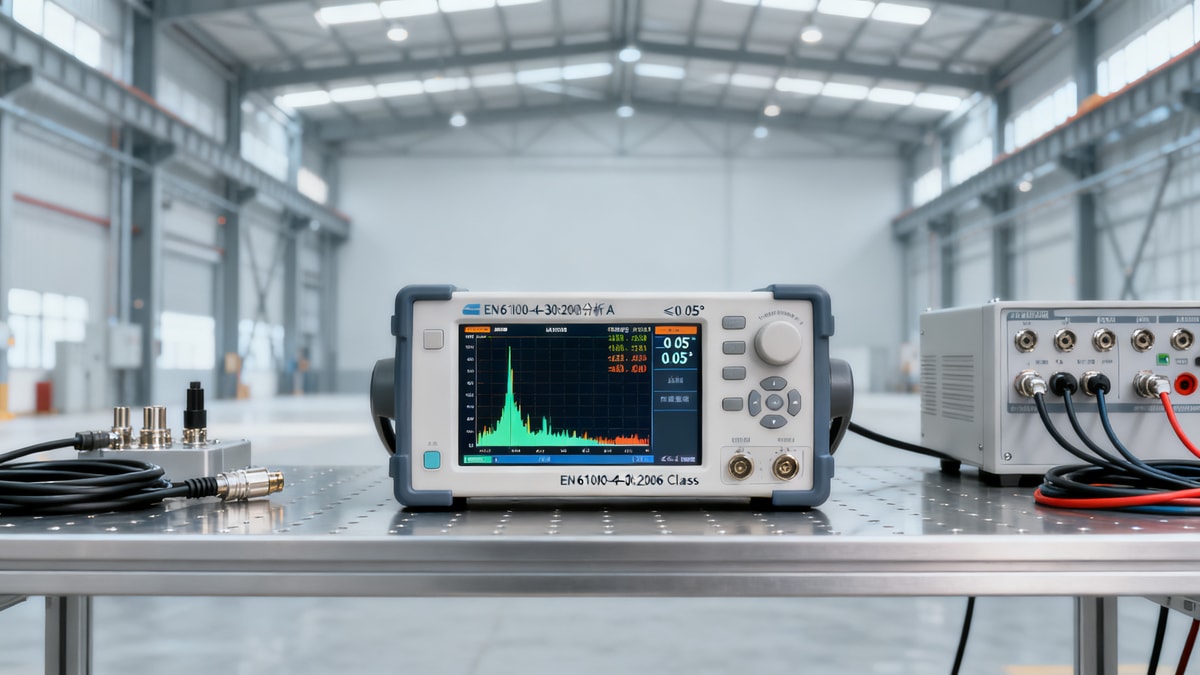
As of 4 May 2026, the European Union has formally enforced EN 61000-4-30:2026, requiring all newly placed-on-market industrial power quality (PQ) analyzers to comply with Class A real-time harmonic measurement and traceability requirements. This development directly affects manufacturers, exporters, and distributors of testing & measurement equipment targeting the EU market — particularly those supplying energy-intensive industries, grid operators, and industrial automation integrators.
Event Overview
On 4 May 2026, the revised electromagnetic compatibility standard EN 61000-4-30:2026 entered into mandatory force across the EU. Under this standard, all new industrial-grade power quality analyzers placed on the EU market must meet Class A accuracy for real-time harmonic analysis and provide a third-party laboratory report verifying dynamic phase error ≤ 0.05°. Non-compliant devices risk customs detention or prohibition from sale.
Industries Affected by Segment
Direct Exporters of Testing & Measurement Equipment
These enterprises face immediate market access barriers if their PQ analyzers lack Class A certification under EN 61000-4-30:2026. Impact manifests as delayed shipments, retesting costs, and potential loss of EU distribution agreements.
Industrial Equipment Manufacturers Integrating PQ Analyzers
Firms embedding PQ analyzers into larger systems (e.g., smart switchgear, energy management platforms) must now verify supplier compliance at component level. Non-conforming subassemblies may invalidate CE marking of the final product.
Calibration & Certification Service Providers
Laboratories accredited under ISO/IEC 17025 must confirm capability to validate dynamic phase error ≤ 0.05° per EN 61000-4-30:2026 Annex C. Demand for Class A-specific test reports is expected to rise.
Distribution & Channel Partners in EU Member States
Importers and authorized representatives are legally responsible for ensuring conformity documentation (including harmonized standards references and test reports) is available upon request by market surveillance authorities.
What Enterprises and Practitioners Should Focus On Now
Verify current product certification status against EN 61000-4-30:2026
Confirm whether existing PQ analyzer models hold valid Class A verification reports issued under the 2026 edition — not earlier versions such as EN 61000-4-30:2015 or :2021. Retesting may be required even for previously certified units.
Review technical documentation for alignment with Annex C requirements
Ensure user manuals, declarations of conformity, and test reports explicitly reference EN 61000-4-30:2026 and include traceable evidence of dynamic phase error performance at harmonic orders up to at least 50th.
Engage accredited labs early to secure test capacity
Lead times for Class A harmonic validation have lengthened in several EU-accredited labs. Prioritize scheduling tests before Q2 2026 to avoid bottlenecks ahead of full enforcement.
Update internal compliance workflows for future revisions
EN 61000-4-30 is subject to periodic updates; analysis shows that the 2026 version introduces stricter real-time synchronization criteria. Establish a process to monitor CENELEC announcements and assess impact of draft amendments (e.g., prEN 61000-4-30:202X).
Editorial Perspective / Industry Observation
Observably, EN 61000-4-30:2026 signals a tightening of metrological rigor for PQ measurement — shifting emphasis from static accuracy to dynamic, time-synchronized harmonic fidelity. This is less a one-off regulatory change and more an indicator of broader EU alignment with IEC 61000-4-30 Ed. 4’s traceability framework. From an industry perspective, it reflects growing reliance on PQ data for grid stability assessments, renewable integration, and digital twin modeling in industrial settings. Current enforcement focuses on new market entries; however, analysis shows that market surveillance authorities may extend scrutiny to legacy devices during post-market checks where non-compliance poses safety or interoperability risks.
Consequently, this regulation is best understood not merely as a conformity hurdle, but as a catalyst accelerating standardization of high-fidelity power monitoring across industrial automation, distributed energy resource management, and smart infrastructure projects.
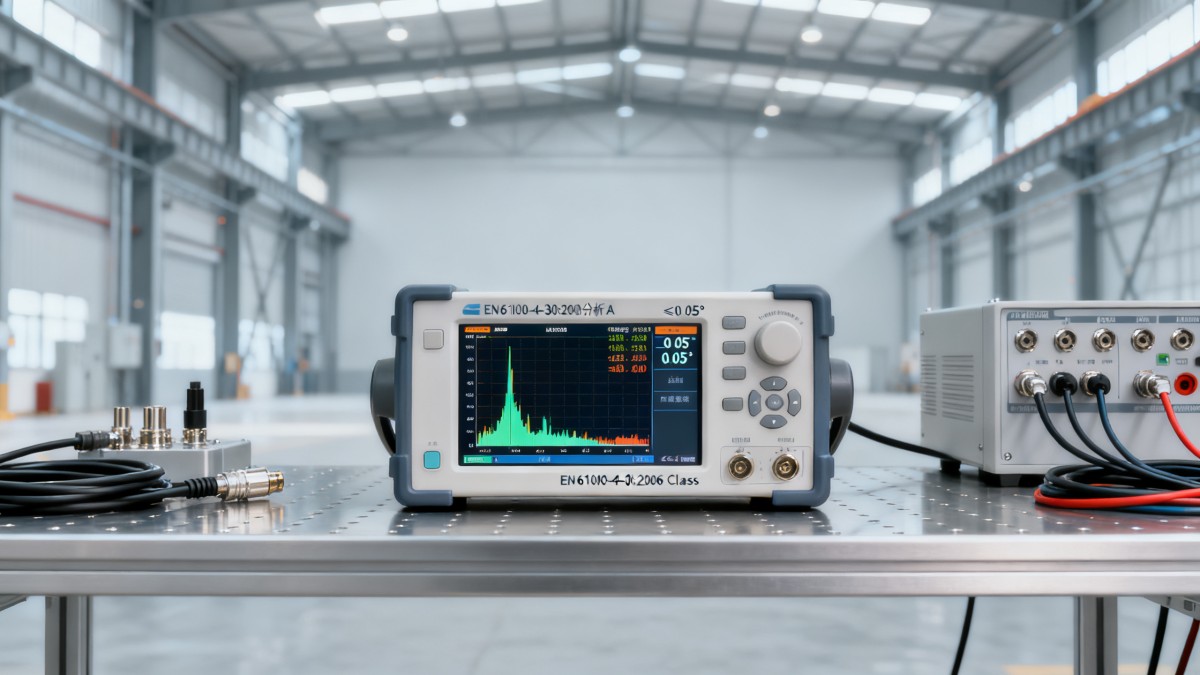
This development underscores how electromagnetic compatibility standards increasingly serve dual roles: ensuring device interoperability and enabling trustworthy energy data exchange. For stakeholders, the priority remains verification readiness — not just for CE marking, but for system-level reliability claims demanded by end users in energy-critical applications.
Source: Official publication in the EU Official Journal referencing EN 61000-4-30:2026 (CENELEC); CENELEC Technical Report CLC/TR 61000-4-30:2026 Guidance Note. Note: Ongoing observation is recommended for national transposition timelines and potential transitional arrangements announced by individual EU member states’ market surveillance authorities.
Technical Specifications
- US DOE Level 3 Transformer Efficiency Rule Takes Effect July 1, 2026Author :Grid Infrastructure Analyst
- INMETRO Proposes EMP Immunity Requirement for Industrial Laser Distance Meters in BrazilAuthor :Precision Metrology Expert
- Indonesia BPOM Fast-Tracks Chinese Industrial Air PurifiersAuthor :Environmental Engineering Director
Expert Insights

Chief Security Architect
Dr. Thorne specializes in the intersection of structural engineering and digital resilience. He has advised three G7 governments on industrial infrastructure security.
Related Analysis
- May 05, 2026US DOE Level 3 Transformer Efficiency Rule Takes Effect July 1, 2026Author :Grid Infrastructure Analyst
- May 05, 2026INMETRO Proposes EMP Immunity Requirement for Industrial Laser Distance Meters in BrazilAuthor :Precision Metrology Expert
- May 05, 2026Indonesia BPOM Fast-Tracks Chinese Industrial Air PurifiersAuthor :Environmental Engineering Director
Core Sector // 01
Security & Safety
- INMETRO Proposes EMP Immunity Requirement for Industrial Laser Distance Meters in BrazilAuthor :Precision Metrology Expert

- EN 61000-4-30:2026 Mandatory for Industrial PQ Analyzers in EUAuthor :Precision Metrology Expert

- Industrial Standards Compliance Problems That Surface Too LateAuthor :Precision Metrology Expert

- What an Instruments & Measurement OEM Should Prove Up FrontAuthor :Precision Metrology Expert

- When Industrial Standards Solutions Reduce Rework Instead of PaperworkAuthor :Precision Metrology Expert

- CPSC Recalls 32 Batches of Chinese Industrial Laser Distance MetersAuthor :Precision Metrology Expert

- What makes an Instruments & Measurement supplier dependableAuthor :Precision Metrology Expert

- When rapid prototyping CNC saves money and when it does notAuthor :Precision Metrology Expert