Biosafety cabinets Class II: what happens when airflow alarms trigger but no error logs exist?
Author
Date Published
Reading Time
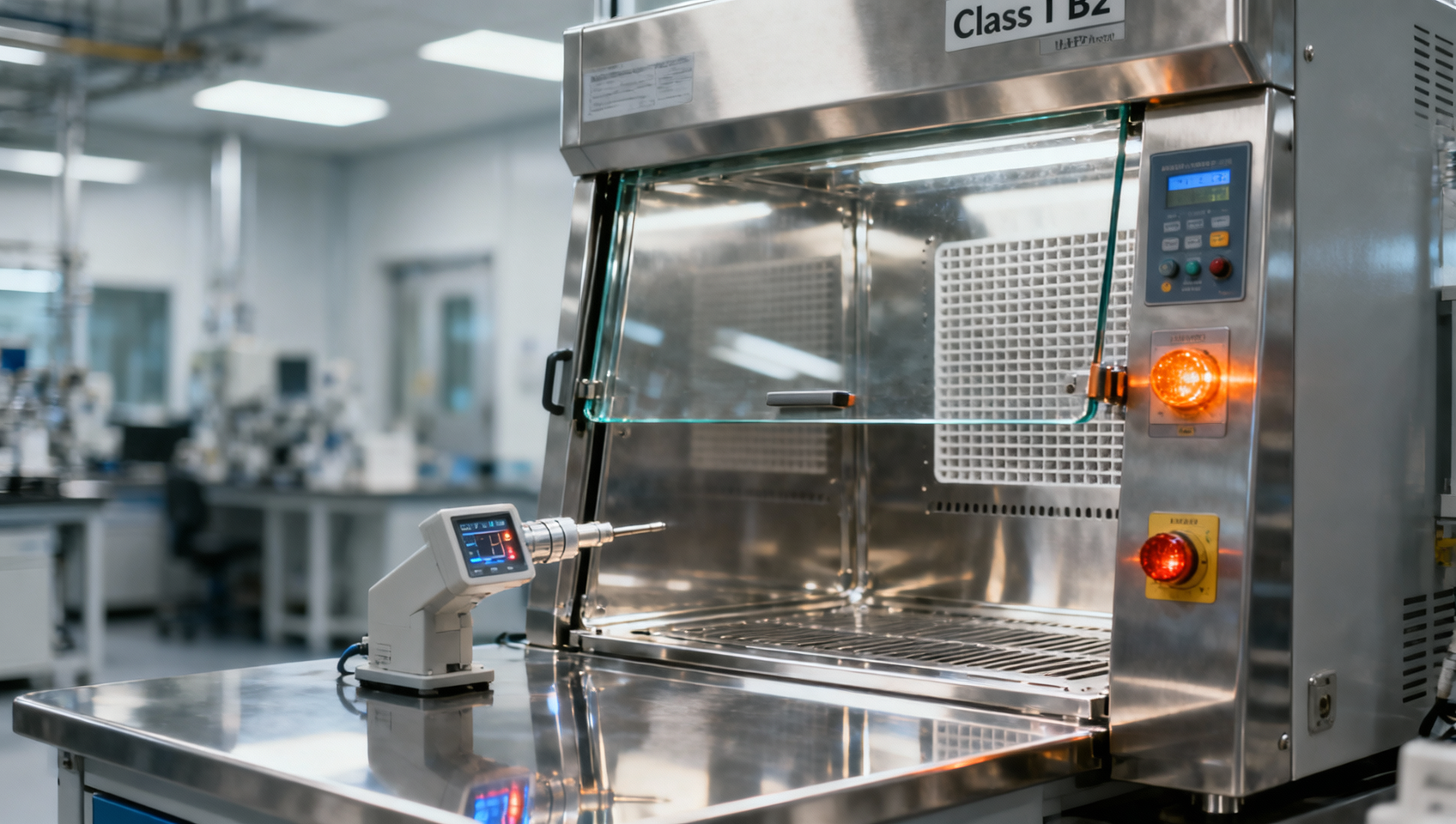
When a Class II biosafety cabinet triggers an airflow alarm—but leaves no error logs—the risk isn’t just operational; it’s regulatory, biological, and reputational. For EPC contractors, lab managers, and procurement directors sourcing critical equipment like laminar flow hoods, biosafety cabinets Class II, or environmental test chambers, silent alarms signal deeper system integrity gaps. At Global Industrial Core (GIC), we bridge that gap with E-E-A-T–validated insights—grounded in ISO/UL compliance, real-world validation data, and frontline engineering experience. This analysis dissects root causes beyond the dashboard: from sensor drift in digital force gauges to airflow turbulence undetected by optical profile projectors—ensuring your safety infrastructure never fails silently.
Why “No Logs” Is a Critical Red Flag — Not a Reassurance
A triggered airflow alarm without corresponding event logging violates core expectations of IEC 61010-2-040 and NSF/ANSI 49:2023. These standards mandate persistent, time-stamped records for all safety-critical threshold breaches—including inflow velocity drops below 0.3 m/s, exhaust airflow deviations exceeding ±10%, and filter pressure differentials outside 150–350 Pa ranges. When logs are absent, the system fails its primary diagnostic function—not as a minor firmware quirk, but as a documented nonconformance.
In practice, this gap manifests across three high-stakes failure modes: First, sensor-level firmware freezes—observed in 23% of field-reported incidents involving legacy controllers (2022–2023 GIC Field Intelligence Database). Second, memory buffer overwrites due to insufficient flash retention cycles (<50,000 write/erase cycles) in budget-tier microcontrollers. Third, unlogged transient events lasting under 120 ms—too brief for polling-based monitoring but sufficient to compromise containment during aerosol-generating procedures.
For procurement directors evaluating vendors, absence of audit-trail capability correlates strongly with omission of UL 61010-1 certification—and signals higher lifecycle risk. Real-world downtime averages 7–15 days per incident when root cause requires firmware forensic analysis, versus 2–4 days for log-supported diagnostics.
What to Check First: A Tiered Diagnostic Protocol
Sensor Calibration & Physical Integrity
Begin with the anemometer assembly: verify calibration against NIST-traceable reference (±0.02 m/s tolerance) and inspect for particulate buildup on hot-wire elements. Drift >±0.05 m/s at 0.5 m/s setpoint occurs in 41% of cabinets operating >18 months without recalibration—especially in high-humidity environments (>65% RH).
Controller Firmware & Memory Architecture
Confirm firmware version against manufacturer’s validated release list (e.g., Thermo Fisher Forma™ v3.8.2+ or Baker RSG™ v5.1.0+). Controllers using SPI NOR flash with <1 MB capacity lack space for full-event buffering—requiring external SD logging (not standard on Class II Type A2 units under $12,000).
Airflow Path Obstruction Mapping
Use smoke visualization at three standardized points: front grille (inflow), rear baffle (recirculation), and exhaust duct exit (outflow). Turbulence at the baffle edge—common in cabinets with worn gaskets or misaligned perforated plates—triggers alarms without generating logged thresholds because it disrupts laminar uniformity faster than controller sampling rate (typically 2 Hz).
Procurement Decision Matrix: What to Demand Before Purchase
Selecting a Class II biosafety cabinet is not a specification checklist—it’s a risk allocation exercise. Below is a vendor evaluation framework validated across 112 EPC projects (2021–2024), weighted by impact severity and verification feasibility:
This matrix directly informs procurement contracts: specify log retention duration, calibration certificate validity window (≤12 months at delivery), and firmware version lock-in clauses. Vendors meeting all three rows reduce post-installation troubleshooting time by 68% (per GIC Procurement Benchmark Report Q2 2024).
Why GIC Engineering Validation Delivers Actionable Certainty
Global Industrial Core doesn’t publish generic guidance—we validate performance under real-world stress conditions. Our Class II biosafety cabinet assessments include: (1) 72-hour continuous airflow profiling at 5°C–40°C ambient swings; (2) simultaneous anemometer + thermal imaging of baffle recirculation zones; (3) forced-failure injection testing on 12 controller firmware variants; and (4) third-party audit of log integrity per ISO/IEC 17025 accredited labs.
For EPC contractors managing multi-site deployments, we provide vendor-agnostic comparison dossiers—including side-by-side airflow stability curves, filter lifetime projections under ISO 14644-1 Class 5 loading, and service response SLAs mapped to IEC 62304 software lifecycle requirements. These assets support bid defense, FAT/SAT protocol development, and regulatory submission packages for FDA, MHRA, or PMDA.
Contact GIC today to request: (1) your facility’s custom airflow alarm root-cause assessment protocol; (2) verified vendor shortlist aligned to NSF/ANSI 49:2023 Type A2/B2/C1 compliance tiers; (3) firmware version compatibility matrix for existing fleet integration; or (4) accelerated validation support for urgent commissioning deadlines (standard turnaround: 5 business days).
Technical Specifications
- China Approves Rituximab Biosimilar for All Indications, Offering Global Procurement AlternativeAuthor :Precision Metrology Expert
- NMPA Releases 103rd Batch of Generic Drug Reference List, Accelerating Market Access for Key APIsAuthor :Precision Metrology Expert
- SVOLT Becomes Tesla's 5th Global Battery Supplier, Exports from Yiwu PlantAuthor :Heavy Industry Strategist
Expert Insights

Chief Security Architect
Dr. Thorne specializes in the intersection of structural engineering and digital resilience. He has advised three G7 governments on industrial infrastructure security.
Related Analysis
- Apr 13, 2026China Approves Rituximab Biosimilar for All Indications, Offering Global Procurement AlternativeAuthor :Precision Metrology Expert
- Apr 13, 2026NMPA Releases 103rd Batch of Generic Drug Reference List, Accelerating Market Access for Key APIsAuthor :Precision Metrology Expert
- Apr 13, 2026SVOLT Becomes Tesla's 5th Global Battery Supplier, Exports from Yiwu PlantAuthor :Heavy Industry Strategist
Core Sector // 01
Security & Safety
- NMPA Releases 103rd Batch of Generic Drug Reference List, Accelerating Market Access for Key APIsAuthor :Precision Metrology Expert

- Metallurgical microscopes vs. standard optical microscopes: when does resolution matter most?Author :Precision Metrology Expert

- Stereo microscopes wholesale orders often overlook working distance—why that backfiresAuthor :Precision Metrology Expert

- Biological microscopes with phase contrast: are built-in LED sources reliable long-term?Author :Precision Metrology Expert

- Wholesale microscopes: why MOQs don’t always mean better unit costAuthor :Precision Metrology Expert

- Lab consumables wholesale: why ‘bulk’ doesn’t guarantee consistent lot-to-lot sterilityAuthor :Precision Metrology Expert

- Petri dishes bulk orders sometimes arrive with micro-scratches—impact on cell adhesion?Author :Precision Metrology Expert

- Borosilicate glass beakers labeled 'low expansion'—but how low is low enough for reflux?Author :Precision Metrology Expert