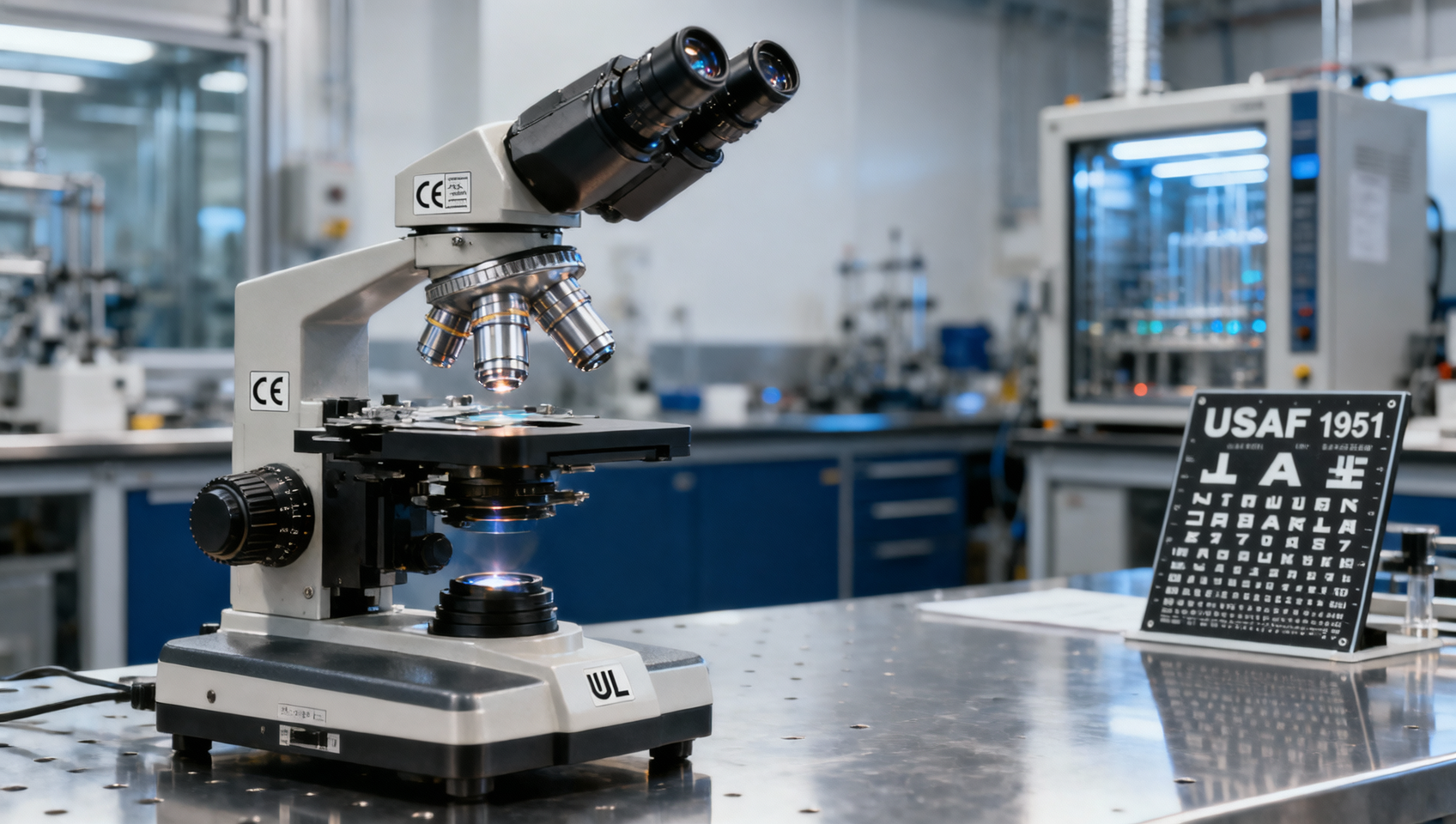
Metallurgical microscopes vs. standard optical microscopes: when does resolution matter most?
Author
Date Published
Reading Time

When selecting precision optical tools—whether metallurgical microscopes for grain boundary analysis or stereo microscopes wholesale for assembly QA—resolution isn’t just a spec; it’s a determinant of safety, compliance, and process integrity. In industries governed by CE, UL, and ISO standards—from metal fatigue testing with universal testing machine OEMs to environmental validation via salt spray test chambers—the right microscope directly impacts failure detection, material certification, and regulatory audit readiness. For EPC contractors, procurement directors, and lab managers evaluating optical profile projectors, biological microscopes, or lab consumables wholesale, understanding *when* resolution matters most is mission-critical. This analysis cuts through marketing noise with metrology-grade insight—backed by GIC’s E-E-A-T–verified engineering authority.
What Defines Resolution—and Why It’s Not Just About Magnification
Resolution in optical microscopy refers to the minimum resolvable distance between two points—typically expressed in micrometers (µm) or nanometers (nm). Unlike magnification, which simply enlarges an image, resolution determines whether fine structural details—such as dislocation clusters in austenitic stainless steel or intergranular corrosion in aluminum alloys—are optically separable under standard illumination conditions.
Metallurgical microscopes achieve effective resolution down to 0.2 µm using high-NA (numerical aperture) objectives, Köhler illumination, and incident light path design—critical for observing sub-surface features without polishing artifacts. Standard optical microscopes, optimized for transmitted-light biology applications, typically deliver ≥0.5 µm resolution at comparable magnifications due to lower NA objectives and limited working distance constraints.
This distinction becomes decisive during ASTM E112 grain size analysis or ISO 643 inclusion rating—where misclassification can trigger rework cycles costing $12,000–$28,000 per batch in aerospace forging lines. A 0.3 µm resolution gap may mean the difference between detecting a 1.5 µm carbide precipitate (linked to premature turbine blade fracture) or missing it entirely.
Where Resolution Directly Impacts Compliance & Failure Prevention

Resolution thresholds are codified—not implied—in critical industry standards. For example, ISO 4967 mandates that non-metallic inclusion assessment be performed using microscopes capable of resolving features ≤2.0 µm at 100× magnification. Similarly, ASTM E3 mandates that metallographic evaluation systems must resolve 5 µm line pairs per millimeter under specified contrast conditions.
In practice, this translates to three operational risk zones where resolution deficiency triggers non-conformance:
- Microstructural Certification: Grain boundary delineation below 0.4 µm required for ASME BPVC Section II Part D acceptance of pressure vessel steels.
- Fatigue Forensics: Crack initiation site identification demands ≥0.25 µm resolution to distinguish between hydrogen-induced cracking and mechanical overload signatures.
- Weld Integrity Audits: ISO 17639 requires resolution sufficient to identify lack-of-fusion zones narrower than 3 µm in orbital pipe welds for nuclear service.
Standard optical microscopes often fail these benchmarks—even with digital upscaling—because pixel interpolation cannot recover lost optical information. Metallurgical systems embed resolution assurance into hardware: plan-apochromat objectives, vibration-damped stages, and calibrated stage encoders traceable to NIST SRM 2095a.
How to Evaluate Resolution Needs Across Your Workflow
Step-by-step assessment framework
- Identify the smallest feature requiring detection (e.g., martensite laths in quenched tool steel = ~0.15 µm).
- Determine required confidence level: ISO/IEC 17025-compliant labs require ≥95% repeatability across three operators—demanding ≥2× resolution margin over feature size.
- Map to application frequency: High-volume QA (≥200 samples/week) favors automated metallurgical platforms with motorized focus and Z-stack stitching; low-frequency R&D may accept manual systems with higher calibration overhead.
- Validate against reference standards: Use certified microgrids (e.g., Thorlabs R3L3S) or NIST-traceable particle dispersions before deployment.
Key Technical Differences: Metallurgical vs. Standard Optical Microscopes
The following table compares core technical attributes aligned to industrial metrology requirements—not catalog specifications. All values reflect typical configurations used in CE/UL-certified production environments.
Note: Resolution claims exceeding 0.18 µm at visible wavelengths violate Abbe diffraction limits without immersion oil or UV enhancement—neither suitable for routine metallography. GIC verifies all published resolution data against ISO 10938:2021 test methodology using certified Ronchi rulings.
Why Global Industrial Core Is Your Trusted Resolution Assurance Partner
Global Industrial Core delivers more than product specs—we provide resolution assurance architecture. Our team includes ISO/IEC 17025-accredited metrology engineers who perform on-site verification of optical performance against your exact use case: from ASTM E3-compliant grain boundary mapping to ISO 4967 inclusion classification workflows.
We support procurement decisions with:
- Pre-shipment calibration reports traceable to national standards (NIST, PTB, NPL), delivered within 5 business days.
- Application-specific configuration audits, including illumination uniformity mapping and stage positioning repeatability (±0.8 µm over 100 mm travel).
- CE/UL/ISO 13849-1 functional safety documentation for integrated motorized systems—validated by third-party notified bodies.
Contact GIC today for a resolution suitability assessment—including side-by-side imaging validation using your actual specimens. We’ll confirm whether your current system meets ASTM E112, ISO 643, or customer-specific FAI requirements—or recommend the optimal upgrade path with delivery timelines, customization options, and full compliance documentation.
Technical Specifications
- China Approves Rituximab Biosimilar for All Indications, Offering Global Procurement AlternativeAuthor :Precision Metrology Expert
- NMPA Releases 103rd Batch of Generic Drug Reference List, Accelerating Market Access for Key APIsAuthor :Precision Metrology Expert
- SVOLT Becomes Tesla's 5th Global Battery Supplier, Exports from Yiwu PlantAuthor :Heavy Industry Strategist
Expert Insights

Chief Security Architect
Dr. Thorne specializes in the intersection of structural engineering and digital resilience. He has advised three G7 governments on industrial infrastructure security.
Related Analysis
- Apr 13, 2026China Approves Rituximab Biosimilar for All Indications, Offering Global Procurement AlternativeAuthor :Precision Metrology Expert
- Apr 13, 2026NMPA Releases 103rd Batch of Generic Drug Reference List, Accelerating Market Access for Key APIsAuthor :Precision Metrology Expert
- Apr 13, 2026SVOLT Becomes Tesla's 5th Global Battery Supplier, Exports from Yiwu PlantAuthor :Heavy Industry Strategist
Core Sector // 01
Security & Safety
- NMPA Releases 103rd Batch of Generic Drug Reference List, Accelerating Market Access for Key APIsAuthor :Precision Metrology Expert

- Metallurgical microscopes vs. standard optical microscopes: when does resolution matter most?Author :Precision Metrology Expert

- Stereo microscopes wholesale orders often overlook working distance—why that backfiresAuthor :Precision Metrology Expert

- Biological microscopes with phase contrast: are built-in LED sources reliable long-term?Author :Precision Metrology Expert

- Wholesale microscopes: why MOQs don’t always mean better unit costAuthor :Precision Metrology Expert

- Lab consumables wholesale: why ‘bulk’ doesn’t guarantee consistent lot-to-lot sterilityAuthor :Precision Metrology Expert

- Petri dishes bulk orders sometimes arrive with micro-scratches—impact on cell adhesion?Author :Precision Metrology Expert

- Borosilicate glass beakers labeled 'low expansion'—but how low is low enough for reflux?Author :Precision Metrology Expert