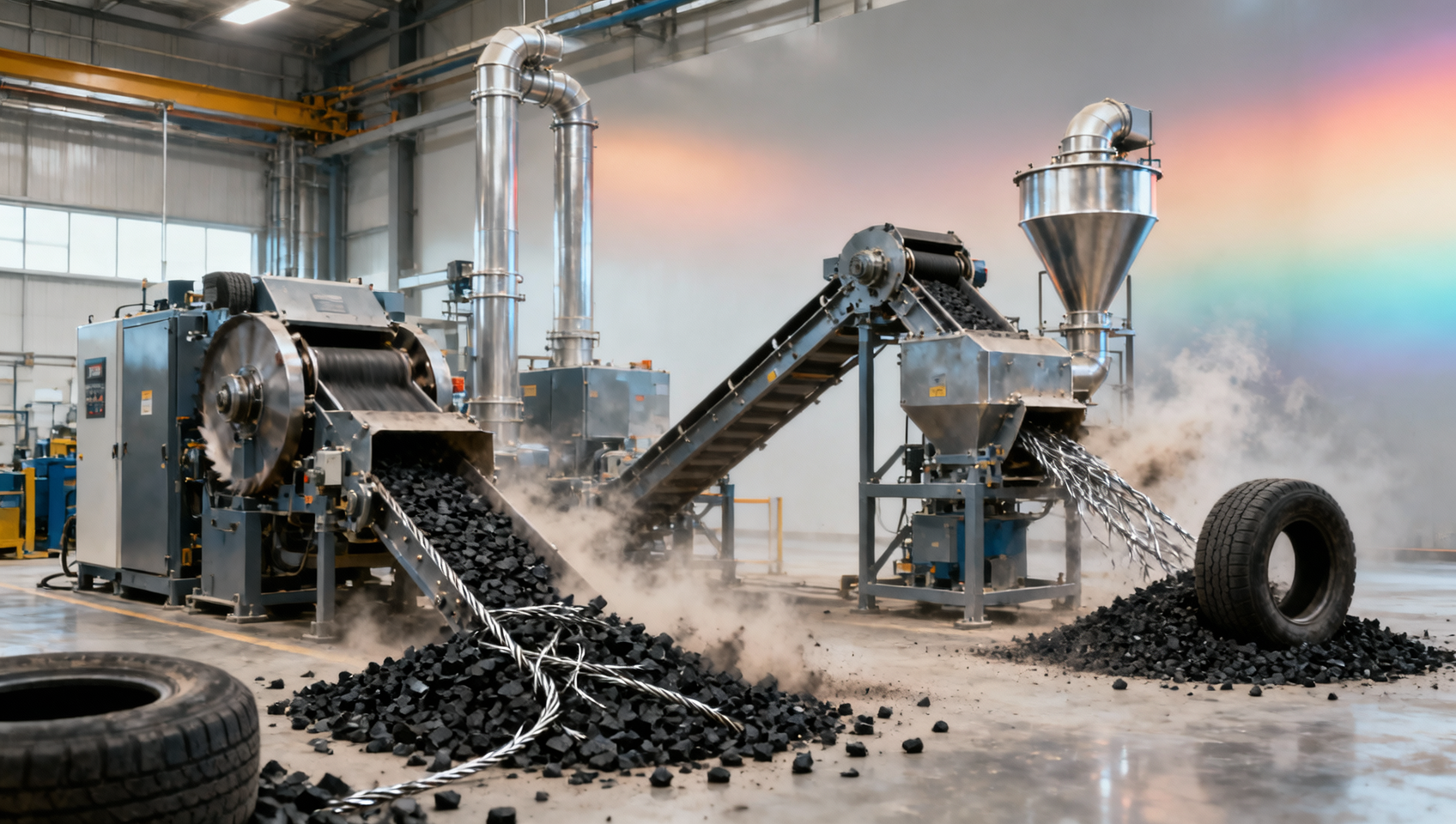
RCEP Industrial Waste Equipment Mutual Recognition Launches
Author
Date Published
Reading Time

On April 22, 2026, the RCEP Secretariat and environmental authorities of the ten ASEAN member states jointly activated the RCEP Framework for Technical Mutual Recognition of Industrial Solid Waste Management Equipment. This development directly affects manufacturers and exporters of waste-to-energy boilers, intelligent sorting systems, and fly ash stabilization equipment — particularly those based in China supplying to Vietnam, Thailand, Indonesia, and other RCEP-ASEAN markets. It signals a structural shift in cross-border equipment market access, with implications for delivery timelines, regulatory compliance, and supply chain planning.
Event Overview
On April 22, 2026, the RCEP Secretariat and environmental authorities of all ten ASEAN countries officially launched the RCEP Framework for Technical Mutual Recognition of Industrial Solid Waste Management Equipment. The first batch of recognized equipment includes Chinese-made municipal solid waste incineration waste-heat boilers, intelligent sorting lines, and fly ash stabilization systems. Certified products are now eligible for exemption from redundant type-testing, expedited registration, and priority customs clearance in participating ASEAN countries.
Industries Affected by This Framework
Direct Exporters of Waste Management Equipment
Manufacturers exporting incineration boilers, sorting systems, or fly ash treatment units to ASEAN face reduced technical barriers. Exemption from duplicate type-testing lowers certification costs and shortens time-to-market; however, eligibility depends strictly on formal inclusion under the framework’s certified product list — not automatic coverage for all models or variants.
System Integrators and EPC Contractors
Firms delivering turnkey waste management projects in ASEAN may benefit from faster equipment commissioning and reduced project scheduling risk. Yet integration timelines remain contingent on local permitting processes beyond equipment registration — including site-specific environmental approvals and grid interconnection requirements — which are not covered by this mutual recognition arrangement.
Aftermarket Service and Spare Parts Providers
While the framework addresses initial equipment approval, it does not extend to spare parts, software updates, or field service protocols. Providers must still comply with national import regulations and technical documentation requirements for components entering ASEAN markets post-installation.
What Enterprises and Practitioners Should Monitor and Act On
Track official implementation guidance from national ASEAN regulators
The framework is operational as of April 22, 2026, but individual ASEAN members may issue distinct procedural rules for application, documentation, and verification. Companies should monitor announcements from Vietnam’s Ministry of Natural Resources and Environment, Thailand’s Pollution Control Department, and Indonesia’s Ministry of Environment and Forestry for country-specific registration pathways.
Verify model-level inclusion before tender submission
Only specific product models pre-approved under the framework qualify for streamlined treatment. Exporters must confirm whether their exact boiler design, sorting line configuration, or stabilization unit version appears on the publicly updated RCEP-ASEAN certified equipment list — not just the manufacturer or product category.
Distinguish between regulatory signal and operational readiness
This is a mutual recognition framework, not a fully harmonized standard. It enables process efficiencies but does not replace local conformity assessments for non-listed functions (e.g., cybersecurity features, remote monitoring interfaces) or post-commissioning performance verification.
Align internal technical documentation with ASEAN reporting formats
Although type-testing is waived, applicants still submit full technical dossiers. Companies should review ASEAN-relevant labeling, bilingual user manuals (English + local language), and safety certification formats (e.g., Thai TISI, Indonesian SNI alignment) ahead of filing — avoiding delays due to formatting rework.
Editorial Perspective / Industry Observation
From an industry perspective, this framework is best understood as an institutional signal — not yet a fully scaled operational mechanism. Its launch confirms political commitment to harmonizing industrial environmental infrastructure standards across RCEP-ASEAN, but actual throughput depends on national capacity to administer applications and resolve disputes. Analysis来看, early adoption will likely concentrate among large-scale Chinese OEMs with dedicated regional compliance teams, while SME suppliers may face practical bottlenecks in dossier preparation and translation. Observation来看, the absence of EU-style third-party notified bodies in the current structure means verification remains largely government-to-government — introducing potential variability in interpretation across ASEAN jurisdictions.
Current more appropriate understanding is that this marks the beginning of a multi-year alignment process, not an immediate ‘green channel’ for all shipments. The framework creates optionality — not obligation — for ASEAN members to accept recognized equipment, and its long-term utility hinges on consistent implementation tracking and transparency in rejection reasons.
Conclusion
This initiative represents a targeted regulatory coordination effort within the RCEP architecture, focused specifically on industrial solid waste equipment. Its significance lies not in immediate market transformation, but in establishing a precedent for sector-specific technical alignment — one that may inform future mutual recognition efforts for water treatment, air pollution control, or circular economy technologies. For now, it is more accurately interpreted as a procedural enabler requiring active navigation, rather than a de facto market access guarantee.
Information Sources
Main source: Official announcement issued jointly by the RCEP Secretariat and environmental ministries of the ten ASEAN member states on April 22, 2026. Ongoing implementation details — including the certified equipment list, application templates, and national procedural guidelines — remain subject to continuous update and require direct monitoring via official ASEAN environmental agency portals.
Technical Specifications
- CIBF2026 Highlights Lithium Battery Recycling Equipment DemandAuthor :Environmental Engineering Director
- Canton Fair Phase II 2026 Industrial Components Zone Fully BookedAuthor :Heavy Industry Strategist
- TÜV Rheinland Updates EMC Guide for Industrial Optics DevicesAuthor :Precision Metrology Expert
Expert Insights

Chief Security Architect
Dr. Thorne specializes in the intersection of structural engineering and digital resilience. He has advised three G7 governments on industrial infrastructure security.
Related Analysis
- Apr 23, 2026CIBF2026 Highlights Lithium Battery Recycling Equipment DemandAuthor :Environmental Engineering Director
- Apr 23, 2026Canton Fair Phase II 2026 Industrial Components Zone Fully BookedAuthor :Heavy Industry Strategist
- Apr 23, 2026TÜV Rheinland Updates EMC Guide for Industrial Optics DevicesAuthor :Precision Metrology Expert
Core Sector // 01
Security & Safety
- CIBF2026 Highlights Lithium Battery Recycling Equipment DemandAuthor :Environmental Engineering Director
![]()
- RCEP Industrial Waste Equipment Mutual Recognition LaunchesAuthor :Environmental Engineering Director
![]()
- RCEP Launches Industrial Waste Equipment Mutual RecognitionAuthor :Environmental Engineering Director
![]()
- How to choose an organic fertilizer machine for wet raw materialsAuthor :Environmental Engineering Director

- What affects output stability in a hydraulic briquetting pressAuthor :Environmental Engineering Director

- Waste paper baler wholesale prices vary for reasons beyond tonnageAuthor :Environmental Engineering Director

- When a scrap metal baler becomes too small for daily loading needsAuthor :Environmental Engineering Director

- Tire recycling machine layouts that reduce dust and wire lossAuthor :Environmental Engineering Director