Residual Current Device RCD Selection Tips
Author
Date Published
Reading Time
Choosing the right residual current device (RCD) is not just about picking a rated current and installing it in the panel. In industrial and commercial systems, the correct RCD must match the earthing arrangement, load type, leakage characteristics, coordination strategy, and applicable standards. A poor selection can lead to nuisance tripping, hidden safety gaps, costly downtime, or compliance issues. For buyers, engineers, operators, and decision-makers, the practical question is simple: which RCD type, sensitivity, and configuration will provide the required protection without compromising operational continuity?
This guide explains practical residual current device RCD selection tips for real-world applications. It also shows how RCDs relate to associated protection equipment such as an earth leakage circuit breaker, miniature circuit breaker MCB, molded case circuit breaker MCCB, air circuit breaker ACB, and low voltage switchboard architecture, so you can make better technical and procurement decisions.
Start with the key decision: what hazard are you trying to control?
The most important first step in RCD selection is defining the protection objective. In practice, most users are trying to solve one or more of the following:
- Protection against electric shock for personnel
- Fire risk reduction caused by earth leakage currents
- Equipment or process protection in sensitive installations
- Regulatory or project compliance with IEC, local code, client specification, or insurer requirements
- Selective coordination to avoid whole-system shutdown from a minor downstream fault
If the application involves socket outlets, maintenance areas, temporary power, wet environments, or accessible equipment, personnel protection usually dominates the selection. If the installation is a distribution board, motor feeder group, or large commercial facility, fire prevention and selective continuity may be equally important.
That is why there is no universal “best” RCD. The right choice depends on who or what must be protected, how quickly disconnection must occur, and how much operational interruption is acceptable.
Understand the basic selection factors before choosing a device
When comparing RCD options, experienced engineers and procurement teams typically review the following technical factors first:
- Rated residual operating current such as 10 mA, 30 mA, 100 mA, 300 mA, or higher
- RCD type such as AC, A, F, or B depending on leakage waveform
- Rated current of the device under normal load conditions
- Breaking and short-circuit coordination with upstream or integrated protective devices
- Time delay / selectivity for discrimination between upstream and downstream devices
- Number of poles based on single-phase or three-phase circuits
- Installation environment including temperature, humidity, harmonics, transients, and contamination
- Applicable standards and approvals such as IEC, CE, UL, and project-specific compliance requirements
Skipping any of these can create expensive problems later. For example, a device with the correct sensitivity but the wrong RCD type may fail to respond properly to DC-influenced fault current from modern electronic loads.
Choose the right sensitivity: 30 mA is common, but not always correct
One of the most misunderstood parts of RCD selection is sensitivity. Many buyers assume lower sensitivity is always better. In reality, sensitivity must fit the application.
Typical practical guidance
- 10 mA: Used where enhanced personal protection is needed, but more prone to nuisance tripping
- 30 mA: Common choice for additional protection against electric shock in personnel-accessible circuits
- 100 mA: Often used where some leakage exists naturally and greater system stability is needed
- 300 mA: Frequently selected for fire protection or upstream distribution protection rather than direct personal protection
In industrial environments, using 30 mA protection everywhere is rarely optimal. Variable frequency drives, filters, long cable runs, heating elements, and electronic power supplies can all generate standing leakage current. If this background leakage is already significant, a highly sensitive device may trip repeatedly during normal operation.
The better approach is to assess:
- Expected earth leakage during normal operation
- Whether the circuit is intended for personnel protection or fire protection
- Whether the load includes power electronics
- Whether downtime from tripping is tolerable
For procurement and facility management teams, this is a key cost-control point. A cheaper, overly sensitive RCD can cause production losses that far exceed the initial device price.
Match the RCD type to the actual load, especially with modern electronics
This is where many field issues begin. Not all residual currents are simple sinusoidal AC leakage. Modern equipment can produce pulsating DC or smooth DC components, and the RCD must be capable of detecting the relevant fault pattern.
General load matching guidance
- Type AC: For simple AC sinusoidal residual currents only; increasingly limited in modern installations
- Type A: Suitable for AC and pulsating DC residual currents; commonly preferred for many contemporary commercial and industrial loads
- Type F: Used for certain single-phase equipment with frequency-controlled drives
- Type B: Required where smooth DC residual currents may occur, such as EV charging, some inverters, advanced drives, and specialized industrial equipment
If the circuit supplies VFD-driven motors, UPS systems, solar inverters, rectifiers, or chargers, basic RCD assumptions may be unsafe. In those cases, the device must be selected based on the manufacturer’s leakage profile and the system design. Type A is often a practical baseline in modern facilities, while Type B is essential for specific electronic applications.
For operators and engineers, the rule is straightforward: choose based on the load’s leakage waveform, not on habit.
Know the difference between an RCD, RCCB, RCBO, and earth leakage circuit breaker
Many buyers search for an earth leakage circuit breaker when they actually need to distinguish among several related devices. Terminology varies by market, but the functional distinction matters.
- RCD: Generic term for a device that detects residual current
- RCCB: Residual current circuit breaker without integral overcurrent protection
- RCBO: Residual current protection combined with overcurrent and short-circuit protection
- Earth leakage circuit breaker: A broader field term often used for devices that trip on leakage to earth, depending on local usage
This matters because an RCCB alone does not replace an MCB, MCCB, or other overcurrent protective device. If short-circuit and overload protection are required in the same outgoing way, an RCBO may be the more compact solution. In larger industrial feeders, the earth leakage function may instead be coordinated with an MCCB or external relay system.
Coordinate the RCD with MCB, MCCB, ACB, and the low voltage switchboard design
An RCD should never be selected in isolation. In industrial power distribution, performance depends heavily on how the device fits into the wider protection chain.
RCD and miniature circuit breaker MCB
At final circuit level, an RCD is often paired with a miniature circuit breaker MCB, or replaced by an RCBO. This is common in lighting, sockets, small loads, and local sub-circuits. The MCB handles overload and short-circuit protection; the RCD handles residual current protection.
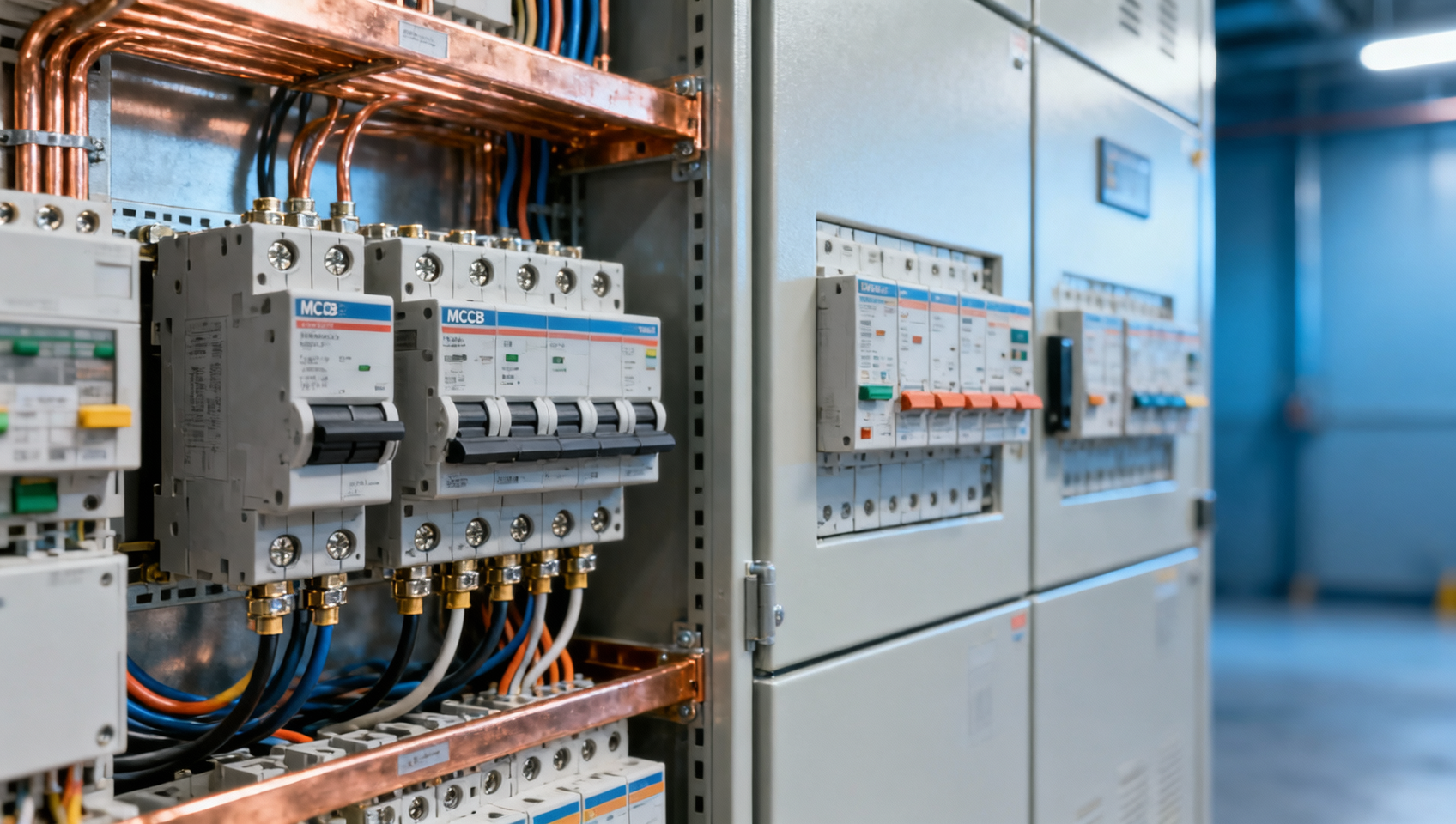
RCD and molded case circuit breaker MCCB
At feeder level, coordination with a molded case circuit breaker MCCB is common. The MCCB provides higher current handling and breaking capacity, while earth leakage protection may be integrated or added depending on system design. This arrangement is often used in motor control centers, distribution boards, and industrial branch circuits.
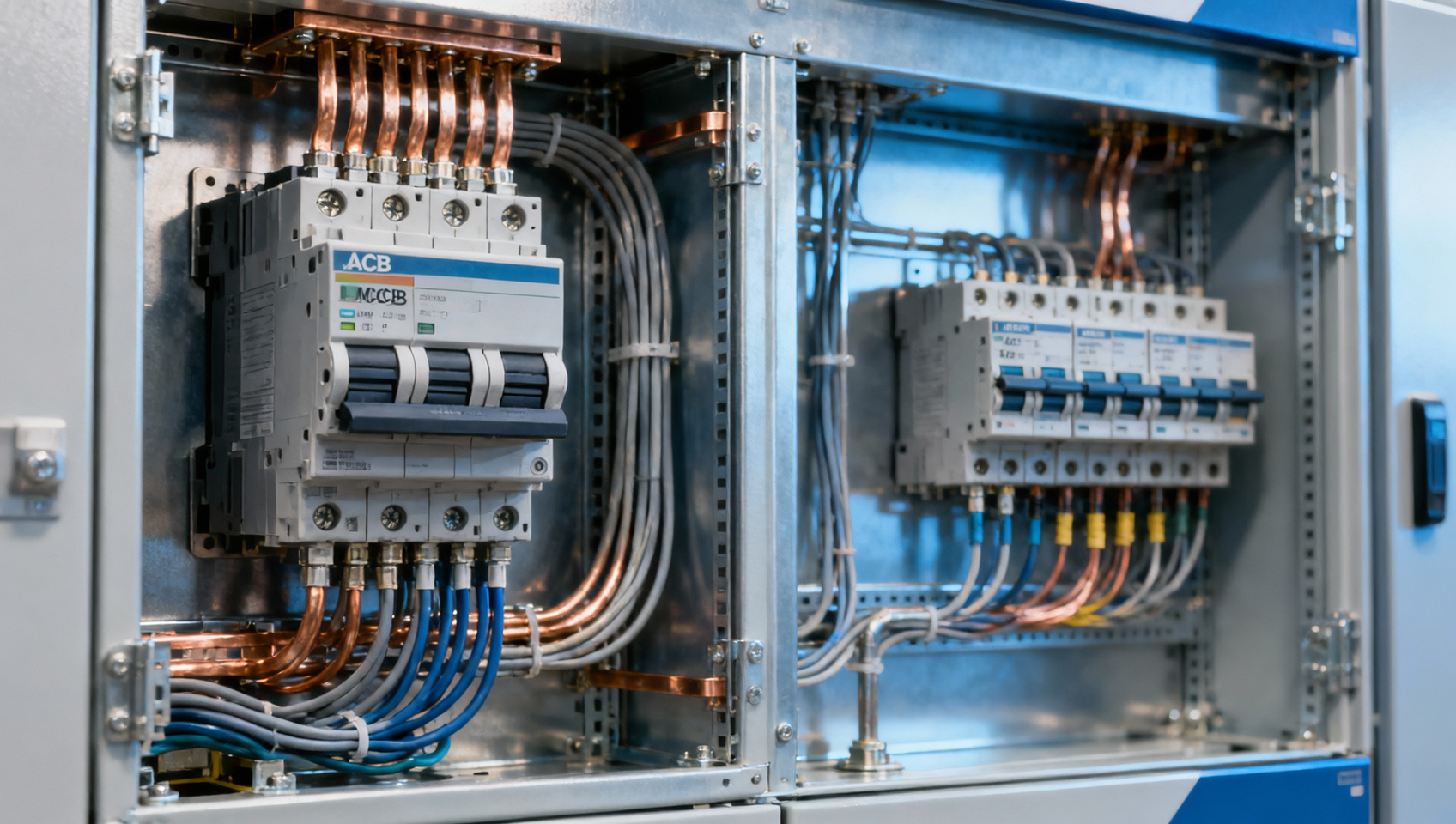
RCD and air circuit breaker ACB
In main incomers or high-capacity low-voltage distribution, an air circuit breaker ACB may be the principal protective device. Here, earth fault protection strategy may be implemented through the ACB’s protection functions, zone-selective interlocking, or higher-level coordination logic rather than using standard final-circuit RCDs alone.
RCD in the low voltage switchboard
The low voltage switchboard layout is critical for discrimination, maintenance, thermal performance, and testing access. If multiple outgoing ways are protected by similar residual current devices without selectivity planning, one leakage event can trip a large section of the board. Good switchboard design reduces this risk through zoning, selective devices, clear labeling, and appropriate upstream/downstream coordination.
For procurement teams, this is a major evaluation point: do not compare devices only by unit price. Compare how they fit the board architecture, fault levels, test regime, spares strategy, and continuity requirements.
Prevent nuisance tripping without weakening safety
One of the biggest concerns in industrial environments is nuisance tripping. Unplanned shutdowns can interrupt production, damage process continuity, trigger alarms, and increase maintenance hours.
Common causes include:
- Normal leakage current from EMC filters and power electronics
- Transient events during switching or lightning activity
- Long cable capacitance
- Moisture, contamination, or insulation degradation
- Poor selectivity between upstream and downstream devices
- Incorrect RCD type for the load
Practical ways to reduce nuisance trips
- Measure actual standing leakage before finalizing device sensitivity
- Use selective or time-delayed upstream devices where appropriate
- Separate high-leakage loads onto dedicated circuits
- Choose Type A, F, or B where electronic loads demand it
- Review surge protection and transient environment
- Maintain insulation quality and environmental sealing
The goal is not to “desensitize” the system blindly. The goal is to apply the correct protective layer at the correct circuit level.
Check earthing system and standards before final specification
RCD performance is linked to the installation’s earthing arrangement and the governing standard. TN, TT, and IT systems have different protection implications, and local regulations may specify where RCDs are mandatory or how disconnection times must be achieved.
Before final approval, confirm:
- The site earthing system and fault loop characteristics
- Applicable IEC or local code requirements
- Sector-specific obligations for construction, healthcare, infrastructure, utilities, or process industry
- Required certifications and acceptance criteria for the project
- Any client engineering standards exceeding minimum legal compliance
For international sourcing, this is especially important. A device acceptable in one region may not satisfy certification, marking, or test expectations in another. For global industrial buyers, compliance validation should be part of the supplier qualification process, not a post-purchase check.
Use a practical RCD selection checklist for purchasing and engineering review
If you need a concise decision framework, use the checklist below before issuing a purchase order or approving a design:
- Define the purpose: personal protection, fire protection, equipment protection, or selectivity
- Identify the load type: resistive, inductive, electronic, drive-based, inverter-based, or mixed
- Select the correct RCD type: AC, A, F, or B based on residual current waveform
- Choose sensitivity: 30 mA, 100 mA, 300 mA, etc., based on hazard and leakage environment
- Confirm rated current and poles for the circuit design
- Verify short-circuit coordination with MCB, MCCB, fuse, or switchboard assembly
- Plan selectivity between upstream and downstream protective devices
- Review standards and certifications for target market and project requirements
- Assess installation conditions including temperature, humidity, harmonics, and maintenance access
- Validate supplier quality through test reports, brand reliability, and traceable compliance documentation
This checklist helps all stakeholder groups. Engineers use it for technical fit, operators for reliability, procurement teams for supplier comparison, and business decision-makers for risk control.
What decision-makers should prioritize beyond the device price
For enterprise buyers and project leaders, the value of proper RCD selection extends beyond electrical code compliance. It affects:
- Worker safety outcomes
- Fire and liability exposure
- Production uptime
- Maintenance callout frequency
- Insurance and audit readiness
- Lifecycle cost of the distribution system
A low-cost product with poor immunity, weak documentation, or questionable certification may increase the total operating cost of the facility. In mission-critical settings, decision-makers should prioritize traceability, test data, technical support, and compatibility with the broader protection scheme.
In other words, the best RCD is not the cheapest item on the list. It is the one that delivers the required safety performance, reliable coordination, and acceptable continuity over the full service life of the installation.
Conclusion: select the RCD as part of a protection system, not as a standalone component
The most effective residual current device RCD selection tips all point to the same conclusion: start with the real hazard, understand the load, match the RCD type and sensitivity correctly, and coordinate it with the wider protection architecture. In industrial and commercial applications, the right choice depends on more than residual current rating alone. It must align with the circuit purpose, leakage behavior, earthing system, applicable standards, and the relationship with the earth leakage circuit breaker concept, miniature circuit breaker MCB, molded case circuit breaker MCCB, air circuit breaker ACB, and low voltage switchboard design.
For buyers, operators, and engineering teams, a good RCD decision reduces safety risk and avoids unnecessary downtime. For business leaders, it protects continuity, compliance, and long-term asset value. If there is one practical takeaway, it is this: do not select an RCD by habit or price alone—select it by application, coordination, and verified performance.
Technical Specifications
- RCEP Launches Industrial Waste Equipment Mutual RecognitionAuthor :Environmental Engineering Director
- IEC 61850-90-15:2026 Released — Time Stamp Precision Upgrade Impacts Power Equipment ExportsAuthor :Grid Infrastructure Analyst
- Copper Price Surge Impacts BOM Costs for Industrial Breakers & TransformersAuthor :Grid Infrastructure Analyst
Expert Insights

Chief Security Architect
Dr. Thorne specializes in the intersection of structural engineering and digital resilience. He has advised three G7 governments on industrial infrastructure security.
Related Analysis
- Apr 22, 2026RCEP Launches Industrial Waste Equipment Mutual RecognitionAuthor :Environmental Engineering Director
- Apr 22, 2026IEC 61850-90-15:2026 Released — Time Stamp Precision Upgrade Impacts Power Equipment ExportsAuthor :Grid Infrastructure Analyst
- Apr 22, 2026Copper Price Surge Impacts BOM Costs for Industrial Breakers & TransformersAuthor :Grid Infrastructure Analyst
Core Sector // 01
Security & Safety
- Copper Price Surge Impacts BOM Costs for Industrial Breakers & TransformersAuthor :Grid Infrastructure Analyst
![]()
- What to Check Before Buying MCCBAuthor :Grid Infrastructure Analyst

- Miniature Circuit Breaker MCB MistakesAuthor :Grid Infrastructure Analyst

- MCCB vs MCB: Which One Fits BetterAuthor :Grid Infrastructure Analyst

- How to Size an Air Circuit Breaker ACBAuthor :Grid Infrastructure Analyst

- Residual Current Device RCD Selection TipsAuthor :Grid Infrastructure Analyst

- Earth Leakage Circuit Breaker vs RCDAuthor :Grid Infrastructure Analyst

- Why Magnetic Contactors Fail EarlyAuthor :Grid Infrastructure Analyst