Water Filtration for Cooling Towers: Which System Works Best for Scale Control?
Author
Date Published
Reading Time
Why scale control starts with the operating context
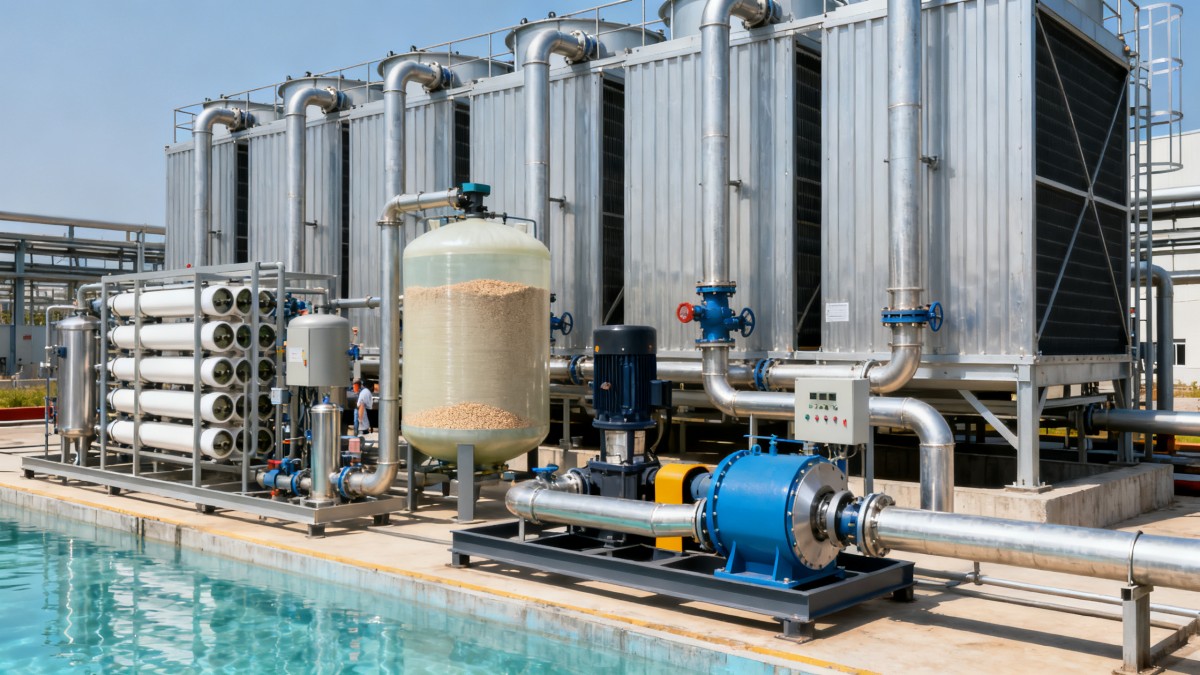
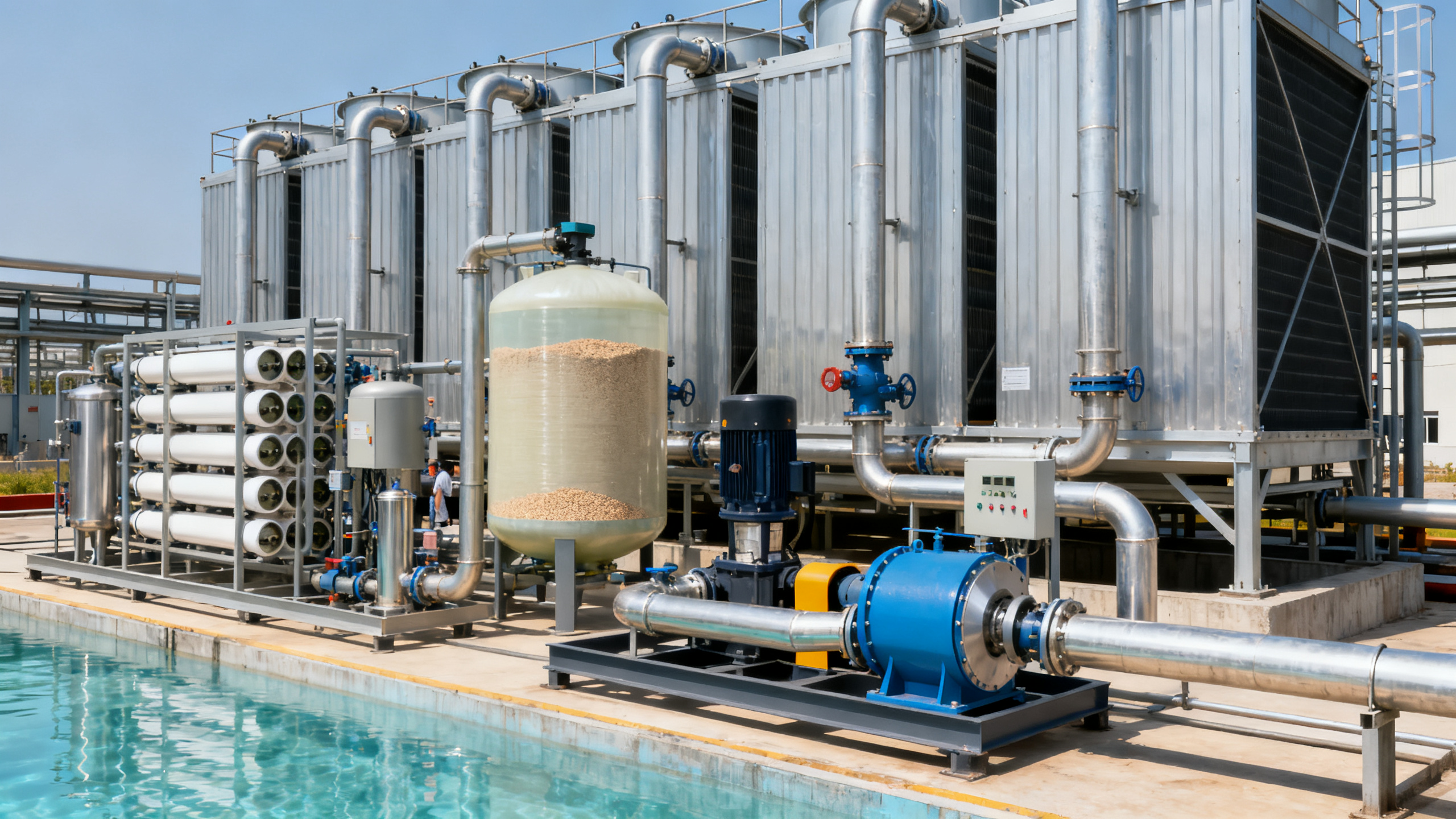
Water filtration for cooling towers matters because scale is rarely caused by hardness alone. It develops from the combined effect of suspended solids, cycles of concentration, heat load, and water chemistry drift.
That is why the best water filtration for cooling towers is usually the system that fits site conditions, not the most complex skid or the finest nominal micron rating.
In real facilities, a lightly loaded commercial tower behaves very differently from a process-critical tower in metals, chemicals, food production, or district cooling.
Some loops struggle with airborne debris and corrosion byproducts. Others face high silica risk, seasonal makeup variation, or limited shutdown windows. Those differences change the filtration decision.
From an industrial reliability perspective, water filtration for cooling towers supports more than cleaner water. It helps stabilize heat transfer, reduce chemical overfeed, limit unplanned cleaning, and protect pumps, valves, and exchangers.
For organizations working to CE, UL, ISO, or internal asset integrity standards, the practical question is straightforward: which filtration approach controls solids well enough to slow scale formation without creating unnecessary maintenance burden?
Different tower conditions create different filtration priorities
A common mistake is to treat all cooling towers as the same application. In practice, water filtration for cooling towers must reflect where fouling starts and how fast consequences appear.
Open towers near dusty yards, ports, foundries, or construction zones usually collect heavier particulate loads. There, side-stream filtration often delivers the fastest improvement.
Closed loops with cooling towers may look cleaner, yet plate exchangers and small passages can become intolerant to even moderate solids carryover. Finer control becomes more relevant.
Systems using reclaimed water or variable municipal sources face another challenge. The solids profile can swing week to week, so a fixed design assumption becomes risky.
Where uptime is critical, filtration is often selected for maintainability first. Automatic backwashing, predictable pressure loss, and access to replacement parts matter as much as capture efficiency.
A practical comparison before choosing water filtration for cooling towers
The table below reflects how common options perform when scale control is the main objective, rather than general water polishing.
In most cases, scale control improves when filtration removes the suspended matter that becomes nucleation sites for mineral deposition. That is especially true when chemistry control is already reasonably stable.
When open industrial towers carry heavy solids
This is the scenario where water filtration for cooling towers delivers visible operational gains quickly. Dust, pollen, process fines, corrosion products, and basin sludge continuously recycle through the loop.
In these conditions, media filtration is usually the strongest candidate. It handles variable particle loading better than fine disposable elements and supports continuous side-stream cleaning.
A useful rule is to treat 5% to 15% side-stream flow as a starting design range, then adjust for basin volume, contamination rate, and acceptable cleanup time.
The judgment point is not only micron performance. It is whether the system can keep basin solids from re-entering heat exchange surfaces during peak load periods.
Where makeup water is hard and ambient contamination is persistent, water filtration for cooling towers should be paired with close review of blowdown strategy and inhibitor chemistry. Filtration alone will not solve saturation problems.
Cleaner loops with tighter heat exchangers need finer decisions
Some cooling towers serve systems with narrow channels, precision plate packs, or process temperature tolerances that leave little room for fouling. Here, the solids load may look modest, yet the impact of a small deposit is disproportionate.
Disc filters or finer screen systems often work well when incoming solids are moderate and maintenance access is limited. They fit retrofits where floor space is constrained.
Cartridge systems can also support water filtration for cooling towers in these tighter applications, but only when the upstream water is already fairly clean. Otherwise replacement frequency rises quickly.
This is where many projects over-specify filtration fineness while underestimating service effort. A 5-micron target looks attractive on paper, but pressure drop, changeout frequency, and disposal cost can erase the benefit.
A better approach is to define the fouling sensitivity of the most vulnerable equipment first, then choose the simplest filtration level that keeps deposits within manageable limits.
Variable makeup water changes the answer
Water filtration for cooling towers becomes harder to standardize when the makeup source changes by season or by supply mix. Municipal water, surface water, and reclaimed water do not fail in the same way.
Reclaimed sources can carry higher organics, fine colloids, and inconsistent suspended matter. That shifts the design conversation toward resilience rather than ideal laboratory performance.
In these cases, dual-stage arrangements often make sense. A separator or coarse screen removes heavier material first, while a side-stream media filter handles finer solids over time.
The key is to review more than one water analysis. Single-point sampling often misses the operating extremes that actually determine scale risk and cleaning intervals.
What usually matters most by operating condition
- High airborne dust: prioritize solids holding capacity, automatic cleaning, and basin turnover rate.
- High exchanger sensitivity: prioritize stable particle control and predictable differential pressure.
- Reclaimed or mixed makeup water: prioritize tolerance to variable solids and service flexibility.
- Limited maintenance windows: prioritize backwash automation, spare part availability, and simple isolation.
- High hardness or silica risk: use filtration to support chemistry control, not to replace it.
Where scale control decisions are often misread
The most common error is assuming water filtration for cooling towers can directly remove dissolved scale-forming minerals. Standard filtration removes suspended particles, not calcium hardness or dissolved silica.
That still matters for scale control because suspended fines give minerals a place to precipitate. But when saturation is excessive, filtration must work alongside dosing, softening, or other treatment steps.
Another misread is choosing solely by initial equipment price. In industrial service, backwash water use, labor hours, cartridge disposal, valve reliability, and shutdown coordination often dominate lifecycle cost.
There is also a tendency to copy specifications from similar sites. Two towers with the same nominal tonnage can require different water filtration for cooling towers because environmental solids, metallurgy, and cycles of concentration differ.
A more defensible selection method, consistent with GIC-style technical review, ties filtration choice to verified water data, site contamination sources, mechanical sensitivity, and maintenance capability.
How to match the system before installation
Before finalizing water filtration for cooling towers, document four conditions clearly: suspended solids profile, critical equipment passages, available footprint, and acceptable service routine.
Then compare options against actual operating constraints rather than brochure claims. The most durable answer is usually the one that remains manageable during peak contamination and peak thermal load.
For most facilities, the next step is to map current fouling symptoms against water data and maintenance records. That exposes whether the main issue is heavy suspended solids, chemistry-driven scaling, or both.
From there, water filtration for cooling towers can be specified with clearer boundaries: target side-stream rate, realistic micron range, cleaning method, and integration with broader treatment controls.
That approach usually produces the best result: lower deposit growth, steadier heat transfer, and a system that remains practical long after commissioning.
Technical Specifications
- Air Handling Unit Supplier Checklist: Performance Data, Lead Times, and SupportAuthor :Environmental Engineering Director
- Buying Fiberglass Water Tanks Wholesale: Compare Quotes and Delivery CostsAuthor :Environmental Engineering Director
- Choosing an XLPE Power Cable Supplier: Test Reports, Traceability, and Lead TimesAuthor :Grid Infrastructure Analyst
Expert Insights

Chief Security Architect
Dr. Thorne specializes in the intersection of structural engineering and digital resilience. He has advised three G7 governments on industrial infrastructure security.
Related Analysis
- Oct 19, 2026Air Handling Unit Supplier Checklist: Performance Data, Lead Times, and SupportAuthor :Environmental Engineering Director
- Oct 18, 2026Buying Fiberglass Water Tanks Wholesale: Compare Quotes and Delivery CostsAuthor :Environmental Engineering Director
- Oct 17, 2026Choosing an XLPE Power Cable Supplier: Test Reports, Traceability, and Lead TimesAuthor :Grid Infrastructure Analyst
Core Sector // 01
Security & Safety
- Buying Fiberglass Water Tanks Wholesale: Compare Quotes and Delivery CostsAuthor :Environmental Engineering Director

- How to Select Industrial pH Meters for Continuous Wastewater Process ControlAuthor :Environmental Engineering Director

- How to Size a Rinse Fill Cap Machine for Your Bottle Format and Target OutputAuthor :Environmental Engineering Director

- How to Size a Heavy-Duty Submersible Sewage Pump for High-Solids Lift StationsAuthor :Environmental Engineering Director

- How to Size a Wafer Butterfly Valve for HVAC Chilled-Water and Heating LoopsAuthor :Environmental Engineering Director

- How Pressure Class and Joint Design Affect Long-Term Performance of Ductile Iron Pipes in Drainage InfrastructureAuthor :Environmental Engineering Director

- How Ductile Iron Pipe Joints Affect Installation Reliability and Leak ControlAuthor :Environmental Engineering Director

- How to Size Effluent Treatment Equipment for Variable Industrial Wastewater LoadsAuthor :Environmental Engineering Director