Choosing a Step-Down Transformer Supplier: Test Reports, Lead Times, and Warranty
Author
Date Published
Reading Time
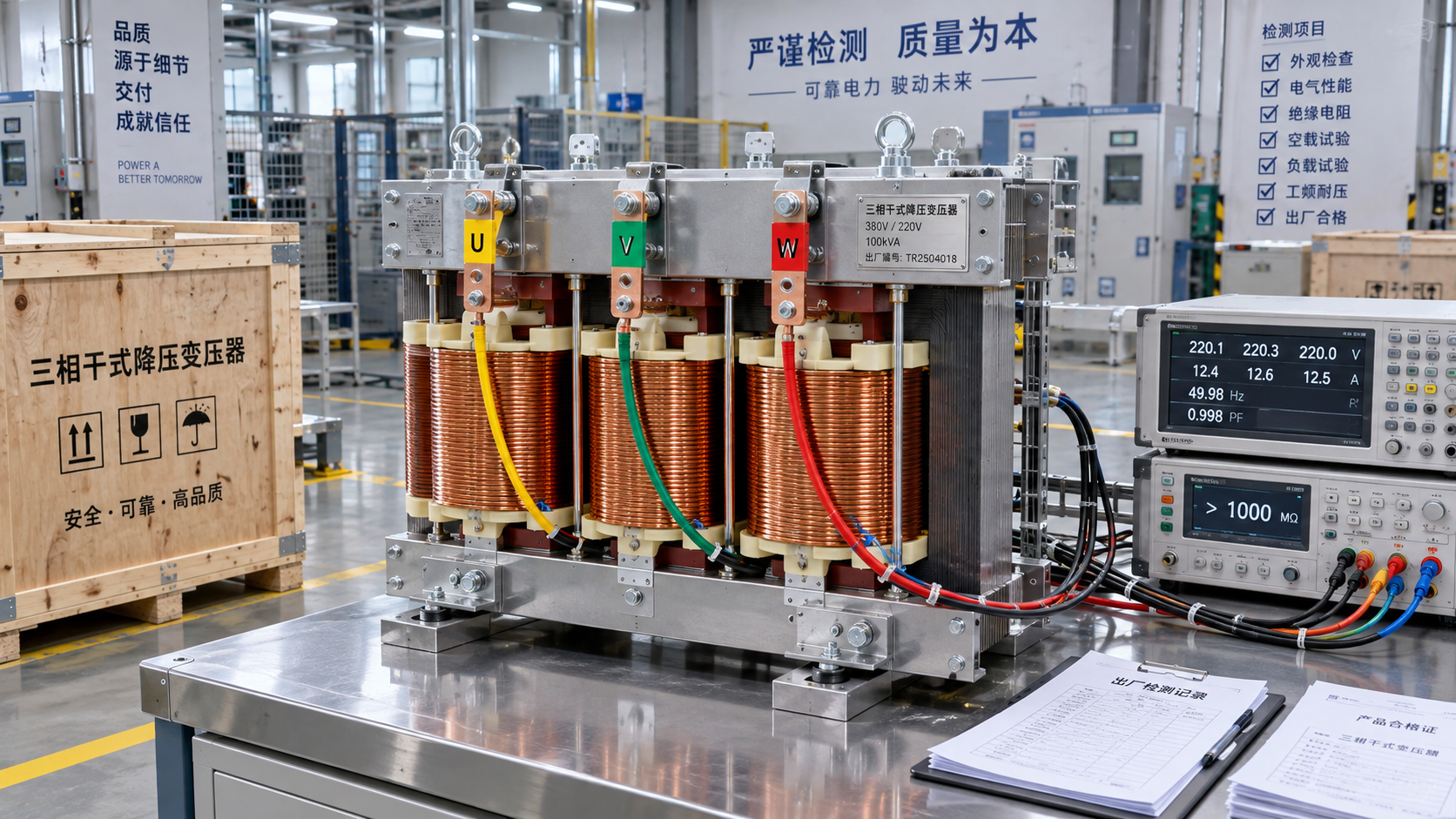
The lowest transformer quote can become the most expensive order when testing, delivery, or warranty obligations remain undefined. A competitive step down transformer supplier should quote against a settled electrical specification, provide traceable evidence of performance, and accept clear responsibility for delivery and defects. Compare offers only after those commitments are documented; otherwise, a lower price may simply exclude work that another quotation includes.
Three documents establish a useful starting point: a technical schedule with declared exceptions, a test and inspection plan, and commercial terms covering delivery and warranty. Together, they reveal whether the quoted equipment will suit the installation, whether its performance can be verified, and what happens if it arrives late or fails.
Settle the specification before comparing prices
Voltage ratio and kVA rating alone do not define equivalent offers. A transformer supplying steady resistive loads faces different demands from one serving motor starts, rectifiers, or variable-speed drives. The quotation should identify the intended load, supply frequency, phase arrangement, duty, installation environment, and required enclosure. Where ambient temperature or altitude affects cooling, the offered continuous rating must reflect those conditions.
Clarify whether the application requires separate primary and secondary windings. An autotransformer can provide voltage reduction with different material requirements, but it does not provide galvanic isolation. Treating the two constructions as interchangeable can invalidate both price comparisons and the intended protection arrangement.
The technical schedule should also resolve these details:
- Secondary voltage under load: distinguish nominal ratio from the voltage expected at the terminals under the specified load and power factor.
- Impedance and tolerances. Impedance influences voltage drop and available fault current, so an alternative value needs review against protection coordination and starting requirements.
- For three-phase equipment, state the winding connection, phase displacement, and neutral requirements explicitly.
- Scope of supply: identify taps, temperature sensors, terminals, cable-entry arrangements, enclosure accessories, and any separately supplied protection devices.
Copper and aluminum windings require different conductor dimensions and termination arrangements. Material alone does not establish efficiency or service life. Compare guaranteed losses, temperature rise, connection design, and physical dimensions before accepting a premium or discount attributed to winding material.
Separate design evidence from tests on the actual unit
A polished sample report establishes very little unless its relationship to the offered transformer is clear. Request an example report during evaluation, then make the final documentation requirements contractual. Records for the delivered unit should identify its serial number, rating, drawing revision, test date, acceptance criteria, and measured results.
Routine production tests and design-verification tests answer different questions. Routine tests help establish whether an individual unit was built correctly. Temperature-rise or other design tests support performance claims for a defined construction. A report covering another rating or enclosure needs a technical explanation of why it applies; similar appearance is insufficient evidence.
An insulation-resistance reading does not replace specified dielectric withstand tests. Equally, a satisfactory ratio test does not establish acceptable temperature rise or efficiency. Each result answers a particular question; a report containing many measurements can still omit the evidence needed for acceptance.
Measurement credibility also matters. Reports should identify the test procedure and relevant instrument traceability. When a result falls close to a contractual limit, the agreed acceptance method and measurement uncertainty deserve attention. Resolve borderline results before shipment, while repeat testing and corrective work remain accessible.
Verify certification against the supplied configuration
A company quality-management certificate does not certify an individual transformer’s electrical safety. Likewise, a declaration, third-party listing, and laboratory report carry different meanings. Establish which conformity evidence the installation actually requires, then verify its scope through the relevant issuer or official record where available.
The model family, manufacturing location, rating range, and construction must align with the offered equipment. If the transformer is supplied inside a larger assembly, clarify whether the evidence covers the transformer alone or the completed assembly. An enclosure change or revised insulation system warrants review where it affects the evaluated construction.
Turn the quoted lead time into a dated delivery commitment
“Delivery in several weeks” is incomplete without a starting event and an agreed endpoint. The clock might begin at order acceptance, deposit receipt, approved drawings, or release of technical queries. The endpoint might be factory readiness, carrier collection, arrival at a destination port, or delivery to the installation site. These distinctions determine whether two offers share the same schedule.
A useful production schedule identifies drawing submission, approval, material availability, assembly, testing, document release, and dispatch. Where witness testing is required, include the notification period and the process for rescheduling. A missed witness slot can delay dispatch even when manufacturing is complete.
Stock availability needs similar scrutiny. A stocked transformer with the wrong taps, winding connection, or enclosure is not necessarily a quick delivery option. Modification can require engineering review, additional parts, and repeat testing. Request a firm description of the available unit and the work needed to make it compliant.
For custom equipment, distinguish material already allocated to the order from material awaiting purchase. Cores, winding conductors, enclosures, and accessories have separate availability constraints. A credible schedule explains the limiting item and provides dated milestones against which progress can be assessed.
Keep shipment release tied to acceptance
Agree which records must be approved before dispatch and how deviations will be closed. A factory acceptance test should reference the approved specification, required tests, acceptance limits, and the treatment of outstanding items. Attendance at a test should not automatically waive unresolved contractual requirements.
Shipping arrangements belong in the same schedule. Define the delivery term, named place, unloading responsibility, packaging, and transit insurance. Large or heavy units need confirmed lifting provisions and access dimensions. Transit time estimates should distinguish transport from customs clearance and final site delivery, with ownership assigned to the documents needed for each stage.
Read the warranty as a recovery procedure
Warranty duration is only one part of the protection offered. Start with the commencement date: dispatch, delivery, commissioning, or another agreed event. For equipment installed well after arrival, a dispatch-based warranty can lose substantial useful coverage before energization. If coverage begins at commissioning, the contract may also include an outer limit from shipment; both dates need to be explicit.
Then follow a plausible failure through the written terms. If a winding defect appears after installation, who authorizes investigation, arranges transport, pays for removal, and reinstalls the repaired unit? A repair-or-replace promise can leave substantial costs uncovered when freight, lifting, site labor, and commissioning are excluded.
Warranty negotiations should resolve the following points:
- The remedy and its timing. State how claims are acknowledged, how technical assessment proceeds, and whether repair, replacement, or another remedy applies. Separate response time from restoration time.
- Coverage for transport, diagnosis, removal, and reinstallation should be stated individually. Silence leaves room for dispute.
- Exclusions need defined operating limits: overload, inadequate ventilation, contamination, incorrect protection, and unauthorized changes should be tied to the approved specification and installation instructions.
- For repaired or replaced equipment, establish the remaining warranty period and the treatment of repeat failures.
Installation conditions deserve particular attention. Ventilation clearances, terminal tightening requirements, storage conditions, and commissioning records should be available before delivery. If warranty validity depends on following an instruction that arrives after installation, avoidable disagreement becomes likely.
For an operationally critical load, the recovery plan may matter more than an extended warranty period. Establish where repairs take place, whether local support exists, and how replacement availability is determined. Any temporary transformer arrangement requires compatible voltage, capacity, impedance, connections, and protection; a generic loan-unit promise offers limited assurance.
Compare the cost of an accepted, installed transformer
Normalize quotations around the same scope before calculating a price difference. Include the equipment, mandatory testing, documentation, accessories, packaging, freight, applicable import charges, and installation interfaces. Keep uncertain items visible instead of hiding them in a broad contingency allowance.
Losses deserve a separate calculation when operating hours justify it. No-load losses continue while the transformer is energized, including periods with little useful load. Load losses vary approximately with the square of load current under comparable conditions. Comparing efficiency at a single loading point can therefore misrepresent operating cost where the actual load varies substantially.
Use guaranteed loss values with a stated reference basis, the expected load profile, electricity cost, and the chosen evaluation period. This produces an application-specific comparison without assuming that the highest-efficiency offer always delivers the best economic outcome. For intermittent service, acquisition and installation costs can carry greater weight.
Payment milestones should correspond to verifiable progress, such as approved drawings, completed contractual tests, and delivery of the agreed document package. Define how nonconforming results affect shipment and payment. Where retention or other security is agreed, its release conditions should be measurable and consistent with the acceptance process.
Resolve exceptions before releasing the order
A final comparison is strongest when every departure from the requested specification has an explicit disposition. An exception might be acceptable because it reduces cost without affecting the application, or unacceptable because it changes fault levels, installation space, thermal performance, or delivery certainty. Record the decision against the relevant drawing or requirement.
The order should incorporate the accepted technical schedule, guaranteed values and tolerances, testing obligations, delivery milestones, documentation, and warranty terms. Establish which document takes precedence if quotation notes conflict with the purchase specification. That agreement creates a clear basis for accepting the transformer, resolving defects, and paying for the performance actually ordered.
Technical Specifications
- Air Handling Unit Supplier Checklist: Performance Data, Lead Times, and SupportAuthor :Environmental Engineering Director
- Buying Fiberglass Water Tanks Wholesale: Compare Quotes and Delivery CostsAuthor :Environmental Engineering Director
- Choosing an XLPE Power Cable Supplier: Test Reports, Traceability, and Lead TimesAuthor :Grid Infrastructure Analyst
Expert Insights

Chief Security Architect
Dr. Thorne specializes in the intersection of structural engineering and digital resilience. He has advised three G7 governments on industrial infrastructure security.
Related Analysis
- Oct 19, 2026Air Handling Unit Supplier Checklist: Performance Data, Lead Times, and SupportAuthor :Environmental Engineering Director
- Oct 18, 2026Buying Fiberglass Water Tanks Wholesale: Compare Quotes and Delivery CostsAuthor :Environmental Engineering Director
- Oct 17, 2026Choosing an XLPE Power Cable Supplier: Test Reports, Traceability, and Lead TimesAuthor :Grid Infrastructure Analyst
Core Sector // 01
Security & Safety
- Choosing a Step-Down Transformer Supplier: Test Reports, Lead Times, and WarrantyAuthor :Grid Infrastructure Analyst

- Metallurgy Processes That Improve Conductivity and Reliability in Power Grid ComponentsAuthor :Grid Infrastructure Analyst

- How to Size a UPS for Server Rooms: Load, Runtime, and Redundancy FactorsAuthor :Grid Infrastructure Analyst

- How to Choose a Step-Down Transformer for a Control Panel: Key Sizing FactorsAuthor :Grid Infrastructure Analyst

- How Often Should Overseas Power Systems Undergo Safety Inspections?Author :Grid Infrastructure Analyst

- How to Choose Panels for Extreme-Cold Industrial Sites?Author :Grid Infrastructure Analyst

- What Should a Cross-Border EPC Equipment Procurement Reference Include?Author :Grid Infrastructure Analyst

- How to Compare Low-Voltage Equipment for Panel IntegrationAuthor :Grid Infrastructure Analyst