U.S. April PCE Rises 3.8% YoY: Export Pricing Strategy for Test & Measurement Equipment Needs Dynamic Adjustment
Author
Date Published
Reading Time

On May 28, 2026, the U.S. Department of Commerce reported that the Personal Consumption Expenditures (PCE) price index rose 3.8% year-on-year in April — matching expectations — while core PCE increased only 0.2% month-on-month, below the anticipated 0.3%. This signals a marginal easing of inflationary pressure. For exporters of test and measurement equipment, this development directly affects pricing discipline, contract terms, and buyer negotiation dynamics — particularly in dollar-denominated transactions with U.S.-based importers.
Event Overview
On May 28, 2026, the U.S. Department of Commerce released the April 2026 Personal Consumption Expenditures (PCE) price index data. The headline PCE index rose 3.8% year-on-year. Core PCE — excluding food and energy — rose 0.2% month-on-month, below the consensus forecast of 0.3%. The report is publicly available and reflects official U.S. government statistics.
Industries Affected by This Development
Exporters of test and measurement equipment: These firms price goods in U.S. dollars for U.S. importers and often operate under long-lead contracts. A slower-than-expected core PCE monthly gain may delay procurement budget releases or extend payment terms requested by buyers — affecting cash flow planning and working capital requirements.
U.S.-based importers and distributors of test and measurement equipment: Their purchasing power and timing are sensitive to domestic inflation trends. A softer core PCE print may support more cautious inventory buildup or extended negotiations on payment schedules and volume commitments.
Contracting and legal service providers supporting cross-border equipment trade: With inflationary pressure moderating but still elevated year-on-year, the operational relevance of ‘inflation-linked clauses’ — especially those tied to PCE benchmarks — increases in contract drafting and renegotiation.
What Relevant Enterprises or Practitioners Should Monitor and Do Now
Track upcoming Federal Reserve communications and revisions to PCE methodology
The Fed closely monitors PCE as its preferred inflation gauge. Any shift in tone from policymakers — or upcoming technical updates to how PCE is calculated — could reshape near-term import demand expectations and contract renegotiation leverage.
Review active and pending export contracts for U.S. dollar invoicing and adjustment mechanisms
Specifically assess whether existing agreements include PCE-based indexation, fixed-price periods, or currency-hedging provisions. Contracts lacking explicit inflation-adjustment language may require proactive discussion ahead of renewal or delivery milestones.
Monitor procurement cycles of key U.S. industrial end-users
End markets such as semiconductor fabrication, aerospace testing, and calibration labs often align capex and procurement decisions with quarterly budget reviews — which may now be influenced by the latest PCE signal. Early engagement with procurement teams can clarify timing shifts before formal RFQs are issued.
Prepare revised quotation templates reflecting dynamic pricing parameters
Instead of static list prices, consider introducing tiered pricing windows (e.g., 60-day validity), optional indexation riders, or surcharge triggers tied to published PCE thresholds — all clearly disclosed and negotiable upfront.
Editorial Perspective / Industry Observation
Observably, this PCE release functions less as an immediate policy trigger and more as a calibration point for commercial decision-making. Analysis shows that while the 3.8% YoY headline figure remains above the Fed’s 2% target, the subdued 0.2% MoM core gain suggests cooling momentum — making it a signal rather than a decisive outcome. From an industry perspective, the growing emphasis on ‘inflation-linked clauses’ reflects not just macroeconomic awareness, but a practical response to persistent volatility in input costs and currency exposure. Current conditions favor structured contractual flexibility over rigid pricing assumptions.
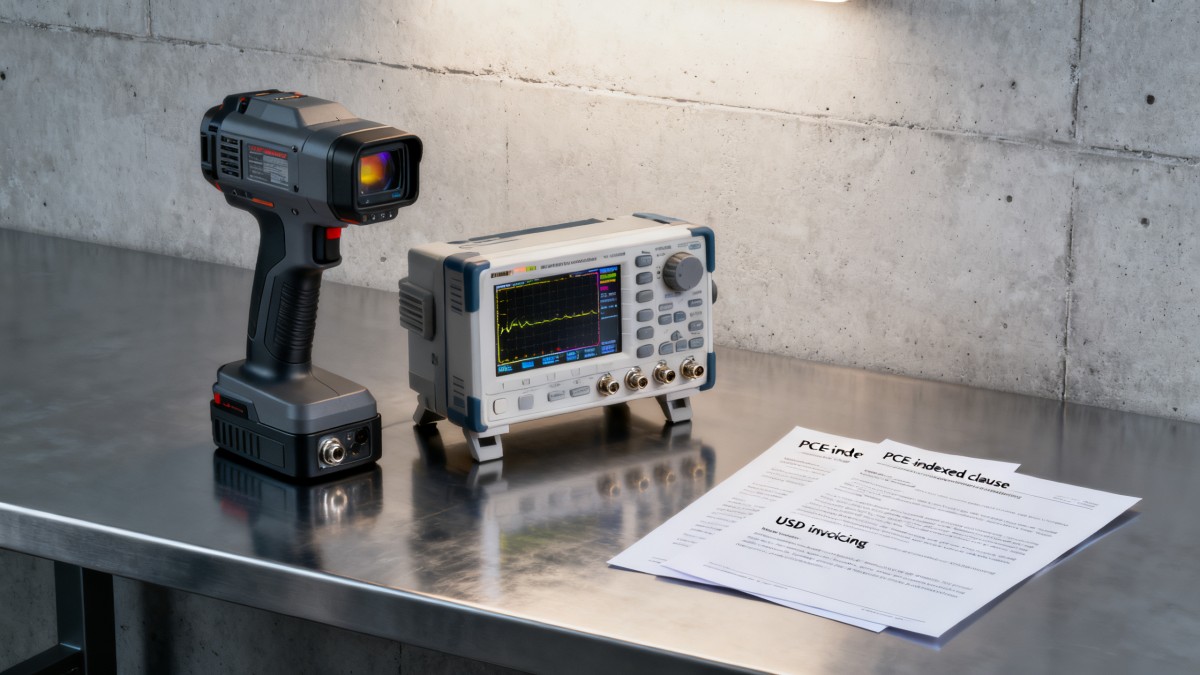
Conclusion: This PCE reading does not represent a turning point in U.S. monetary policy, but it does reinforce the need for export-oriented test and measurement equipment suppliers to treat pricing strategy as an iterative, contract-level process — not a one-time setting. It is better understood as a prompt to revisit commercial terms with precision, rather than as a catalyst for broad strategic shifts.
Source: U.S. Department of Commerce, Bureau of Economic Analysis (BEA), May 28, 2026 PCE Price Index Release.
Note: Further interpretation depends on subsequent BEA revisions, Fed commentary, and Q2 procurement behavior — all subject to ongoing observation.
Technical Specifications
- How to Select Electronic Hotel Key Card Locks for Guest Rooms and Staff AreasAuthor :Safety Compliance Lead
- How to Select Lab Instruments for Reliable Chemical Analysis WorkflowsAuthor :Precision Metrology Expert
- How to Size a UPS for Server Rooms: Load, Runtime, and Redundancy FactorsAuthor :Grid Infrastructure Analyst
Expert Insights

Chief Security Architect
Dr. Thorne specializes in the intersection of structural engineering and digital resilience. He has advised three G7 governments on industrial infrastructure security.
Related Analysis
- Sep 17, 2026How to Select Electronic Hotel Key Card Locks for Guest Rooms and Staff AreasAuthor :Safety Compliance Lead
- Sep 16, 2026How to Select Lab Instruments for Reliable Chemical Analysis WorkflowsAuthor :Precision Metrology Expert
- Sep 15, 2026How to Size a UPS for Server Rooms: Load, Runtime, and Redundancy FactorsAuthor :Grid Infrastructure Analyst
Core Sector // 01
Security & Safety
- How to Select Electronic Hotel Key Card Locks for Guest Rooms and Staff AreasAuthor :Safety Compliance Lead

- How to Select Lab Instruments for Reliable Chemical Analysis WorkflowsAuthor :Precision Metrology Expert

- How to Size a UPS for Server Rooms: Load, Runtime, and Redundancy FactorsAuthor :Grid Infrastructure Analyst

- Stainless Steel Welded Tube Applications: Matching Tube Supply to Fabrication NeedsAuthor :Heavy Industry Strategist

- Selecting Low-Friction Pneumatic Seals for High-Cycle, Low-Pressure CylindersAuthor :Heavy Industry Strategist

- Selecting Spherical Roller Bearings for Mining: Load, Contamination, and Service LifeAuthor :Heavy Industry Strategist

- What to Check When Sourcing Vibration Meters Wholesale for Industrial MaintenanceAuthor :Precision Metrology Expert

- How to Size a Wafer Butterfly Valve for HVAC Chilled-Water and Heating LoopsAuthor :Environmental Engineering Director